EuroLLM-22B: Technical Report
- Authors
- Miguel Moura Ramos
- Duarte M. Alves
- Hippolyte Gisserot-Boukhlef
- et al.
- Affiliations
- Instituto Superior Técnico & Universidade de Lisboa (Lisbon ELLIS Unit)
- Instituto de Telecomunicações
- MICS, CentraleSupélec, Université Paris-Saclay
- Acolad
- Carnegie Mellon University
- University of Edinburgh
- Diabolocom
- others
- Released as
- Technical report
- Date
- arXiv
- 2602.05879
Abstract
This report presents EuroLLM-22B, a large language model trained from scratch to support the needs of European citizens by covering all 24 official European Union languages and 11 additional languages. EuroLLM addresses the issue of European languages being underrepresented and underserved in existing open large language models. We provide a comprehensive overview of EuroLLM-22B's development, including tokenizer design, architectural specifications, data filtering, and training procedures. Across a broad set of multilingual benchmarks, EuroLLM-22B demonstrates strong performance in reasoning, instruction following, and translation, achieving results competitive with models of comparable size. To support future research, we release our base and instruction-tuned models, our multilingual web pretraining data and updated EuroBlocks instruction datasets, as well as our pre-training and evaluation codebases.
Cite this paper
@article{ramos2026eurollmb,
  title = {EuroLLM-22B: Technical Report},
  author = {Miguel Moura Ramos and Duarte M. Alves and Hippolyte Gisserot-Boukhlef and et al.},
  journal = {Technical report},
  year = {2026},
  eprint = {2602.05879},
  archivePrefix = {arXiv},
  url = {https://arxiv.org/abs/2602.05879}
}Copied
Introduction
Large language models (LLMs) continue to drive progress in natural language processing, pushing substantial advances in reasoning, multilinguality, and instruction following (Wei et al., 2022; Ouyang et al., 2022; DeepSeek-AI et al., 2025). Despite these developments, most leading models are either closed (Anthropic, 2023; OpenAI et al., 2024; Comanici et al., 2025) or only partially open—commonly releasing model weights but providing limited transparency about training data or procedures (Llama Team et al., 2024; Yang et al., 2025; Team et al., 2025a; Team et al., 2025b). While fully open alternatives do exist (Olmo et al., 2025), they often prioritise English or a small set of high-resource languages. As a result, in the current open model ecosystem, many European languages remain underserved (Rehm and Way, 2023) and relatively few LLMs have been “made in Europe” (BigScience et al., 2022; Jiang et al., 2024; Gonzalez-Agirre et al., 2025; Hernández-Cano et al., 2025).
We launched the EuroLLM (https://eurollm.io) project to address this gap by developing open models that natively support all 24 official European Union (EU) languages, fostering the development of AI technologies in the EU. Our earlier releases, EuroLLM 1.7B (Martins et al., 2024) and EuroLLM 9B (Martins et al., 2025), demonstrated strong multilingual capabilities and competitive translation performance when compared to existing open alternatives, marking important progress toward this objective. Overall, EuroLLM supports the 24 official EU languages (Bulgarian, Croatian, Czech, Danish, Dutch, English, Estonian, Finnish, French, German, Greek, Hungarian, Irish, Italian, Latvian, Lithuanian, Maltese, Polish, Portuguese, Romanian, Slovak, Slovenian, Spanish, and Swedish) and 11 additional languages (Arabic, Catalan, Chinese, Galician, Hindi, Japanese, Korean, Norwegian, Russian, Turkish, and Ukrainian).
Building on this trajectory, we introduce EuroLLM 22B, our largest and most capable model to date. For this release, we improve the quality of the pre-training corpus through large-scale multilingual data filtering, adopting a multi-phase training strategy that progressively exposes the model to higher-quality data. We further extend the context window to 32K tokens, enabling more effective modeling of long-form inputs. In addition, we substantially expand and strengthen the post-training data by introducing a new version of EuroBlocks, a multilingual instruction dataset constructed from diverse public sources and enhanced with higher-quality synthetic responses (Nathawani et al., 2025b; Nathawani et al., 2025a; Teknium et al., 2024; Lambert et al., 2025). Together, these improvements yield significant gains in multilingual reasoning and instruction-following performance. Across a wide range of multilingual benchmarks, EuroLLM 22B achieves competitive results relative to leading open models of similar scale, positioning it as a highly capable model of its size.
Along with this technical report, we release:
Instruct models: the EuroLLM-22B (https://huggingface.co/utter-project/EuroLLM-22B-Instruct-2512) model, together with an improved EuroLLM-9B (https://huggingface.co/utter-project/EuroLLM-9B-Instruct-2512) obtained adopting the same post-training recipe as EuroLLM-22B;
Base models: the EuroLLM-22B-Base (https://huggingface.co/utter-project/EuroLLM-22B-2512) model, together with an improved EuroLLM-9B-Base (https://huggingface.co/utter-project/EuroLLM-9B-2512) version adopting the same long context extension (32K) as EuroLLM-22B-Base;
Data: the EuroWeb (https://huggingface.co/datasets/utter-project/EuroLLM-Multilingual-Data-2512) dataset, our multilingual web dataset used for pre-training EuroLLM 22B, together with a new version of EuroBlocks (https://huggingface.co/datasets/utter-project/EuroBlocks-SFT-2512), our multilingual instruction dataset which we used in the post-training our models;
Open-source code: our fork (https://github.com/deep-spin/Megatron-LM-pretrain) of Megatron-LM (Shoeybi et al., 2019) for pretraining, and code (https://github.com/deep-spin/eurollm-eval) to reproduce all model evaluations.
Pre-training
We first describe the modeling and architectural design of EuroLLM-22B (§2.1), then outline the multi-phase training procedure (§2.2), and finally detail the composition and curation of the pre-training dataset (§2.3). We pretrain our models using NVIDIA’s Megatron-LM (Shoeybi et al., 2019), which we extend to support our scheduler (https://github.com/deep-spin/Megatron-LM-pretrain).
Modeling
EuroLLM 22B follows most of the design decisions made during the development of the 1.7B (Martins et al., 2024) and the 9B (Martins et al., 2025) versions. It uses the same BPE-based tokenizer as the previous models, providing broad coverage of European and global languages. The associated vocabulary contains 128,000 units. The model architecture adopts grouped query attention (Ainslie et al., 2023), pre-layer normalization (Xiong et al., 2020), RMS normalization (Zhang and Sennrich, 2019), SwiGLU activation functions (Shazeer, 2020), and rotary positional embeddings (RoPE; (Su et al., 2024)). The architectural and optimization hyperparameters are summarized in Table 1.
Training Phases
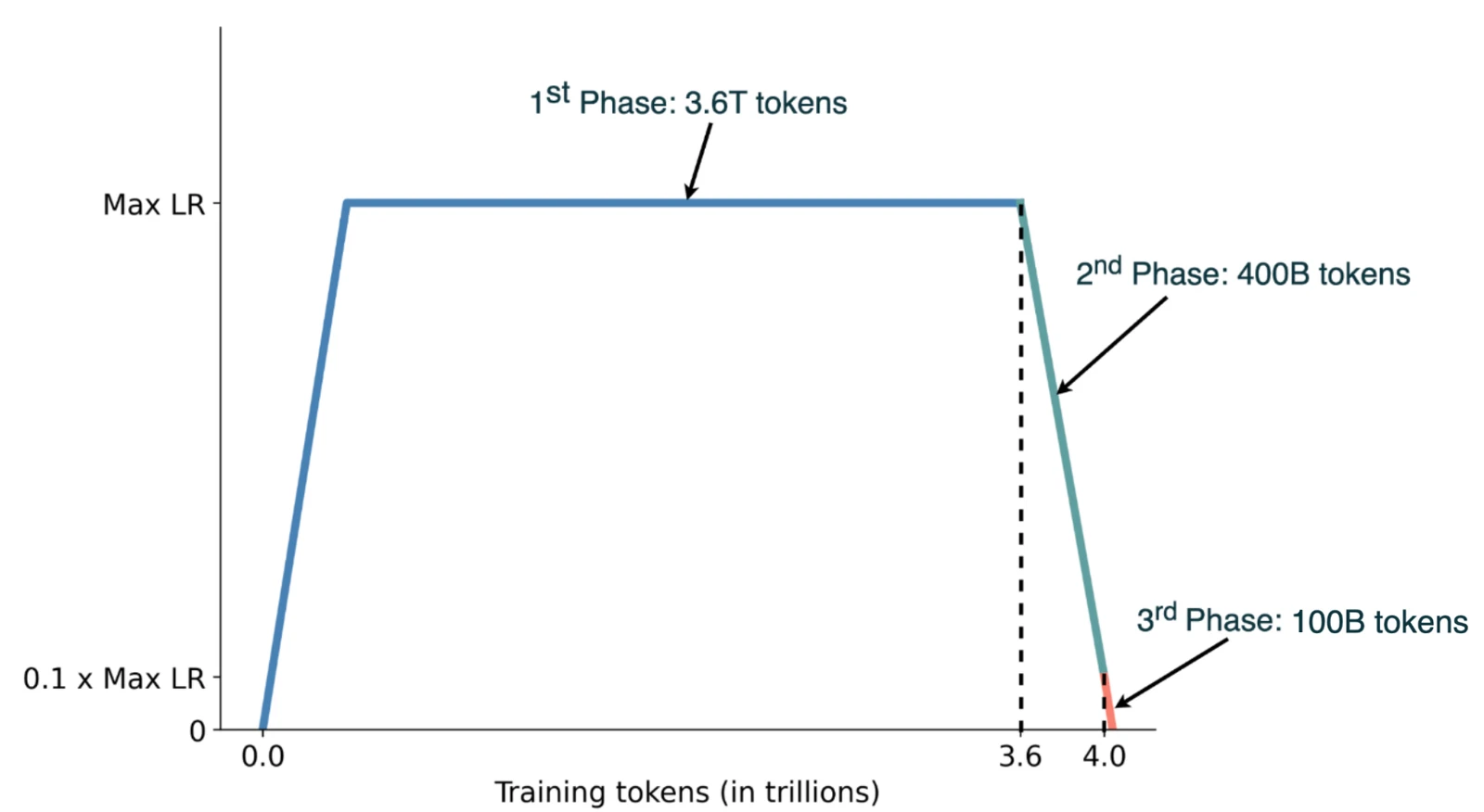
Similar to the 9B version, EuroLLM 22B was pretrained with approximately 4T tokens, using a 3-phase training schedule. In the first phase, we train on 3.6T tokens with a 10% linear warmup to a peak learning rate of , which is kept constant thereafter. We then anneal over 400B tokens, linearly reducing the learning rate to 10% of its peak, and decay it to zero in the final learning phase. This schedule, illustrated in Figure 1, allows us to progressively expose the model to higher quality data (AI@Meta, 2024).
Differing from the 9B version, in the final training phase of EuroLLM 22B, we extend its context window from 4K to 32K, adjusting the maximum sequence length and applying RoPE scaling (Xiong et al., 2024), increasing the value from to .
Dataset
The pre-training dataset for EuroLLM 22B builds upon the one used for pre-training EuroLLM 9B, with a series of targeted modifications aimed at improving overall quality. For completeness, we describe the full dataset below, explicitly highlighting the changes introduced with respect to the 9B setup.
For the initial training phase, we use the FineWeb-edu dataset (Lozhkov et al., 2024a) as the source of our English web data, retaining only documents with an educational score above 2 according to their model-based classifier. In contrast with the 9B training strategy, which the highest-quality FineWeb-edu documents were reserved for the final two stages, we include these documents already in the first phase. The subsequent stages instead sample from the high-quality split of Nemotron-CC (Su et al., 2025).
To collect web data for the remaining languages, we employ language-specific strategies based on resource availability. For high-resource languages (German, Spanish, French, and Italian), we collect data from RedPajama-Data-v2 (Computer, 2023), which is pre-deduplicated. We further apply perplexity filtering using KenLM (Heafield, 2011), complemented with a set of heuristic filters. Specifically, we discard documents shorter than 200 characters (Xue et al., 2021a), and any page containing the phrase “lorem ipsum,” the word “javascript,” or curly brackets (Raffel et al., 2023). Additionally, we remove paragraphs where the fraction of uppercase characters exceeds 40%, the symbol-to-word ratio is greater than 0.1, or the fraction of words without alphabetic characters exceeds 0.2 (Rae et al., 2022).
For the remaining languages, we aggregate data from HPLT (de Gibert et al., 2024), MADLAD-400 (Kudugunta et al., 2023), CulturaX (Nguyen et al., 2023), and mC4 (Xue et al., 2021b). After concatenation, we apply deduplication, language identification, perplexity filtering, and the same set of heuristic filters that we used for the high-resource languages, using a CCNet-based preprocessing pipeline (Wenzek et al., 2019).
We classified all our multilingual web data with EuroFilter (https://huggingface.co/utter-project/EuroFilter-v1) (Martins et al., 2024), our educational filter that assigns a quality score from 0 to 5 to each record (The filter is publicly available at utter-project/EuroFilter-v1 (https://huggingface.co/utter-project/EuroFilter-v1)). This classifier was developed by fine-tuning the mDeBERTa (He et al., 2023) on the quality annotations from the FineWeb-Edu (Lozhkov et al., 2024a) classifier, which were translated to all languages supported by Tower v2 (Rei et al., 2024).
Unlike the 9B version, which utilized quality scores only to select data for the final two stages, the 22B version divides all classified web data into three tiers, one for each phase of our training recipe, reserving the highest quality data for the later stages. We publicly release this data as EuroWeb (https://huggingface.co/datasets/utter-project/EuroLLM-Multilingual-Data-2512).
Regarding parallel data, we collect sentence-level to-English (xx→en) and from-English (en→xx) parallel data from various public sources, listed in Table 2.
We use Bifixer (Ramírez-Sánchez et al., 2020) to remove duplicates and ensure translation quality by removing sentence pairs below quality thresholds for Bicleaner (Sánchez-Cartagena et al., 2018; Ramírez-Sánchez et al., 2020) and CometKiwi-22 (https://huggingface.co/Unbabel/wmt22-cometkiwi-da) (Rei et al., 2022b). For Bicleaner, we use a threshold of 0.6 for Portuguese and of 0.5 for all the other languages, while for CometKiwi-22 (https://huggingface.co/Unbabel/wmt22-cometkiwi-da) we use a threshold of 0.7.
For the second and third training phases, we additionally incorporate document-level parallel data from Europarl (Koehn, 2005) and ParaDocs (Wicks et al., 2024), applying the same filtering criteria.
We collect code and mathematical data from The Stack (Kocetkov et al., 2022), the Algebraic-stack (Azerbayev et al., 2023), and Open-web-math (Paster et al., 2023). For the second and third training phases, we also incorporate the python-edu dataset (Ben Allal et al., 2024) and the training sets of GSM8k (Cobbe et al., 2021) and of Mathematics Aptitude Test of Heuristics (Hendrycks et al., 2021b). In contrast with the previous EuroLLM versions, we also introduced the FineMath dataset (Ben Allal et al., 2025) to improve mathematical reasoning capabilities.
For the third training phase, we additionally incorporate approximately 1.7 million samples of synthetic data generated using the Qwen-2.5 models (Qwen-Team et al., 2025; Yang et al., 2024). Starting from the MathInstruct (Toshniwal et al., 2024b; Toshniwal et al., 2024a) and MetaMathQA (Yu et al., 2024) datasets, we rewrite the questions and generate new answers using Qwen2.5-Math-7B (https://huggingface.co/Qwen/Qwen2.5-Math-7B). The generated answers are then evaluated with LLM-as-a-Judge (Zheng et al., 2023), with Qwen2.5 32B (https://huggingface.co/Qwen/Qwen2.5-32B-Instruct) acting as the judge, and retaining only samples with a score of at least 9/10.
Additionally, we sample from these datasets to generate multiple-choice questions derived from the original data, using Gemma2-9B (https://huggingface.co/google/gemma-2-9b-it). The dataset was further augmented with samples from SlimOrca, which include original prompts and generations from Gemma2-9B (https://huggingface.co/google/gemma-2-9b-it), Gemma2-27B (https://huggingface.co/google/gemma-2-27b-it) (Gemma 2 Team et al., 2024), Llama3.1-70B (https://huggingface.co/meta-llama/Llama-3.1-70B-Instruct) (AI@Meta, 2024), and Qwen2.5-32B (https://huggingface.co/Qwen/Qwen2.5-32B-Instruct). For these answers, Qwen2.5 32B (https://huggingface.co/Qwen/Qwen2.5-32B-Instruct) provided judgements to ascertain the “best-of-N” answer, with ties resolved by randomly selecting one of the top-scoring answers.
Regarding high-quality data, we use Wikipedia (Foundation,) for all languages and ArXiv (Clement et al., 2019), Books (Majstorovic, 2024), and Apollo (Wang et al., 2024a) for English.
For the second and third training phases, we also add the Cosmopedia dataset (second version; Ben Allal et al. (2024)). In the third phase, we further include documents of Cosmopedia translated using Tower (Alves et al., 2024) to German, Spanish, French, Italian, Portuguese, Dutch, Chinese, and Russian.
Supporting longer contexts of up to 32k tokens represents a key distinction from the previous EuroLLM models. To better accomodate this capability, we incorporated an additional 60B tokens in the final training phase, evenly divided between books and code. This involved upsampling our books corpus and sampling code examples from The Stack v2 (Lozhkov et al., 2024b), applying a lightweight quality filter, selecting only code examples from repositories with at least 500 stars and 100 forks.
Post Training
We outline the post-training methodology used for EuroLLM 22B, describing the post-training corpus—released as the new version of EuroBlocks (https://huggingface.co/datasets/utter-project/EuroBlocks-SFT-2512) (§3.1)—and the fine-tuning procedure (§3.2).
Data
To construct the new version of EuroBlocks (https://huggingface.co/datasets/utter-project/EuroBlocks-SFT-2512), we build upon the EuroBlocks series (Martins et al., 2024; Martins et al., 2025) by incorporating instructions from additional data sources and responses generated with more capable models. Following Rei et al. (2025), we begin with a collection of publicly available datasets (Teknium, 2023; Dang et al., 2024; Wang et al., 2024b; Xu et al., 2024), regenerate answers using multiple open models (DeepSeek-AI et al., 2025; Qwen-Team et al., 2025; Lambert et al., 2025; Llama Team et al., 2024), and select the best response using Skywork-Gemma2-27B (Liu et al., 2024) as the reward model.
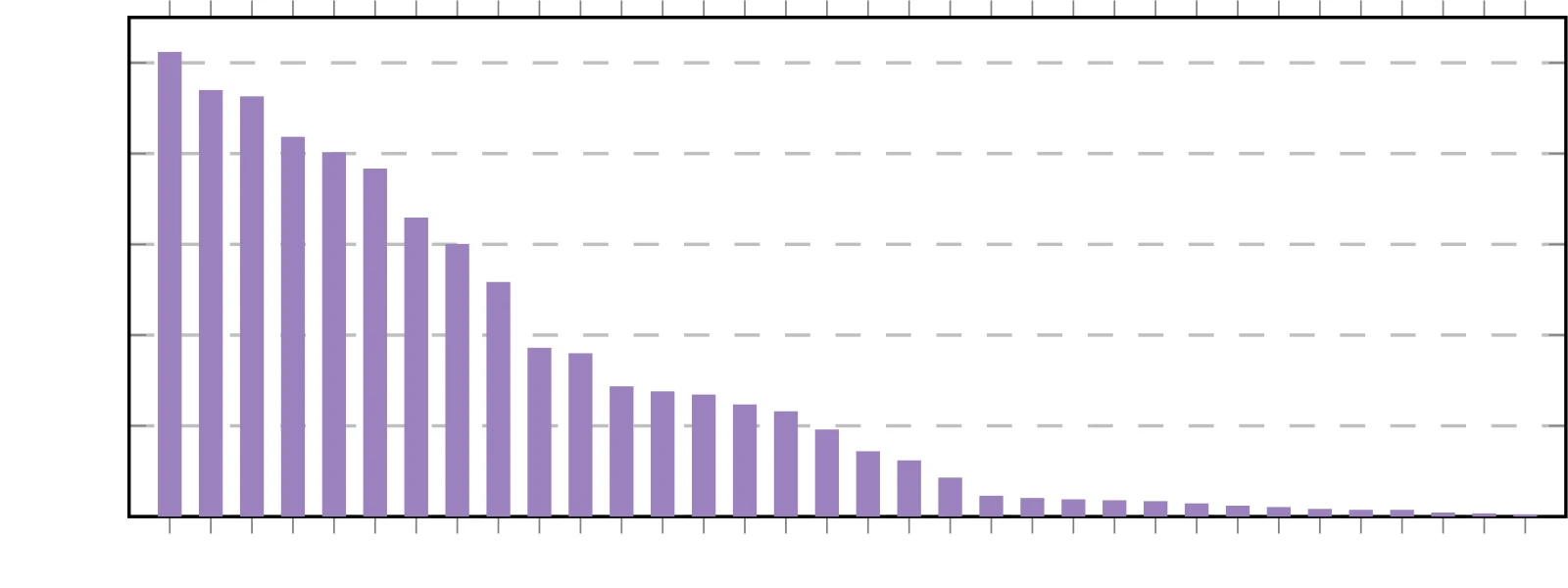
To broaden domain coverage, we further augment the data with Hermes-3 (https://huggingface.co/datasets/NousResearch/Hermes-3-Dataset) (Teknium et al., 2024), Tülu 3 (https://huggingface.co/datasets/allenai/tulu-3-sft-mixture) (Lambert et al., 2025), and Nemotron V2 (https://huggingface.co/datasets/nvidia/Nemotron-Post-Training-Dataset-v2) (Nathawani et al., 2025a). We also include two million STEM-oriented samples from Nemotron V1 (https://huggingface.co/datasets/nvidia/Nemotron-Post-Training-Dataset-v1) (Nathawani et al., 2025b). These sources provide diverse prompts and responses spanning general conversation, coding, mathematical problem solving, and other STEM content. Many collected samples contained structured reasoning traces. We remove all such traces, yielding a fully non-reasoning instruction–response corpus. We then perform instruction-level deduplication and discard poorly formatted samples. The resulting dataset contains approximately 10.6 million multilingual examples (see Figure 2 for the language distribution).
Supervised fine-tuning
To obtain EuroLLM-22B-Instruct, our instruction-following model, we fine-tune our base model on EuroBlocks-22B using a maximum context length of tokens. Training optimizes the standard cross-entropy objective, computing the loss only on the target tokens. We train for epochs using bfloat16 mixed precision, sequence packing, and a cosine learning rate scheduler with a maximum learning rate of and warmup steps.
We adopt Axolotl (https://axolotl.ai/) coupled with Liger-Kernel (https://github.com/linkedin/Liger-Kernel) (Hsu et al., 2025), which significantly improves training efficiency and reduces memory consumption. We enable optimized implementations from Liger-Kernel for RoPE, RMSNorm, GLU activation, layer normalization, and fused linear cross-entropy. Complete training configurations—including the Axolotl YAML configuration—are available in the model card accompanying each released EuroLLM model.
Evaluation
Our evaluations span a broad set of benchmarks commonly used for instruction-tuned models, covering both English and multilingual settings. The English suite includes instruction-following, general-knowledge, and STEM tasks, while the multilingual suite covers general-knowledge, STEM, and translation tasks. We release our evaluation framework to ensure reproducibility and facilitate future research (https://github.com/deep-spin/eurollm-eval).
English Benchmarks
We evaluate instruction following using IFEval (Kovalevskyi, 2024), a suite of prompts designed to assess a model’s ability to follow explicit instructions (e.g., avoiding a specific word in the answer or structuring the response into a given number of sections).
We employ several benchmarks, including Hellaswag (Zellers et al., 2019), MMLU (Hendrycks et al., 2021a), MMLU-Pro (Wang et al., 2025), and BBH (Suzgun et al., 2023), which together assess commonsense reasoning, broad knowledge, and multitask generalization.
We evaluate STEM knowledge using several benchmarks, including ARC-C (Clark et al., 2018), the challenge split of the ARC multiple-choice science exam corpus, and GPQA (Rein et al., 2024), a set of difficult graduate-level physics problems. For mathematics, we use GSM8K (Cobbe et al., 2021), which contains grade-school math word problems requiring multi-step reasoning, and MATH-500 (Lightman et al., 2023), which includes high-school and early undergraduate math problems. For coding, we use HumanEval (Chen et al., 2021), a benchmark for generating python code from natural language descriptions.
Multilingual Benchmarks
We evaluate multilingual general knowledge using multilingual Hellaswag, MMMLU, and MMLU-ProX (Dac Lai et al., 2023; Xuan et al., 2025), which are multilingual extensions of the Hellaswag and MMLU benchmarks, and a multilingual adaptation of MMLU-Pro, respectively.
We evaluate multilingual STEM knowledge using multilingual ARC-C (Dac Lai et al., 2023) and MGSM (Shi et al., 2022), which are a multilingual extension of the ARC-C benchmark and a manually translated subset of 250 GSM8K questions into 10 languages, respectively.
We evaluate machine translation using FLORES-200 (Costa-jussà et al., 2024), a benchmark for translation between English and low-resource languages. We also employ WMT24++ (Deutsch et al., 2025), an extension of WMT24 (Kocmi et al., 2024) covering 55 languages and dialects, and WMT25 (Kocmi et al., 2025), the latest WMT benchmark for translation across diverse language pairs.
All multilingual benchmarks are restricted to the languages supported by EuroLLM-22B, which include Bulgarian, Croatian, Czech, Danish, Dutch, English, Estonian, Finnish, French, German, Greek, Hungarian, Irish, Italian, Latvian, Lithuanian, Maltese, Polish, Portuguese, Romanian, Slovak, Slovenian, Spanish, Swedish, Arabic, Catalan, Chinese, Galician, Hindi, Japanese, Korean, Norwegian, Russian, Turkish, and Ukrainian.
Baselines
We compare EuroLLM-22B (https://huggingface.co/utter-project/EuroLLM-22B-Instruct-2512) and our newly released EuroLLM-9B (https://huggingface.co/utter-project/EuroLLM-9B-Instruct-2512) with instruction-tuned baselines of comparable size, including both European and non-European models, and encompassing fully open as well as open-weights models.
We compare with the fully open European baselines Apertus-8B (https://huggingface.co/swiss-ai/Apertus-8B-Instruct-2509) and Apertus-70B (https://huggingface.co/swiss-ai/Apertus-70B-Instruct-2509) (Hernández-Cano et al., 2025). We also include an open-weights baseline, Mistral-3.2-24B (https://huggingface.co/mistralai/Mistral-Small-3.2-24B-Instruct-2506) (Jiang et al., 2023). Additionally, for completeness and historical comparison, we separately compare against our previous EuroLLM models, EuroLLM-9B (old) (https://huggingface.co/utter-project/EuroLLM-9B-Instruct) and EuroLLM-22B-Preview (https://huggingface.co/utter-project/EuroLLM-22B-Instruct-Preview) (Martins et al., 2025).
The fully open baselines include OLMo-3-7B (https://huggingface.co/allenai/Olmo-3-7B-Instruct) and OLMo-3.1-32B (https://huggingface.co/allenai/Olmo-3.1-32B-Instruct) (Olmo et al., 2025). We additionally compare with open-weights baselines such as Llama-3.1-8B (https://huggingface.co/meta-llama/Llama-3.1-8B-Instruct), Llama-3.3-70B (https://huggingface.co/meta-llama/Llama-3.3-70B-Instruct) (Llama Team et al., 2024), Gemma-3-12B (https://huggingface.co/google/gemma-3-12b-it), Gemma-3-27B (https://huggingface.co/google/gemma-3-27b-it) (Team et al., 2025a), Qwen-3-14B (https://huggingface.co/Qwen/Qwen3-14B), Qwen-3-32B (https://huggingface.co/Qwen/Qwen3-32B), and Qwen-3-30B-A3B (https://huggingface.co/Qwen/Qwen3-30B-A3B) (Yang et al., 2025).
Evaluation Protocol
To ensure a fair comparison between models, we use the generation parameters recommended by the authors when available and otherwise default to greedy decoding, performing all generation in non-reasoning mode. Accordingly, inference for Qwen-3 is performed with a temperature of 0.7, top-p of 0.8, top-k of 20, min-p of 0, and a presence penalty of 1.5, as suggested by Yang et al. (2025). Additionally, all models are allowed to generate up to their maximum length, giving more verbose models the full opportunity to produce their outputs.
All tasks are evaluated using LLM-as-a-judge. For non-translation tasks, this approach primarily avoids the limitations of rule-based extraction, which can be unreliable for some models that sometimes fail to format their outputs correctly. Specifically, a high-capacity judge is provided with the question, the generated answer, and the ground truth, and is asked to determine whether the generated answer is equivalent to the ground truth. As judges, we use Nemotron-49B (https://huggingface.co/nvidia/Llama-3_3-Nemotron-Super-49B-v1_5) (Bercovich et al., 2025), GPT-OSS-120B (https://huggingface.co/openai/gpt-oss-120b) (OpenAI, 2025), and Qwen3-235B-A22B (https://huggingface.co/Qwen/Qwen3-235B-A22B-Instruct-2507) (Yang et al., 2025), and aggregate their judgments by mean. For translation, we use COMET-22 (https://huggingface.co/Unbabel/wmt22-comet-da) (Rei et al., 2022a), providing the source, generated translation, and gold reference for scoring.
Results
This section documents performance results on English benchmarks (Table 3) and aggregate results on multilingual benchmarks restricted to European languages (Table 4). Aggregate results over all multilingual benchmarks (Table 7) and over non-EU languages (Table 8), as well as detailed per-language and per-language-pair results, are provided in Appendix A.
The instruction-tuned results are summarized in Tables 3 and 4, with full per-language breakdowns reported in Appendix A. Across the benchmark suite, the new EuroLLM-9B consistently improves over Apertus-8B, while EuroLLM-22B is the strongest model among the fully open European systems considered, confirming a clear scaling trend within the EuroLLM family. A particularly informative comparison is against Apertus-70B. Here, EuroLLM-22B operates with roughly one third of the parameters, yet is frequently competitive and in several settings achieves higher scores across both English and multilingual European evaluations, indicating that its instruction tuning and multilingual design translate into robust downstream behavior rather than gains concentrated in a narrow subset of tasks. Taken together, while the EuroLLM family still trails the very best open-weights models overall, it offers the strongest fully open European alternative as to date.
The base-model results are reported in Appendix B. EuroLLM-22B-Base shows consistent gains over EuroLLM-9B-Base, aligning with the expected benefits from scaling while remaining broadly competitive with the strongest fully-open European baselines. The remaining gap to Apertus-70B-Base should be interpreted in the context of substantially different training regimes, as EuroLLM-22B is trained on approximately 4T tokens, whereas Apertus-70B reports pre-training on 15T tokens at a much larger parameter scale. These results suggest that EuroLLM achieves strong quality with a comparatively modest token budget, and that increasing the amount of high-quality training data is a promising direction for further closing the gap.
Post-training Analysis and Discussion
To isolate the effect of our updated post-training recipe, Table 5 and Table 6 compare the previous (old) and current (new) instruction-tuned EuroLLM checkpoints (9B and 22B) on identical English and multilingual evaluation suites, with the multilingual suite restricted to European languages. Additional results by language and language pair are provided in Appendix A.
Across both English and multilingual evaluations, the new EuroLLM checkpoints show consistent improvements, with the largest gains in instruction following and in knowledge- and STEM-focused problem solving (including coding). These gains come with translation quality remaining essentially unchanged, suggesting that the updated post-training recipe strengthens general assistant behavior and multilingual reasoning without meaningful trade-offs in translation. The longer maximum context length also closes prior evaluation gaps and enables coverage of additional long-context benchmarks (e.g., WMT25). Overall, the results show that the improved post-training recipe yields a significant performance gap over the previous EuroLLM checkpoints, even though both versions start from similar base models trained on a comparatively modest pre-training budget of 4T tokens.
Conclusions
In this work, we present EuroLLM-22B, detailing its development from data collection and filtering to pre-training and post-training procedures. We release both the base and instruction-tuned variants of EuroLLM-22B, accompanied by extensive evaluations on multilingual general benchmarks and machine translation tasks. Alongside the 22B models, we release improved versions of our 9B models, incorporating long-context extension and our improved post-training. To further support research and downstream applications, we also release the new EuroBlocks dataset, a multilingual instruction dataset designed to improve the model’s performance across European languages; EuroWeb, our multilingual pretraining data; and our pre-training and evaluation codebases. Collectively, these resources contribute to advancing multilingual language modeling and provide a foundation for future research in European language understanding and generation.
Acknowledgments
Part of this work was supported by the EU’s Horizon Europe Research and Innovation Actions (UTTER, contract 101070631), by the project DECOLLAGE (ERC-2022-CoG 101088763), and by the Portuguese Recovery and Resilience Plan through project C645008882-00000055 (Center for Responsible AI). We thank EuroHPC for the HPC resources used to support this work through grant EHPC-EXT-2023E01-042 and grants EHPC-AI-2024A01-085 and EHPC-AI-2024A05-044.
Next step
A problem worth researching?
Tell us what you are trying to solve, and we will put you in touch with the people who work on it.