Scale or Reason? A Compute-Equivalent Analysis of Reasoning Distillation
- Authors
- Nicolas Boizard
- Hippolyte Gisserot-Boukhlef
- Kevin El Haddad
- Céline Hudelot
- Pierre Colombo
- Affiliations
- Diabolocom
- Artefact Research Center
- Equall
- ISIA Lab, University of Mons
- MICS, CentraleSupélec, Université Paris-Saclay
- Accepted at
- EMNLP 2026
- Date
- arXiv
- 2509.22193
Abstract
Distilling reasoning traces from strong teacher models has become the standard recipe for building capable small language models. Yet reasoning traces are 5-20× longer than standard instruction fine-tuning (IFT) outputs, meaning every practitioner who chooses reasoning distillation implicitly forgoes training a larger IFT model on the same compute budget. Whether this trade-off is worthwhile remains unaddressed. We study it with a controlled experiment: a single teacher generates paired IFT and reasoning outputs for identical prompts by toggling only its reasoning mode, isolating supervision format as the sole variable. Training students at five scales (0.5B to 14B) and evaluating on 18 benchmarks, we find that at matched FLOPs, IFT lies on or near the Pareto frontier across the majority of configurations. Reasoning reaches the Pareto frontier only on open-ended tasks at 7B and above. Even there, a sequential curriculum mixing just 25-50% reasoning data with IFT captures most of the accuracy benefit at far lower compute cost.
Cite this paper
@inproceedings{boizard2026scale,
  title = {Scale or Reason? A Compute-Equivalent Analysis of Reasoning Distillation},
  author = {Nicolas Boizard and Hippolyte Gisserot-Boukhlef and Kevin El Haddad and Céline Hudelot and Pierre Colombo},
  booktitle = {Conference on Empirical Methods in Natural Language Processing (EMNLP 2026)},
  year = {2026}
}Copied
Introduction
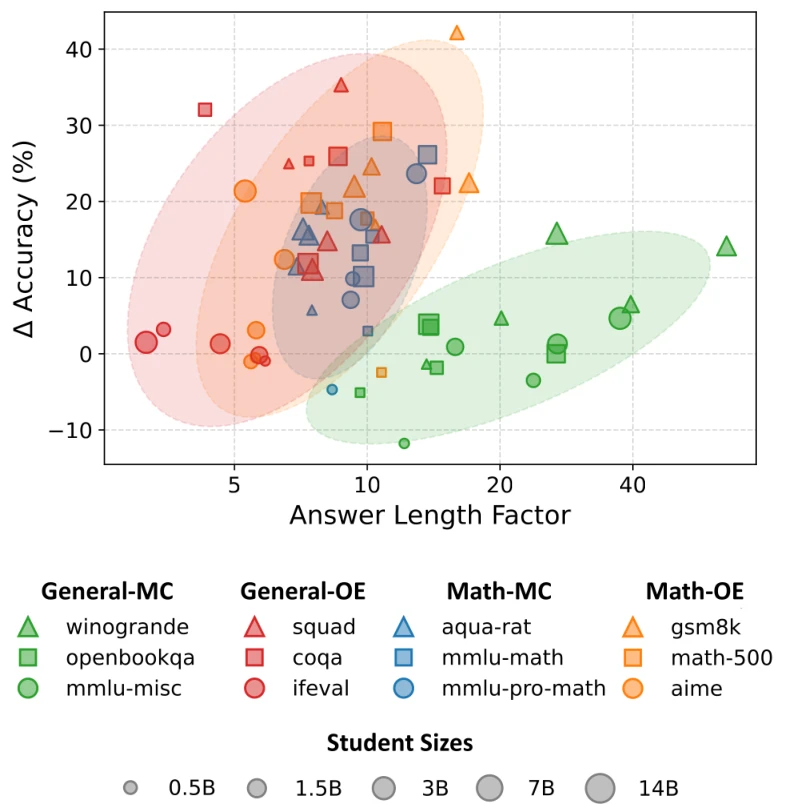
Reasoning distillation has become the dominant training recipe for capable small language models (Guo et al., 2025; Yang et al., 2025; Rastogi et al., 2025). Yet every reasoning trace is 5-20 longer than a standard IFT output (Figure 1), and this length gap has a direct cost: training on reasoning data consumes proportionally more compute. A practitioner with a fixed budget who chooses reasoning distillation implicitly gives up the option of training a larger IFT model instead, an alternative that standard scaling laws suggest is a highly efficient use of additional compute (Kaplan et al., 2020; Hoffmann et al., 2022). Whether reasoning justifies this cost has not been studied: DeepSeek-R1 (Guo et al., 2025), s1 (Muennighoff et al., 2025), and Snell et al. (2024) all evaluate at fixed model sizes, leaving the compute-allocation question entirely open. This leads directly to our question:
For a given compute budget, should a practitioner invest in reasoning distillation, or train a larger IFT model?
To isolate the effect of supervision format from all other variables, we use a single teacher that generates paired IFT and reasoning outputs for identical prompts by toggling its reasoning mode on and off. Both formats are thus distilled from the same teacher weights in a controlled setup, ensuring that supervision format is the sole variable. We train Qwen2.5 students at five scales (0.5B to 14B), track FLOPs precisely across all configurations, and evaluate on 18 benchmarks spanning four task families. We replicate all key findings using a second teacher-student pair (Nemotron-Super-49B with Gemma-3; Appendix G), confirming that results are not specific to a single architecture or teacher. This yields three findings:
Scaling IFT is compute-efficient by default. At matched training and inference FLOPs, IFT models lie on or near the Pareto frontier across the majority of configurations. Reasoning only approaches the frontier on open-ended tasks and at larger scales (§3).
Format and capacity jointly determine the value of reasoning. Output format, rather than knowledge domain, is the primary predictor: open-ended tasks consistently benefit from reasoning distillation, whereas multiple-choice tasks do not. Model capacity acts as a secondary prerequisite, as reasoning captures the Pareto frontier only at 7B parameters and above (§4).
A little reasoning goes a long way. In the regime where reasoning is beneficial, a sequential curriculum using just 25 to 50% reasoning data captures most of the accuracy benefit at a fraction of the training cost. Furthermore, mixed training below the 50% threshold delivers enhanced accuracy while strictly maintaining efficient inference costs (§5).
Together, these findings provide a systematic answer to the compute allocation question in reasoning distillation.
Experimental Setup
Distillation
Our central methodological challenge is to compare IFT and reasoning supervision without confounding label quality with supervision format. We address this by using a single teacher, Qwen3-235B-A22B (Yang et al., 2025), to generate both formats for every prompt: IFT outputs are produced with reasoning mode disabled, reasoning outputs with it enabled. Student models in the IFT condition are trained on pairs; in the reasoning condition on tuples. Because both formats come from the same teacher weights and the same prompts, supervision format is the sole independent variable.
We train Qwen2.5 base models (Qwen-Team, 2024) at five parameter scales: 0.5B, 1.5B, 3B, 7B, and 14B. Students are drawn from a different model family than the teacher to limit shared pretraining overlap. Training data covers two domains: a general-purpose corpus of 1.3M pairs from Infinity-Instruct (Li et al., 2025), and a reasoning-centric corpus of 300K pairs from the math subset of the Llama-Nemotron-Post-Training-Dataset (Bercovich et al., 2025).
We study sequential training across reasoning proportions , where is the percentage of reasoning instances in the dataset. At the model sees only IFT supervision; at only reasoning supervision. Intermediate values correspond to a curriculum where IFT examples come first, followed by reasoning examples. We also evaluate a mixed training baseline in which IFT and reasoning data are shuffled together within a single phase (§5). All models train for one epoch on 16 H100 GPUs with a fixed global batch size of 32; learning rates are selected by grid search (Appendix C).
Evaluation
Our evaluation centers on 18 benchmarks structured along two dimensions: domain (general vs. math) and answer format (multiple-choice (MC) vs. open-ended (OE)). This taxonomy defines four task families: General-MC (winogrande (Keisuke et al., 2020), openbookqa (Mihaylov et al., 2018), mmlu-misc (Hendrycks et al., 2021)), General-OE (squad (Rajpurkar et al., 2016), coqa (Reddy et al., 2019), ifeval (Zhou et al., 2023)), Math-MC (aqua-rat (Ling et al., 2017), mmlu-math (Hendrycks et al., 2021), mmlu-pro-math (Wang et al., 2024)), and Math-OE (gsm8k (Cobbe et al., 2021), math-500 (Lightman et al., 2024), aime (Zhang and Math-AI, 2025)). Additional tasks are introduced selectively in §4 to address specific experimental needs.
Answers are scored by a majority-vote jury of three judge models: Llama-3.3-70B-Instruct (Grattafiori et al., 2024), Nemotron-Ultra-253B-v1 (Bercovich et al., 2025), and GPT-OSS-120B (Agarwal et al., 2025). Each judge follows a two-step protocol: first extracting the final answer from the model output while ignoring any intermediate reasoning, then assessing its semantic equivalence to the reference. This ensures that scores reflect answer correctness, not trace quality, and prevents reasoning-trained models from receiving credit for verbose but wrong answers. Median absolute error across judges is 1.2 points; pairwise agreement is below 2 points on all benchmarks. Distilled models are evaluated zero-shot while base checkpoints rely on three-shot prompting. Full prompts and judge statistics are provided in Appendix B.
Because reasoning traces are 5-20 longer than IFT outputs, reasoning training and inference consume proportionally more compute for both forward and backward passes. We systematically track this overhead in FLOPs and report the formula used in Appendix D. This disparity is the foundation for the compute-matched comparisons in §3.
Is Reasoning Worth the Compute Cost?
We approach this question in three distinct steps: comparing the two supervision formats at equal model size, at matched training compute, and at matched inference compute.
At Fixed Size, Reasoning Helps
To establish an initial baseline, Table 1 presents the raw performance of both supervision paradigms across all model sizes and the two relevant training corpora: the general-purpose one derived from Infinity-Instruct and the math-centric one derived from Llama-Nemotron-Post-Training-Dataset.
Reasoning supervision consistently outperforms IFT when trained on the general-purpose corpus, with the largest gains on open-ended and mathematical tasks. On Math-OE, a 3B reasoning model already surpasses the 14B IFT baseline outright (55.4 vs. 53.7); on General-OE, it comes within 1.4 points of it (64.7 vs. 66.1). On both MC families, the 14B reasoning model narrows the performance gap with the teacher to within 4-5 points, despite being roughly 17 smaller. The pattern holds across nearly all conditions with one notable exception: on General-MC, IFT leads at 0.5B, and the two formats remain effectively tied at 1.5B. However, from 3B onward, reasoning re-establishes a definitive lead.
When trained on the math-centric corpus, reasoning supervision again outperforms IFT from 1.5B onward on math tasks. More strikingly, from 3B upward, math-centric reasoning models surpass even general-purpose reasoning on both Math-OE (57.5 vs. 55.4) and Math-MC (72.2 vs. 70.9), despite training on just 300K samples compared to 1.3M. However, this specialization comes at a cost: on general-domain tasks, math-centric reasoning lags well behind general-purpose reasoning at smaller scales, and the gap closes only partially by 14B (General-MC: 90.3 vs. 90.4; General-OE: 69.2 vs. 74.2). Conversely, standard IFT models trained on the exact same math-centric corpus do not exhibit this penalty, remaining competitive on general-domain tasks across all tested scales. This demonstrates that the general-task degradation is tied to the reasoning format rather than the math-centric data itself. This penalty is particularly severe at smaller scales, demonstrating that distilling general capabilities from a reasoning-intensive domain (e.g., mathematical problem solving or code generation, as commonly used in RL pipelines) strictly requires larger parameter counts. Consequently, we report the remainder of our experiments with the general-purpose training corpus.
Both supervision formats improve with model size, but at different rates. IFT improves steadily across all four task families, exhibiting consistent gains at each size step; yet even at 14B, it remains well below teacher accuracy, with the largest gap appearing on open-ended tasks. Reasoning scales more steeply and outperforms IFT in 70% of scale-corpus configurations (28 out of 40 pairs), though not uniformly. While these results make a strong case for reasoning at a fixed parameter count, this comparison carries a fundamental limitation: equal model size does not imply equal compute. Because a 3B reasoning model consumes substantially more FLOPs than a 3B IFT model, this disparity changes the efficiency picture entirely.
At Fixed FLOPs, IFT Dominates
In this section, we shift our focus to compute efficiency by plotting accuracy against training and inference FLOPs for IFT and reasoning distillation on the general-purpose corpus.
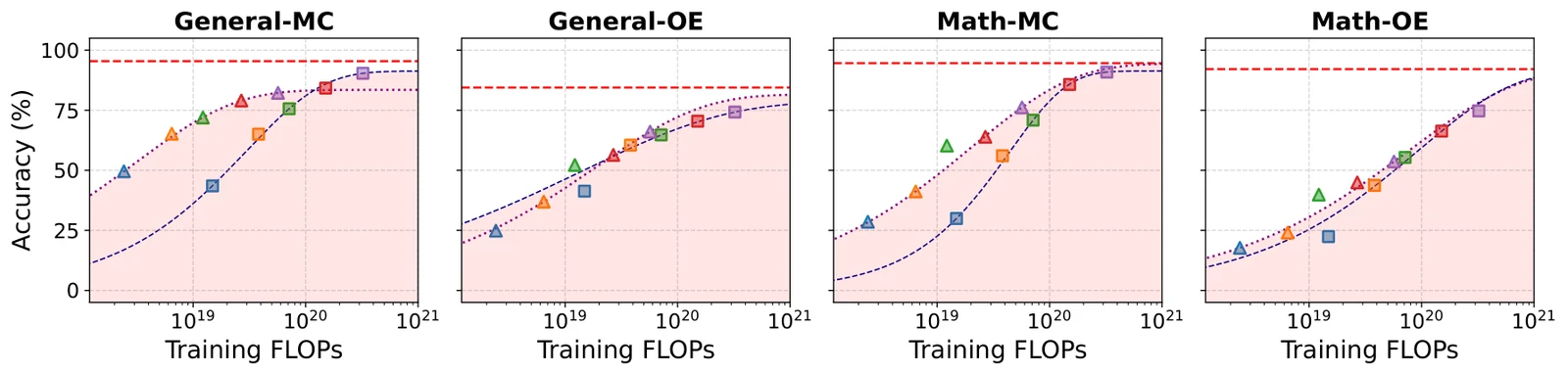
Contrary to the fixed capacity comparison, when compute is held constant rather than model size, the efficiency picture reverses entirely. Figure 2 reveals that IFT models define the Pareto frontier of performance as a function of the training budget, with no reasoning configuration matching the accuracy of a compute-equivalent IFT model at any tested scale. This establishes that scaling model size is a more compute-efficient strategy for maximizing performance across the majority of our evaluations. For example, on general multiple-choice tasks, despite being twice the size, a 7B IFT model required 5 less training compute to achieve similar accuracy compared to a 3B reasoning-distilled model. While the cost overhead is smaller on open-ended tasks, a gap remains; for instance, on open-ended math tasks, a 7B IFT model achieves performance similar to a 1.5B reasoning model while being 1.6 less costly to train. However, we observe that the performance gap at matched training FLOPs continuously narrows with model scale, suggesting this disparity may close beyond 14B parameters.
Shifting focus from training to deployment, the pattern holds (Figure 2). Because reasoning models generate outputs 7-15 longer than standard IFT models of the same size, their inference cost is substantially higher at every scale. On OE tasks, reasoning models still generate outputs approximately 7 longer than their compute-equivalent IFT counterparts, yet they approach or even join the Pareto frontier. On MC tasks, however, this overhead grows to 10-15 , causing reasoning models to fall well behind IFT efficiency across most evaluated scales.
What Drives Reasoning Efficiency?
§3 demonstrates that while standard IFT generally dominates at fixed compute, systematic exceptions emerge for open-ended tasks at larger parameter scales. This section investigates why output format and model capacity dictate when reasoning distillation justifies its computational overhead.
Format Predicts Value; Domain Does Not
Reasoning models incur significantly higher overhead on multiple-choice tasks than on open-ended tasks across diverse domains, questioning whether distillation efficiency is driven by domain complexity or output format.
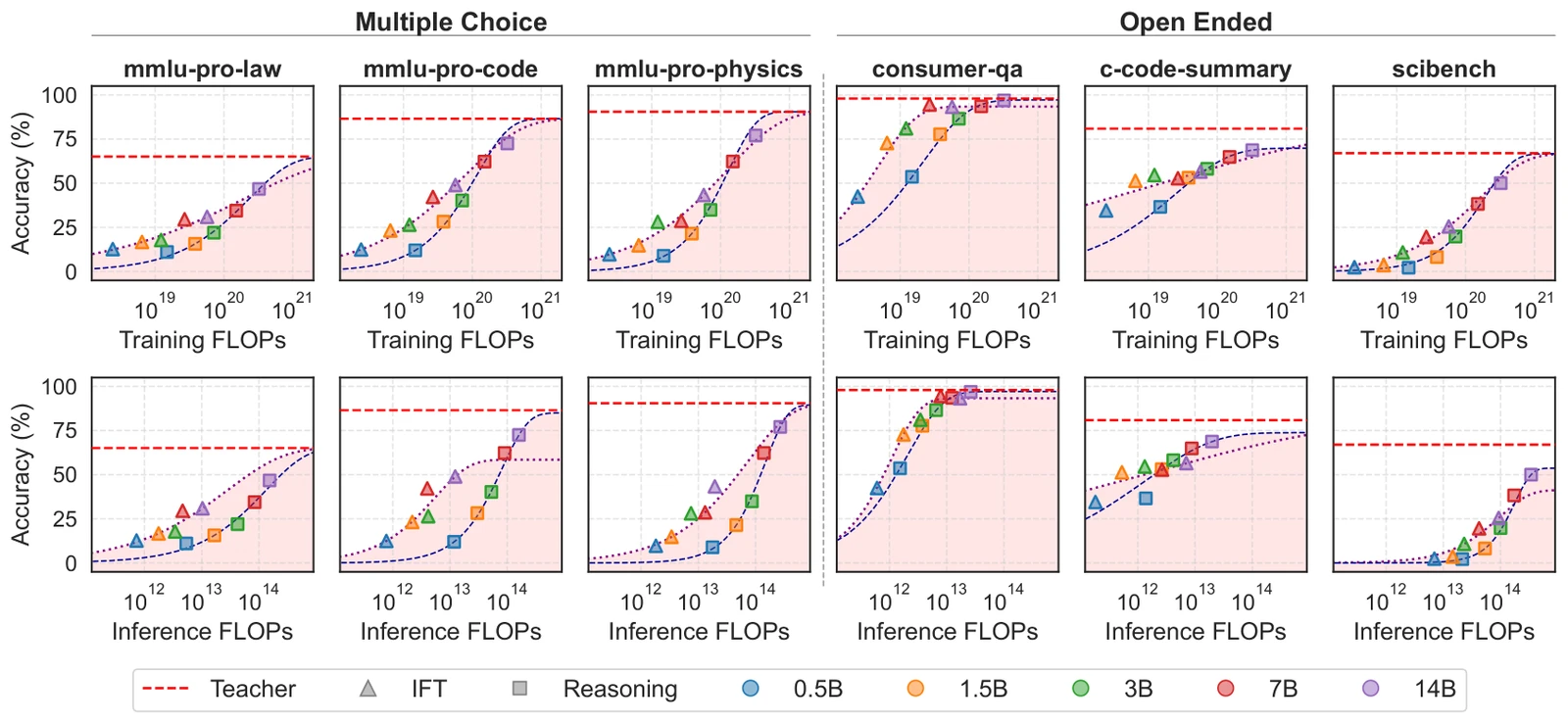
To disentangle these factors further, we evaluate three additional reasoning-intensive domains featuring one open-ended and one multiple-choice benchmark each: law (mmlu_pro_law (Wang et al., 2024), consumer_qa (Guha et al., 2023)), code (mmlu_pro_code, C_Code_Summarization (Liu et al., 2020)), and physics (mmlu_pro_physics, scibench (Wang et al., 2023)). Holding the knowledge domain constant while varying task format provides a precise test. If domain dictates efficiency, reasoning-intensive tasks will uniformly favor reasoning models. Conversely, if output format dominates, open-ended and multiple-choice versions of the same domain will diverge, with one capturing or resting near the Pareto frontier alongside IFT models, and the other falling behind.
As initially illustrated in Figure 2 and further complemented by Figure 3, the two task formats exhibit a clear divergence: open-ended benchmarks place reasoning models on or near the Pareto frontier for both training and inference efficiency, while a significant gap remains for multiple-choice evaluations. For example, on C_Code_Summarization, a 7B reasoning model matches an IFT model at identical inference cost with a training overhead of only 1.3 . Conversely, on multiple-choice benchmarks like mmlu_pro_code, a 10 inference compute gap exists between a 7B IFT model and a 3B reasoning model achieving similar performance, although this narrows with scale. These results confirm that while knowledge domain exerts marginal influence (math and reasoning-intensive multiple-choice tasks benefit slightly more than general ones), output format strictly dictates efficiency. For open-ended setups, this Pareto equivalence transforms the architectural decision into a practical exchange between model capacity and generation length, allowing practitioners to deploy smaller reasoning models for memory constraints, or larger IFT models to minimize latency.
Model Capacity Determines Whether Traces Help or Hurt
While output format dictates where reasoning distillation is computationally viable, model capacity acts as a strict secondary prerequisite.
Beyond this capacity threshold, reasoning models reliably capture both the training and inference Pareto frontiers. On open-ended tasks (Figure 2, Figure 3), reasoning models match or exceed IFT accuracy while maintaining optimal compute efficiency. On multiple-choice tasks, reasoning models at this scale surpass IFT in absolute accuracy, though they incur higher inference costs that deviate from established scaling trends.
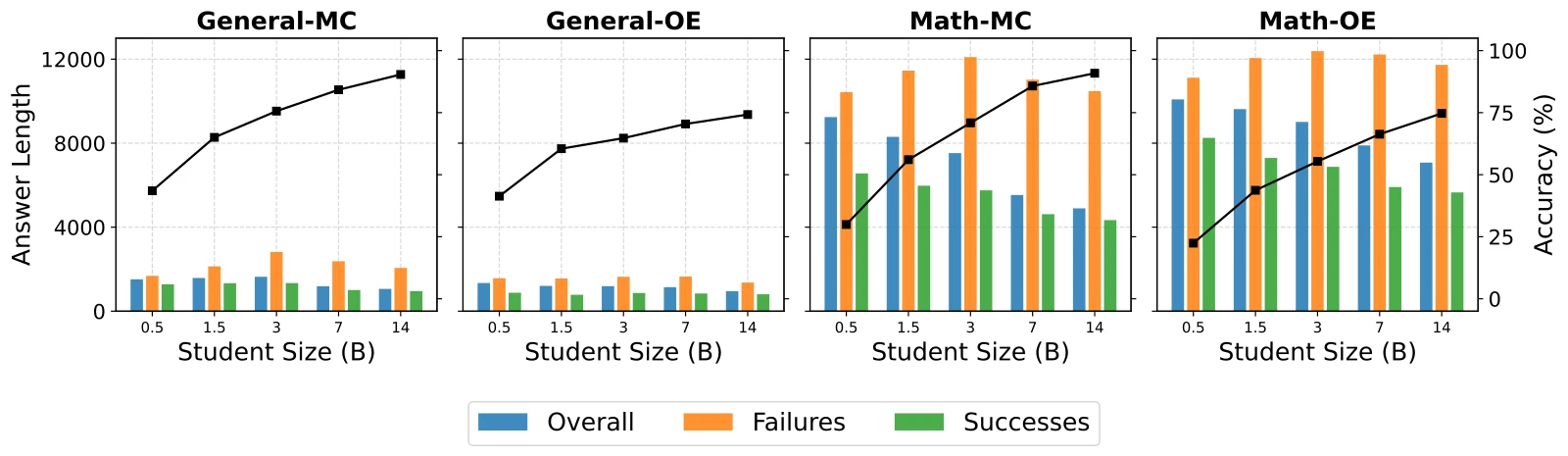
The relative difference in inference cost between consecutive reasoning model scales decreases steadily with model size (Figure 2, Figure 3, and highlighted in Appendix I). Plotting the generation length of correct versus incorrect reasoning traces against model size and accuracy (Figure 4) reveals a consistent relationship: across all scales and task families, incorrect answers yield traces 1.5 to 2 longer than correct ones. Rather than reflecting deeper processing, longer traces correlate directly with failure. Qualitative inspection reveals smaller models frequently explore dead ends or restate problems without making tangible progress. As capacity increases, two phenomena emerge:
The length ratio between failures and correct answers shrinks (from roughly 2 at 0.5B to 1.5 at 14B), indicating larger models allocate generation effort more efficiently.
Because accuracy inherently increases with scale, the average output length naturally gravitates toward the shorter, correct trace length.
Conversely, average generation length for smaller models is skewed by long, incorrect traces, severely degrading the accuracy to inference cost ratio. This makes small reasoning models computationally expensive and practically ineffective. While this strong correlation makes trace length a natural confidence signal (similar to multi sampling strategies utilizing answer length as an uncertainty measure (Hassid et al., 2025)), attempting a simple early stopping strategy based on length thresholds proved unsuccessful. The reduction in inference FLOPs is entirely offset by a corresponding drop in accuracy without shifting the Pareto frontier, an outcome we consequently report in Appendix H.
Together, output format and model capacity define when reasoning distillation earns its compute cost. open-ended formats make reasoning a viable alternative to IFT: both reach comparable accuracy on the efficiency frontier, reducing the choice to a deployment constraint. Scaling beyond 7B pushes this further: reasoning overtakes IFT on the frontier, becoming the dominant strategy for open-ended tasks.
Leveraging IFT and Reasoning with Hybrid Data Mixtures
§3 demonstrates that reasoning distillation boosts performance but carries a steep compute premium, with training and inference costs running 5 to 20 higher than standard IFT. §4 traced this overhead to smaller models generating inefficiently: producing long traces that correlate with failure rather than reasoning depth, driving up costs without proportionate accuracy gains. This section investigates whether this computational burden can be reduced. We study two hybrid strategies blending IFT- and reasoning-style data in varying proportions: sequential training (IFT followed by reasoning) and mixed training (both data types combined and shuffled in a single training pass).
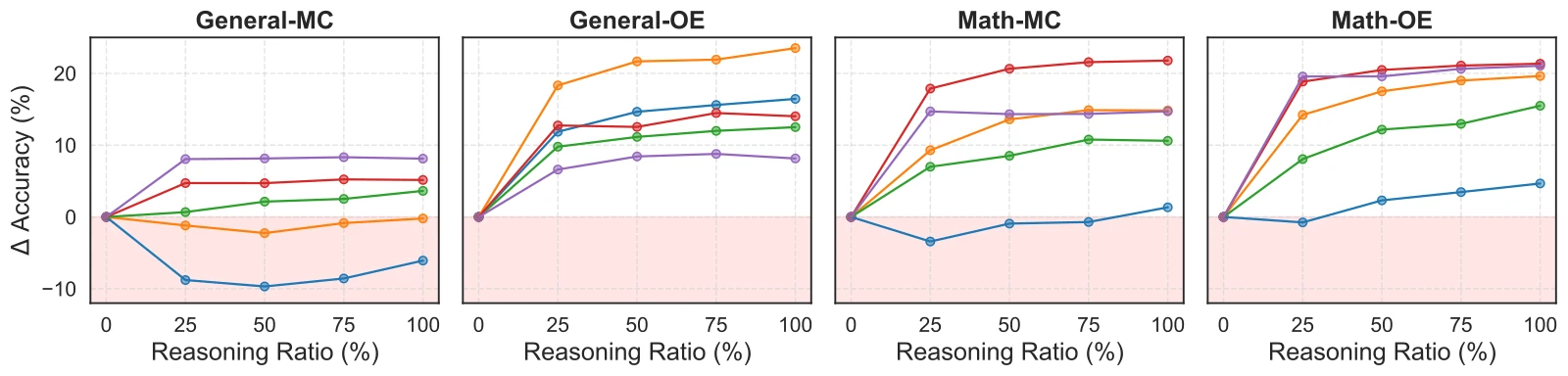
Sequential training addresses a direct question: how much reasoning data is required? Figure 5 demonstrates that performance gains emerge at just a 25% reasoning ratio (meaning 75% IFT data followed by 25% reasoning traces) and remain broadly consistent across task families and model sizes, with the notable exception of the smallest models (0.5B and 1.5B) evaluated on general multiple-choice tasks. At every intermediate ratio (25%, 50%, and 75%), sequential models successfully rest on the Pareto frontier for open-ended tasks. This matches the efficiency of full reasoning distillation at a mere fraction of its training cost.
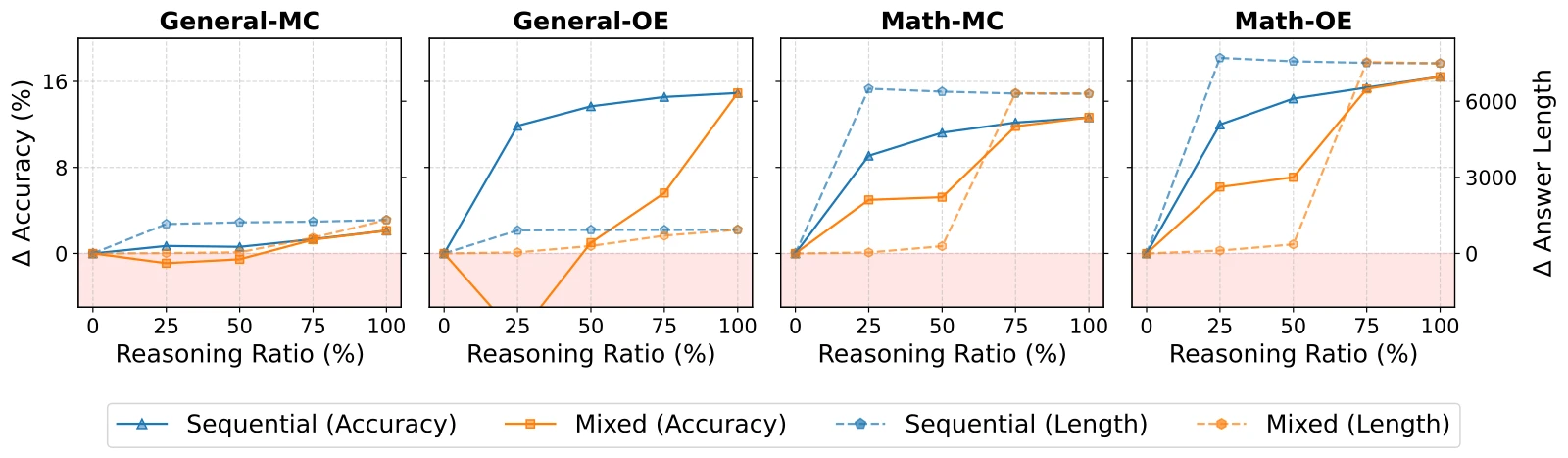
Mixed training pursues a distinctly different objective. Rather than strictly maximizing overall accuracy, it investigates whether a model can acquire reasoning capabilities while still retaining the concise output style typical of standard IFT. Figure 6 demonstrates that this is achievable below a specific data threshold. At reasoning proportions between 25 and 50%, models improve substantially over the IFT baseline on mathematical tasks while maintaining short outputs. This allows them to gain accuracy without incurring the typical inference compute penalty.
While mixed training remains beneficial at lower proportions of reasoning data, a clear mode switch emerges beyond the 50% threshold. Models begin to default entirely to reasoning style generation at inference time, which completely erases any inference cost advantage. Output lengths converge toward full reasoning distillation, while accuracy remains slightly behind that of sequential training at the 75% mark. Extending the benefits of mixed training beyond this point would likely require an explicit mechanism to control exactly when reasoning is invoked (Byrd and Srivastava, 2022; AlKhuzaey et al., 2024), a promising direction we leave for future work.
Sequential training reduces the training compute required to approach full reasoning performance: utilizing just 25% reasoning data recovers most accuracy gains at a fraction of the cost. Mixed training reduces inference cost: below the 50% threshold, models improve over standard IFT while preserving output brevity. Together, these findings establish that committing fully to reasoning distillation is unnecessary. When training compute is the primary constraint, sequential mixing efficiently captures most performance gains; when inference cost is the constraint, mixed training below the 50% threshold offers a practical middle ground.
Related Work
Instruction Fine-Tuning (IFT) has been the standard recipe for aligning LLMs with human instructions (Wei et al., 2021; Ouyang et al., 2022; Chung et al., 2024). Chain-of-Thought (CoT) extended this paradigm by supervising intermediate reasoning steps, yielding strong gains on arithmetic, symbolic, and commonsense reasoning benchmarks (Rajani et al., 2019; Nye et al., 2021; Cobbe et al., 2021; Wei et al., 2022; Kojima et al., 2022).
Knowledge Distillation (KD) transfers capabilities from strong teachers to smaller students (Bucilua et al., 2006; Hinton et al., 2015). Beyond representation-based KD, text-based distillation has become central for reasoning: large teacher models generate either IFT- or reasoning-style traces that guide student learning (Kim and Rush, 2016; Zhou and Chiam, 2023; Hsieh et al., 2023; He et al., 2023). This approach reduces the cost of expensive RL while preserving performance (Guo et al., 2025; Yang et al., 2025; Rastogi et al., 2025). Despite its widespread adoption, the structural conditions under which reasoning distillation is actually more compute-efficient than standard IFT remain underexplored.
The relationship between model capacity, dataset size, and training compute has been extensively formalized to guide the efficient pretraining of large language models (Kaplan et al., 2020; Hoffmann et al., 2022). Recently, this framework has expanded to encompass inference time scaling, revealing that allocating additional compute during generation can systematically enhance reasoning capabilities (Snell et al., 2024; Brown et al., 2024; Muennighoff et al., 2025). Recent research extends this analysis to API-based models, evaluating performance as a function of token cost (Chen et al., 2026) and finding analogous cost heterogeneity.
Conclusion
In this paper, we investigate whether the compute overhead of reasoning distillation is justified compared to scaling standard IFT, as a function of training and inference budgets. Surprisingly, while reasoning models boost raw performance, standard IFT lies on or near the Pareto frontier for the vast majority of configurations. Reasoning reaches the frontier only when two conditions hold simultaneously: the tasks require an open-ended output format rather than a specific knowledge domain, and the models contain at least 7B parameters. Below this capacity threshold, answer length is dictated by failure, which heavily inflates inference costs. Additionally, we demonstrate that hybrid approaches can significantly reduce these compute costs. A sequential curriculum using just 25 to 50% reasoning data recovers most of the accuracy benefit at a fraction of the training cost, while mixed training below a 50% corpus mix threshold improves accuracy while strictly preserving standard IFT inference efficiency.
Limitations
This study focuses on models up to 14B parameters, covering the typical regime where distillation is utilized to enhance small model performance. While this reflects a practically motivated experimental setup, and our results establish that reasoning models capture the Pareto frontier at 7B (a finding further confirmed at the 14B scale), additional scaling experiments are necessary to verify whether the identified conditions remain stable beyond this capacity. Additionally, this work specifically examines the distillation paradigm. At the model scales we consider, reinforcement learning typically underperforms distillation and incurs substantially higher training costs, suggesting that our core observations may remain consistent in that setting. Nevertheless, a dedicated study using reinforcement learning remains a promising avenue for future work to confirm this hypothesis.
Next step
A problem worth researching?
Tell us what you are trying to solve, and we will put you in touch with the people who work on it.