Should We Still Pretrain Encoders with Masked Language Modeling?
- Authors
- Hippolyte Gisserot-Boukhlef
- Nicolas Boizard
- Manuel Faysse
- Duarte M. Alves
- Emmanuel Malherbe
- Andre F. T. Martins
- Celine Hudelot
- Pierre Colombo
- Affiliations
- Artefact Research Center
- Diabolocom
- TransPerfect
- Cohere
- MICS, CentraleSupelec, Université Paris-Saclay
- Instituto de Telecomunicaçoes
- Instituto Superior Tecnico & Universidade de Lisboa (Lisbon ELLIS Unit)
- Accepted at
- ICLR 2026
- Date
- arXiv
- 2507.00994
Abstract
Learning high-quality text representations is fundamental to a wide range of NLP tasks. While encoder pretraining has traditionally relied on Masked Language Modeling (MLM), recent evidence suggests that decoder models pretrained with Causal Language Modeling (CLM) can be effectively repurposed as encoders, often surpassing traditional encoders on text representation benchmarks. However, it remains unclear whether these gains reflect an inherent advantage of the CLM objective or arise from confounding factors such as model and data scale. In this paper, we address this question through a series of large-scale, carefully controlled pretraining ablations, training a total of 38 models ranging from 210 million to 1 billion parameters, and conducting over 15,000 fine-tuning and evaluation runs. We find that while training with MLM generally yields better performance across text representation tasks, CLM-trained models are more data-efficient and demonstrate improved fine-tuning stability. Building on these findings, we experimentally show that a biphasic training strategy that sequentially applies CLM and then MLM, achieves optimal performance under a fixed computational training budget. Moreover, we demonstrate that this strategy becomes more appealing when initializing from readily available pretrained CLM models, reducing the computational burden needed to train best-in-class encoder models. We release all project artifacts at https://hf.co/MLMvsCLM to foster further research.
Cite this paper
@inproceedings{gisserotboukhlef2026should,
  title = {Should We Still Pretrain Encoders with Masked Language Modeling?},
  author = {Hippolyte Gisserot-Boukhlef and Nicolas Boizard and Manuel Faysse and Duarte M. Alves and Emmanuel Malherbe and Andre F. T. Martins and Celine Hudelot and Pierre Colombo},
  booktitle = {International Conference on Learning Representations (ICLR 2026)},
  year = {2026}
}Copied
Introduction
Learning meaningful representations is essential for a wide range of natural language processing (NLP) tasks, such as sequence classification, named entity recognition, extractive question answering, and information retrieval. Traditionally, these representations are learned with encoders pretrained solely with Masked Language Modeling (MLM) (Devlin et al., 2019). More recently, however, decoder models pretrained with Causal Language Modeling (CLM) and later adapted with MLM have challenged the MLM-only paradigm (BehnamGhader et al., 2024), achieving state-of-the-art results on the Massive Text Embedding Benchmark (MTEB) (Muennighoff et al., 2023; Enevoldsen et al., 2025). Yet, these results have so far only been observed on models that are significantly larger than typical encoders and trained on substantially more data (Lee et al., 2024; Meng et al., 2024; Kim et al., 2024; Muennighoff et al., 2024). As a result, it remains unclear whether the success of this training paradigm stems from CLM, or merely from increased scale.
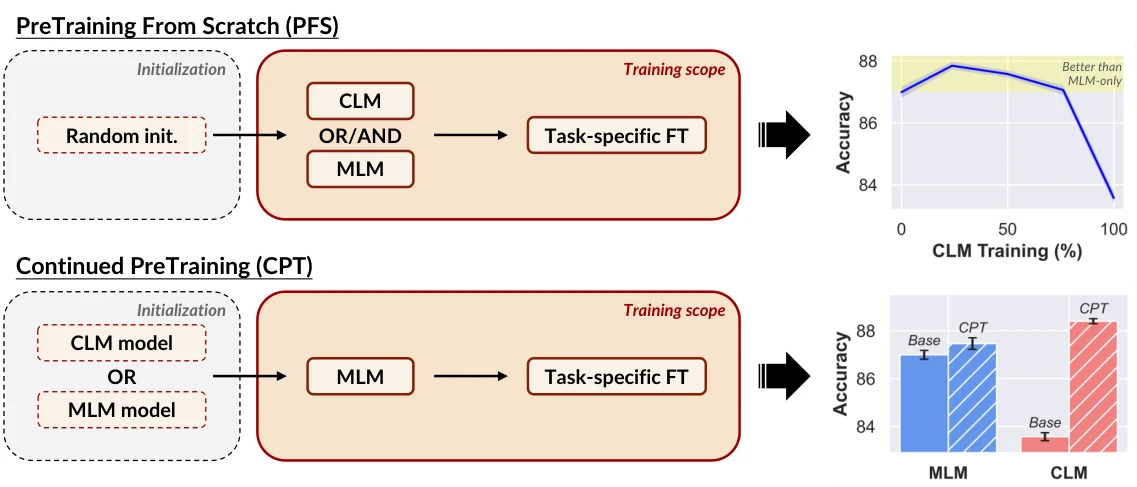
In this paper, we present a controlled study examining the impact of training with MLM and CLM on learning textual representations. We compare models with equal architecture and size, trained on an equal amount of data, and evaluate them on an extensive range of text representation tasks. We start by comparing pretraining exclusively with either approach, and then investigate a two-stage pretraining alternative, where CLM and MLM are applied sequentially. Additionally, leveraging existing pretrained models, we investigate a continued pretraining setup, where training starts from models initially trained with either MLM or CLM and is then extended with MLM for a portion of the pretraining steps. In total, we train 38 models ranging from 210 million to 1 billion parameters and conduct over 15,000 fine-tuning and evaluation runs to ensure fair design comparisons, amounting to 110k MI250X GPU hours. These large-scale experiments show that:
Although CLM training delivers strong performance on certain tasks and demonstrates good data efficiency and fine-tuning stability, MLM remains essential for achieving robust performance across all tasks, underscoring that bidirectional training remains essential (section 3).
When pretraining a model from scratch, a two-stage protocol that first applies CLM followed by MLM offers a data-efficient way to build strong text representations, effectively combining the strengths of both paradigms (section 4).
In a continued pretraining setting, adapting a CLM-pretrained model with MLM proves more effective than continuing MLM training from an MLM-pretrained model. This result suggests that leveraging widely pretrained decoder models is currently the best approach to obtain a strong encoder model (section 5).
To facilitate reproducibility and support future research, we release all pretrained model checkpoints (https://hf.co/MLMvsCLM), together with the corresponding training (https://github.com/Nicolas-BZRD/EuroBERT/tree/MLM_vs_CLM) and evaluation codebases (https://github.com/artefactory/EncodEval/tree/MLM_vs_CLM).
Experimental Setup
In this section, we describe our controlled experimental setup, covering model architectures, pretraining and fine-tuning protocols, as summarized in Figure 1.
The model architectures closely follow those of the EuroBERT models (Boizard et al., 2025), with sizes of 210M, 610M, and 1B parameters. All models use a maximum context length of 2,048 tokens and a RoPE value of 10,000.
Models are trained on unique English tokens from the FineWeb-Edu dataset (Penedo et al., 2024), which is known for supporting efficient model training. To ensure fair comparison across model configurations and training setups, all models are exposed to the same sequence of samples during training.
Models are trained using one of 3 approaches:
CLM employs next-token prediction, where each token is generated autoregressively using a causal attention mask. Given an input sequence , the training objective is to minimize the negative log-likelihood:
where denotes the model’s predicted distribution over the vocabulary conditioned on the preceding tokens under the causal attention mask.
MLM randomly masks a subset of tokens and trains the model to reconstruct them using a bidirectional attention mask. The sequence-level training objective is given by:
where denotes the model’s predicted distribution under a bidirectional attention mask, specifies the indices of the masked tokens, and is the input sequence with the corresponding tokens replaced by special placeholders. In practice, tokens are masked uniformly and independently, each with probability . In our experiments, we consider .
Finally, CLM+MLM sequentially combines the former approaches in a two-stage setup, where CLM pretraining is performed first, followed by MLM.
Pretraining is performed with a per-device batch size of 12 samples across 192 GPUs, yielding an effective batch size of 2,373,120 tokens. We employ a Warmup-Stable-Decay (WSD) learning rate schedule: a 2,000-step warmup phase, followed by 38,000 steps with a constant learning rate of , ending with a 2,000-step linear decay phase, for a total of 42,000 training steps.
We consider two pretraining setups reflecting common real-world scenarios: training a model from scratch and continuing training from an existing model.
Pretraining From Scratch (PFS). Models are trained from random initialization for a fixed number of steps using one of 3 approaches: CLM, MLM, or sequential CLM+MLM. For CLM and MLM, a standard WSD learning rate scheduler is applied. For CLM+MLM models, training is first performed with CLM, and then resumed with MLM from CLM checkpoints that have not undergone learning rate decay.
Continued PreTraining (CPT). Training is initialized from models pretrained using either CLM or MLM and is then continued with MLM. In contrast to the PFS setup, the pretrained models used for CPT have already undergone learning rate decay during their initial training phase, reflecting real-world constraints and continued training practices. Another key difference is that CPT starts from checkpoints where the loss has already converged, whereas in PFS, the paradigm switch typically occurs while gradient norms are still large and learning is active.
We evaluate all models across a broad range of text representation tasks, focusing on 4 key categories commonly used in real-world applications. For Sequence Classification (SC), we use SST-2 (Socher et al., 2013), MNLI (Williams et al., 2018), and QQP (Wang et al., 2017). For Token Classification (TC), we evaluate on the English subsets of CoNLL (Tjong Kim Sang and De Meulder, 2003), OntoNotes (Hovy et al., 2006), and UNER (Mayhew et al., 2024). Question Answering (QA) is assessed using SQuAD (Rajpurkar et al., 2016), SQuAD-v2 (Rajpurkar et al., 2018), and ReCoRD (Wang et al., 2019). For Information Retrieval (IR), we use MS MARCO (Bajaj et al., 2016), NQ (Kwiatkowski et al., 2019), and the English subset of MLDR (Chen et al., 2024) for long-context evaluation.
To ensure a fair comparison, all models are fine-tuned using a consistent protocol. Each model is trained for up to 1,000 steps or one full epoch, whichever comes first, using a batch size of 32. To account for differences in model architecture and task requirements, we perform a grid search over 6 learning rates (, , , , , and ) for each model-dataset pair, with 10% warmup followed by linear decay. The learning rate yielding the best validation performance is selected. Fine-tuning employs bidirectional attention mask with task-specific loss functions: for SC, we use cross-entropy on mean-pooled token embeddings; TC and QA are trained using token-level cross-entropy; and for IR, we rely on the InfoNCE loss (Oord et al., 2018) with in-batch negatives, using mean pooling. To account for the fine-tuning instability commonly observed in BERT-style models for representation learning (Devlin et al., 2019; Lee et al., 2020; Dodge et al., 2020; Zhang et al., 2020), the entire procedure is repeated across 5 random seeds. Fine-tuning is conducted on the in-domain training set, except for NQ and MLDR, for which training is performed on MS MARCO.
SC is assessed with accuracy, TC and QA with F1 score, and IR with NDCG@10. We report results averaged across seeds, along with 95% confidence intervals.
All pretraining and fine-tuning experiments are carried out on MI250X GPUs provided by the Adastra supercomputer, using the AMD-optimized EuroBERT codebase (Boizard et al., 2025). Pretraining runs are executed on 24 nodes with 8 GPUs each (192 GPUs total), while fine-tuning is carried out on single GPUs.
Drawing reliable conclusions about model design choices typically requires scaling up and repeating experiments, as statistically sound results often require a large number of runs and sufficient training to reach minimal convergence (Hoffmann et al., 2022). We therefore carefully design our experiments to ensure robust and well-supported findings. The default pretraining setup uses 100B tokens, which corresponds to 5 times the optimal data budget proposed by Hoffmann et al. (2022) for decoder models in the 1B-parameter range. The total compute budget amounts to 110k GPU hours, broken down as follows:
Base pretraining includes all 3 model sizes (210M, 610M, and 1B), trained with both CLM and MLM. For MLM, 4 masking ratios (20%, 30%, 40%, and 50%) are explored, resulting in a total of 15 models, each trained for 42,000 steps (100B tokens), and accounting for 81k GPU hours.
PFS experiments explore various CLM-to-MLM step ratios (0%-100%, 25%-75%, 50%-50%, 75%-25%, and 100%-0%) across 3 training lengths (12,000, 22,000, and 42,000 steps), focusing on the 610M model size with a 40% masking ratio for MLM. This setup is also used to evaluate the effect of masking ratio on models pretrained with CLM followed by MLM. To minimize redundant computation, we reuse checkpoints from the base pretraining runs whenever possible, applying learning rate decay only during the final 2,000 steps. In total, these runs result in 17 new models and account for 120,000 additional training steps and 16k GPU hours.
CPT experiments are performed on 610M models with a 40% masking ratio and varying training lengths (2,000, 12,000, and 22,000 steps) applied to both CLM- and MLM-pretrained models. To avoid redundant computation, training is resumed from shared checkpoints whenever possible. These runs yield 6 new models, totaling 26,000 training steps and 4k GPU hours.
Model evaluation involves fine-tuning 50 model checkpoints in total, including 38 final pretrained checkpoints and 12 intermediate ones. Each model is fine-tuned on 12 datasets, across 6 learning rates and 5 random seeds, resulting in 15,120 fine-tuning runs which total about 9k GPU hours. Allocating substantial compute to the evaluation phase is particularly important in representation learning, where fine-tuning can exhibit high variance and instability (Devlin et al., 2019; Lee et al., 2020; Dodge et al., 2020; Zhang et al., 2020).
Pretraining with CLM or MLM
This section presents preliminary results comparing MLM and CLM pretraining in terms of downstream performance, data efficiency, and training and fine-tuning stability.
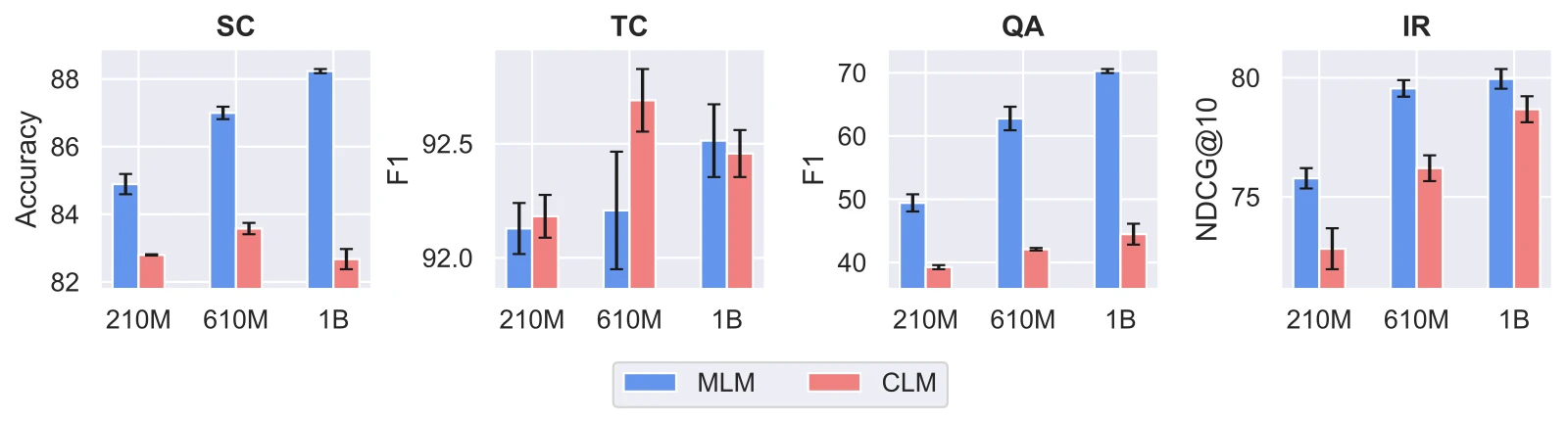
Bidirectional attention during pretraining tends to enhance representation quality on downstream tasks (Figure 2). The performance gap between models trained with MLM and those trained with CLM is especially noticeable on SC and QA tasks, and remains consistent across model sizes. The largest discrepancy is observed on QA, which appears particularly sensitive to the absence of bidirectional attention during pretraining. Interestingly, some task-specific trends emerge: for instance, the MLM-to-CLM gap widens with increasing model size on SC, but narrows on IR.
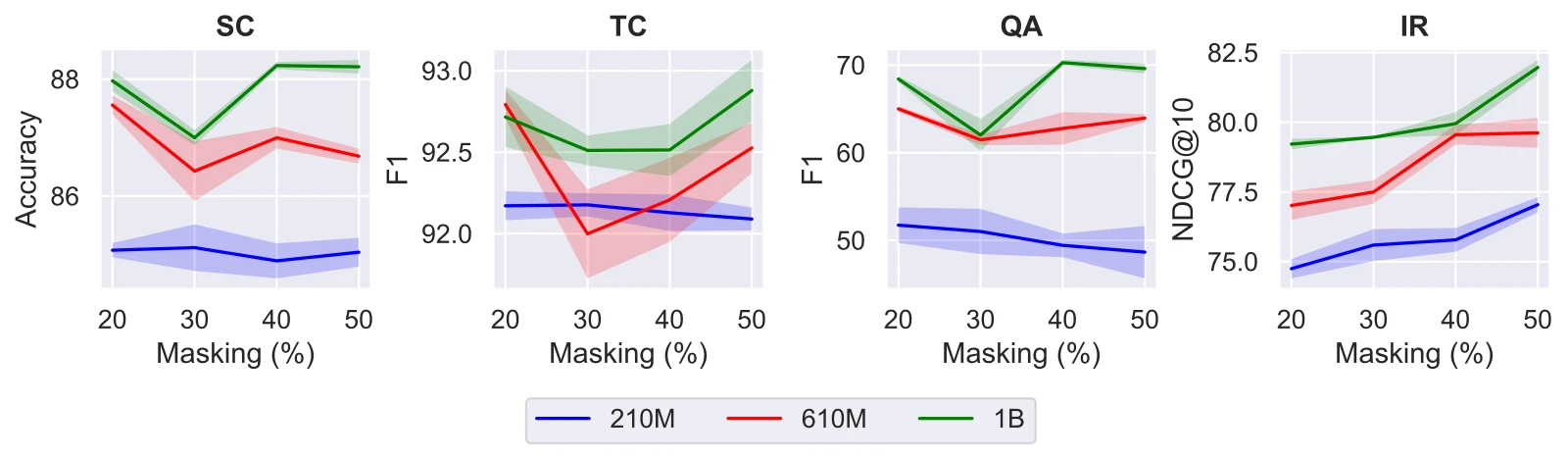
The masking ratio is a key design choice when pretraining models with MLM. As shown in Figure 3, there is no single best ratio, as it depends on both model size and downstream task, making MLM pretraining a delicate balance. Larger models tend to benefit from higher masking ratios, consistent with prior findings from Wettig et al. (2023). Across tasks, IR datasets consistently prefer higher masking ratios regardless of model size. In contrast, for token-level tasks such as TC and QA, smaller models perform better with lower masking ratios. For larger models (610M and 1B), the performance curves exhibit a U-shape, indicating improved performance at both low and high masking ratios. To reduce computational overhead, subsequent experiments report results on 610M models trained with a 40% masking ratio for MLM, which provides a strong overall compromise across tasks.
Interestingly, although CLM-pretrained models typically underperform on SC and QA tasks, they achieve solid results on IR, with the gap to MLM models narrowing as model size increases. On TC, they consistently match MLM models and even outperform them by a substantial margin at the 610M scale (Figure 2). This suggests that causal pretraining can produce strong token-level representations, highlighting its potential despite the absence of bidirectional context.
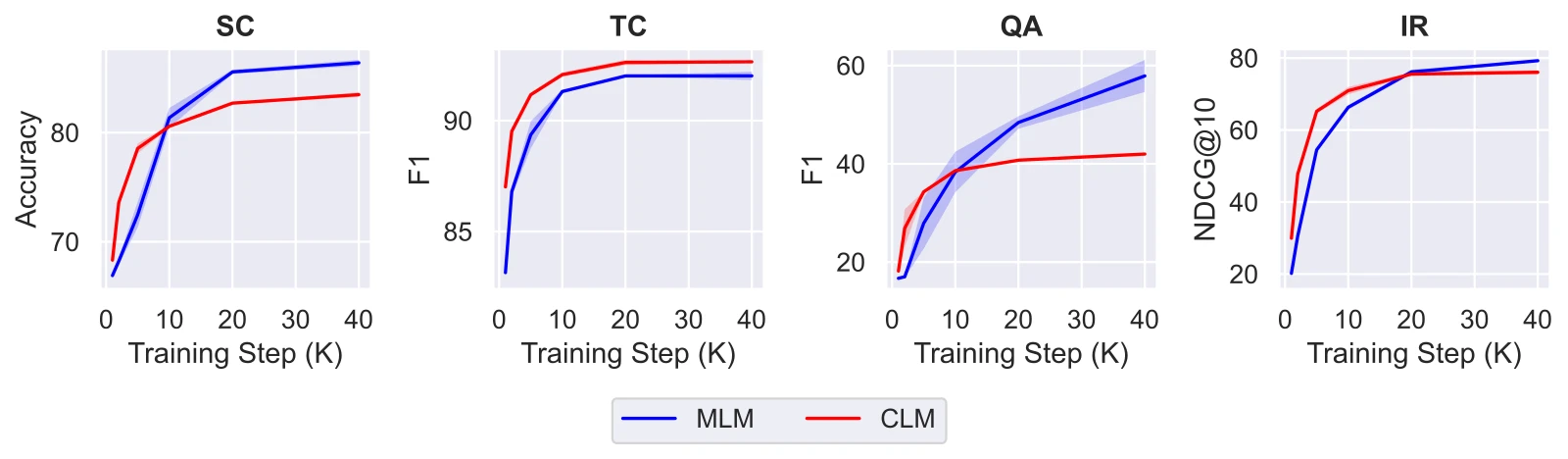
As shown in Figure 4, CLM consistently outperforms MLM in downstream performance during the early stages of training (up to step 10,000 for SC and QA, 20,000 for IR, and even until the end for TC). However, as training progresses, MLM models tend to catch up and often surpass CLM, while CLM shows more limited gains in later steps. This suggests that although CLM saturates earlier, it enables more efficient representation learning in fewer steps. Notably, this makes CLM an appealing option for data-scarce scenarios, such as pretraining on low-resource languages, or simply as a warmup stage before MLM-based encoder training.
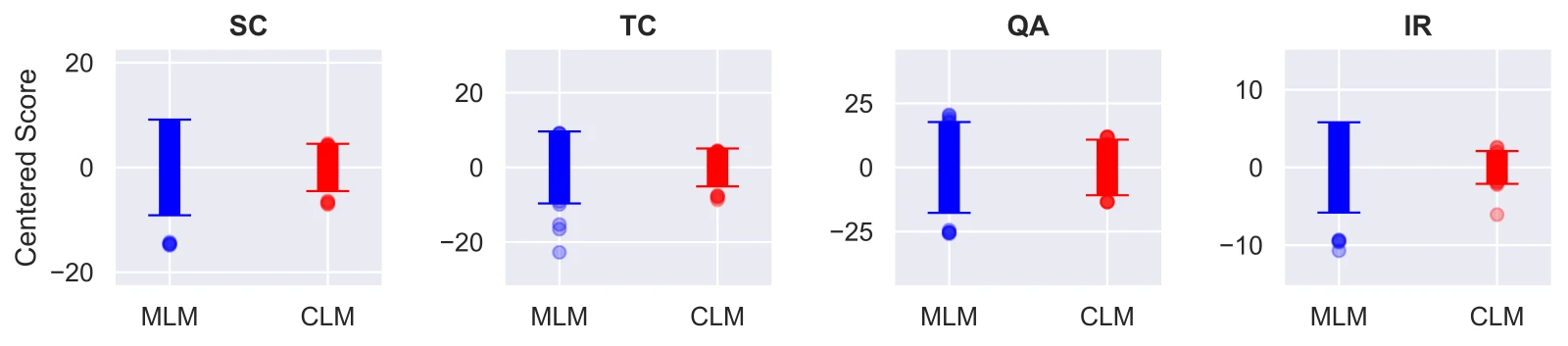
A key challenge in fine-tuning models for text representation tasks is selecting optimal hyperparameters, particularly the learning rate, which can be sensitive to factors like model size, task type, or dataset scale, making exhaustive grid searches computationally expensive. As shown in Figure 5, models pretrained with CLM demonstrate lower sensitivity to learning rate choices than those pretrained with MLM. This indicates that CLM pretraining provides a more stable initialization for fine-tuning, facilitating more reliable performance and reducing the need for extensive hyperparameter tuning.
Two-Stage CLM+MLM Pretraining
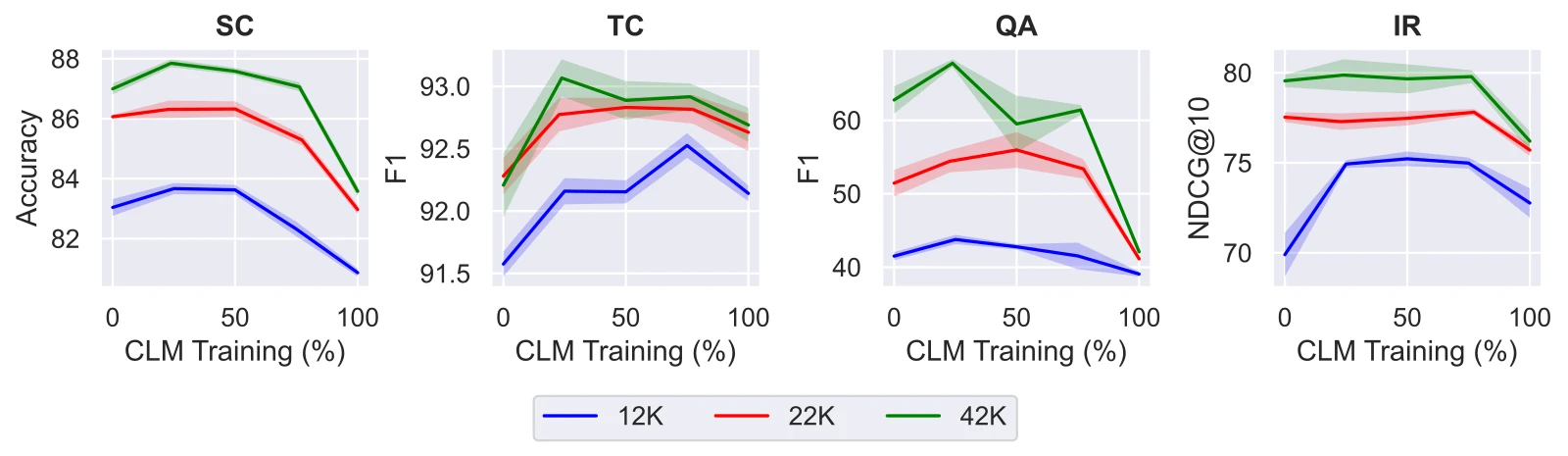
Building on section 3, which highlights clear advantages of CLM over MLM in terms of token-level representation quality, data efficiency, and training stability, we investigate the benefits of applying CLM and MLM sequentially during pretraining. We focus on the PFS setting, where a single learning rate scheduler is used, and evaluate this approach under fixed compute budgets of 12,000, 22,000, and 42,000 training steps, using different splits: 100% CLM, 25%-75%, 50%-50%, 75%-25%, and 100% MLM. To keep computation costs manageable, we focus on the 610M model scale and use a fixed masking ratio of 40%.
As shown in Figure 6, combining CLM and MLM consistently improves downstream performance compared to MLM-only training. In particular, the 25%-75% split reliably surpasses the MLM baseline, while even a 75% CLM allocation maintains comparable results. These findings confirm the benefits of CLM pretraining for learning strong text representations and showcase the synergies it provides when combined sequentially with MLM training.
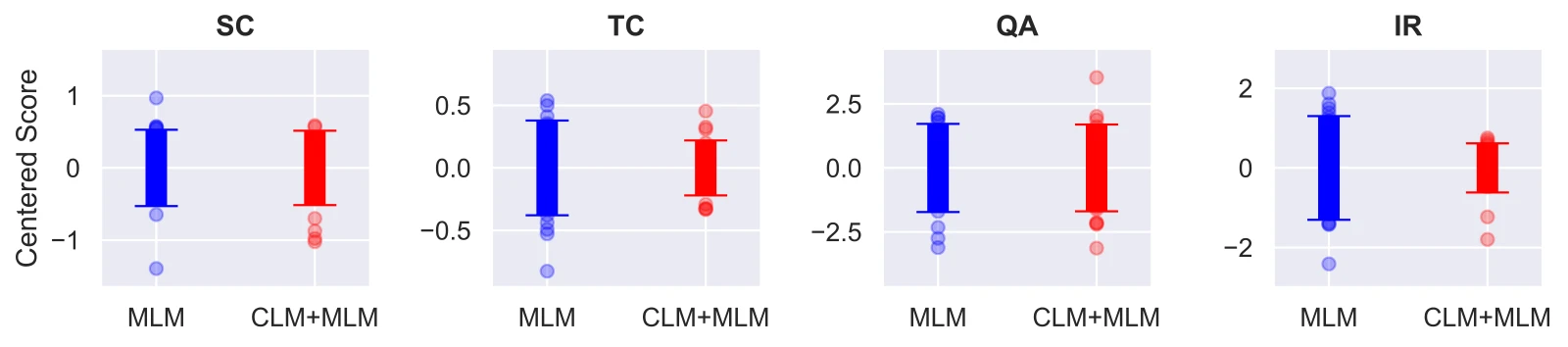
As shown in Figure 7, adapted CLM models show less variation in performance across different masking ratios compared to fully MLM-trained models. Initial CLM pretraining appears to stabilize model performance, making adaptation more robust to masking ratio choices.
Continued Pretraining from CLM and MLM Models
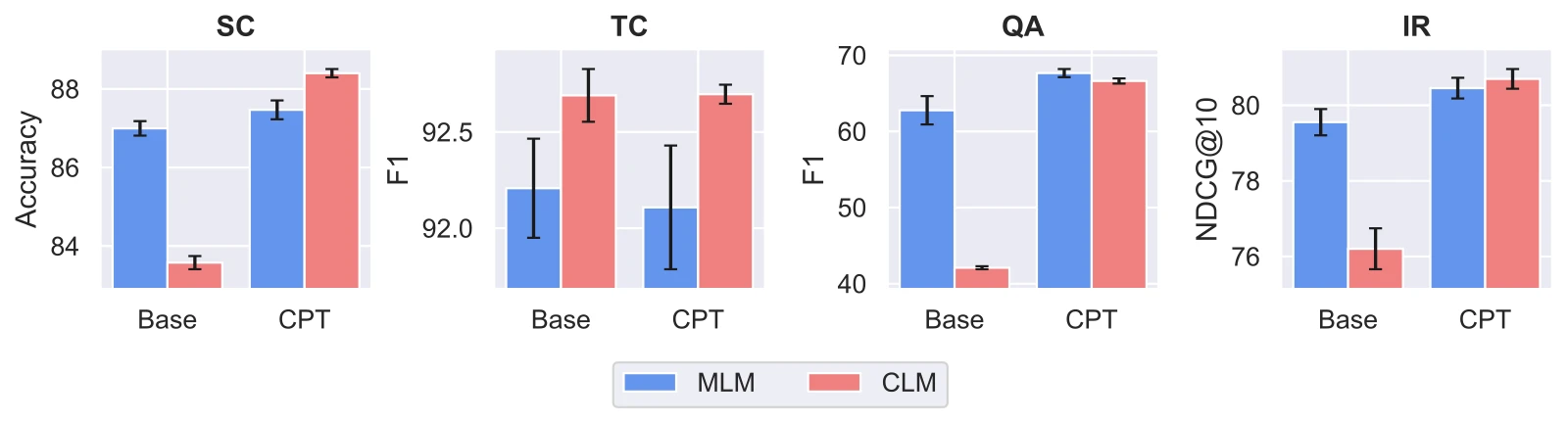
In this section, we focus on the CPT setting, starting from equally sized CLM and MLM models pretrained on the same data (100B tokens in total). The key question is whether it is more beneficial to allocate additional compute to applying MLM CPT to a CLM model or to further train an MLM model. We consider 3 CPT budgets: 2,000, 12,000, and 22,000 steps, and focus on the 610M model scale with a 40% masking ratio to keep computational costs manageable.
As shown in Figure 8, the MLM-adapted CLM model consistently achieves superior downstream performance. On TC, where CLM-only models were already strong, performance is maintained and the gap to MLM remains. For QA and IR, the gap is effectively closed, while for SC, the MLM-adapted CLM model significantly outperforms the MLM-only model.
Interestingly, we observe that it is not necessary to run as many as 22,000 CPT steps to achieve comparable performance between MLM and adapted CLM. As early as 12,000 steps, the results are already strong and broadly match those of MLM-only CPT (Figure 9), with better results on TC and IR, comparable performance on SC, and nearly on par on QA. In terms of trends, applying MLM CPT on a CLM model also appears more promising, showing a steeper improvement curve toward the end, while MLM-only training seems to plateau (particularly noticeable on SC).
Related Work
Learning universal text representations has been a central focus in NLP, with MLM emerging as the dominant pretraining paradigm following the success of models like BERT (Devlin et al., 2019). MLM-based encoders leverage bidirectional attention to capture rich contextual dependencies, enabling strong performance across a wide range of tasks such as classification, question answering, and named entity recognition. Subsequent work has explored architectural extensions (e.g., RoBERTa (Liu et al., 2019), DeBERTa (He et al., 2021), ModernBERT (Warner et al., 2024b)) and more efficient pretraining strategies (Clark et al., 2020). In contrast, decoder-only architectures such as GPT-style models were originally optimized for autoregressive generation (Brown et al., 2020; Grattafiori et al., 2024; Jiang et al., 2023; Almazrouei et al., 2023), making them less naturally suited for text representation tasks.
Nevertheless, numerous studies have successfully explored adapting decoder-only models (typically larger and trained on more data than standard encoders) for learning high-quality text representations (Muennighoff, 2022; Lee et al., 2024; Meng et al., 2024; Zhang et al., 2025; Lee et al., 2025). As a result, these adapted decoders now rank among the top-performing models on prominent embedding benchmarks such as MTEB (Muennighoff et al., 2023; Enevoldsen et al., 2025). However, their strong performance does not disentangle the underlying factors (likely a combination of model scale and data regime) notably leaving open the question of whether causal pretraining itself plays a meaningful role in downstream representation quality.
Several recent studies have investigated the key factors influencing the performance of text representation models. On the MLM-only side, Wettig et al. (2023) explore the impact of the masking ratio on downstream tasks such as sequence classification and question answering, with a focus on learning dynamics, model scale, and fine-tuning behavior. From another perspective, BehnamGhader et al. (2024) propose a general framework for adapting decoder-only models to embedding tasks, along with a series of ablations designed to isolate the primary contributors to performance. Complementary work explores ways to reintroduce bidirectional attention into causal decoder models, such as by repeating sequences (Springer et al., 2024), using custom-shaped attention masks (Raffel et al., 2023), or selectively removing the causal mask on portions of the sequence in a post-training phase (Kopiczko et al., 2024; Beyer et al., 2024). Articles most closely related to ours propose controlled setups for comparing CLM, MLM, and hybrid strategies, but have either focused on very small amounts of pretraining data (Charpentier and Samuel, 2024), or prioritized other design parameters. For example, Weller et al. (2025) train on very large data regimes (2T tokens), analyze MLM-then-CLM learning curricula, and evaluate on generative benchmarks, providing practical insights into the impact of training design on downstream performance. However, their approach does not support extensive evaluation on encoder-specific tasks and limits exploration of additional training design choices, such as masking ratio or the CLM-MLM share in pretraining. Building on these efforts, we provide a comprehensive analysis of how the choice of learning objective and attention mask during training affects downstream representation quality. By employing a unified and controlled pretraining setup and evaluating across a broad range of representation tasks with statistically grounded results, we ensure fair comparisons and reduce confounding factors, enabling more precise attribution of observed effects.
Conclusion
Our study challenges the long-standing assumption that Masked Language Modeling (MLM) is the universally optimal approach for encoder pretraining. Through large-scale experiments at the 100B training token scale, we provide robust empirical evidence that encoders can be trained more data-efficiently without relying solely on MLM. In particular, we demonstrate that decoder-only models trained with Causal Language Modeling (CLM) offer clear advantages in data efficiency, training stability, and performance on specific text representation tasks. Moreover, we show that sequential training (first with CLM followed by MLM) is more effective than MLM alone. These results suggest that the most effective path to high-performing encoder models may involve leveraging pretrained decoder models and continuing with MLM-based training, paving the way for future state-of-the-art encoders at a discounted price. We hope our findings and released resources will support further advancements in this area.
Limitations and Future Work
Our study deliberately focuses on a targeted set of parameters, namely learning objective, model size, training setup, data budget, and masking ratio. As in large-scale studies such as (Kaplan et al., 2020; Hoffmann et al., 2022), this required fixing several other parameters, including the model architecture, tokenizer, language, and training mixture. While these factors are certainly of interest, varying them would introduce significant computational overhead, making them difficult to incorporate into our current scope. We therefore view them as a promising direction for future work, including extensions to multilingual settings or to additional modalities such as vision-language.
Additionally, although we provide insights into scaling behaviors with respect to both model size and data budget, we constrained these dimensions to 1B parameters and 100B training tokens. This allowed us to keep compute costs manageable while still exploring a broad range of design parameters. While 100B tokens correspond to roughly five times the compute-optimal budget suggested by Hoffmann et al. (2022) for 1B-parameter decoder models, and most pre-trained encoders in the literature remain below the 1B scale (Devlin et al., 2019; Liu et al., 2019; He et al., 2021; Warner et al., 2024a), we still view pushing beyond these limits as an important direction for future work, as many top entries in the MTEB benchmark (Muennighoff et al., 2023; Enevoldsen et al., 2025) frequently exceed the 1B-parameter range (Zhang et al., 2025; Babakhin et al., 2025). Exploring more sophisticated training curricula also appears promising for improving downstream performance, for instance, alternating CLM and MLM objectives multiple times throughout pretraining.
In a similar spirit, our study focuses on the extensive evaluation of pre-trained models and deliberately does not include contrastive post-training for zero-shot retrieval. Applying such post-training across a large number of training configurations would have incurred substantial computational costs and could have introduced additional confounding factors that require careful control (Xiong et al., 2020; Qu et al., 2021; Wang et al., 2022; Mohr et al., 2024; Chen et al., 2024; Sturua et al., 2024). While this lies outside the scope of the present work, exploring contrastive post-training would be a valuable way to complement and extend our findings.
Finally, several observations emerged throughout the paper that appear intriguing but fall outside the current scope of our study. Future work could, for example, further investigate the relationship between masking ratio and downstream performance across tasks. This includes providing deeper insights into patterns such as the U-shaped curve observed in Figure 3 for TC on the 610M and 1B models, in contrast with the monotonic trend observed for IR. More broadly, gaining a deeper understanding of how pretraining learning objectives transfer to different downstream tasks remains an interesting yet largely unexplored direction with substantial promise.
Reproducibility Statement
We have made every effort to ensure that our experiments are reproducible. All pretraining and evaluation experiments are described in detail in the paper, including model architectures, training objectives, data sources, and hyperparameter settings. To facilitate replication, we release all project artifacts, including pretrained models, training scripts, and evaluation code.
Next step
A problem worth researching?
Tell us what you are trying to solve, and we will put you in touch with the people who work on it.