Is Preference Alignment Always the Best Option to Enhance LLM-Based Translation? An Empirical Analysis
- Authors
- Hippolyte Gisserot-Boukhlef
- Ricardo Rei
- Emmanuel Malherbe
- Céline Hudelot
- Pierre Colombo
- Nuno M Guerreiro
- Affiliations
- Artefact Research Center
- Unbabel
- Equall
- MICS, CentraleSupélec, Université Paris-Saclay
- Instituto de Telecomunicações
- Instituto Superior Técnico & Universidade de Lisboa (Lisbon ELLIS Unit)
- Accepted at
- WMT 2024
- Date
- arXiv
- 2409.20059
Abstract
Neural metrics for machine translation (MT) evaluation have become increasingly prominent due to their superior correlation with human judgments compared to traditional lexical metrics. Researchers have therefore utilized neural metrics through quality-informed decoding strategies, achieving better results than likelihood-based methods. With the rise of Large Language Models (LLMs), preference-based alignment techniques have gained attention for their potential to enhance translation quality by optimizing model weights directly on preferences induced by quality estimators. This study focuses on Contrastive Preference Optimization (CPO) and conducts extensive experiments to evaluate the impact of preference-based alignment on translation quality. Our findings indicate that while CPO consistently outperforms Supervised Fine-Tuning (SFT) on high-quality data with regard to the alignment metric, it may lead to instability across downstream evaluation metrics, particularly between neural and lexical ones. Additionally, we demonstrate that relying solely on the base model for generating candidate translations achieves performance comparable to using multiple external systems, while ensuring better consistency across downstream metrics.
Cite this paper
@inproceedings{gisserotboukhlef2024preference,
  title = {Is Preference Alignment Always the Best Option to Enhance LLM-Based Translation? An Empirical Analysis},
  author = {Hippolyte Gisserot-Boukhlef and Ricardo Rei and Emmanuel Malherbe and Céline Hudelot and Pierre Colombo and Nuno M Guerreiro},
  booktitle = {Conference on Machine Translation (WMT 2024)},
  year = {2024},
  doi = {10.18653/v1/2024.wmt-1.127},
  url = {https://doi.org/10.18653/v1/2024.wmt-1.127}
}Copied
Introduction
Neural metrics for machine translation evaluation that are trained to mimic human preferences, such as BLEURT Sellam et al. (2020), COMET Rei et al. (2020); Rei et al. (2022a), or Metric-X Juraska et al. (2023), have become increasingly prevalent. These metrics offer greater accuracy and better reflect human judgments compared to traditional lexical metrics Mathur et al. (2020); Kocmi et al. (2021); Freitag et al. (2022b); Kocmi et al. (2024) like BLEU Papineni et al. (2002), METEOR Banerjee and Lavie (2005) or chrF Popović (2015), which mainly consider lexical overlap with a reference text. As such, researchers have attempted to leverage these improvements by integrating them directly into translation systems.
One appealing strategy to incorporate quality information to improve downstream translation performance involves using decoding strategies such as N-Best reranking and Minimum Bayes Risk (MBR) decoding Kumar and Byrne (2002); Kumar and Byrne (2004); Eikema and Aziz (2020); Fernandes et al. (2022); Freitag et al. (2022a). These techniques rely on generating multiple candidates to maximize a given quality metric at inference time, and research has shown that they consistently yield better results than likelihood-based decoding techniques Eikema and Aziz (2020); Koehn and Knowles (2017); Ott et al. (2018).
With the rise of decoder-only LLMs in MT, quality-informed fine-tuning techniques have gained significant attention. Unlike decoding-based methods that inject quality information at inference time, fine-tuning modifies model weights using training sets induced with quality information. These approaches include filtering parallel training data based on a quality metric Alves et al. (2024), distilling gains from more expensive quality-aware methods such as MBR Finkelstein et al. (2024), or employing preference-based alignment techniques Rafailov et al. (2024); Xu et al. (2024a), where the model learns preferences induced by quality metrics between candidate translations typically generated by multiple systems. In this work, we focus specifically on the latter.
Alignment techniques represent a paradigm shift from quality-aware inference time approaches, as they optimize the metric of interest indirectly. Understanding the impact of these approaches on translation quality is thus a relevant problem. While some studies have examined quality-informed decoding techniques and their influence on translation output Amrhein and Sennrich (2022), there is still a gap in our understanding of how preference-based fine-tuning affects translation quality.
In this work, we aim to bridge this gap by examining the properties of preference-based alignment techniques, with a particular focus on Contrastive Preference Optimization (CPO) Xu et al. (2024a), which has been used successfully to achieve very competitive translation performance. Our analysis seeks to describe the effects of preference-based fine-tuning on downstream performance, specifically regarding alignment effectiveness, the interactions between optimized and non-optimized metrics, and the impact of using multiple candidate translation systems for generating preference data. Through extensive experimentation, we find that:
Preference-based alignment globally outperforms Supervised Fine-Tuning (SFT) on high-quality data in terms of maximizing the alignment metric.
However, preference-based alignment is highly sensitive to the choice of candidate systems used for generating preference data, affecting both the alignment metric and downstream metric consistency.
Aligning a model using its own translations achieves performance comparable to employing multiple external systems, while ensuring better metric consistency and allowing for improved control over the alignment process.
Background
Quality-Informed Translation
Along with human evaluation, lexical metrics like BLEU Papineni et al. (2002), chrF Popović (2015), METEOR Banerjee and Lavie (2005), and ROUGE Lin (2004) have long been used for translation evaluation. However, human evaluation is costly, and lexical metrics have been shown to correlate poorly with human judgements.
More recently, some neural metrics have emerged as a preferred method to mimic human preferences without relying on expensive human evaluation. The intuitive approach involves training an encoder model on human-annotated source-translation-reference triplets. Among the metrics most frequently mentioned in the literature are BLEURT Yan et al. (2023), COMET Rei et al. (2020), CometKiwi Rei et al. (2022b), xCOMET Guerreiro et al. (2023), and Metric-X Juraska et al. (2023). They can be divided into two families: reference-based metrics, that include a human-written gold reference as an input to the scoring model, and reference-free metrics, which only require access to the source sentence and the generated translation. These neural metrics have proven particularly effective at scoring translations and achieve much higher correlation with human judgments than their lexical counterparts Mathur et al. (2020); Kocmi et al. (2021); Freitag et al. (2022b); Kocmi et al. (2024).
These neural metrics have also been leveraged to improve translation models through decoding strategies. The approach involves sampling various candidate translations, scoring them according to a given metric, and selecting the one with the highest score. This methodology is exemplified by MBR decoding in the reference-based setting and N-best reranking in the reference-free setting Fernandes et al. (2022); Freitag et al. (2022a).
Quality-Based Fine-Tuning
With the recent rise of decoder-only LLMs applied to translation tasks Zhu et al. (2023); Jiao et al. (2023); Hendy et al. (2023); Kocmi et al. (2023); Freitag et al. (2023); Xu et al. (2023); Alves et al. (2023); Xu et al. (2024a); Alves et al. (2024), and with automatic metrics increasingly reflecting human judgments Sellam et al. (2020); Rei et al. (2020); Juraska et al. (2023), quality-based fine-tuning has gained considerable traction. This approach shifts the objective from selecting the best candidate translation according to a metric at inference time to directly updating model weights through fine-tuning to produce the desired translations. A straightforward approach is to perform SFT on high-quality translations, evaluated and then filtered with respect to a metric of interest Alves et al. (2024).
Another attractive alternative is Preference Optimization (PO) Simianer (2018); Rafailov et al. (2024); Xu et al. (2024a); Yang et al. (2023); Xu et al. (2024b); Wu et al. (2024), which focuses on learning preferences between chosen and rejected translations rather than simply increasing the likelihood of high-quality sentences. A popular PO method is Direct Preference Optimization (DPO) Rafailov et al. (2024), which aims to maximize a scaled likelihood gap between a chosen and a rejected option. More recently, CPO Xu et al. (2024a) has emerged as a promising alternative, incorporating an SFT term into the DPO loss, effectively combining the strengths of both methods. Moreover, by removing the reference policy from the learning objective, it improves training efficiency.
Experimental Setup
Here, we detail our experimental setup, explaining how we built the preference data, and train and evaluate the models.
Preference Data
To build a preference dataset, one needs candidate translations, an evaluation metric to score these translations, and a method to select chosen and rejected hypotheses. We denote a candidate dataset by
where denotes the source sentence and is a set of candidate translations. One can then derive a preference dataset,
where (chosen hypothesis) is a translation preferred to (rejected hypothesis) according to a metric and a given selection method.
In the multi-system scenario, we follow the setting outlined by Xu et al. (2024a). Candidate translations are generated using three different systems, namely ALMA-13B-LoRA (the base model we aim to align, referred to as Base) Xu et al. (2023), GPT-4 OpenAI (2023), and the human-written gold reference (referred to as Ref). Formally, for all data samples,
Then, for each sample, the three translations are evaluated with regard to . The one with highest (resp. lowest) score is selected as the chosen (resp. rejected) hypothesis. Formally,
In the mono-system setting, we solely rely on the base model for candidate generation. For each source sentence, candidates are top- -sampled with a temperature , and are then ranked based on evaluation metric . For all samples, this results in a set of candidates
where are sorted in increasing quality order, with no loss of generality. Preference pairs are then derived to ensure that holds for all samples. Further details on the construction of mono-system preference datasets are given in Section 5 and Appendix B.1.
We rely on the FLORES-200-based Team et al. (2022) dataset used in Xu et al. (2024a) as a primary data source. It includes over translation pairs spanning six languages (English (en), Czech (cs), German (de), Icelandic (is), Russian (ru), and Chinese (zh)) and covering ten language directions, either into-English (xx-en) or out-of-English (en-xx).
In line with Xu et al. (2024a), we rely on reference-free neural metrics, namely xCOMET-QE-XXL Guerreiro et al. (2023) (referred to as xCOMET-QE), and the WMT’23 version of CometKiwi-XXL Rei et al. (2023) (denoted by CometKiwi), as well as on a reference-based lexical metric, chrF Popović (2015).
Training
Learning objective. We focus our diagnosis on CPO Xu et al. (2024a), which combines a preference term with a likelihood term and achieves state-of-the-art performance in preference-based metric alignment for translation tasks. The empirical loss function is formally expressed as:
where is the negative-log-likelihood loss applied to chosen translations, is the model to fine-tune, is the sigmoid function and is a hyperparameter. In our experiments, CPO alignment is consistently compared to vanilla SFT on chosen translations.
We replicate the exact same parameters as the ones outlined by Xu et al. (2024a). ALMA-13B-LoRA is LoRA fine-tuned with rank for one epoch, starting with a learning rate of , using inverse square root decay and a batch size of . The parameter of the CPO objective function is set equal to , in line with the original DPO paper by Rafailov et al. (2024).
Evaluation
Following other works on LLM-based translation Alves et al. (2024); Briakou et al. (2024), all generations at inference time are produced using greedy decoding, as it provides maximum computational efficiency while preserving high output quality.
We evaluate our approaches on the WMT’22 test dataset, which consists of source-reference pairs and includes the same ten language pairs as the preference data. Evaluations on WMT’23 test data are provided in Appendix A.
We use the same three metrics used to create the preference datasets: xCOMET-QE, CometKiwi, and chrF. Additional evaluation metrics are reported in Appendix A, specifically the reference-based version of Metric-X-Large (referred to as Metric-X) Juraska et al. (2023), and BLEU Papineni et al. (2002).
Multi-System Preference Fine-Tuning
We begin our analysis by focusing on the multi-system setting Xu et al. (2024a), in which the chosen and rejected options are derived from a pool of three candidate systems consisting of ALMA-13B-LoRA (base model), GPT-4, and the gold reference.
Top-Level Analysis
Table 1 shows that when aligning with neural metrics (xCOMET-QE or CometKiwi), both SFT on preferred translations and CPO consistently improve performance on the alignment metric across language pairs. We also observe that aligning on xCOMET-QE improves results on CometKiwi, and vice-versa. We hypothesize this may be the result of high correlation between different neural metrics, as they are typically trained on similar data. Overall, these results demonstrate that alignment-based techniques can achieve similar objectives to those of quality-aware decoding approaches like MBR, even though the target metric is only indirectly optimized.
In Table 1, we observe that when aligning with neural metrics, CPO yields significantly greater improvements on the alignment metric compared to SFT. The inclusion of the reject option seems to offer additional benefits over the traditional SFT objective in this context. However, aligning with CPO also introduces adverse effects between neural and lexical metrics for out-of-English translations. More specifically, and consistent with the findings of Xu et al. (2024a), aligning on neural metrics negatively impacts lexical metrics. Importantly, this is further evidence to support recommendations provided in Kocmi et al. (2024): even though, in most cases, neural and lexical MT evaluation metrics should be positively correlated, we should employ caution when using the same metric for evaluation that was used during training/inference. Nevertheless and perhaps more interestingly, it turns out SFT does not produce such effects, raising the question of whether these contradictory evaluation dynamics seen with CPO stem from the learning objective itself or the mix of candidate systems used.
Table 1 shows that preference-based lexical alignment behaves differently compared to neural alignment. Specifically, SFT results are roughly stagnant, showing a slight decrease in chrF for into-English translations and a slight increase for out-of-English translations. In contrast, CPO results in a steep drop across the metric board for both into- and out-of-English translations. Using the gold reference as the chosen system appears to impair downstream performance, especially when performing alignment using CPO.
Impact of the Candidate Systems
We now turn to investigating how much the success of alignment-based fine-tuning depends on the choice of the candidate systems. Unless otherwise specified, we use xCOMET-QE as the alignment metric and examine the performance impact of withdrawing systems from the candidate pool. We perform SFT and CPO on the newly created datasets. We report results in Table 2.
Table 2 shows that for both SFT- and CPO-based methods, removing systems from the pool of candidates significantly affects performance on the alignment metric. This is particularly the case for out-of-English translation with CPO optimization. Notably, removing GPT-4 has the strongest negative impact on downstream xCOMET-QE. This is expected as it is the highest-quality system among the system candidates (see Table 11 in Appendix B).
In Section 4.1, we observed CPO negatively impacts en-xx chrF when aligning on neural metrics, unlike SFT on preferred translations. Table 2 suggests this may stem from including gold references in the candidate system pool: removing them eliminates this adverse effect. We also noted in Section 4.1 that lexical alignment fails to improve downstream chrF, with sharp decreases with CPO. This issue is resolved by removing gold references. Overall, candidate system choice affects alignment effectiveness and downstream metric consistency, with CPO showing higher sensitivity to preference settings than SFT.
Impact of the Chosen System
To complement findings from Section 4.2 and further characterize the sensitivity of preference-based alignment, we propose examining downstream performance when the chosen system is fixed to a single system. We create three preference datasets based on xCOMET-QE, in which we either impose the base model, reference or GPT-4 as the chosen system. When applicable, the rejected translation is selected from the remaining systems (if one has a lower xCOMET-QE than the chosen system); otherwise, the sample is discarded.
In contrast to the observations made in Section 4.1, Table 3 shows that, under this setup, CPO fails to outperform SFT for both xx-en and en-xx translations. When systematically choosing base translations, CPO is unable to surpass the trivial SFT setting where the base model is fine-tuned on its own translations. Moreove, downstream CPO performance significantly declines when gold references are chosen, underperforming the non-aligned model across all metrics, even including the alignment metric. These results reinforce the claims made in Section 4.2 and indicate a lack of robustness of CPO compared to SFT. In the following section (Section 5), we demonstrate that this instability observed with CPO can be mitigated by using a more normalized preference setting, relying only on the base model for candidate generation.
Mono-System Preference Fine-Tuning
So far, we have exclusively focused on multi-system alignment, which involves using external models for candidate generation and preference dataset building. Although this approach is common for metric alignment Luong and Manning (2015); Sennrich et al. (2016); Xu et al. (2024a), some works have shown that a model can be aligned effectively using only its own outputs Yang et al. (2023); Yuan et al. (2024); Dubey et al. (2024). In this section, we propose to take a closer look at this strategy and identify its potential advantages and disadvantages compared to the multi-system approach. We use xCOMET-QE as the alignment metric. To ensure a fair comparison, we first generate the mono-system dataset to approximately replicate the properties of the multi-system dataset regarding the alignment metric. Details on the construction of mono-system preference datasets are given in Section 3 and Appendix B.1.
Comparison With Multi-System Alignment
Table 4 shows that performing SFT and CPO on a mono-system dataset using xCOMET-QE for alignment results in improved downstream performance across all neural metrics compared to the base model, as observed in the multi-system scenario (Section 4.1). This finding highlights the effectiveness of alignment techniques even when using only the model’s own translations for candidate generation, without needing access to high-quality external systems. This is particularly relevant in practical scenarios in which such access may be limited or unavailable.
Similar to when relying on multiple systems for candidate generation, we observe in Table 4 that CPO outperforms SFT regarding downstream performance on neural metrics. This finding reinforces the observation made in Section 4.1 and tends to confirm the superiority of the CPO objective over SFT on preferred translations in optimizing neural-based alignment performance.
Table 4 shows that while mono-system alignment increases downstream performance on neural metrics, the improvement levels are not as high as in the multi-system setting. Despite the mono- and multi-system preference datasets being built with the same alignment metric properties, having translations from different distributions, particularly from GPT-4 (cf. Section 4.2 and Table 2), appears to add value for achieving optimized alignment effectiveness.
In Section 4.1, we showed that multi-system neural alignment using CPO greatly impacts lexical performance for out-of-English translations. Table 4 demonstrates that mono-system alignment almost completely mitigates these negative effects. While there is still a slight decrease in en-xx chrF, it is much smaller compared to the multi-system scenario. This confirms the findings from Sections 4.2 and 4.3 that CPO is sensitive to the preference setting, but also shows that relying solely on candidate translations from the base model limits adverse effects on downstream metric consistency. A possible explanation is that candidate translations from the same system distribution tend to have similar properties, thereby reducing the likelihood of observing high lexical instability when performing alignment based on a neural metric like xCOMET-QE.
Specifically, mono-system alignment provides more fine-grained control over the respective qualities of the chosen and rejected options. This setting allows for tuning these qualities to maximize post-alignment performance, which is not possible when using a limited number of external systems. This aspect is further explored in the following section (Section 5.2).
Optimizing the Preference Data
In this final experiment, we examine how the quality of chosen and rejected options affects downstream performance. We build nine preference datasets, each with varying average xCOMET-QE scores for chosen and rejected options. The hypotheses’ average qualities are categorized into three groups: High, Mid, and Low. As detailed in Section 3.1, the quality of the chosen (resp. rejected) option is always ensured to be above (resp. below) the quality of the base translation. The statistics of the created datasets are summarized in Appendix B.1 (Table 11).
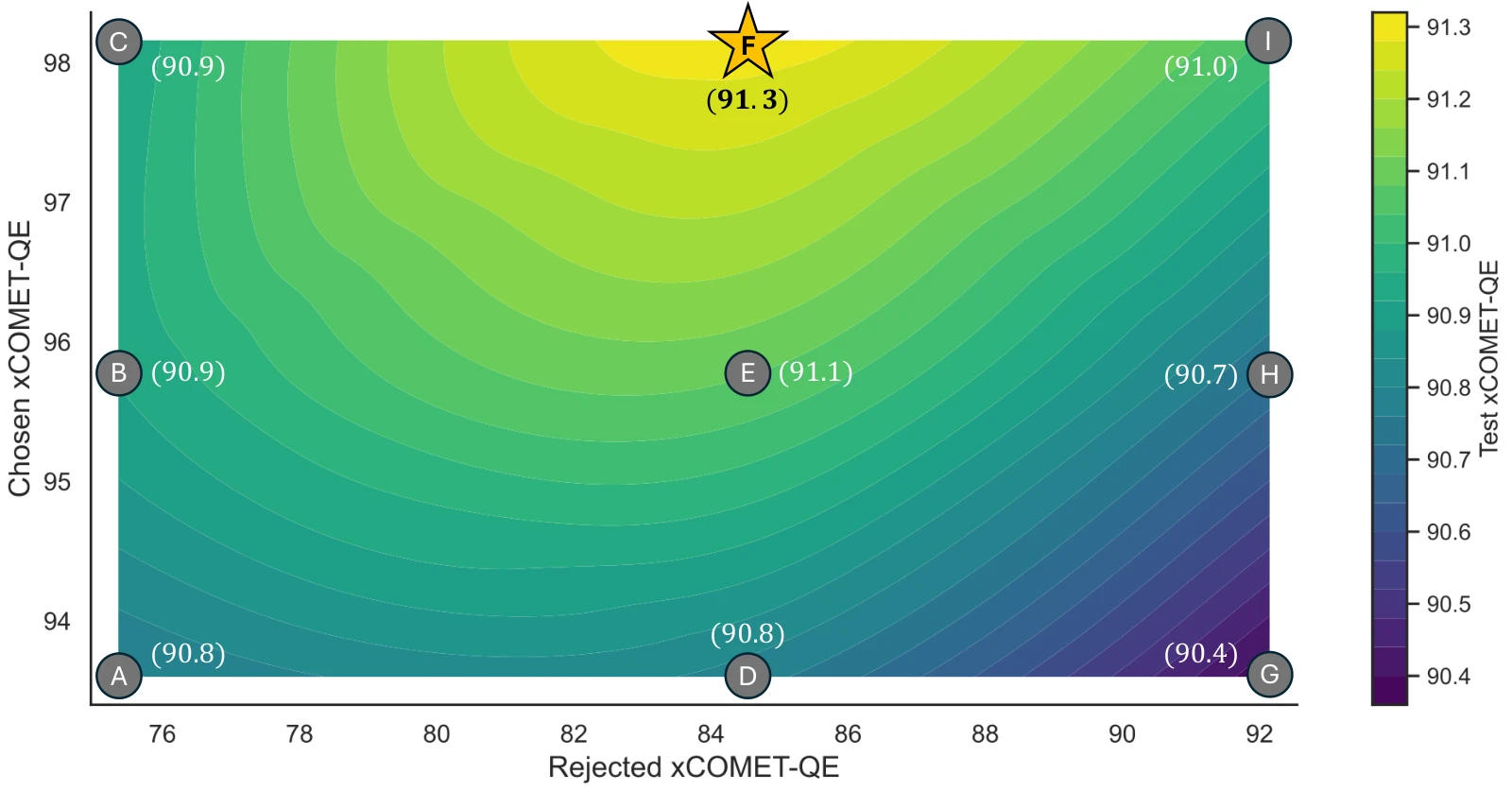
Figure 1 highlights the need to closely monitor the qualities of chosen and rejected options to fully leverage the mono-system approach. Specifically, several properties of preference data were found to negatively impact post-CPO performance: (i) a chosen option of too low quality, (ii) an extremely low or high quality of the rejected option, and (iii) too wide a gap between the qualities of the rejected and chosen options.
Figure 1 shows that for effective metric alignment with CPO, the rejected option’s quality should be moderate (neither too high nor too low), while the chosen option’s quality should be as high as possible. Specifically, optimal test performance was obtained with rejected options average around 90% () of the base model’s quality, and chosen options averaging around 105% (). Under this scenario, we show that performance levels can match those in the multi-system setting while maintaining consistency with lexical scores (Table 4). However, these results also highlight the complexity of achieving optimal preference-based alignment and get the most of the reject option.
Conclusion
Our experiments revealed several key findings. Firstly, we showed that preference-based alignment, specifically using CPO, globally outperforms SFT on high-quality data in terms of improving neural evaluation metrics. However, we identified significant drawbacks when relying on multiple systems for preference data generation, revealing adverse effects between neural and lexical metrics, and highlighting a lack of robustness in preference-based alignment compared to the SFT approach. Finally, we showed that using candidate translations all originating from the same system distribution, specifically the base model, can be an effective strategy for gaining more control over preference-based fine-tuning. This approach achieves performance comparable to using multiple external systems while ensuring better consistency across evaluation metrics. In a nutshell, while preference-based alignment techniques hold promise for improving MT quality, careful consideration must be given to the choice of candidate translations, the learning objective, and the potential trade-offs regarding downstream metric consistency.
Limitations
In this work, we conducted extensive experiments to assess the impact of preference-based fine-tuning on downstream translation quality. For efficiency and practicality, we focused on the experimental setup detailed by Xu et al. (2024a), which utilizes three systems for candidate generation. Similarly, we used the same evaluation metrics and datasets. Future experiments could benefit from validating our findings using different model families, a broader range of alignment and evaluation metrics, and additional translation datasets, for instance including other languages.
Additionally, in the mono-system setting, we explored the impact of varying the qualities of chosen and rejected options and derived general insights on optimizing preference data. Further research could involve using different datasets, models, and alignment metrics to characterize more precisely the factors that influence downstream performance in this specific scenario. This approach could lead to a deeper mathematical understanding of the elements that affect performance in preference-based fine-tuning, resulting in more robust and scalable optimization techniques.
Finally, our evaluation relied on automatic metrics, both lexical and neural, with the latter closely approximating human judgments but still being unable to fully replace them. Given their imperfect correlation with human preferences, future work could benefit from additional human evaluation of outputs obtained via the approaches we studied to get an even deeper understanding of post-alignment downstream performance dynamics.
Next step
A problem worth researching?
Tell us what you are trying to solve, and we will put you in touch with the people who work on it.