
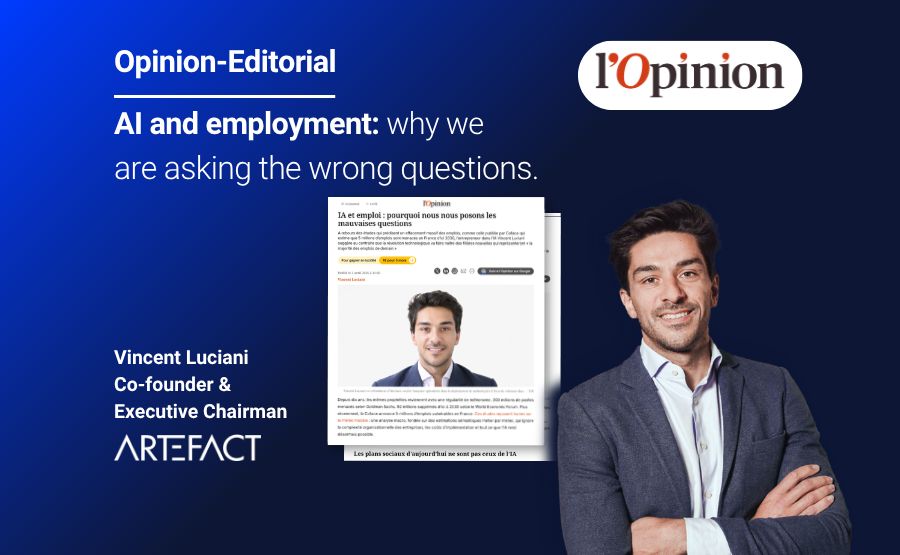
Contrary to the dire studies predicting a massive erasure of the workforce, such as the recent Coface report estimating 5 million French jobs are at risk by 2030, AI entrepreneur Vincent Luciani argues that this technological revolution will instead birth entirely new sectors. These industries, he suggests, will soon represent “the vast majority of tomorrow’s jobs.”
Every ten years, the same prophecies return with metronomic regularity. Goldman Sachs warns of 300 million roles at risk. The World Economic Forum predicts 92 million cuts by 2030. Most recently, Coface flagged 5 million vulnerable positions in France. These studies all share a common flaw: they rely on a macro-analysis of job titles and semantic tasks that ignores the sheer complexity of corporate organization, implementation costs, and, crucially, everything that AI now makes possible.
Today’s Layoffs Are Not “AI Layoffs”
Let’s look at the reality on the ground. Europe is currently caught in a pincer movement: stagnant growth, flagging demand, and Chinese competition hollowing out entire industrial sectors. When Volkswagen closes German plants for the first time in its history, it is because China has moved up the value chain. When Société Générale announces 1,800 job cuts, it is because physical branch visits have plummeted. In neither case did an algorithm replace a human being.
Slapping the “Artificial Intelligence” label on every restructuring is a convenient shorthand that suits Silicon Valley’s narrative, but it is fundamentally misleading. The reality is more prosaic: Europe has a competitiveness problem. AI is not the cause; it is the best possible cure.
Lessons from the Power Grid
When electricity arrived at the end of the 19th century, the consensus focused on the automation of mechanical labor. No one saw what was coming next: mass refrigeration, which birthed international logistics and modern agribusiness. We didn’t foresee radio, television, or the entire media industry. We missed the dawn of electrochemistry, aluminum, synthetic fertilizers, and batteries. We missed household appliances, electric transport, and telecommunications.
Dozens of industries and hundreds of millions of jobs were born from a single disruptive innovation. AI is the electricity of the 21st century. Right now, we are still at the stage where we are just counting the streetlights.
The Era of “Startup as a Service”
The studies counting threatened roles within existing companies are looking in the wrong direction. What no one has yet fully grasped is AI’s incredible capacity for scale.
Asymptotically, the cost of any process is trending toward zero. The cost and time required to incorporate a company, file a trademark, launch a site, or solicit customers will become negligible. Driven by AI agents, every process can scale without the organizational layers that historically bottleneck growth. A 100-person company, amplified by its agents, will be able to rival a conglomerate of tens of thousands. Fintechs like Qonto, Alan, and Revolut are already proving the concept. The real disruption won’t come from inside existing firms. It will come from new domestic and international competitors, who, armed with AI agents, will seize the market share of established incumbents.
The Great Value Shift
The real question is: “How do we rebuild an entire economy with AI to be radically more competitive, produce more wealth, and create the jobs of tomorrow?”
What we currently consider “high-value” tasks analyzing data, writing code, summarizing information will become commodities. Every business process must be reimagined from the ground up. This is a colossal undertaking that, ironically, requires a massive influx of human labor, brains, and expertise.
Most importantly, we must imagine the industries of the future. Just as electricity gave us modern transport and media, AI will birth new sectors: industrial robotics, personalized education, and preventive health a field where demand is, by its nature, infinite. These industries will represent the majority of tomorrow’s employment. Every major technological revolution has ended by producing far more jobs than it destroyed. This one will be no exception provided we focus on inventing the economy of tomorrow rather than desperately defending the one of yesterday. That is where growth and employment truly live.
By Vincent Luciani, Co-Founder & Executive Chairman of Artefact