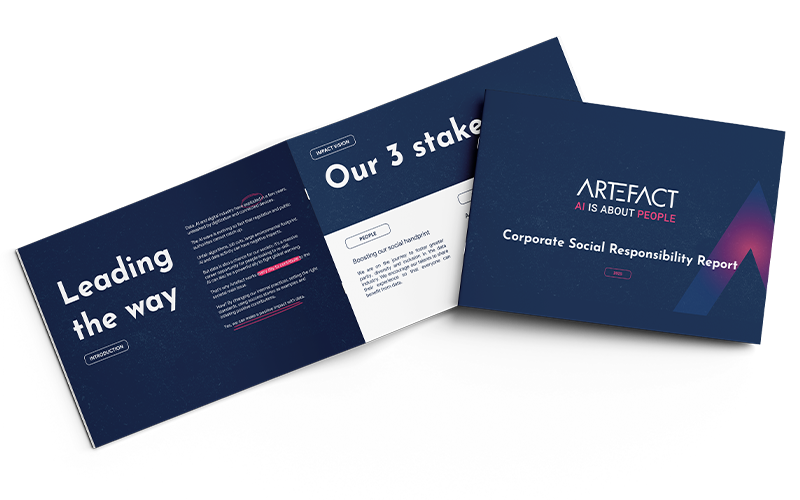
Artefact Corporate Social Responsibility
Through its CSR strategy, Artefact is committed to addressing the social and environmental challenges of its sector by engaging its employees and its clients.

Artefact’s internal CSR strategy


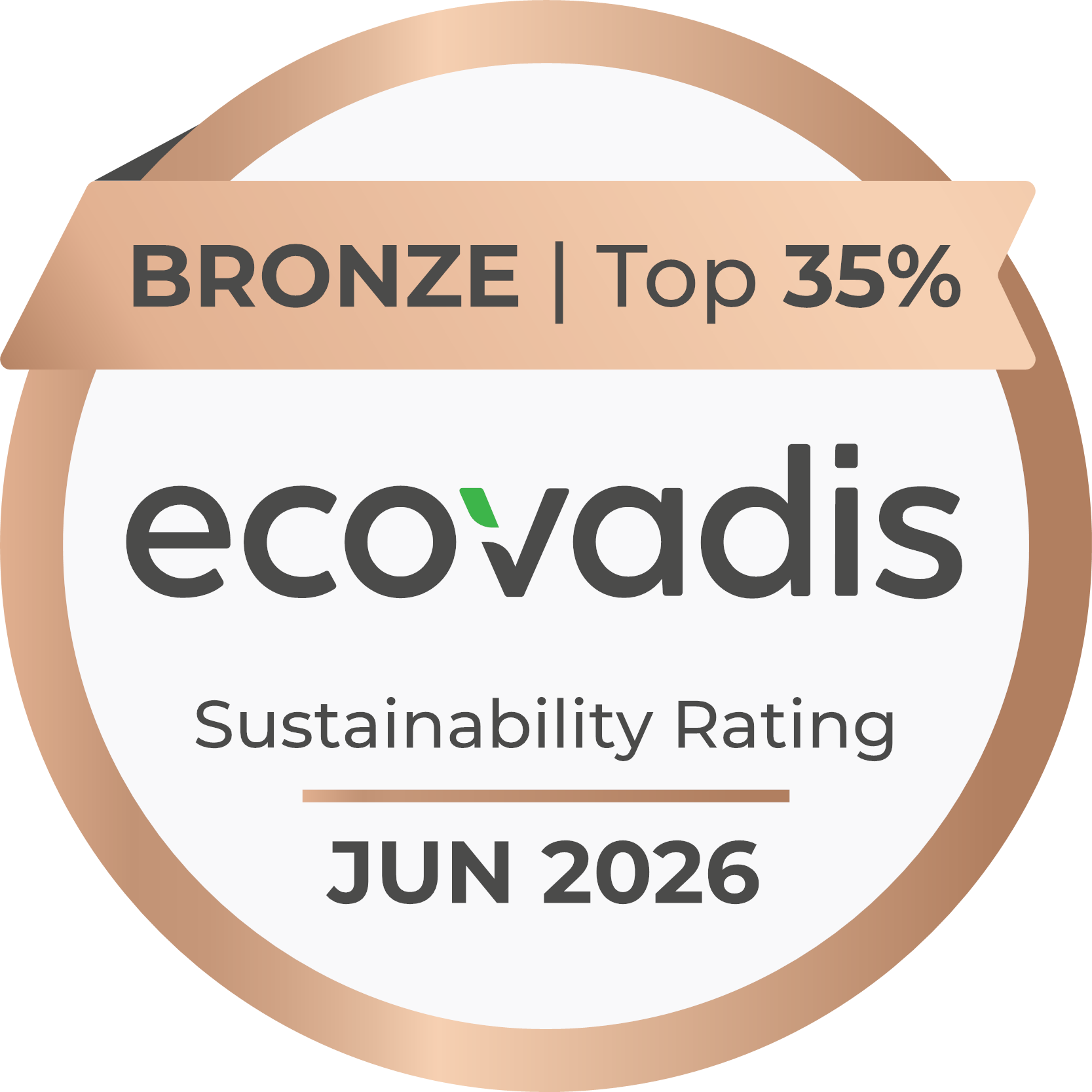
Artefact obtained an EcoVadis Bronze medal company with a score of 72/100 in 2026.

Artefact achieved a CDP Climate Change score of C
in 2025
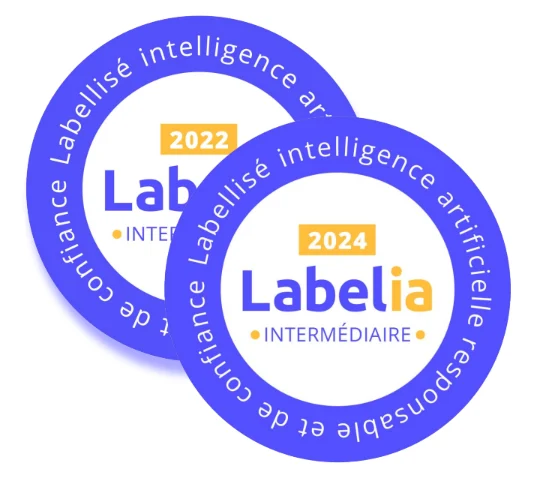
Artefact received the Labelia certificate Intermediary level in 2022 and 2024.

Artefact France and Artefact UK achieved ISO 27001 certification in 2025.

Artefact has been certified Great Place to Work® in eight countries in 2026
PLANET – Acting on climate change.
We aim to reduce the environmental impact of our activities by engaging our ecosystem in a collective dynamic of impact reduction.
Following the completion of its latest carbon assessment, Artefact has committed to a reduction plan covering all emissions generated (Scope 1, 2 and 3).

Acting on climate change
In 2022, Artefact completed its first group-level carbon assessment, establishing a baseline of 28,968 tCO₂eq across all three scopes. The results confirmed a strong concentration of emissions in Scope 3 (98%).
Building on this assessment, Artefact has committed to concrete reduction targets: −42% on Scopes 1 & 2 by 2030 and −25% on Scope 3 by 2030, with a long-term objective of −90% by 2050.
To reach these targets, we have structured a reduction roadmap around 5 key initiatives:
- Sustainable Media — Integrating carbon measurement into our media activity, which represents the largest share of our emissions.
- Green Mobility — Reducing the carbon footprint of business travel through a group-wide travel policy prioritising low-emission alternatives.
- Responsible Purchasing — Engaging our key suppliers on carbon criteria and integrating sustainability into our procurement processes.
- High-Carbon Offices Reduction — Transitioning our highest-emitting sites to renewable energy sources.
- Green IT — Reducing the environmental footprint of our digital infrastructure and extending the lifespan of IT equipment.
Sustainable Data & AI
At Artefact, we are deeply committed to minimizing the environmental impact of data and AI. A challenge of this scale requires collective action, which is why we regularly collaborate with industry peers and trusted partners to develop innovative solutions and drive meaningful change.
By sharing expertise and best practices, we aim to build a more sustainable digital future.


PEOPLE – Boosting our social handprint.
As a data and AI company, we are committed to addressing the social and societal challenges of our industry. Our approach focuses on promoting diversity and inclusion and democratising access to knowledge in data and AI.
Through our actions, we aim to contribute to a more inclusive tech ecosystem and make data and AI more accessible to all.
Diversity & Inclusion
At Artefact, we believe that data is about people and we defend diversity and inclusion in all our actions.
Our goal is to create a work environment where diversity is celebrated daily, reflecting our commitment to equity and inclusion in all practices and policies, ensuring that our decisions and services eliminate bias, increase accuracy and meaningfully serve diverse communities. populations we serve.
Data & AI democratization
The rapid development of AI and data is creating new opportunities, but access to the knowledge and skills needed to understand and use these technologies remains highly unequal. At Artefact, we are committed to helping bridge this gap by working with a network of non-profit partners and making our expertise, resources and people available to diverse audiences.
Through the Artefact Academy, our employees and our broader expertise, we contribute to training and mentoring programmes that make AI and data knowledge more accessible and help foster a more inclusive digital society.



PRINCIPLES – Shaping AI ethics.
As a data and AI company, we recognise our responsibility to promote the responsible and trusted use of these technologies.
We are committed to developing clear principles that guide our practices and ensure that AI and data are used in ways that respect privacy, fairness, transparency and accountability, while complying with applicable regulations.
Data & AI Ethics
Artefact is committed to addressing the ethical challenges associated with data and AI and to ensuring that these technologies are developed and used responsibly.
Our Ethical Data Charter, built around 10 guiding principles, provides a framework for responsible data practices across the data lifecycle. We continuously strengthen this approach by working with external experts and partners to challenge and improve our practices.
Responsible & Trusted AI
As a data and AI company, we are committed to developing responsible, secure and trustworthy AI that respects fundamental rights.
Our LabelIA certification reflects our adherence to rigorous ethical and security standards, with a focus on transparency, privacy and accountability. Renewed every two years, it is part of our ongoing commitment to continuously improving the way we design and deploy AI. We also work with external experts, such as Positive AI, to challenge our practices and continuously strengthen our approach to responsible AI.


Our clients CSR commitments
Artefact is also dedicated to supporting its customers in tackling the emerging challenges of sustainability. By leveraging our expertise in data and AI, we work closely with our clients to help them navigate and address the growing need for sustainable practices, ensuring that their strategies are both effective and aligned with long-term environmental and social goals.

Data for sustainability
Artefact is dedicated to supporting its clients in achieving their environmental and social goals through our Data for Sustainability offering.
This service is designed to help businesses structure their sustainability strategies, measure their environmental and social impact, and take actionable steps to reduce it.
By leveraging data and AI, we provide tailored solutions that enable our clients to track progress, optimize operations, and make informed decisions to drive positive, long-term change in line with their sustainability ambitions.