
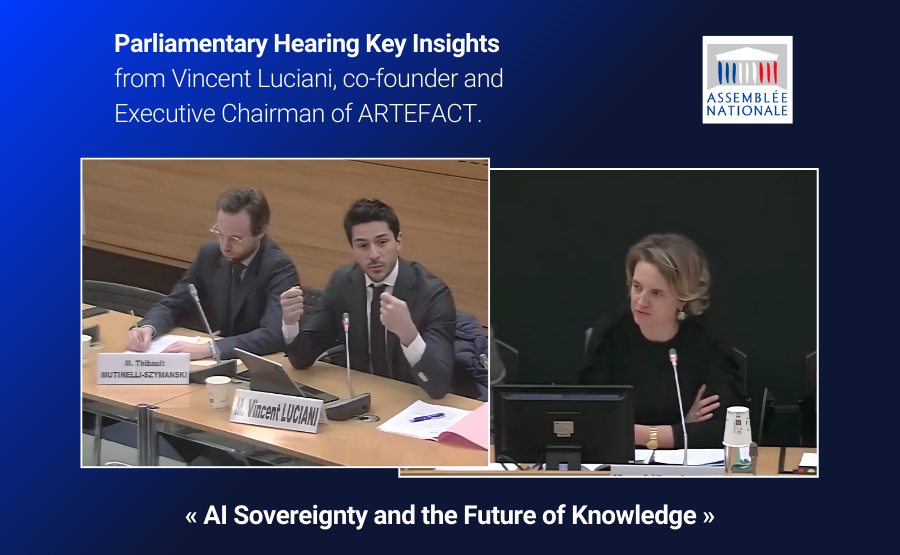
On January 19, 2026, Vincent Luciani, Co-founder and Executive Chairman of Artefact, addressed the French National Assembly’s Commission for Cultural Affairs and Education. In a session marked by the urgency of the Generative AI revolution, Vincent Luciani did not merely present a technical roadmap; he articulated a vision for a society where technology serves as a catalyst for human excellence rather than a substitute for intellectual rigor.
“AI must not function as a response generator that stifles thought, but as an analogical framework that drives intellectual growth.” – Vincent Luciani.
Overcoming the “illusion of knowledge”
The transition to the era of generative AI imposes a fundamental distinction between immediate access to information and the actual acquisition of knowledge. For Vincent Luciani, the major challenge lies in preserving intellectual effort.
“AI represents a disruption particularly for education, it is a cognitive rupture. […] Having access to knowledge does not constitute mastery. Ultimately, we are left with an illusion…”
The use of AI often induces a form of intellectual blindness (the Dunning-Kruger effect): the user, seduced by a fluid response, believes they have mastered a subject whose underlying mechanisms they do not understand. To counter this risk of memory erosion, Vincent Luciani advocates for:
- Interfaces that force interaction: To guarantee the ‘electrical trace’ of reasoning.
- AI as a demanding tutor: Transforming the tool into a mentor that questions the student rather than providing a ‘turnkey’ answer.
Project ArGiMi: building a sovereign cultural moat
Vincent Luciani highlighted the geopolitical significance of large language models (LLMs) and introduced the ArGiMi Project (Artificial General Intelligence for Multimedia Integration), a flagship initiative officially selected by Bpifrance as part of the France 2030 investment plan. In collaboration with the Bibliothèque nationale de France (BnF) and the Institut National de l’Audiovisuel (INA), ArGiMi trains AI models on verified French cultural content. The goal is to develop AI that reflects France’s unique heritage, values, and perspectives, rather than defaulting to Anglo-Saxon biases.
Redefining education: the rise of the “Teacher-Coach” and “AI+” skills
The hearing outlined a radical shift in how we approach professional development and education. Vincent Luciani argued for a transition from a top down approach of teaching to a role of the professor as a coach and a supervisor, with each student empowered by a personalized AI tutor.
- The Teacher-Coach: Educators must leverage AI to handle repetitive tasks and personalize learning paths, allowing them to focus on high-value human interaction: ethics, methodology, and mentorship.
- The “AI+” Curricula: In the near future, professional excellence will not be defined by a single degree, but by the hybridization of skills. We will no longer be just doctors or lawyers; we will be Doctor+AI or Jurist+AI. This requires a reinforced mastery of “hard” fundamentals logic and mathematics to ensure that humans remain in control of the prompt and the output.
Vincent Luciani concludes by using the game of chess as an optimistic parallel for the future of work and education. He notes that while machines now beat humans at chess, the level of human players has never been higher because they train with robots. Similarly, he argues the battle is not “lost” to AI; rather, humans must use these tools to become better, creating an ecosystem where the result of “Human + AI” is superior to AI alone.
Watch Vincent Luciani’s session at the Assemblée nationale