
[Foreword] Pharma’s New Marketing Imperative: The Agentic Shift
in a complex ecosystem: channels are fragmented, regulatory review cycles are lengthy, and success hinges on simultaneously influencing three distinct stakeholders – patients, prescribers (HCPs), and payers.
The life science industry is at a critical inflection point. Driven by the twin forces of personalized medicine and an explosion of real-world data, the demand for innovative, patient-centric engagement has never been higher. Yet, pharmaceutical marketing remains trapped Ecosystem Partner & Enablers Agencies (Comms, Digital) – Data Providers Medical Media & Publishers – Distributors – start-ups Regulators & Payers Regulatory Bodies (e.g., EMA, FDA …) Payers & HTA Bodies – Purchasing Organizations Direct Target & Beneficiaries Healthcares Professionals (HCPs & KOLs) Patients & Patient Advocacy Groups Pharmaceutical company Marketing Team – Medical Affairs – Sales Team – MLR (Medical, Legal, Regulatory) The traditional marketing model is failing to master this complexity, leading to content overload, low personalization, and mounting commercial pressure. This operational gap creates an urgent need for a new technological paradigm capable of operating with intelligence, foresight, and independence.
and lacking the autonomy needed to drive complex commercial outcomes.
Agentic AI represents the critical next evolution. An Agentic system is empowered to autonomously execute multi-step actions, pursue defined goals, and achieve outcomes without continuous human intervention. It is not just about generating messages; it is about executing strategy.
While the industry has explored Generative AI (GenAI) – which is effective for creating content – GenAI remains fundamentally reactive, requiring constant prompting
[FOREWORD] PHARMA’S NEW MARKETING IMPERATIVE: THE AGENTIC SHIFT Agentic AI’s core capabilities unlock the future of marketing.
- Strategic Reasoning & Autonomous Decision- Making: Initiating complex actions and making tactical decisions in real-time.
- Real-Time Foresight: Evolve market research from static reports to continuous, real-time intelligence gathering, ensuring your team uncovers emerging trends and gains early insights before the competition.
- Adaptive Orchestration: Coordinating tasks across fragmented channels, continuously learning, and optimizing performance across the entire customer journey.
The choice is stark. Organizations that embrace Agentic AI will dramatically shorten drug-to-market timelines and gain a critical advantage in speed and efficiency. Those that delay risk falling behind in a future defined by autonomous, personalized, and compliant commercial operations.
- Actionable Execution: Connecting directly to approved systems to deploy, measure, and refine campaigns proactively.
This white paper serves as your essential guide. We will move beyond the hype to explore real-world Agentic use cases, detail the necessary regulatory and organizational framework changes, and provide actionable recommendations for implementing this revolutionary technology today.
This shift is not a gradual trend; it is a competitive imperative. The stakes could not be higher:
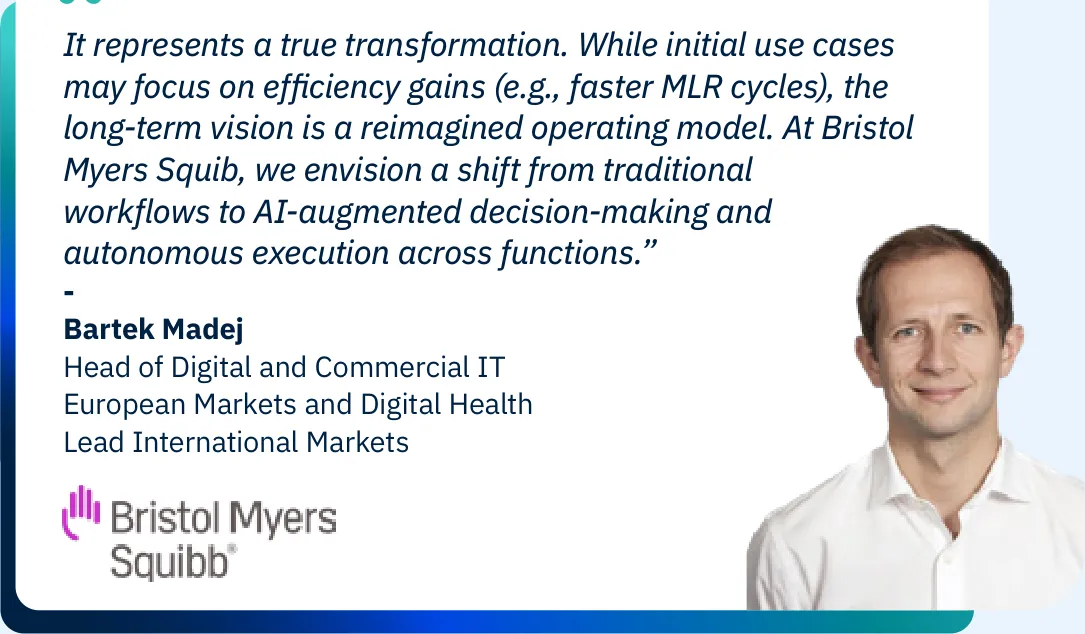
- Accelerated Compliance: Imagine cutting content regulatory review cycles from weeks to days, with AI agents performing scientific and compliance pre- checks the moment content is drafted.
Thomas Filaire Partner – Healthcare Data & AI Transformation
- True Omnichannel Personalization: Achieve truly adaptive care journeys where every piece of communication – for patients, HCPs, and payers – is instantly optimized and delivered across every touchpoint.

02 The next evolution: from Generative AI to Agentic AI
What is Agentic AI?
Before diving into Agentic AI, it’s worth taking a step back to understand how artificial intelligence has evolved – from rule-based automation to generative systems and now to autonomous, goal-driven agents. This context helps clarify what’s truly new about the Agentic era and why it represents a fundamental shift in how AI creates value.

2 – THE NEXT EVOLUTION: FROM GENERATIVE AI TO AGENTIC AI
Regarding the definition, Generative Artificial Intelligence, or GenAI, is the collective term for sophisticated algorithms that excel at creating brand new, original content, such as images, audio or code to a user’s prompt. It functions as a prediction engine, basing its output on patterns taken from its broad training data.
GenAI creates tangible value across diverse domains, for example, through automated content generation, information summarization, and idea creation. This provides teams with a foundation for faster execution and more consistent delivery at scale.
However, today’s generative AI is fundamentally reactive and requires constant prompting to produce content while lacking the ability to plan, prioritize, or integrate across enterprise systems. Marketing teams generate insights but must manually translate them into action. The gap between outputs and outcomes remains wide.
The critical distinction is that GenAI generates outputs in response to human prompts, whereas Agentic AI autonomously executes multi-step actions to achieve defined outcomes.
What makes Agentic AI different and truly “Agentic”?
Agentic AI systems go beyond traditional generative models. They don’t just produce outputs, they pursue goals. Their strength lies in combining autonomous behavior with the technological architecture that makes it possible.
3. Contextual understanding & memory – Retains and learns from interactions across platforms (e.g., CRM, medical inquiry databases), enabling continuity and smarter adaptation over time. Example: An agent remembers prior touchpoints, tailoring medical content for each HCP based on specialty, channel preference, and prior engagement behavior.
Five capabilities define Agentic AI:
4. Adaptive orchestration – Coordinates tasks and collaborates with other agents/people, dynamically adjusting plans based on feedback and results. Example: One agent manages content approval workflows, another triggers compliant digital engagement, while a third monitors real-time feedback – all synchronizing to maintain MLR (Medical, Legal, and Regulatory) compliance and optimize reach.
1. Autonomous decision-making – Operates independently of constant prompting, initiating actions and decisions based on defined goals or changing conditions. Example: An agent monitors HCP engagement data, identifies low-response segments, and automatically adjusts communication cadence or channel mix without human intervention.
2. Strategic reasoning – Uses advanced LLMs to analyze complex scenarios, plan multi-step solutions, and make informed trade-offs to achieve objectives. Example: An agent reviews prescribing trends, formulary access, and competitive activity, then recommends the optimal next-best action for each HCP audience.
5. Actionable execution – Connects to approved APIs and systems to take meaningful steps in the real world-deploying, testing, and optimizing in real time. Example: An agent launches an HCP email campaign through Veeva CRM, tracks open and click-through rates, and refines segmentation or timing based on observed response patterns.
2 – THE NEXT EVOLUTION: FROM GENERATIVE AI TO AGENTIC AI
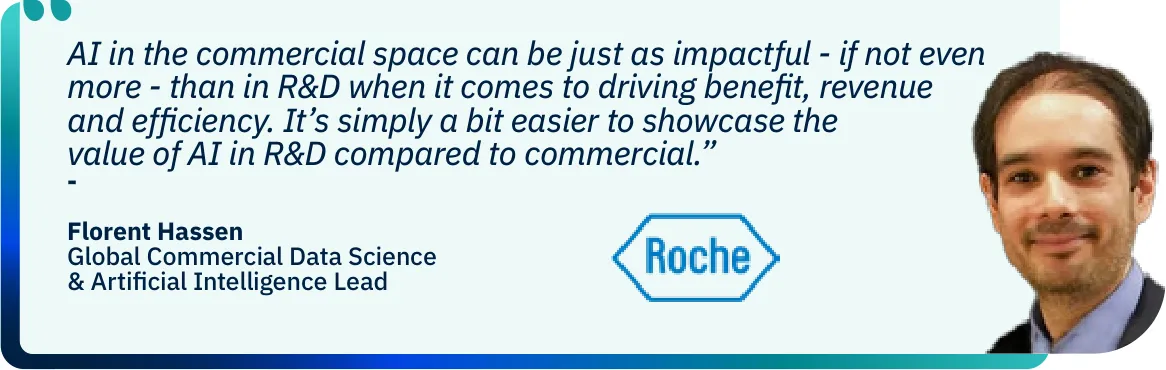
AI in the commercial space can be just as impactful – if not even more – than in R&D when it comes to driving benefit, revenue and efficiency. It’s simply a bit easier to showcase the value of AI in R&D compared to commercial.” –
Florent Hassen Global Commercial Data Science & Artificial Intelligence Lead
In essence: Agentic AI shifts the value from reactive content creation to proactive outcome achievement, enabling marketers to deliver the right message, to the right audience, through the right channel – autonomously and at scale.
Agentic AI is reshaping the way we approach work and unlocks 3 main value opportunities
- Save today to fuel tomorrow – Cost efficiency & reinvestment: Agentic AI automates repetitive, time-intensive tasks, reducing manual errors and operational overhead. By freeing up resources and streamlining workflows, organizations can redirect savings toward innovation, capability building, and future growth initiatives.
This early insight enables proactive strategy adjustments – helping teams anticipate change rather than react to it.
- Win on speed & accuracy – Intelligent agility & precision Agentic systems analyze vast datasets and make optimized decisions in real time, far beyond human capacity. They enable organizations to respond faster to market dynamics, personalize actions at scale, and maintain precision even under constant change.
- Find new value – Market insight: Agents continuously scan data across channels, uncovering emerging customer behaviors, sentiment shifts, and unmet needs before they become visible to competitors.

2 – THE NEXT EVOLUTION: FROM GENERATIVE AI TO AGENTIC AI How Agentic AI is impacting marketing workflows
Agentic AI is transforming processes across the healthcare value chain. In the next section, we will deep dive into each area with concrete use cases. As an illustration, we first illustrate how a key marketing workflow gets reshaped by Agentic AI.
To-be Agentic Process
~ 3 weeks
The benefit of using GenAI and Agentic AI goes beyond broad metrics like overall speed increases or ROI improvements, it lies in its ability to deliver highly tailored, audience-specific value at every stage of the marketing process.
- Precise segmentation: Creates accurate and granular audience segments, leading to more effective campaigns. – Optimized product outcomes: Insights are used to define the specific benefit or value the product delivers for each audience. – Targeted content delivery: Ensures the right content reaches the right people through the right channels. – Continuous optimization: Campaigns are refined automatically through performance reporting and A/B testing variations.


From theory to field: Real-world Use Cases 03
The life science sector is undergoing a profound transformation. Driven by breakthroughs in personalized medicine, a proliferation of real-world data, and a shift towards patient-centricity, the industry is evolving at an unprecedented pace. This shift has broken traditional marketing models, forcing a fundamental change in how scientific breakthroughs are brought to market.
to payers, investors, and primary decision-makers, all of whom have different needs and definitions of «value.»
This is precisely why a gap persists between strategy and implementation. While there is a palpable desire to advance and innovate, marketing is often not perceived as the same priority as R&D (the largest expense for pharmaceutical companies). Consequently, securing investment is more difficult, especially when a clear return on investment (ROI) has not yet been demonstrated.
For Marketing teams, the ability to translate complex research into engaging content is crucial for commercial success. However, this task is not easy. They must balance scientific accuracy, strict regulatory compliance, and the demands of a vastly diverse set of stakeholders– from researchers and Healthcare Professionals (HCPs) Nevertheless, use cases (some more mature than others) are emerging all along the value chain, which is precisely what we will explore in the next section.
01
Market Research Content Development & Validation
02
03 Campaign Execution & Omnichannel Engagement
04 Sales Enablement & Field Support
Disclaimer: This use case mapping is not exhaustive and is informed by client feedback, scientific literature, and our own experience in developing solutions for healthcare organizations. While it highlights important examples, it does not encompass all potential opportunities within the clinical trials’ value chain.
3- FROM THEORY TO FIELD: REAL-WORLD USE CASES

3- FROM THEORY TO FIELD: REAL-WORLD USE CASES Use Case #1 Market research: From static reports to real-time intelligence
The life sciences industry operates across evolving niches, each developing unique products which directly affect the wellbeing and health of many stakeholders. Content marketing plays a crucial role as every niche needs its own well-researched, targeted, and highly strategic marketing that conveys the core message to researchers and scientists.
- Limited real-time insight generation: Most analyses are static and quickly outdated, preventing marketing teams from capturing emerging trends, new stakeholder needs, or competitive shifts as they happen.
To do so, market research is the first step of the campaign, helping identify the target B2B audience, understand the industry demand for your products, and evaluate competitors. Information on the latest customer needs, pain points, scientific patterns, and future challenges/opportunities is what you require to market your products strategically; as missing the right audience wastes budget and weakens impact.
In this context, agentic and machine learning systems play a critical role by generating real-time, granular insights from scientific literature, competitor intelligence, payer requirements and stakeholder behaviors to pinpoint key strategic drivers and opportunities.
Yet, major challenges persist:
- High cost and inefficiency: Traditional market research is expensive and time-consuming, often requiring investments approaching €1 million to produce hundreds of pages of analysis – most of which are later condensed into short summaries and archived without reuse.
- Fragmented and inconsistent data: Healthcare data is dispersed across multiple systems, formats, and standards, making it difficult to build a unified, actionable view of customers, patients, or prescribers.
USE CASES
1. Autonomous market insight generation: Agentic AI continuously scans publications, sales data, digital channels, and competitors to detect trends and market shifts. It turns signals into early insights, enabling faster strategy adjustments and replacing costly traditional research.
2. Behavioural journey modelling & micro-segmentation: Agentic AI unifies prescription data, digital interactions, and sentiment signals to map physician and patient behaviours. This enables precision targeting and scalable personalization through adaptive segmentation, audience targeting, and strategic execution.
3. Competitive intelligence: By autonomously monitoring conferences, social media, and press releases, agentic AI “virtual scouts” can enhance competitive intelligence by identifying emerging competitor moves, uncovering strategic patterns, and surfacing early market signals.
3- FROM THEORY TO FIELD: REAL-WORLD USE CASES FOCUS USE CASE AI-Powered Campaign Testing CONTEXT
- Pre-launch campaign testing is a critical step for validating the effectiveness of messaging, visuals and calls-to-action.
- Marketers can use the platform iteratively, adjusting a sentence or visual in real-time and immediately seeing how the change impacts the campaign’s predicted performance and its ability to drive a specific call- to-action (e.g., «intent to vaccinate»).
- Traditionally, this process relies on slow and expensive market research methods, such as focus groups and broad surveys which creates a significant bottleneck, with test cycles lasting 8-10 weeks and costing upwards of $100,000, limiting a team’s ability to test and optimize effectively.
- It creates long delays between the emergence of external signals and internal strategic action, limiting agility and competitiveness.
SOLUTION
- An AI-powered testing platform integrates external datasets (publications, patents, social media, clinical data) with internal knowledge bases (SharePoint, research repositories) to generate real-time and predictive analysis of all campaign assets.
IMPACT
- Massive Cost Reduction:
Campaign testing costs can be reduced by over 90%.
- Faster time-to-market: Latency between signal detection and response drops from months to days – or even real time.
- Data-Driven Optimization: Teams can move beyond subjective feedback to data- driven confidence, launching campaigns that are scientifically optimized for memorization and, most importantly, patient or HCP action.
- The AI is trained to analyze creative, copy, and video, providing instant scores on key metrics like memorization, emotional response, and eye-tracking data on visuals.
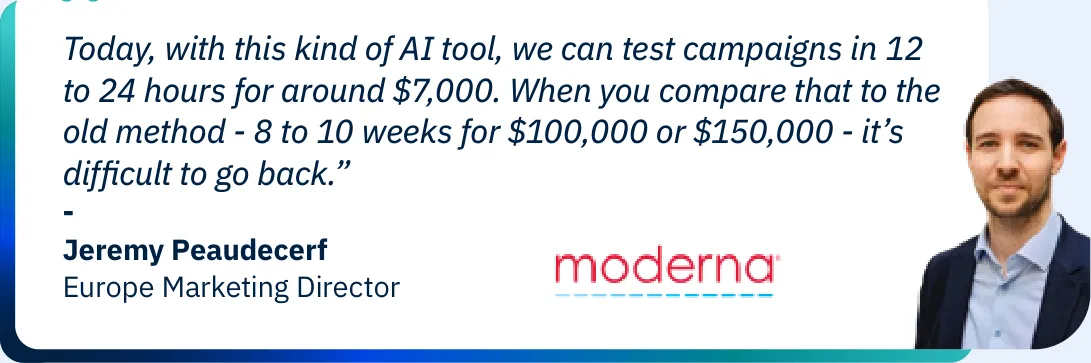
Today, with this kind of AI tool, we can test campaigns in 12 to 24 hours for around $7,000. When you compare that to the old method – 8 to 10 weeks for $100,000 or $150,000 – it’s difficult to go back.” – Jeremy Peaudecerf Europe Marketing Director
3- FROM THEORY TO FIELD: REAL-WORLD USE CASES
- Use Case #2 | Content Development & Validation
Accelerating the creation of high-impact assets while ensuring scientific accuracy and regulatory compliance
The pharmaceutical industry is at a pivotal transformation stage, with traditional content creation methods becoming rapidly outdated. The traditional content creation timeline has become a critical bottleneck for marketing effectiveness, encouraging pharma marketers to adopt AI to overcome these limitations:
compliant core messages that articulate a pharmaceutical product’s unique value proposition – ultimately driving more meaningful and timely engagement with healthcare professionals (HCPs).
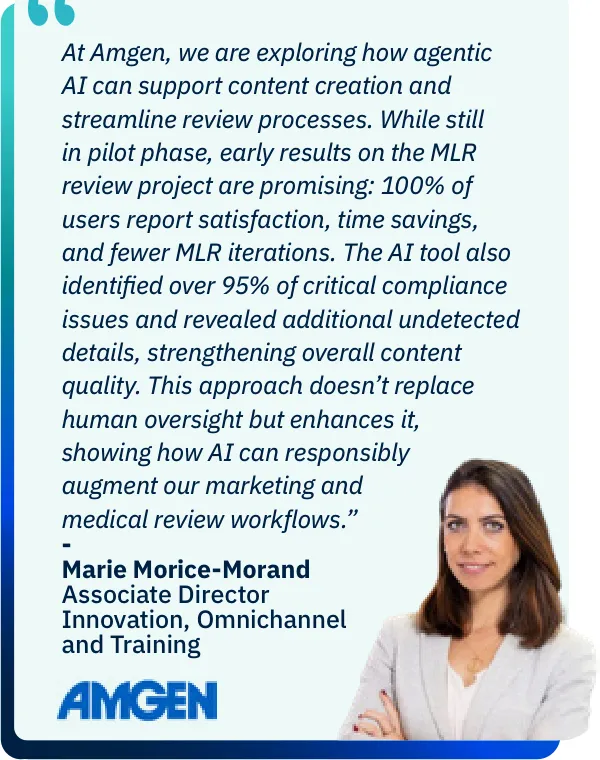
At Amgen, we are exploring how agentic AI can support content creation and streamline review processes. While still in pilot phase, early results on the MLR review project are promising: 100% of users report satisfaction, time savings, and fewer MLR iterations. The AI tool also identified over 95% of critical compliance issues and revealed additional undetected details, strengthening overall content quality. This approach doesn’t replace human oversight but enhances it, showing how AI can responsibly augment our marketing and medical review workflows.” – Marie Morice-Morand Associate Director Innovation, Omnichannel and Training
- Lengthy and complex validation processes: Pharma companies must maintain high standards of accuracy and credibility, relying on rigorous multi-step reviews to verify medical content and its sources before publication.
- Costly and resource-intensive content production: Beyond the significant budgets devoted to agency partnerships, marketing teams spend countless hours on repetitive, low-value tasks that could be automated. Multiple revision cycles not only slow down delivery but also drive substantial budget overruns.
- MLR review bottleneck: While essential for ensuring compliance and scientific integrity, it is often a time-consuming, multi-stage journey involving detailed scrutiny and alignment across stakeholders, considerably delaying time-to- market.
Agentic AI bridges this gap by autonomously analyzing clinical literature, engagement signals, sentiment data, and prescribing patterns to detect emerging narratives and unmet needs in real time. It translates complex clinical insights into clear, compelling, and
USE CASES
1. AI-Automated Prechecks: AI agent validates content against regulatory guidelines in real-time. This proactive compliance check minimizes errors before submission, leading to fewer review cycles and faster approvals.
2. Content ideation acceleration: AI agents can analyze HCP engagement data to generate hyper- personalized content concepts for product launches. They autonomously iterate creative directions and produce ABPI-compliant variants based on real-time feedback, significantly reducing ideation time and boosting HCP recall and engagement rates.
3. Content tagging: AI automatically tags marketing and medical materials, enabling precise content tracking across tools and systems. This automation can reduce operational costs by up to 76% by eliminating repetitive manual tasks and enhancing the reuse of existing tagged assets.
3- FROM THEORY TO FIELD: REAL-WORLD USE CASES FOCUS USE CASE AI-assisted MLR review process CONTEXT
- The medical, legal, and regulatory (MLR) review process is central to maintaining compliance, accuracy, and ethical standards in pharmaceutical marketing and communications.
- Automated pre-screening: Regulatory, legal and medical rules are automatically applied to draft materials, flagging potential issues before submission and minimizing manual review cycles.
- Yet, it can be a slow, difficult, costly process with multiple review rounds to ensure alignment with regulatory guidance, approved claims, and legal restrictions.
- Balancing speed with strict compliance is a persistent challenge – yet mastering it is essential to deliver timely, compliant, and effective communications in today’s highly regulated environment.
IMPACT
- Shorter review cycles: Pre- validated content reduces back-and-forth and approval times – cutting MLR review from weeks to days (up to 60% faster).
SOLUTION
Agentic AI enables a new approach to MLR by embedding compliance directly into the content creation process:
- Built-in compliance: AI-assisted authoring tools integrate MLR requirements so materials start in a compliant state, reducing costly revisions later on.
- Integrated frameworks: Brand lexicons, regulatory guidelines , copyrights and approved claims libraries are connected directly to authoring workflows to ensure alignment from the start.
- Lower compliance risk and
legal risk: Every output is aligned with regulatory frameworks from creation.
- Accelerated time-to-market:
Marketing and medical teams gain the agility to launch campaigns and scientific content faster, without compromising compliance.
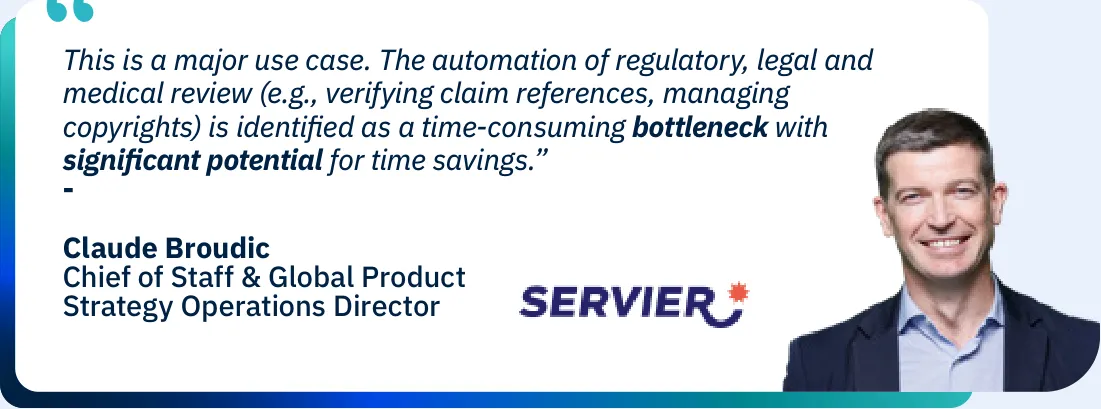
This is a major use case. The automation of regulatory, legal and medical review (e.g., verifying claim references, managing copyrights) is identified as a time-consuming bottleneck with significant potential for time savings.” –
Claude Broudic Chief of Staff & Global Product Strategy Operations Director 3- FROM THEORY TO FIELD: REAL-WORLD USE CASES Use Case #3 Campaign Execution & Omnichannel Engagement
Pharma companies are undergoing a strategic transformation, moving from fragmented, siloed models to personalized, integrated experiences across all touchpoints. This shift – reflected by the 10-15% of advertising budgets now devoted to omnichannel initiatives – is essential to deliver consistent and connected engagement where every message reinforces the customer journey.
Agentic AI is overcoming existing barriers to unlock the full potential of omnichannel – and the opportunity ahead remains immense.
Yet, despite recognizing its potential, many pharma companies continue to face major challenges in executing a truly effective omnichannel strategy:
- Siloed organizations: Marketing, Sales, Medical, and Digital teams often operate independently, leading to misaligned messaging, fragmented communications, and underused data – ultimately weakening the customer experience.
- Legacy technology: Outdated IT infrastructures hinder data integration and the seamless deployment of omnichannel solutions.
- Limited customer journey insight: Without a clear, end-to-end understanding of the HCP journey – from awareness to prescription – companies risk delivering disjointed, low-impact experiences that miss their audience’s real needs.
USE CASES
1. Channel Mix Optimisation: Agentic AI continuously evaluates cross-channel performance to identify underperforming segments and automatically refine targeting or budget allocation based on strategic goals.
2. Dynamic Customer Journeys & Segments: Agentic AI monitors customer behaviours to identify changes in the journey, such as increased preference for app engagement rather than web engagement. The agents update the journey logic and customer segments, to trigger outreach tailored to the new preferred channels.
3. Personalised & Consistent Narrative: AI agents continuously personalise content using real-time consumer insights, while staying within the brand tone and messaging guidelines. This allows large- scale, cross-channel personalisation that feels consistent, relevant, and true to the brand across every customer touchpoint.
3- FROM THEORY TO FIELD: REAL-WORLD USE CASES FOCUS USE CASE Agent-Driven Omnichannel Orchestration CONTEXT
- Current omnichannel strategies rely on static rules and predefined logic, where interactions are based on expected rather than actual HCP behaviors.
- Compliance Agent: Acts as a real-time guardrail for all AI-driven actions.
- When behaviors shift, traditional analytics and segmentation struggle to detect and adapt quickly.
Implement with a «start small, scale fast» approach, deploying one agent on predefined datasets to prove value before expanding capabilities.
- Implementing journey updates often takes weeks of manual effort due to complex approval and deployment processes.
- As a result, omnichannel approaches cannot keep pace with real-time behavior, leading to missed engagement opportunities and inefficiencies.
SOLUTION Establish an Agentic AI ecosystem – a network of intelligent, semi-autonomous agents that continuously optimize omnichannel engagement in real time – and deploy a team of specialized agents:
- Insight Agent: Analyzes live data to uncover behavioral shifts.
IMPACT
- Efficiency: Automates routine, manual decisions – freeing marketers to focus on strategy and high-value engagement.
- Speed: What once took weeks now updates in hours, enabling real-time journey optimization.
- Scalability: Delivers personalized, compliant content at scale – and once the agentic framework is built for one brand, it can be rapidly replicated across others and new markets.
- Content Agent: Generates personalized, compliant content.
- Channel Agent: Orchestrates the right channel, timing, and frequency.

3- FROM THEORY TO FIELD: REAL-WORLD USE CASES
Use Case #4 Sales Enablement & Field Support : Empowering the sales team with strong field support resources
Designing an effective HCP engagement strategy is a critical, high-stakes investment. The pharmaceutical industry invests over $90 billion globally per year (up to 30% of commercial budgets) to build these relationships, which in turn can influence up to 60% of all prescription decisions. However, this traditional model is under pressure, strained by digital saturation and a new, AI-informed patient now using AI to self- diagnose symptoms.
- Trust and Value Measurement: Traditional trust- building through expensive congresses is losing ground. Stricter regulations and unclear ROI make it harder than ever to justify their value.
Today, several critical factors are making the HCP relationship landscape increasingly complex:
This process has traditionally been high-cost and rep- dependent. With the emergence of Agentic AI, this relationship is now being transformed and revolutionized by creating an intelligent, autonomous, and scientifically relevant ecosystem.
- Volumetry and Digital Access: The traditional in-person rep model is costly and cannot scale. It fails to meet modern demand, as the majority of doctors now state they prefer online communication over in-person visits.
- Quality and Personalization: The era of “one-size- fits-all” messaging is over. Physicians now report that social media and digital content influence not only their perception of a brand, but also their prescribing decisions.
- Frequency and Saturation: Healthcare professionals report feeling overwhelmed by excessive promotional content, often perceived as “spam”, ultimately eroding trust and damaging relationships.
USE CASES
1. Summary of HCP interactions: An AI agent that automatically processes and summarizes all past omnichannel interactions (emails, CRM notes, calls, web activity) to provide the sales rep with a concise 360° view of the HCP’s history and sentiment before the next meeting.
2. AI-HCP Conversation Simulator: An AI agent acts as a «virtual HCP» persona. The rep or MSL practices their full conversation with the agent, which is trained on all approved scientific data and potential objections.
3. AI persona generator: An agent that dynamically creates and updates HCP personas in real-time. It analyzes content consumption, digital behavior, and prescription patterns to enable true hyper- personalization and real-time micro-segmentation for campaigns.
3- FROM THEORY TO FIELD: REAL-WORLD USE CASES FOCUS USE CASE “Turing”, Sanofi’s Next Best Action Companion for HCPs CONTEXT
The primary challenge Sanofi faced was a fundamental shift in how Healthcare Professionals engage with sales representatives.
- Engaging with Healthcare Professionals has become increasingly complex. Reps face declining in-person access and significant «digital fatigue» as doctors are saturated with online content from multiple sources.
- They must move beyond a traditional, high-volume sales model and ensure every interaction is personalized, timely, and provides clear value to the specific needs of each HCP.
SOLUTION
- Deployed «Turing,» an AI-driven «Next Best Action» (NBA) engine that functions as a «companion» for sales reps, analyzing omnichannel data to recommend the optimal engagement for each HCP.
- The platform delivers a simple list of weekly suggestions directly into the rep’s native CRM (Veeva), eliminating the need for a separate dashboard and embedding the insight directly into their daily workflow.
IMPACT
- Drives significant «sales uplift» across more than 15 major brands and has been successfully scaled to over 20 countries.
- Achieves a key KPI of a 10:1 cumulative Return on Investment (ROI), generating 10€ in revenue for every 1€ invested in the program.
- Increases sales rep efficiency by helping them prioritize high- value activities and personalize their outreach at scale.
- Enhances HCP engagement and satisfaction by ensuring communications are relevant, coordinated, and delivered at the right moment.
- Implemented a «human-in-the-loop» continuous learning model. Reps can «accept» or «dismiss» each suggestion. The reasons for dismissal are fed back into the AI to continuously refine and improve the relevance of future recommendations.
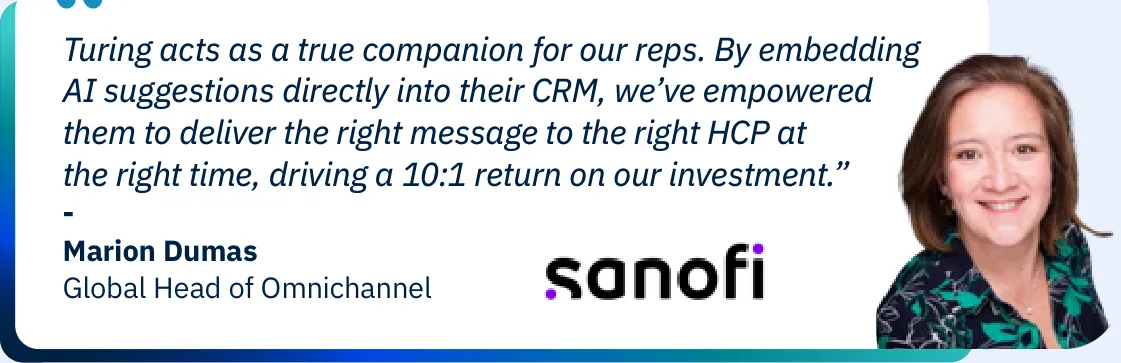
Turing acts as a true companion for our reps. By embedding AI suggestions directly into their CRM, we’ve empowered them to deliver the right message to the right HCP at the right time, driving a 10:1 return on our investment.” – Marion Dumas Global Head of Omnichannel
Emerging players: Startups and agentic opportunities 04
While the adoption of AI in life sciences has been significant, it has not been uniform across all functions. The Research & Development segment has seen a large number of startups emerge, focusing on areas like drug discovery and clinical trial optimization. In contrast, the market for Generative and Agentic AI in the commercial and marketing functions is still a bit less developed.
provided must comply with stringent MLR review processes and global transparency laws (such as the US Sunshine Act or France’s Loi Encadrement des Avantages).). The key risks include the generation of statements not supported by approved clinical data, or non-compliant suggestions related to hospitality, invitations, or expenses ; creating significant barriers to entry for marketing-focused tools.
This discrepancy can be explained by several factors.
1. Demand for ROI: Pharma labs demand clear ROI, which is easy to prove for efficiency (e.g., automating administrative tasks, reducing time spent on CRM entries) but «premature» and far more complex to quantity for measure effectiveness (e.g., proving an AI-driven insight directly led to a new prescription).
2. Complex Regulatory and compliance hurdles:
Every AI-generated message or recommendation
3. Long sales cycles driven by technical integration: Deeply embedded platforms like Veeva and Salesforce dominate the commercial tech stack, requiring any new AI tool to undergo rigorous validation, security, and integration processes. At the same time, adoption depends on alignment across multiple stakeholders – Commercial, IT, Legal, Procurement and field teams – making implementation slow and complex.
However, some players have nonetheless positioned themselves along the value chain and are trying to seize the opportunity:
This mapping is not exhaustive and highlights only the startups mentioned during our interviews and personal research.
Augmenting the Field Force: AI-Powered Training
This category includes startups that use AI agents to improve the skills and compliance of human sales reps and MSLs: interviews and personal research.
Provides an AI role-playing platform for pharma teams. Reps practice high-stakes conversations with lifelike, AI-powered «virtual HCPs.» The system provides immediate, granular feedback on message delivery and compliance, allowing teams to practice at scale and accelerate onboarding.
A similar «AI-enabled sales simulator» where reps engage in video-based role-play with an AI-HCP persona. Its key function is its ability to automatically flag non-compliant medical statements during the simulation, providing both performance and regulatory coaching.
Automating Commercial Operations: From Insights to Engagement
This category includes platforms that use autonomous agents to generate insights, create entire campaigns, or even act as virtual reps.
An AI insights platform that transforms real-world patient conversations from social listening into compliant, actionable intelligence. It provides role-specific «AI Copilots» (e.g., «Medical Affairs Agent,» «Brand Sentinel») to help commercial teams build strategy based on the «patient voice.»
An «AI Agency» (in partnership with Google Cloud) that uses a team of cooperative AI agents to automate the entire creative process. It can generate a full, compliant product campaign (videos, emails, social content) in minutes rather than months, all supervised by a human expert to guide the query formulation, context, audience/subject specification.
Deploys autonomous AI agents to act as virtual sales reps and Medical Science Liaisons (MSLs). This platform involves marketing and commercial activity by automating personalized interactions with healthcare providers (HCPs) to increase prescription rates.
A platform for building customer-facing AI agents for sales and support. A pharma company could use this to deploy agents that handle inbound HCP inquiries, patient support questions, automate lead qualification and data entry into a CRM.
Boosting Field Force Productivity: The AI «Co-Pilot»
This category focuses on AI assistants that act as a «co-pilot» for Field reps in the field, automating low-value tasks and ensuring compliance.
A voice-first AI assistant built as the rep’s “office on the road.” Sales representatives spend up to 30% of their time on administrative tasks; the goal is to reduce this to under 10%, unlocking significant gains in efficiency and performance. The AI co-pilot focuses on augmenting field teams through three key capabilities:
1. Pre-Visit optimal preparation: Summarizes all relevant CRM data to equip the rep for their next customer meeting and recommends specific, approved key messages and next best actions to maximize impact.
2. Post-Visit effortless reporting: Automates CRM reporting via voice dictation. The rep can dictate their visit notes in natural language, eliminating hours of manual data entry and ensuring timely, high quality documentation..
3. Compliance: Acts as an on-demand compliance check (e.g., for French «Loi Encadrement des Avantages») and automates cross-functional handoffs to other functions (e.g., logging a request for a MSL).

05 From potential to practice: A need of organisational and structural changes for enterprises
The use cases detailed earlier in this paper demonstrate the transformative potential of Agentic AI, from accelerating MLR reviews to deploying hyper- personalized omnichannel campaigns. However, realizing this potential is not as simple as procuring new technology.
Merely plugging Agentic AI into existing legacy workflows will, at best, yield marginal efficiencies. To unlock true, sustainable value, enterprises must undergo deep organizational and structural changes. This is not just an IT upgrade; it is a fundamental business transformation.
There is a belief that AI will solve everything – that’s not the case. There is a massive need for internal transformation and acculturation. It’s not just a question of technology-it’s a question of sponsorship, budget, and top-down commitment.” – Jeremy Peaudecerf Europe Marketing Director
5- FROM POTENTIAL TO PRACTICE: A NEED OF ORGANISATIONAL AND STRUCTURAL CHANGES FOR ENTERPRISES Challenges to overcome to successfully implement Agentic AI
Successfully integrating Agentic AI requires a multi- pronged strategy that addresses company culture, core competencies, data infrastructure, and legal governance.
- Navigating Data Privacy & Consent: As Florent Hassen points out, automated decision-making runs directly into regulatory constraints:. “A major challenge in implementing agentic AI for customer engagement lies in regulatory constraints. Following Art. 22 of GDPR, processing personnel level data through automated decision-making requires explicit consent, which limits agentic targeting to opted-in contacts and reduces the overall scope of impact compared with human-mediated interactions.”
1. Securing Top-Down Sponsorship & Fostering a New Culture
The single greatest hurdle is often cultural. An «AI-first» mindset must be championed from the C-suite and embedded across the organization.
4. Unifying a Fragmented Data and Tech Ecosystem
- Executive sponsorship: Leadership must visibly sponsor this shift, allocating dedicated budgets and communicating a clear vision that positions Agentic AI as a core strategic enabler, not just an experimental «side project.»
Agentic AI is only as powerful as the data it can access and the systems it can control.
- Building trust: The narrative must be focused on augmentation, not replacement. The goal is to build trust by demonstrating how AI can free humans from low-value, repetitive tasks to focus on high-value strategic work.
- Breaking down data silos: Most pharmaceutical companies suffer from fragmented data, with customer information trapped in separate CRM, medical, digital, and sales systems. A foundational requirement is creating a unified data infrastructure (often via APIs) that provides a true 360° view of the HCP and patient.
2. Building «AI Literacy» Across the Organization
- Enabling action via APIs: Agents need to act. This requires secure, robust APIs to connect to and control core systems like Veeva, Salesforce, and marketing automation platforms. As noted in Section III, the long integration cycles for new tools in this entrenched tech stack are a major barrier that requires strategic IT planning.
The workforce must be upskilled to collaborate effectively with AI agents. This goes far beyond training a few data scientists; it requires raising the «AI literacy» of the entire commercial and medical organization.
- Company-wide acculturation: Leading companies are already implementing this. For example, Roche has rolled out its corporate AI strategy: «Everyday AI» program. This is a mandatory, top-down, 6-week training program driven by the Group CEO for all 100,000 employees. The goal is to «raise the floor» and make basic AI literacy a core skill, similar to how email was rolled out 30 years ago.
3. Redefining Governance for an Autonomous Era
Agentic AI’s ability to make autonomous decisions creates new, complex challenges for governance, especially in the life science industry.
- Mandating the «human-in-the-loop»: This legal and ethical constraint means that for the foreseeable future, a «human-in-the-loop» model is not just best practice – it’s a necessity. New workflows must be designed to embed human oversight and approval before an agent takes a critical action, especially one involving HCP data or patient communication.
The new operating model: human-led, agent-driven 06
Agentic AI offers a transformative operating model in which human creativity and strategic vision are amplified by autonomous agents. The future is one of collaborative autonomy, where human and AI co-pilot the brand in real time. Insights in this report show that accountability will remain with humans, while agents take on execution, optimization, and adaptation.
edge cases, and maintain ethical and regulatory integrity. The objective is not to replace humans, but to augment their capabilities.
- Plan for the long run: Launch early, but dedicate roughly a third of your budget to post-launch work, including updates, workforce training, and change management. This approach allows organizations to refine Agentic AI workflows, integrate lessons learned, and expand adoption across teams safely and efficiently.
In the pharmaceutical industry, campaign managers are evolving into system orchestrators. Marketing teams will oversee agents capable of performing a range of concrete, time-saving actions, including:
- Train the workforce: Deploy organization-wide upskilling programs that combine role-based training, hands-on experience, and continuous learning at scale. Equip teams to interpret AI outputs, validate recommendations, handle exceptions, and work effectively with agents, while staying aligned with evolving compliance and best practices.
- Generating real-time market insights for informed decision-making,
- Producing compliant, high-impact content at scale,
- And equipping field forces with predictive engagement tools and on-demand scientific support.
- Establish governance at the outset: Implement clear oversight, approval workflows, and documentation to maintain accountability, compliance, and trust. Establish monitoring mechanisms and audit processes to track agent performance, enforce ethical standards, and provide transparency for both internal teams and regulators.
Adoption of Agentic AI is increasingly essential. Companies that delay risk slower decision-making, missed engagement opportunities, and rising operational costs. However, successful adoption requires a deliberate and structured approach. Key strategies to begin include:
- Start small: Select a defined, low-stakes pain point and co-develop an Agentic AI pilot with a small team of experts. Early, tangible results generate momentum, build trust in AI solutions, and establish the foundation for scaling more complex applications.
The future of pharma marketing is collaborative: humans and AI agents working together to turn insights into action. Agentic AI does not replace marketers, but rather extends their capabilities, unifies previously fragmented workflows, and empowers teams to achieve greater impact. Companies that approach adoption step by step, with clear governance and human accountability will be better positioned to improve their overall efficiency and in the end, better address healthcare professionals and strengthen patient engagement.
- Keep humans in the loop: Ensure humans remain actively engaged throughout the AI lifecycle, from testing and validation to compliance checks. Iterative oversight allows teams to fine-tune outputs, address
GLOSSARY
- Agentic AI: Artificial intelligence systems capable of autonomous decision-making and goal-directed actions without constant human input
- API (Application Programming Interface): A set of rules that allows different software systems to communicate and share data or functionality
- CLM (Closed-Loop Marketing): A data-driven marketing approach that uses feedback from customer interactions to continuously refine and personalize future communications
- CRM (Customer Relationship Management): Technology or systems used to manage an organization’s interactions with current and potential customers, improving relationships and efficiency
- EMA (European Medicines Agency): The European Union agency responsible for evaluating and supervising medicines to ensure their safety and efficacy
- EU AI Act: European Union legislation establishing a legal framework for the development and use of artificial intelligence, emphasizing transparency, safety, and ethics
- FDA (Food and Drug Administration): The U.S. federal agency responsible for protecting public health through the regulation of food, drugs, medical devices, and other health-related products
- Generative AI (GenAI): A form of AI that can create new content-such as text, images, or data-based on learned patterns from existing information
- HCPs (Healthcare Professionals): Licensed individuals, such as physicians, nurses, and pharmacists, who provide clinical care and medical expertise to patients
- LLMs (Large Language Models): Advanced AI models trained on vast amounts of text data to understand and generate human-like language
- MDR (Medical Device Regulation): European Union regulation that governs the safety, performance, and market approval of medical devices
- MLR (Medical, Legal, and Regulatory): A review process ensuring that marketing and scientific materials meet medical accuracy, legal compliance, and regulatory standards
- Omnichannel engagement: A coordinated approach to customer communication across multiple channels (digital, in-person, print, etc.) to deliver a consistent, seamless experience
- Patient-centricity: A healthcare approach focused on understanding and addressing patient needs, preferences, and experiences in every stage of care or product development
- Personalized medicine: A medical approach that tailors treatment and prevention strategies to individual patient characteristics, such as genetics and lifestyle
- Precision targeting: The use of data and analytics to deliver highly specific messages or treatments to the right audience or patient segment
- Real-world data (RWD): Health-related data collected from real-world settings, such as electronic health records or patient registries, rather than controlled clinical trials
- Rep (Sales Representative): A professional responsible for promoting and selling products or services, often serving as the main point of contact between a company and its clients
- ROI (Return on Investment): A performance metric that evaluates the profitability or efficiency of an investment relative to its cost
- Semantic linking: The process of connecting data or content through meaning-based relationships, enabling more intelligent search, integration, and interpretation across systems
Thanks & acknowledgements
We would like to express our sincere gratitude to all the interviewees, from all parts of the ecosystem whose valuable input greatly contributed to the creation of this White Paper. Their expertise and collaborative approach were essential in shaping and refining our ideas.
Claude Broudic – Chief of Staff & Global Product Strategy Operations Director at Servier Saber Daassi – Co-founder of Kustoma Marion Dumas – Global Head of Omnichannel as Sanofi Florent Hassen – Global Commercial Data Science & Artificial Intelligence Lead at Roche Bartek Madej – Head of Digital and Commercial IT European Markets and Digital Health Lead International Markets at Bristol Myers Squibb Marie Morice – Associate Director Innovation, Omnichannel and Training at Amgen Jeremy Peaudecerf – Europe Marketing Director at Moderna
We also extend our heartfelt thanks to each member of our team for their tireless efforts and invaluable contributions throughout the entire process.
Artefact editorial team
Thomas Filaire, Healthcare Partner at ARTEFACT (France) Léa Giroulet, Managing Consultant in Healthcare practice at ARTEFACT (France) Anna Sojnoczky, Managing Consultant in Healthcare practice at ARTEFACT (Netherlands) Maria Garzon, Junior Consultant in Healthcare practice at ARTEFACT (Netherlands) Meric Gurgen, Senior Managing Consultant in Healthcare practice at ARTEFACT (UK) Anna Mulbert, Junior Consultant in Healthcare practice at ARTEFACT (France) Sébastien Marguerès, Director, Public Affairs and Science Lead at AI FOR HEALTH – ARTEFACT Gabriel Roteta Maranon, Public Relations Project Manager at AI FOR HEALTH – ARTEFACT