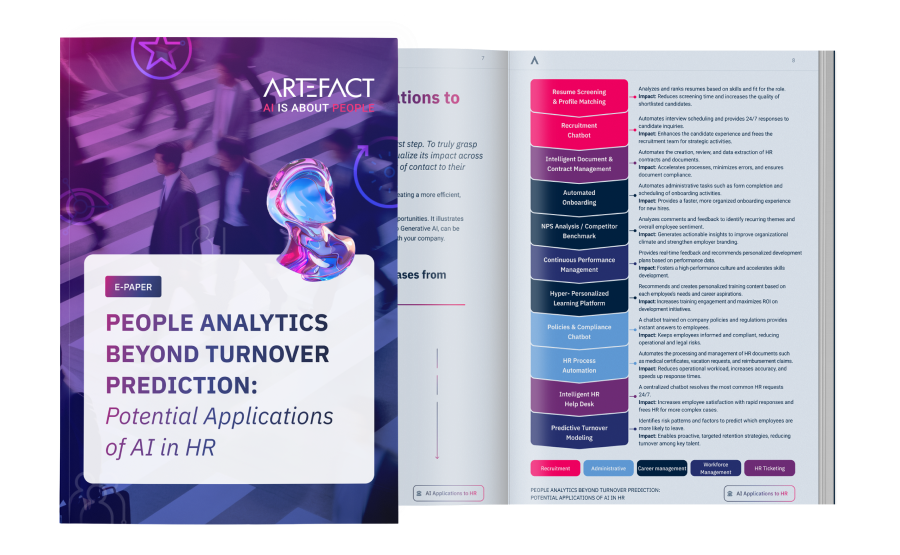
Artefact’s e-paper, “People Analytics Beyond Turnover Prediction: Potential AI Applications in HR,” argues that the focus of Artificial Intelligence (AI) in Human Resources (HR) must evolve beyond simple employee turnover forecasting. The real opportunity lies in transforming HR into a strategic driver, using AI to proactively boost organizational performance.
The Strategic Opportunity of AI in HR
- Untapped Potential: AI’s potential extends to proactive burnout prediction, workforce optimization, identifying hidden internal talent, hyper-personalized learning, and forecasting labor risks.
- New Approaches: Technologies such as Generative AI and Agentic AI enable optimized team allocation and real-time, confidential support for employee well-being.
- Key Challenges: Implementation faces hurdles like fragmented data (silos), inconsistent information, and the need to develop data literacy within HR teams.
Ethics and Governance as the Central Pillar
The use of employee data demands a “critical ethical and legal commitment.” The foundation of trust rests on an Integrated Framework, which includes:
- Global Data Protection (e.g., GDPR, LGPD, AI Act).
- Ethical AI Principles: Focus on Fairness and Bias Mitigation, Transparency (using XAI), and Human-in-the-Loop Supervision.
- Data Security: Use of Role-Based Access Control (RBAC), Data Encryption, and Data Minimization.
Artefact’s Proven Success Cases
Artefact showcases AI solutions that have generated measurable value in different areas.
The Workforce Health Monitoring case, which uses machine learning, resulted in a reduction of R$ 2.4M/year in costs and 46 proactive action plans.
The turnover prediction solution, also ML-based, showed 80% accuracy in forecasts and freed up over 12,000 hours for the HR team.
Furthermore, Labor Lawsuit Prevention, using machine learning, led to greater legal assertiveness and strategic risk prevention.
6-Step Implementation Roadmap
To start the journey, the document recommends a practical roadmap focused on business value:
- Start with a Real Business Problem:Let the most pressing challenge guide the project.
- Build a Cross-Functional Team: Involve IT, Legal, Finance, and business units.
- Focus on a Solid Data Foundation: Ensure data is clean, consistent, and accessible.
- Prioritize Data Transparency: Communicate the “why” behind AI use and the privacy safeguards in place.
- Start with a Pilot Project: Begin small to prove ROI and build momentum.
- Upskill Your HR Team: Develop data literacy among HR professionals.
Share this report