



In today’s digital advertising environment, platform-embedded AI, such as Meta’s Advantage+ and Google’s Performance Max, has become the “floor”, not the ceiling. While these tools are now the industry standard, relying solely on them often leads to performance plateaus because they utilise generic, outdated signals and basic demographic targeting that your competitors also access. To reach the “unreached profit zone” and achieve an optimal ROI, marketers must take back control by enriching platform algorithms with their own proprietary first-party data signals.
In this article, we use a cooking analogy to demystify this transition from generic automation to high-performance activation. Running a successful data activation program is remarkably similar to running a high-end restaurant: it requires a Head Chef to set the vision, fresh ingredients to ensure quality, and a Smart Kitchen to orchestrate the production. We will explore how to move beyond a “messy pantry” of siloed data to serving “signature dishes”, predictive signals like pCLV and lead scoring, that give your brand a unique competitive edge.
The Head Chef: The Marketeer
In this new era of data activation, the marketer acts as the Head Chef, responsible for setting the strategic vision and defining the “menu”. While AI serves as the kitchen staff; capable of cooking faster, smarter, and with more precision, it lacks the brand-specific nuance and context that only a human can provide. Without the chef’s orchestration, critical tasks like bidding, targeting, and creative delivery are left to generic automation, which can ultimately be harmful to long-term performance. The chef sets the vision, and the AI helps them cook it.
The Ingredients: First-Party Data
Successful activation depends entirely on the quality of your “fresh produce”; your first-party data. For these ingredients to be effective, they must be qualitative, clean, and processed in real-time, ideally refreshed every hour rather than every 24 hours. Furthermore, this data must be strictly privacy-compliant and governed by a strong framework to ensure trust across the organisation. Using high-quality ingredients allows your AI “staff” to generate more accurate predictions, shifting spend toward high-value customer segments instead of raw conversion volume.
The Smart Kitchen: Your Technical Architecture
To serve a signature dish, you need a robust infrastructure, or a “Smart Kitchen”. This architecture consists of several vital components:
- The Pantry (Data Foundation): A unified dataset, such as a data warehouse or CDP, that combines CRM, transactional, and product data. A unified data warehouse or CDP where your raw CRM, transactional, and product data are stored, waiting to be prepped.
- The Oven (Cloud AI): A dedicated environment where proprietary models are hosted and trained on your specific brand data to create informed predictions. The dedicated environment where your proprietary machine learning models live. This is where “raw data” is cooked into “predictive insights”
- The Pass (Central hub / Server-Side Tagging): This layer acts as the orchestration point, ensuring a clean, privacy-safe, and controlled flow of information between your website, the cloud, and ad platforms.
The orchestration point. Just as a kitchen “pass” ensures only perfect plates reach the customer, this layer ensures a clean, privacy-safe, and controlled flow of data between your cloud and ad platforms. - The Spice Rack (Feature Store): Your library of ready-to-use “flavors”- predictive signals like pCLV or churn risk, stored and ready to be sprinkled into your bidding engines for immediate impact. This provides ready-to-use customer insights and values for immediate activation.
Crafting Your Signature Recipes: Predictive Use Cases
Standard automation treats every customer like an “average” diner. Signature recipes allow you to bid based on future potential rather than past actions.
(1) Predictive Customer Lifetime Value (pCLV)
- The Problem: Standard bidding engines optimize for immediate conversions, often treating a one-time “discount hunter” the same as a future loyalist.
- The Recipe: While traditional CLV is a “post-mortem” of past spend, pCLV uses early signals like location or browsing behavior to predict a user’s 12-month value the moment they arrive.
- The Chef’s Advantage: This enables Profit-Based Bidding. The marketer can instruct the AI to bid aggressively for “predicted VIPs,” shifting spend toward high-value segments instead of raw conversion volume.
(2) Advanced Lead Scoring (B2B)
- The Problem: AI engines often learn to find the cheapest leads, filling your “pantry” with low-quality data that wastes sales resources.
- The Recipe: Leads are scored based on market type or company size before the signal reaches the media platform.
- The Chef’s Advantage: This ensures the AI trains on predicted quality rather than raw volume, aligning your marketing spend with actual business growth.
The Continuous Refinement Loop: Why the kitchen never closes
A signature dish requires “content tasting”, a continuous refinement loop. Al is not a “set and forget” tool; it is a living system that requires elite maintenance.
- The Risk of “Stale Ingredients”: If models aren’t retrained on current business realities (like seasonal shifts or price changes), your ROI will plateau or worse, collapse.
- The Collaboration Gap: While the Marketer sets the vision, they rarely have the engineering setup to retrain models or manage Cloud AI uptime. This is where the ROI is either won or lost. Without a dedicated “Sous-Chef” (Data Engineering) to maintain the Smart Kitchen, your high-end restaurant quickly reverts to a fast-food output.
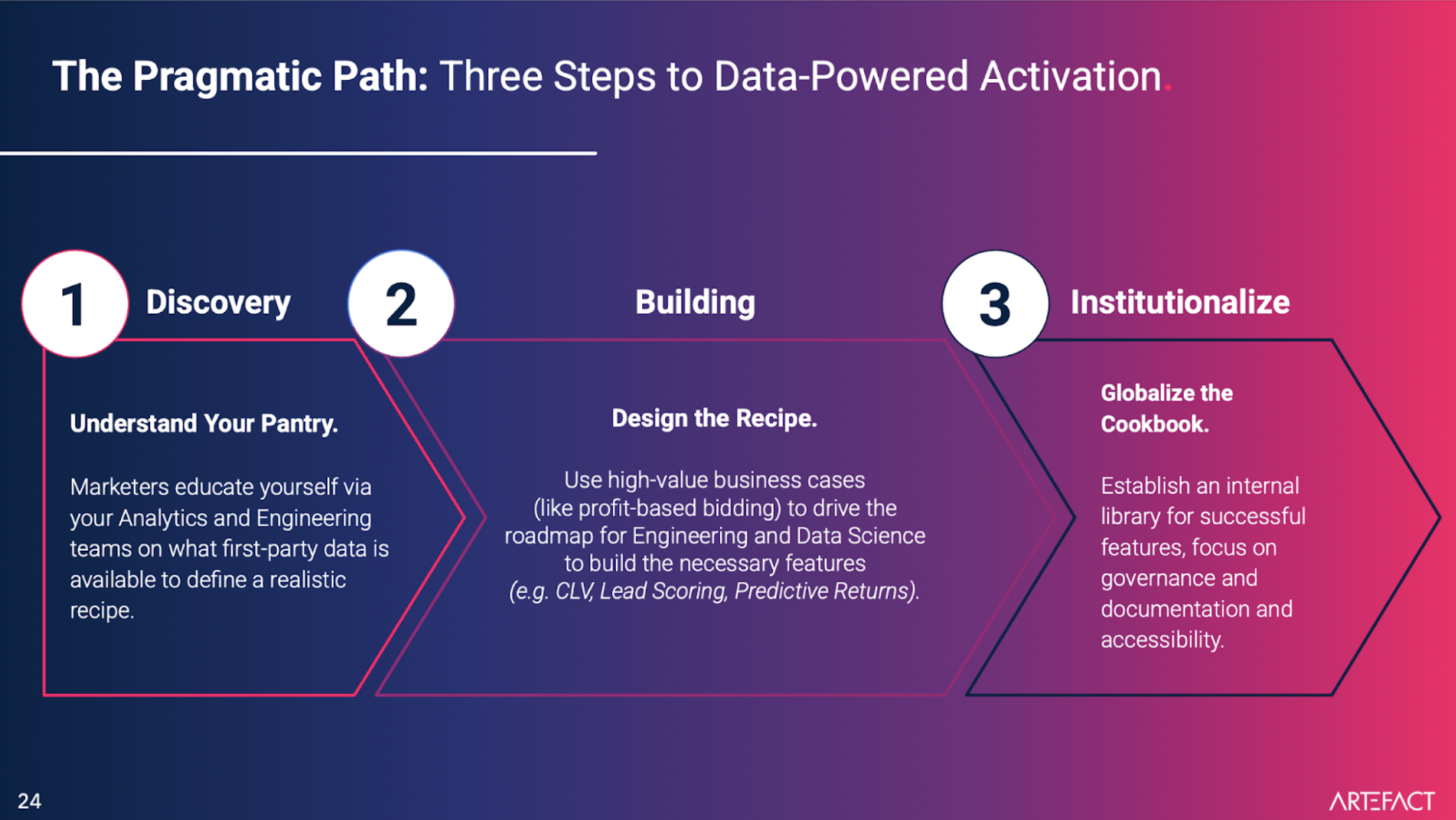
The Pragmatic Path: Your 2026 Roadmap
To avoid being left with a “frozen-meal” strategy while your competitors serve signature dishes, organizations must move beyond simple experimentation toward full institutionalization:
- Discovery: Conduct a thorough audit of your “pantry” to identify which first-party data ingredients are actually viable and high-quality.
- Building: Avoid building for the sake of technology; instead, design “recipes” based on high-value business cases, like profit-based bidding, that solve specific profit leaks.
- Institutionalize: Document every successful predictive signal in a global “Cookbook”. This ensures that high-performing features are governed, accessible, and utilized across the entire global organization rather than remaining trapped in siloed projects.
The gap between brands using generic “frozen” signals and those cooking with proprietary “signature” data is widening. Predictive signals are no longer an “innovation project”, they are the new requirement for survival. If you aren’t building your own signals today, you are effectively subsidizing your competitors’ success by using the same generic tools they do.
Ready to build your signature marketing strategy? Contact an Artefact expert today to assess your data pantry.
Contact us today to assess the full potential of your data ecosystem