
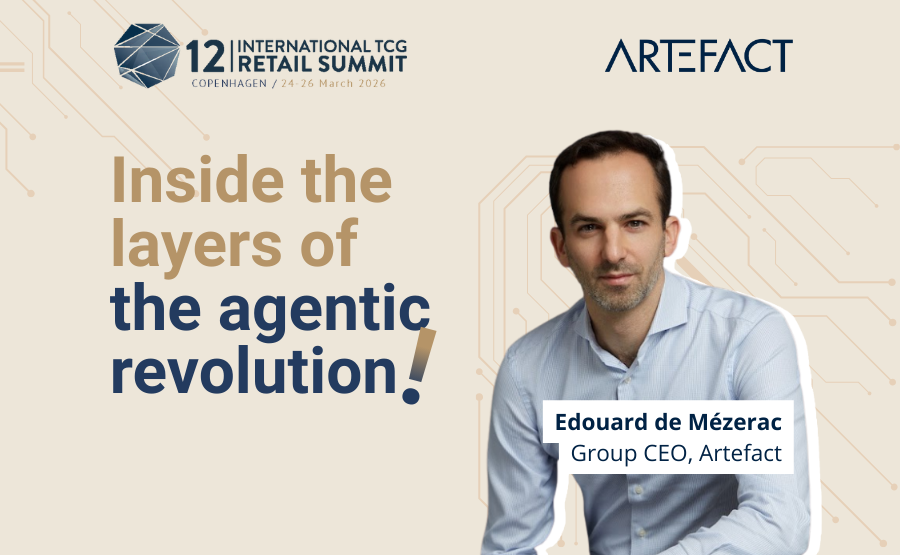
Interview with Edouard de Mézerac, CEO of Artefact, by
Edouard de Mézerac outlines how agentic AI is set to redefine everything from consumer shopping to internal retail operations, and how companies can unlock its full potential.
How will AI agents change the way consumers search, compare, and purchase products over the next few years?
There are three layers to it. The first is individual consumers using their own personal agents to do shopping, which could come sooner than we think. What happens when you start having the AI agents of your consumers shopping, and your website is not ready? What happens if the experience doesn’t work? This could be a strategic threat for some brands.
The second layer is the whole ecosystem of retailers and distributors. Take the example of the partnership between OpenAI and Walmart. Walmart items are available and searchable on ChatGPT, and potentially through a direct link straight to the website for transactions. This is becoming a new shopping interface like any other e-commerce platform in the past, with the difference that the experience can go much deeper because the knowledge ChatGPT, Anthropic, Gemini, etc. have on consumers is much more in-depth than transactional data.
The third layer is agentic commerce, helping all the internal processes of retailers. Tomorrow, agentic commerce will be helping salespeople, engagement with retailers, and using agents to enhance their own jobs. This may touch people in the field on the brand side and all the functions of retailers: promotional planning, negotiation, vendor optimisation, etc.
For companies that want to deploy agentic AI in areas like after-sales service, supply chain, personalised marketing, etc., what prerequisites do they need to get right first?
Here again, there are three angles. There’s being data ready, or for agentic, semantic data ready. Concretely, this means having governed data available in the right data sets, making sure there are standard definitions of what the data actually means, i.e., what a product is, what a flow is, what an entry location is, what a supplier is, etc. Having a common language across the company.
The second layer is being process ready. Many companies in retail or CPG run their business with a very entrepreneurial mindset and a high level of freedom given to the business teams. But if you want to embed agents in the company, you need defined workflows and end-to-end processes that decide where agents actually fit in.
The third prerequisite is to be tech-ready. This means making some choices, such as whether you want to buy or develop your own agents. It is important to have a clear strategy on this, as well as having the tech bricks to make it work.
In the TCG sector, what areas have the strongest potential for ROI when integrating AI agents?
Everything around customer service. Many companies are underutilising the options of self-care and are paying people to answer calls for really small, limited stuff.
This is immediate ROI. The second area is content, marketing, and media. Some companies are automating the adaptation of content for campaigns based on languages, products, and locations, much faster than having a single content format for one campaign.
IT is probably one of the most disrupted areas and holds potential for massive savings. For example, any migration from one language to another is accelerated using AI. Just running the ThinOps of an IT structure with monitoring costs, monitoring anomalies, etc., AI comes in.
With agentic, every function is impacted. In the case I will be sharing at the International TCG Retail Summit, we’ve helped Carrefour go through all their processes and workflows, qualifying the agentic potential of each.