
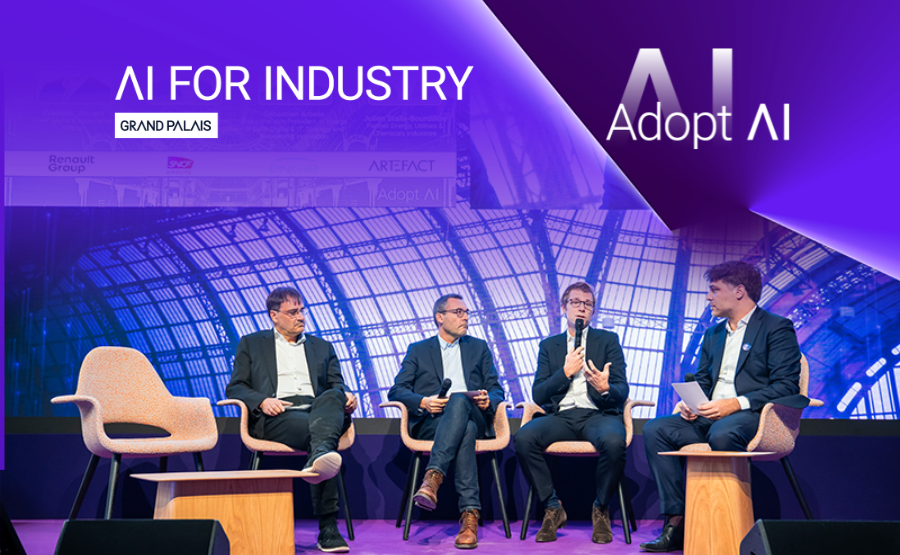
We are proud to share with you the replays of the AI for Industry’ Speakers who took the stage at Adopt AI and delivered outstanding value to the summit. Their vision, strategic perspectives, and real-world experience have been invaluable in inspiring organizations to shape and accelerate their AI roadmaps.
The integration of Artificial Intelligence into the industry sector represents a fundamental paradigm shift, moving far beyond incremental improvements to redefine operational strategy and asset utilization entirely. This transformation is not on the horizon; it is actively reshaping how vehicles, fleets, and infrastructure are managed today. To provide your team with a comprehensive understanding of these changes, the replays are now available.
These strategic highlights detail the most critical AI trends. They are not merely coexisting, they are part of a self-reinforcing flywheel that is rapidly reshaping the industry landscape:
-
Autonomous Operations are Becoming the New Standard: The industry is advancing beyond simple automation to AI agents that perform complex, large-scale dynamic optimization of entire physical infrastructures—such as national railway networks or airport ground operations in real time.
-
The Workforce is Being Augmented, Not Replaced: AI is successfully being deployed as a co-pilot that simplifies complexity and allows specialists to focus on their core craft, a transformation that thrives when championed by middle management, not just imposed from the top.
-
Digital Twins are Evolving into AI-Powered Innovation Engines: Digital twins have transformed from passive sandboxes into proactive discovery engines that accelerate simulation by orders of magnitude, autonomously searching millions of variants to find optimal solutions for physical processes before implementation.
-
Generative AI is Moving from Digital Content to Physical Design: The capabilities of generative AI are expanding beyond text and images and into the physical world, playing an emerging role in R&D and engineering to create novel outputs like new molecules, advanced materials, and optimized mechanical components.
-
AI Sovereignty has Become a Core Business Imperative: Protecting core intellectual property and ensuring operational autonomy in a volatile geopolitical landscape has elevated data and AI sovereignty into an existential business imperative for strategic survival.
To lead your organization through this era of change, it is essential to internalize these strategic principles. We encourage you to explore these themes in greater depth by watching the full session replays, an essential resource for your strategic planning and execution.