





In sport, data and AI are primarily associated with on-field performance: player analytics, tactical modelling and injury prevention. Technology has expanded the boundaries of athletic achievement, enabling athletes to push beyond previous limits.
So why aren’t more sports organisations applying the same thinking to the business of sport? Sport is an intensely competitive entertainment industry where marginal gains in areas such as fan engagement, content, operations and commercial decision-making can matter as much as results. Analysts project that the AI in the sports market could approach at least USD 34 billion by 2032, signalling adoption pressures across the value chain.
The question is no longer if data and AI should be used off-field, but how to deploy them strategically to reshape the sports enterprise. At Artefact, we see this off-field revolution already underway. It is essential to remain competitive and to redefine how clubs and leagues connect with fans, operate day to day and grow sustainably.
Today’s fans expect real-time access and personalised experiences, while clubs face pressure from owners and investors to grow revenue and streamline costs. Applying the same data strategies used for match analysis or scouting can transform every touchpoint from stadium to screen. The next big leap will not happen on the pitch, but behind the scenes in how the business of sport runs.
Where AI Wins Off the Field
1) Hyper-personalised fan engagement
Fans are no longer passive. AI can unify first-party data from apps, ticketing, social, and retail to deliver timely, individual experiences: dynamic offers during matches, tailored highlights, or virtual “courtside” for remote fans.
Mini-case: Wimbledon has shown the direction of travel using generative AI to create tailored match summaries and features at scale for web and app audiences, reaching tens of millions of digital fans in 2023.
The Artefact POV: Loyalty is built on emotion, AI scales emotional relevance into an actionable engagement strategy.
2) Predictive Fan Economics: Seeing the Next Wave
Fans don’t just react to the game; they create the market around it. Predictive AI allows clubs & teams to move from observing behaviour to anticipating it, modelling how fans will watch, buy, travel, and spend weeks or even months ahead. By analysing signals from ticketing, app interactions, weather, team form, and opponent data, AI can forecast attendance, merchandise demand, and churn risk, enabling proactive, revenue-generating decisions.
Mini-case: An NBA team used AI-driven fan segmentation to identify mid-season churn risk and trigger tailored retention offers. The result, a 15% uplift in season ticket renewals and a higher average spend per fan. Other organisations are extending these models to predict secondary spend on food, travel, and retail, turning game-day into an integrated, data-optimised ecosystem.
The Artefact POV: The most valuable fans aren’t just loyal, they’re predictable. Anticipation is the new advantage, when you can see the next wave of demand, you can ride it first.
3) Operational excellence: the invisible advantage
Behind a sold-out crowd is a complex operation. AI can forecast concession demand to cut waste and stock-outs, optimise staffing, and monitor crowd flows to reduce queues and improve safety. The smart stadium segment is projected to keep growing through 2032 as venues invest in connectivity, sensors and analytics to lift both experience and efficiency.
Mini-case: Mercedes-Benz Stadium deployed AI-driven logistics and crowd intelligence to optimise concession operations in real-time. By analysing entry data and purchasing patterns to adjust staffing and stocking dynamically, they reduced fan wait times by 40% and drove a 35% increase in food & beverage revenue.
The Artefact POV: Operational efficiency is not glamorous, but it funds glory. The venues that master logistics and crowd intelligence don’t just reduce costs – they unlock revenue, enhance safety, and create the seamless experiences that keep fans coming back..
Why Sports Stumble (and How to Leap Ahead)
Despite the clear opportunity, three distinct patterns often paralyse progress:
1. The Data Silo Trap. Most sports organisations operate in disconnected verticals. The ticketing team optimises for sell-outs, the retail team for merchandise margins, and the digital team for app engagement.
The friction: Because these systems rarely talk to each other, the organisation has a fractured view of the fan. A Buy Now push notification could be sent to a season ticket holder who is currently stuck in a queue or has just lodged a complaint.
The risk: Without a unified data layer, personalisation is impossible. You are left with generic mass-marketing strategies that frustrate the fans you are trying to engage.
Artefact View: Data isn’t just an IT asset; it’s a listening tool. A siloed organisation guesses what fans want, but a connected organisation knows. You can’t satisfy a fan you don’t recognise across channels.
2. The Purity of Sport Concern. This is potentially the most significant emotional barrier. Leaders and fans alike worry that the “AI-ification” of sport will strip away its soul.
The fear: There is valid concern that hyper-commercialisation will turn a raw, emotional experience into just another optimised entertainment product. Will the stadium atmosphere feel manufactured? Will the at-home fans screen become too cluttered with predictions stats and micro-betting prompts that the game itself becomes secondary?
The reality: AI should not compete with the purity of the game, it should protect it.
In the stadium: Removes friction that ruins the mood (long queues, confusing entry points), allowing fans to focus on the game & atmosphere.
On the screen: AI shouldn’t be used to gamify the match into oblivion. Instead, it should bridge the emotional distance, using data to deepen the narrative, making the fan on the couch or at the pub feel the pulse of the match rather than just watching a broadcast.
Artefact View: Technology should be invisible. If fans notice the off-field AI, you are likely over-engineering it. The best data strategies amplify the human connection, ensuring that even for the fan 5,000 kilometres away, the passion remains the primary product.
3. The Capability Gap. Ambition often outpaces infrastructure. We see many organisations suffering from “shiny object syndrome”, investing in GenAI tools without the underlying data governance to support them.
The gap: Only a minority of enterprises are truly AI-ready. They may lack the cloud infrastructure to process real-time data or the internal skills to interpret the outputs.
The consequences: Organisations that try to skip foundational steps often end up with expensive pilots that fail to scale. Sustainable success requires a foundation: clean data, clear consent frameworks and cross-functional teams.
Artefact View: AI is an amplifier. If you apply it to a messy foundation or bad processes, you’re simply scaling the existing chaos. Capability is built on governance first and tooling second.
To navigate these cultural and technical hurdles, organisations should not attempt to do everything at once. Instead, a phased approach ensures foundations are solid before scaling. The most reliable route follows five phases:
- Phase 1: Diagnose
Audit data assets, map fan journeys, and align AI use cases to business goals, for example increasing fan lifetime value or sponsorship ROI. - Phase 2: Foundations
Build the data and AI platform, governance and operating model required for sustainable change. This includes ethical fan data handling. - Phase 3: Pilot
Prove value with a few high-impact use cases that will scale, such as automated short-form highlights in-app or demand forecasting for food and beverage. - Phase 4: Scale
Embed AI into everyday workflows and decision-making so that marketing, commercial and operations teams routinely use predictions and personalisation as standard. - Phase 5: Adoption & Training
Adoption is where transformation succeeds or fails. When data-driven decision-making becomes instinctive across marketing, operations, and leadership, AI shifts from a tool to a competitive reflex.
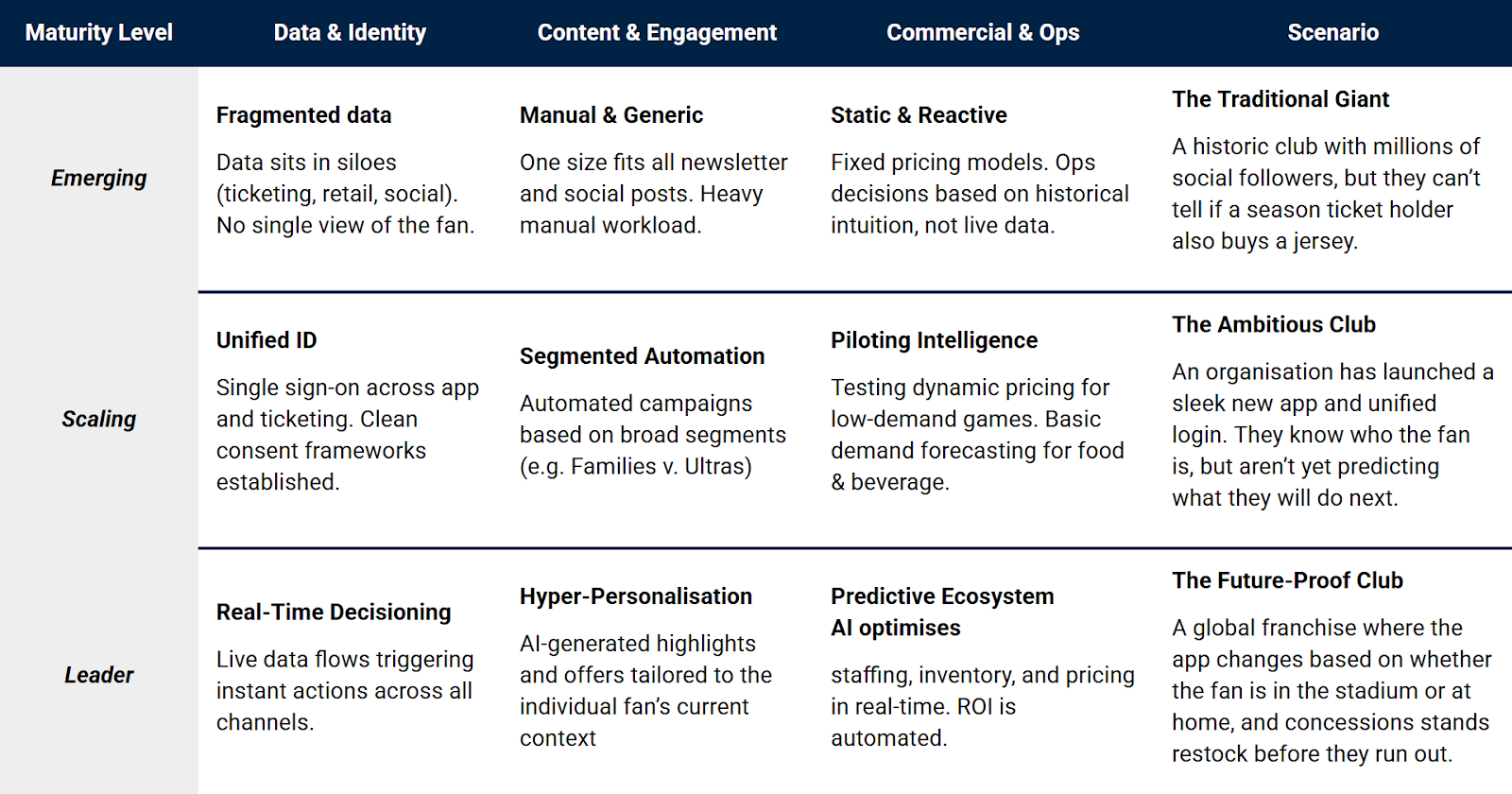
Not all sports organisations are starting from the same place. AI maturity off the field follows a clear progression, from fragmented data and reactive decisions to real-time, predictive ecosystems. The table below illustrates the typical stages seen across the industry.
The Sports Market in the Coming Years
AI investment in sport is accelerating. But the real inflection point is who owns the relationship with the fan. Off-field opportunities (streaming, merchandise, fantasy, dynamic pricing) are redefining club economics. More importantly, they demand first-party data. Organisations that can unify ticketing, app, retail and engagement data into a single fan view will dictate the next decade of sports. Those fragmented across silos will find themselves permanently handicapped.
Younger fans amplify this shift. They expect app-first experiences, real-time personalisation, and interactive features, not broadcasts. They’ve never known passive consumption. This is both the competitive requirement and the opportunity: organisations that design data governance and first-party identity from the outset can deliver hyper-personalised experiences across owned channels. Those without it will remain dependent on third-party data and generic strategies, unable to compete when the next generation of fans demands something more.
Beyond Operations: How Sports AI Will Reshape Fandom
The next wave of Sports AI will redefine how fans experience sports, extending engagement far beyond the stadium and the broadcast.
Over the next 2-3 years, spatial computing, AR glasses, and wearables will transform the fan experience. Fans will attend matches virtually with friends across the world, while stadium audiences will gain overlays such as live stats, replays, and tactical views. These experiences reduce the gap between being present and being remote, expanding the addressable fan base without diluting the atmosphere (e.g. Live sports on the Apple Vision Pro, F1 immersive onboard data, in-stadium AR via mobile devices).
Speed is not new in sports betting, but Intelligence is. AI is pushing betting into an era of hyper-granularity, where markets adapt continuously to live context, fan behaviour, and probability shifts in real-time. The competitive advantage will belong to organisations that can combine live signals, behavioural insight, and robust governance to build trusted, responsible betting ecosystems. (e.g. Genius Sports low latency feeds for micro-markets, FanDuel & DraftKings in-play AI pricing, risk management, and personalised betting journeys)
Across these futures, and many others, the constant remains the same: success depends on trusted data foundations, clear governance, and ownership of the fan relationship.
The Final Whistle
Ignoring data and AI no longer means falling behind; it risks becoming invisible while smarter, faster competitors redefine the game. The next era will be led by organisations that blend data agility with human passion. While the action on the pitch captures the headlines, the off-field opportunity captures the value.
Victories are earned on the pitch, dynasties are built behind the scenes. The same applies to future-proofing your club for a fast-changing world. At Artefact, we help teams move from data-rich to insight-driven so they can win on the scoreboard and in the boardroom.