



Introduction
In the high-stakes aviation landscape, On-Time Performance (OTP) is one of the primary levers for operational profitability. For a Tier-1 carrier, the financial impact of operational slippage has reached a critical threshold. As of 2024/2025, a single minute of delay costs an average of $100.76 in direct operating expenses.
For a major carrier operating a fleet of 500 aircraft, these inefficiencies manifest as a massive erosion of capital, often exceeding $500 million in annual “preventable” costs. Traditional reactive management is no longer sufficient to handle the complexity of modern flight rotations. This paper introduces the OTP AI Agent: an autonomous orchestration layer designed to predict disruptions before they manifest, synchronize cross-functional teams, and execute recovery actions. By transitioning from “buffer-based” scheduling to “agentic” orchestration, airlines can recover millions in lost OPEX while protecting brand equity in an increasingly competitive global market.
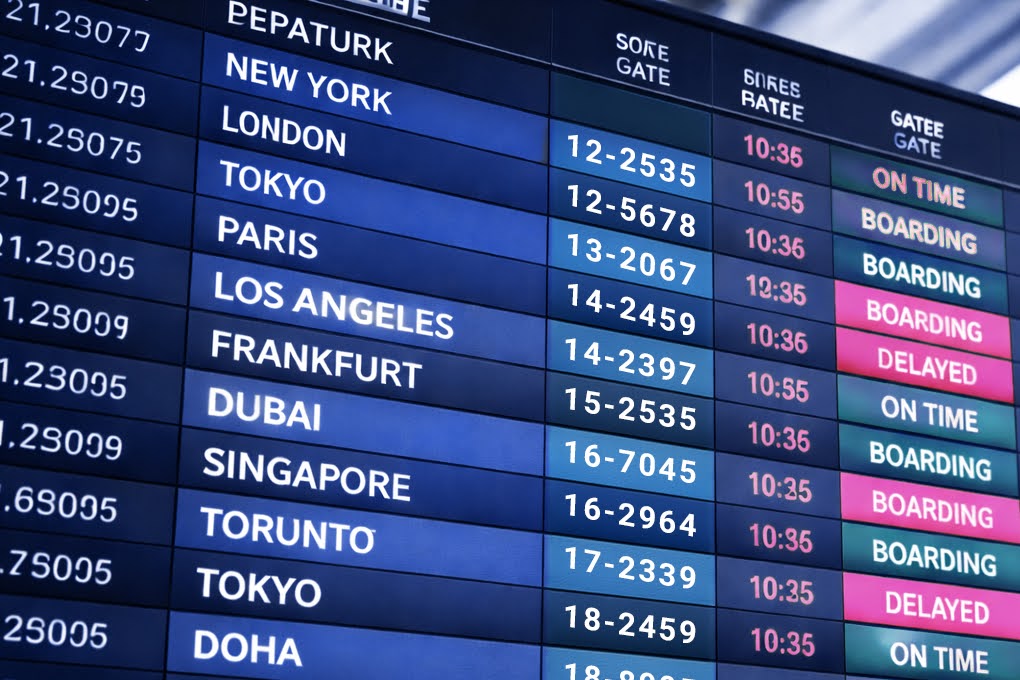
Airlines often underestimate the true impact of delays on operating expenditure, as delay-driven costs are dispersed across fuel burn, crew utilization, passenger handling, and network recovery, concealing their cumulative effect on OPEX. – Anthony Cassab
1. The operational chain is a fragile synchronicity
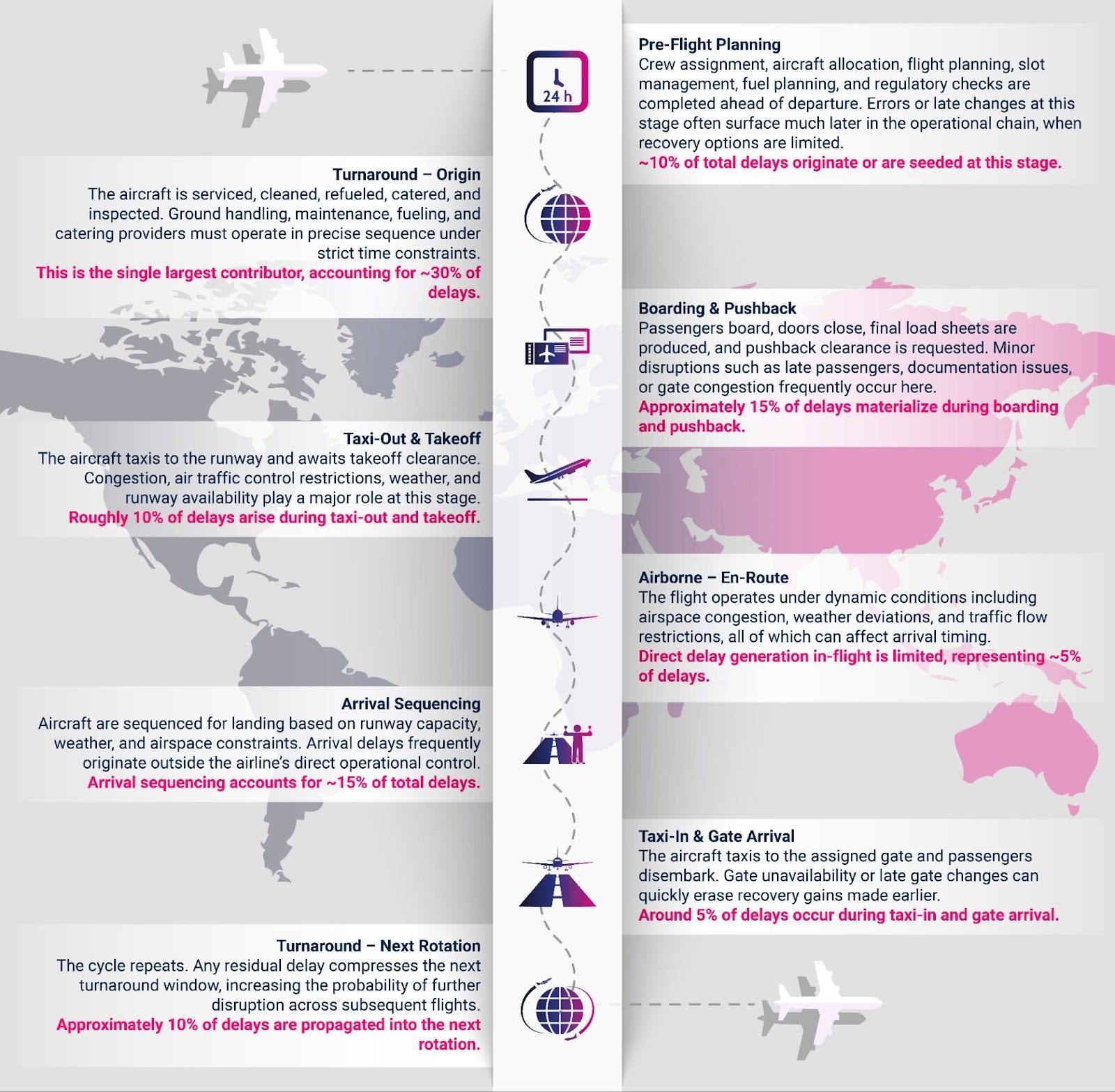
Every flight is a high-dependency sequence of eight stages. A failure in any single “link” creates a “Reactionary Delay” that cascades across the network, often accounting for 46% of total delay minutes globally. Because each stage involves distinct teams (ground handlers, flight deck, Air Traffic Controller, and maintenance), information silos are the primary drivers of inefficiency.
2. The economic friction of delays with global evidence
Delays are not merely an operational nuisance; they represent a direct erosion of capital. In the current economic climate of high labor inflation and fuel price volatility, the financial fallout of operational slippage has reached historic highs.
Direct financial impact
- Cost per minute: According to recent data from Airlines for America, the average cost of a block-minute delay for a passenger carrier is $100.76. For a Tier-1 airline operating hundreds of daily rotations, a systematic 5-minute slippage across the fleet translates to an annual EBITDA drain of approximately $92 million.
- Labor & crew expirations: Crew costs (pilots and attendants) are the primary driver of delay expenses, now exceeding $35.23 per minute. Beyond direct pay, significant costs are incurred when a delay causes a crew to “time out” (exceed legal duty limits), necessitating standby crew activation or, in worse cases, flight cancellations.
- Fuel burn & infrastructure: Ground delays are particularly punitive. American Airlines recently demonstrated that by using AI to optimize gate assignments and reduce taxi times by just one minute per flight at its Dallas-Fort Worth hub, it could save 870,000 gallons of fuel annually.
The regulatory and brand penalty
In jurisdictions with strict passenger protections, such as Europe or emerging consumer frameworks in the GCC, long-tail delays carry immediate liability. For an airline like Lufthansa or Emirates, a delay exceeding three hours can trigger compensation claims of up to $650 per passenger. For a wide-body aircraft with 300 passengers, a single operational failure can result in a $195,000 instant liability, effectively erasing the profit margin of that flight and several subsequent rotations.
3. The agentic OTP orchestrator as a transformative solution
The aviation industry is transitioning from descriptive analytics (identifying what happened in the past) to agentic orchestration (autonomously determining the best course of action and executing it). An OTP Agent is not a passive monitoring tool; it is an autonomous intelligence layer that sits atop the Airline Operations Center. It functions as a digital “Chief Operations Officer” for every individual aircraft (tail number) in the fleet, managing the minute-to-minute variables that human controllers can no longer track at scale.
A. Technical architecture of the “Perceive-Reason-Act” framework for autonomous OTP
To achieve true autonomy, the OTP Agent utilizes a three-tier architectural stack that integrates siloed legacy systems into a unified, proactive decision engine.
- The perception layer (High-frequency data ingestion): Unlike human controllers who monitor systems periodically, the Agent ingests data in millisecond intervals. This includes Aircraft Communications Addressing and Reporting System telemetry (real-time engine and door status), Computer Vision feeds from the apron (using cameras to track the physical movement of fuel trucks and baggage tugs), and Hyper-local Weather Application Programming Interfaces.
> Strategic insight: By correlating CV data with the flight schedule, the Agent “sees” that a catering truck is obstructed five minutes before the ground crew even reports a delay, allowing for immediate intervention. - The reasoning layer (probabilistic simulation): At the core of the “Agent” is a Reinforcement Learning engine, a type of machine learning where the system learns to make decisions by simulating various outcomes. When a potential disruption is detected, the Agent runs thousands of “what-if” simulations to calculate the Total Cost of Disruption.
> Decision Logic: It evaluates whether it is more cost-effective to hold a flight for 10 connecting passengers (calculating the extra fuel burn required to make up time in the air) versus the high cost of rebooking them on a competitor, providing hotel vouchers, and the long-term loss of passenger loyalty. - The action layer (autonomous execution): The differentiator of an “Agent” over standard Artificial Intelligence is the ability to “close the loop” without manual input. Through direct integration with the Passenger Service System and Crew Management Systems, the Agent can execute recovery actions instantly.
> Example: If the Agent identifies a late arrival, it can automatically re-assign the aircraft to a closer gate to minimize taxi-in time, while simultaneously sending a push notification to the ground handling team’s handheld devices to pivot to the new location.
B. Strategic buffer optimization beyond automation
Traditional airline schedules are padded with “buffers”, extra time added to flight durations to absorb potential delays. While buffers protect OTP, they are incredibly expensive, as they reduce aircraft utilization (the amount of time an aircraft is actually earning revenue).
The OTP Agent enables Dynamic Buffer Management. By analyzing historical performance and live context (e.g., “Monday mornings at Dubai International during fog season”), the Agent can advise the scheduling team to shrink buffers on high-certainty routes and expand them only when the risk profile justifies it. This allows an airline to “manufacture” capacity, potentially adding 1–2 extra flight rotations per aircraft per month without the multi-million dollar investment of increasing fleet size.
C. Human-agent synergy (Human-in-the-loop)
The system operates under a “Policy Guardrail” framework to ensure safety and regulatory compliance. For micro-adjustments (e.g., shifting a pushback time by 4 minutes), the Agent acts autonomously. For “High-Regret” decisions, such as swapping one aircraft for another or a total flight cancellation, the Agent prepares a Decision Support Package. It presents the Duty Manager with the top three optimized scenarios, the projected financial impact of each, and the probability of success, reducing the human decision cycle from 30 minutes of manual phone calls to under 60 seconds of digital review.
In today’s hyper-competitive aviation landscape, airlines that operationalize real-time intelligence will outperform those still relying on reactive control models. – Kartik Sen
4. The ROI: Small gains, massive scale
In the aviation sector, the financial “gearing” of OTP is such that even a 1% improvement in punctuality yields outsized returns to the bottom line. This is due to the mitigation of Reactionary Delays, which otherwise multiply the cost of a single disruption across the network by a factor of 3x to 4x.
Financial recovery projections
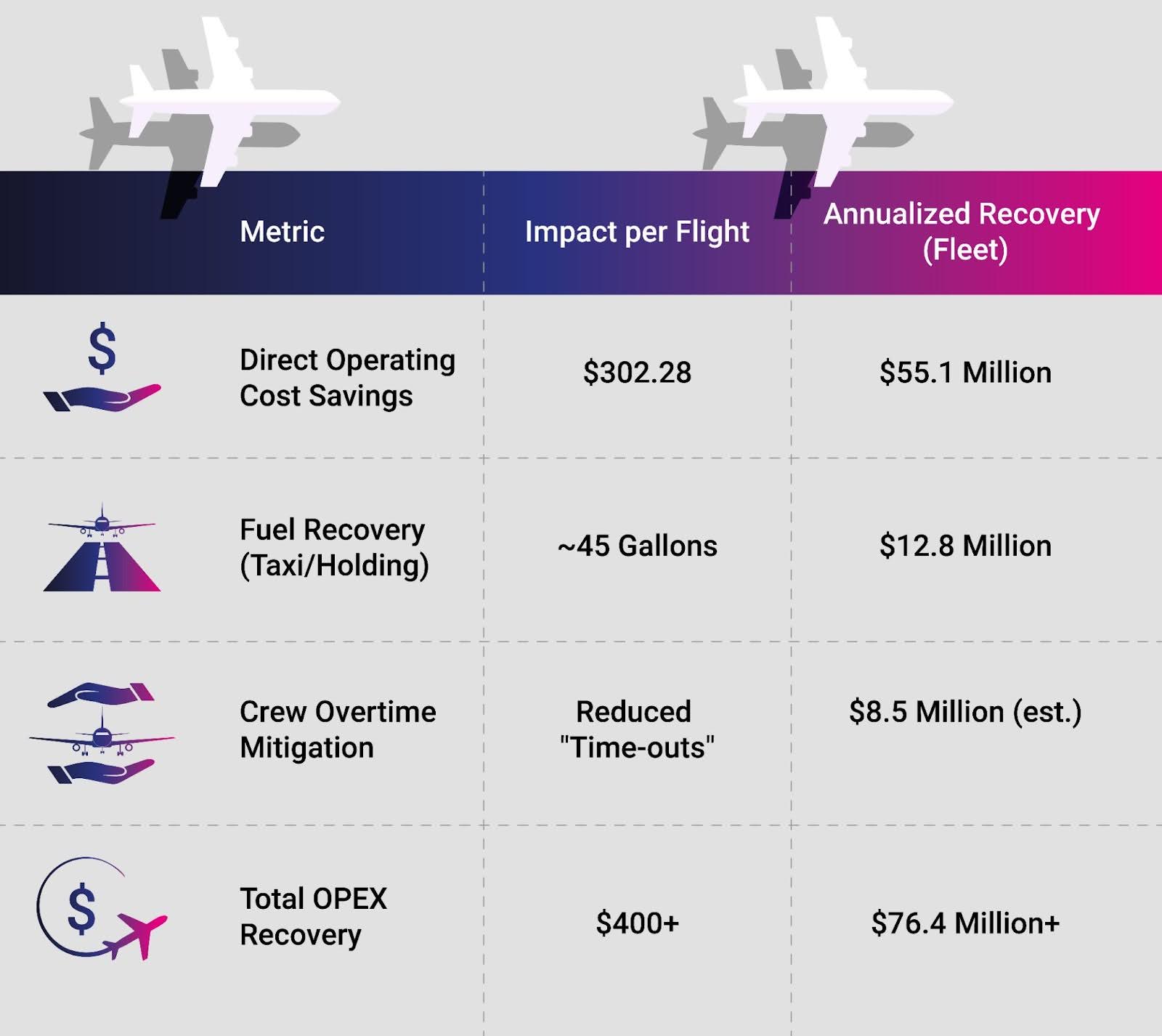
To quantify the impact, we utilize the industry-standard $100.76 cost per block-minute. For a major carrier with a fleet of 500 aircraft, the recovery of just three minutes of delay per flight results in the following annualized impact:
Transitioning to agentic orchestration
The strategic imperative for GCC and global carriers is clear: in an era of razor-thin margins and escalating labor costs, On-Time Performance is the most potent lever for protecting operational profitability. The current “buffer-heavy” approach to scheduling is an expensive relic of a pre-AI era, costing Tier-1 carriers hundreds of millions in preventable Operating Expenditure (OPEX) and underutilized aircraft capacity.
By deploying an OTP AI Agent, leadership can shift from a reactive posture, managing disruptions as they occur, to a proactive, agentic model that perceives micro-delays, simulates optimal recovery paths, and coordinates cross-functional teams in real time. For organizations aiming to dominate the global aviation landscape, the transition from human-led monitoring to autonomous orchestration is no longer a technical choice, but a financial necessity. To maintain a competitive edge, the focus must now shift toward the rapid integration of these autonomous layers into the core of the Airline Operations Center.