
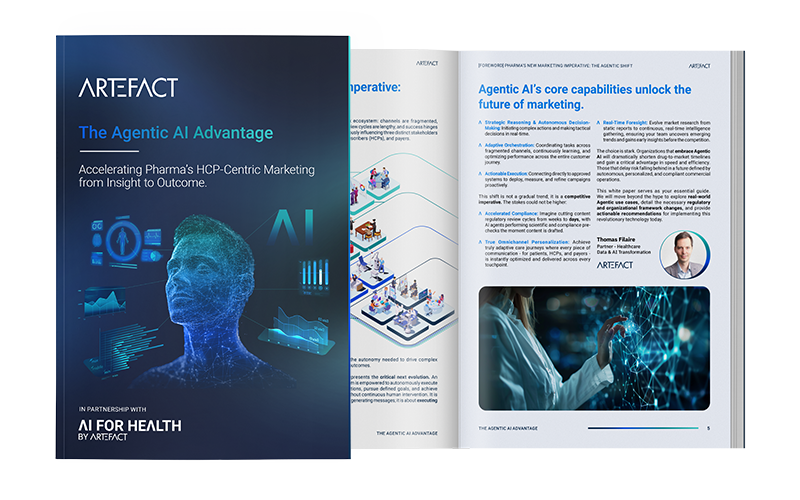
Artefact’s new ebook, The Agentic AI Advantage in Healthcare: Accelerating Pharma’s HCP-Centric Marketing from Insight to Outcome, demonstrates that agentic AI represents a major step forward in solving these challenges. While traditional generative AI focuses on creating content, agentic AI can take action. It receives goals and constraints, reasons strategically, and executes tasks autonomously within the guardrails of compliance and approved data sources. Agentic AI elevates AI from a productivity tool to a business performance engine.
It is clear that agentic AI is poised to redefine marketing, medical engagement, compliance, and the sales model. It is not a futuristic concept. It is already driving measurable return on investment in global organizations. The companies that adopt early will gain a long-term advantage in how they activate data for growth.
“Organizations that embrace agentic AI will dramatically shorten drug-to-market timelines and gain a critical advantage in speed and efficiency. Those that delay risk falling behind in a future defined by autonomous, personalized, and compliant commercial operations.” – Thomas Filaire, Global Head of AI Solutions, Artefact
Why healthcare must move beyond traditional AI.
Generative AI brought immediate productivity wins: faster content creation, smoother translation workflows, enriched analytics dashboards. But healthcare executives are now facing diminishing returns unless they evolve to models where AI drives execution.
Three market forces make this shift urgent:
- Data is outpacing human capacity: Every interaction across channels generates new information: HCP behavior data, claims, EHR-derived insights, CRM actions, field activity, omnichannel triggers. Humans cannot synthesize or act on this volume at the required speed.
- Commercial pressure is rising: Launching successfully now requires highly personalized journeys and scientifically credible interactions. The traditional model of mass content + infrequent field visits is no longer sufficient to drive market share.
- Compliance is still a bottleneck: Medical-Legal-Regulatory (MLR) reviews add weeks of delays. The result is content that is often outdated by the time it reaches customers.
Agentic AI addresses these constraints by allowing companies to work at the speed of the market rather than the speed of the approval cycle.
Five capabilities that make agentic AI different.
Agentic AI systems go beyond traditional generative models. They don’t just produce outputs, they pursue goals. Their strength lies in combining autonomous behavior with the technological architecture that makes it possible.
- Example of autonomous decision-making: An agent monitors HCP engagement data, identifies low-response segments, and automatically adjusts communication cadence or channel mix without human intervention.
- Example of strategic reasoning: An agent reviews prescribing trends, formulary access, and competitive activity, then recommends the optimal next-best action for each HCP audience.
- Example of contextual understanding & memory: An agent remembers prior touchpoints, tailoring medical content for each HCP based on specialty, channel preference, and prior engagement behavior.
- Example of adaptive orchestration: One agent manages content approval workflows, another triggers compliant digital engagement, while a third monitors real-time feedback – all synchronizing to maintain MLR (Medical, Legal, and Regulatory) compliance and optimize reach.
- Example of actionable execution: An agent launches an HCP email campaign through Veeva CRM, tracks open and click-through rates, and refines segmentation or timing based on observed response patterns.
Agentic AI systems don’t replace humans, they automate the “last mile”: connecting data insights to action while humans define strategy and oversight. Agents execute rapidly and continuously optimize. For leaders accustomed to cautious innovation cycles, this marks a major mindset shift. Only C-suite guidance can orchestrate this level of change across commercial, medical, IT, and compliance teams.
“AI in the commercial space can be just as impactful – if not even more – than in R&D when it comes to driving benefit, revenue and efficiency.” – Florent Hassen, Global Commercial Data Science & Artificial Intelligence Lead, Roche
Where agentic AI delivers enterprise-level value.
Agentic AI is proving its impact in four core areas of healthcare operations. Each one has a practical focus use case that is already delivering measurable ROI for early adopters.
1) Market research: From static reports to real-time intelligence
Focus use case: Rapid campaign testing and optimization
Commercial teams gain a new operating rhythm. Instead of planning cycles defined by quarterly approvals and manual setup, agents continuously run controlled experiments, optimize based on real-time data, and activate content only when it proves effective. This reduces spend and reveals growth opportunities that would otherwise be missed.
- Up to 90 percent cost reduction in pilot testing
- Faster discovery of winning messages and segments
- Stronger agility in competitive launches
“Today, with this kind of AI tool, we can test campaigns in 12 to 24 hours for around $7,000. When you compare that to the old method – 8 to 10 weeks for $100,000 or $150,000 – it’s difficult to go back.” Jeremy Peaudecerf, Europe Marketing Director, Moderna
2) Content development and validation
Focus use case: Automated pre-checking and accelerated medical reviews
MLR teams remain gatekeepers of scientific credibility, but agents eliminate repetitive formatting and validation tasks. Automated prechecks flag risks early, while traceable reasoning accelerates approval without compromising compliance.
- Review cycles up to 60 percent faster
- Lower operational burden on medical reviewers
- More confident compliance governance
“While still in pilot phase, early results on the MLR review project are promising: 100% of users report satisfaction, time savings, and fewer MLR iterations.” – Marie Morice-Morand, Associate Director Innovation, Omnichannel and Training, Amgen
3) Campaign execution and omnichannel engagement
Focus use case: “Turing”, Sanofi’s Next Best Action companion for HCPs
Agentic AI unifies behavioral insights, channel preferences, and treatment data to personalize engagement for every HCP. Instead of generic campaigns, each physician receives the right scientific content based on real-time market dynamics and therapeutic relevance.
- Personalization rooted in validated scientific data
- Higher engagement rates and better educational relevance
- Continuous feedback loops improving the system over time
“Turing acts as a true companion for our reps. By embedding AI suggestions directly into their CRM, we’ve empowered them to deliver the right message to the right HCP at the right time, driving a 10:1 return on our investment.” – Marion Dumas, Global Head of Omnichannel, Sanofi
Individually, each use case moves a specific team faster. Together, they create an enterprise engine where strategy and execution operate in real time, improving ROI, compliance, and customer experience simultaneously.
4) Sales enablement and field support
Focus use case: Rep coaching, preparation, and CRM automation
Access to HCPs is scarce and every minute matters. Agents prepare reps with tailored engagement plans based on each HCP’s scientific interests, previous interactions, and patient profiles. They also automate visit reporting and suggest next actions.
- More relevant conversations that strengthen scientific trust
- Reduced admin work and better CRM data quality
- Higher share of voice in priority accounts
“Every [HCP] visit is a critical opportunity that requires the rep to be fully prepared. Here comes the power of AI.” – Saber Daassi, Global Head of Digital and Data, UCB Pharma
What C-suites must solve to scale.
Executives interviewed agree that the technology is not the hardest part. Success depends on:
- Data readiness: Interoperability, structured taxonomies, and access to real-world and CRM data are essential.
- Governance and risk frameworks: Agentic AI must operate on approved sources only, with auditability and human oversight.
- Operating model change: Roles evolve. Marketing strategists shift from producing materials to orchestrating systems. Medical teams focus on scientific validation rather than operational workflows.
- Organizational alignment: AI literacy must become standard. Roche has already made AI training mandatory enterprise-wide.
Without executive sponsorship, progress stalls in isolated pilots. With sponsorship, transformation becomes systemic.
The economic value of adopting agentic AI.
Adopters are demonstrating financial benefit across multiple dimensions, from higher launch effectiveness, faster feedback loops, and improved engagement metrics across channels to faster, enhanced compliance, greater general productivity, and better ability to target “growth pockets” in competitive markets.
Once agentic AI systems are connected end-to-end, they produce compounding value: smarter data, better outcomes, and faster learning cycles.
The impact extends beyond efficiency. It affects topline growth. The companies that deploy agentic AI at enterprise scale will outperform peers in acquisition, retention, and lifetime treatment value.
A new partnership between humans and AI.
Healthcare relies on trust. That will never change. What changes is how high-skilled talent spends its time. Repetitive tasks, compliance checks, and experimental setup become autonomous functions. Human expertise focuses where it matters:
- Crafting differentiated strategy
- Deepening scientific communication
- Building stronger relationships with HCPs
- Accelerating therapeutic adoption
- Improving patient outcomes
The future of pharma marketing is collaborative, with humans and AI agents working together to turn insights into action. Agentic AI does not replace marketers, but rather extends their capabilities, unifies previously fragmented workflows, and empowers teams to achieve greater impact.
A strategic imperative for the future.
Agentic AI is not simply an upgrade to existing systems. It represents a fundamental shift in how pharmaceutical and medical organizations think, operate, and compete. Companies that approach adoption step by step, with clear governance and human accountability, will be better positioned to improve their overall efficiency and in the end, better address healthcare professionals and strengthen patient engagement
The impact is already visible in faster engagement cycles, deeper insights from data, stronger compliance assurance, and better returns across marketing and field activities. Organizations that embrace agentic AI now will secure a durable competitive edge as scientific complexity grows and customer expectations rise. This is the moment to transform AI from a promising innovation into a core engine of business performance.