Human Resources is undergoing a fundamental shift from a reactive cost center to a proactive driver of value. Yet many organizations remain anchored in a minimalist approach to people analytics. While generative AI and autonomous agents are gaining traction across the enterprise, HR’s use of data is still often limited to basic turnover prediction.
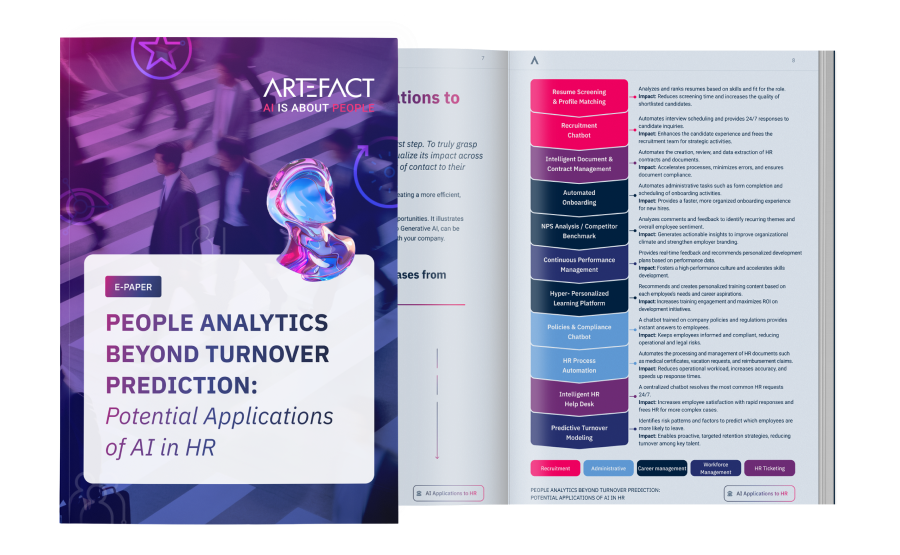
Artefact’s white paper, People Analytics Beyond Turnover Prediction: Potential Applications of AI in HR, explores what’s holding companies back. Fragmented data across HRIS, payroll and engagement platforms, along with inconsistent or outdated information, continues to limit impact and prevent HR from unlocking true competitive advantage.
At the same time, the role of analytics is evolving, moving from passive dashboards to active orchestration. Beneath conventional HR metrics lies a largely untapped opportunity to use AI to reshape how organizations operate at their core. To step into a more strategic role, HR leaders must go beyond surface-level insights and rethink how data is activated.
This paper outlines a blueprint for a modern, agent-augmented HR function that anticipates needs, supports employee well-being and growth, and delivers measurable business impact well before retention becomes a concern.
From predictive to agentic: The executive’s guide to the AI toolkit
Although a foundational understanding of AI technologies is not a technical requirement for the C-suite, it is a strategic imperative for making high-stakes investment decisions. To build a future-ready workforce, leaders must comprehend the technology behind it.
- Machine Learning (ML): The strategic value of ML lies in the transition from attrition costs to stability premiums. By identifying complex patterns in work habits and well-being data, ML allows HR to move from forensic analysis to proactive stability, forecasting burnout or absenteeism before it compromises organizational output.
- Natural Language Processing (NLP) and Generative AI: These technologies function as sentiment intelligence engines. They transform the “noise” of unstructured feedback into actionable insights. Generative AI goes further, scaling the human element by creating hyper-personalized development plans and communications at a speed and volume that manual processes cannot match.
- AI agents and copilots: Together, they represent the death of the traditional HR ticketing system. An autonomous “Concierge” model is emerging, where systems reason, plan, and execute multi-step tasks. These agentic systems increase the span of control for HR leaders by 10x, shifting HR from a support function to an orchestrator of career journeys.
“Artificial Intelligence in Human Resources is often reduced to a single, familiar scenario: predicting employee turnover. The companies that move beyond conventional models are gaining an unprecedented competitive advantage.”
Understanding these technologies is only valuable when mapped to the specific stages of the employee lifecycle, ensuring that innovation translates into a seamless human experience.
Impactful applications: Reimagining the ‘Hire to Retire’ journey
The true power of AI lies in its ability to orchestrate the entire employee experience at scale. By integrating agentic hubs into the “Hire to Retire” journey, companies can move from isolated tools to a continuous, intelligent partnership.
- Talent acquisition: AI removes the bottlenecks of traditional sourcing. By moving from reactive hiring to an always-on recruiting model, organizations can scale candidate engagement significantly. Beyond mere screening, candidate journey intelligence agents can track every touchpoint, ensuring a high-quality, personalized experience from the first interaction.
- Learning and development: Agility is the currency of the modern workforce. AI enables the design of hyper-personalized learning paths that adapt to real-time career aspirations. Visionary firms are now deploying synthetic persona agents that enable managers to role-play and rehearse difficult performance reviews or coaching sessions, effectively institutionalizing leadership excellence.
- Performance and well-being: Utilizing Organizational Network Analysis (ONA), AI identifies knowledge silos and key influencers that traditional charts miss. By pairing ONA with predictive modeling, organizations can reduce employee strain and optimize workforce health, ensuring that high performance remains sustainable.
These applications are not mere theoretical ambitions; they are delivering proven, multi-million dollar financial returns for global market leaders.
The ROI of intelligence: Real-world success stories
AI in HR is no longer a pilot project; it is a proven generator of growth and organizational resilience. The following cases demonstrate the measurable business results achieved when data science is applied to human capital:
- Large beverage company (workforce health): During the pilot phase alone, this organization achieved USD 459,000 in savings. By using ML to forecast absenteeism three months in advance, they created 46 proactive action plans to mitigate burnout and illness.
- Global cosmetics company (Salesforce allocation): Using ML clustering and operations research, this organization optimized store coverage and task allocation. By intelligently grouping locations and tasks based on market demand, they captured significant revenue potential that was previously untapped.
- Microsoft (DEI and representation): Leveraging data-driven accountability, Microsoft achieved a 3.2 percentage point increase in female executive representation in a single year. Critically, the company reached 107.8% of its 2025 leadership target for Black and African American representation.
- Dell Technologies (HiPo identification): By moving to an ML-based “holistic view” of talent that bypasses subjective manager bias, Dell reported a 300% increase in the identification of diverse, high-potential “hidden gems” for leadership development.
While these results are compelling, they are only sustainable when built on a foundation of ethical governance and uncompromising trust.
The foundation of trust: Ethics, security, and compliance
For the C-suite, AI ethics is not a moral suggestion; it is a risk-management imperative. Because people analytics involves sensitive Personally Identifiable Information (PII), protecting employee trust is essential for brand reputation. The white paper advocates for an Integrated Trust Framework built on five critical layers:
- Global data protection: Compliance with GDPR and LGPD is a baseline. Non-compliance risks are severe, with fines reaching up to 4% of global turnover.
- Ethical principles: Organizations must move beyond the black box. Transparency and explainability (XAI) are required to ensure employees understand the logic behind AI-driven decisions.
- Governance and cross-functional roles: Effective AI deployment requires alignment between Legal, HR Analytics, and Compliance to prevent “function creep.”
- Technical safeguards: Implementing “Privacy by Design,” encryption, and Role-Based Access Control (RBAC) ensures data minimization and security.
- Continuous oversight: A culture of trust is maintained through regular audits and human-led accountability.
“AI must augment, not replace, human judgment. Ultimate accountability for significant personnel decisions. Hiring, promotion, and termination must always rest with a person.”
Trust is the ultimate currency. By prioritizing human oversight and bias mitigation, leaders ensure that AI remains a tool for empowerment rather than a mechanism for opaque automated control.
Your implementation roadmap, from pilot to full-scale impact
Start with a real business problem, not with technology: Don’t ask, “What can we do with AI?” Instead, ask, “What is our most pressing people-related challenge?”
Build a cross-functional team: A successful people analytics project requires more than just HR. Involve stakeholders from IT (for data infrastructure), Legal (for compliance and ethical oversight), Finance (to measure business impact), and the business units themselves.
Focus on a solid data foundation and data quality: AI models are only as good as the data they are trained on. Before launching a major initiative, conduct a data audit. Ensure your data is clean, consistent, integrated, and accessible.
Prioritize transparency and communication: Be open with your employees about how you are using data and AI. Explain the “why” behind your initiatives, the benefits you aim to achieve, and the robust safeguards you have in place to protect their privacy and ensure fairness. Create “superusers”, enthusiastic employees who can champion the new tools and methodologies within their teams.
Begin with a pilot project to prove value: Start small to learn fast and demonstrate ROI. Select one well-defined use case with clear, measurable metrics for success. A successful pilot builds momentum and makes a powerful case for broader investment.
Upskill your HR team: Invest in training that empowers them to understand, interpret, and communicate data-driven insights. This will be the bridge between the technology and its practical application.
Conclusion: The future is human + agentic
The roadmap for AI adoption in HR is clear: empower individuals with secure tools, focus on high-impact pilots that demonstrate immediate ROI, and scale through a culture of continuous learning.
By using agentic AI to build a smarter, more proactive, employee-centered ecosystem, the very nature of work is redefined. The future of the enterprise is not a choice between human intelligence and artificial intelligence; it is the powerful synthesis of both. In this human + agentic future, technology handles the complexity, while people focus on the uniquely human qualities of empathy, creativity, and strategic judgment.