
Adopt AI Summit 2025 at a glance
- 20.000 attendees
- 650+ speakers
- 250+ exhibitors
- 7 stages
- 35+ country delegations
- 70+ country represented
- 14 country booths
- 1.000+ CEOs
- 3.000+ CXOs
Watch all the AI for Retail & Consumers session replays
Key highlights
Generative AI is not merely the next wave of technology; it represents a fundamental strategic shift for the retail and consumer goods industries. For leaders, the challenge is to move beyond experimentation and weave AI into the operational fabric of the business to unlock measurable P&L impact. This report distills the most critical strategic lessons from our recent summit, offering C-level clarity on how to navigate this transformation and build a true competitive advantage.
Our analysis of leaders’ journeys reveals that success is not accidental. It is the result of deliberate, often radical, focus on six specific strategic imperatives. These are the areas that separate market leaders from the rest, turning AI from a cost center into a core driver of enterprise value.
- Operational Reinvention AI is creating predictive and autonomous operational frameworks that shift businesses from reactive problem-solving to proactive value creation, mitigating risks before they happen and scaling expert decision-making across the enterprise.
- Human Augmentation as the Primary ROI The most significant and immediate value of AI lies in empowering the workforce transforming domain experts into autonomous AI builders, augmenting sales and service teams with data-driven recommendations, and freeing human talent to focus on high-value strategic work.
- The New Customer Experience Frontier AI is fundamentally reshaping customer interaction by enabling personalization at an unprecedented scale, creating more curated and elevated in-store experiences, and shifting the paradigm from static digital assets to dynamic, conversational commerce.
- The Foundational Imperative Leaders are building their AI advantage on a hybrid organizational model of “central enablement and decentralized execution,” ensuring engineering rigor at the core while using AI agents to dynamically clean and enrich the data foundation needed for business units to innovate at the edge.
- Pragmatic Value Realization The winning approach to AI investment achieves transformative results by relentlessly accumulating “marginal gains” from a focused portfolio of use cases, each selected for its clear, measurable P&L impact rather than speculative potential.
- The Adoption & Culture Challenge The technology is the solvable component; the primary challenge and the true source of competitive differentiation is mastering enterprise-wide adoption and cultural change through a dual strategy of strong executive sponsorship and a decentralized culture of experimentation.
To lead your organization through this era of change, it is essential to internalize these strategic principles. We encourage you to explore these themes in greater depth by watching the full session replays, an essential resource for your strategic planning and execution.

CEO Stage
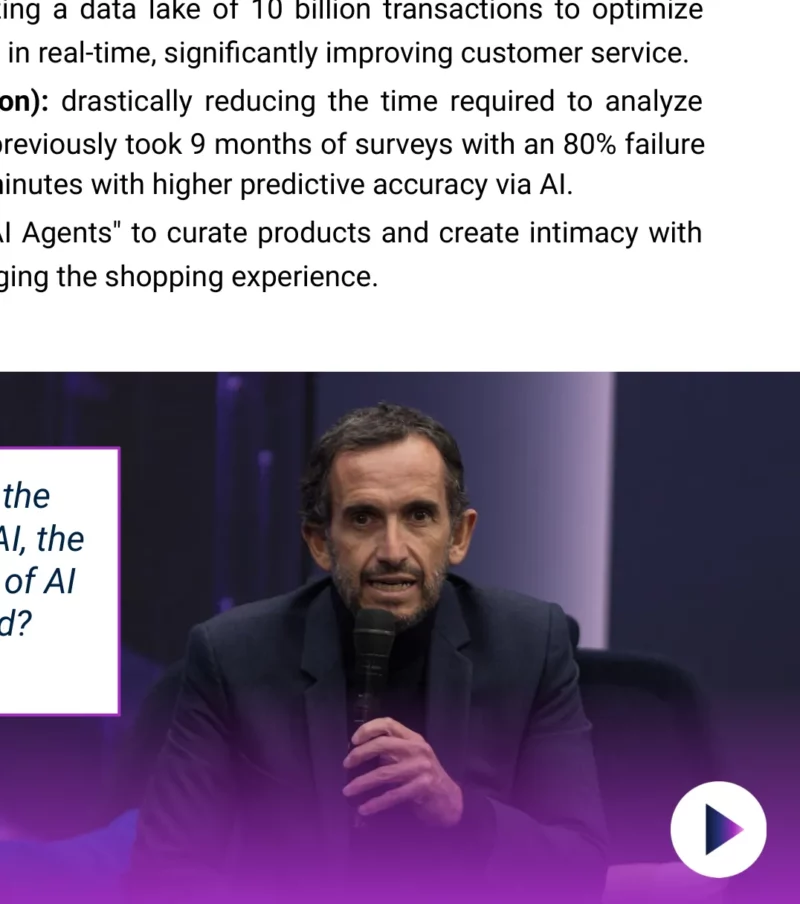
Fireside chat with Alexandre Bompard, Carrefour
Speakers: Alexandre Bompard, Chairman & CEO
Since 2017, Alexandre Bompard has been leading Carrefour, one of the world’s largest retailers with operations across Europe, Latin America and Asia.
Under his leadership, Carrefour is accelerating its digital transformation, integrating artificial intelligence to optimize supply chains, enhance customer experiences and reduce food waste…
Looking back at your journey through media and retail, how do you approach tech and innovation personally and professionally?
- Alexandre Bompard: The primary quality required for leadership today is curiosity; one does not need to be an engineer to drive innovation, but one must provoke curiosity within the organization.
- Coming from “old world” industries (linear TV/Radio and brick-and-mortar retail) threatened by disruption, the goal has always been to reconnect legacy structures with innovation.
- This process involves trial and error; for instance, at Fnac, he launched a successful e-reader platform (Kobo) and a failed music streaming service, yet he maintains that leaders must “do it again” regardless of failures to survive the journey.
How did you successfully drive innovation and cultural change within a massive ship like Carrefour (100B turnover, 500k people)?
- Alexandre Bompard: Upon joining, the management held a mistaken belief that food retail was immune to digital disruption; the first step was establishing the conviction that innovation is essential for survival.
- Innovation cannot be siloed in a corner; it must be democratized across the entire social body of the company to transition from a legacy firm to a digital-oriented, agile organization.
- While Carrefour may not yet rival tech-born giants in pure tech competitiveness, it has successfully established legitimacy and leadership in the digital transformation of brick-and-mortar retail.
What specific role does AI play at Carrefour, and what are the concrete use cases?
- Alexandre Bompard: The goal is not to perform “innovation theater” but to use AI as a pragmatic transformation tool.
- Use Case 1 (Operations): Utilizing a data lake of 10 billion transactions to optimize local assortments and fix prices in real-time, significantly improving customer service.
- Use Case 2 (Strategic Expansion): drastically reducing the time required to analyze potential store locations; what previously took 9 months of surveys with an 80% failure rate is now accomplished in 2 minutes with higher predictive accuracy via AI.
- Use Case 3 (CX): Developing “AI Agents” to curate products and create intimacy with customers, fundamentally changing the shopping experience.
Do we have a chance to be the continent where the use of AI, the scale of AI, the applications of AI could be the most developed? I think so.
Mainstage South
AI for all: LVMH’s plan to scale AI in luxury, guided by its values
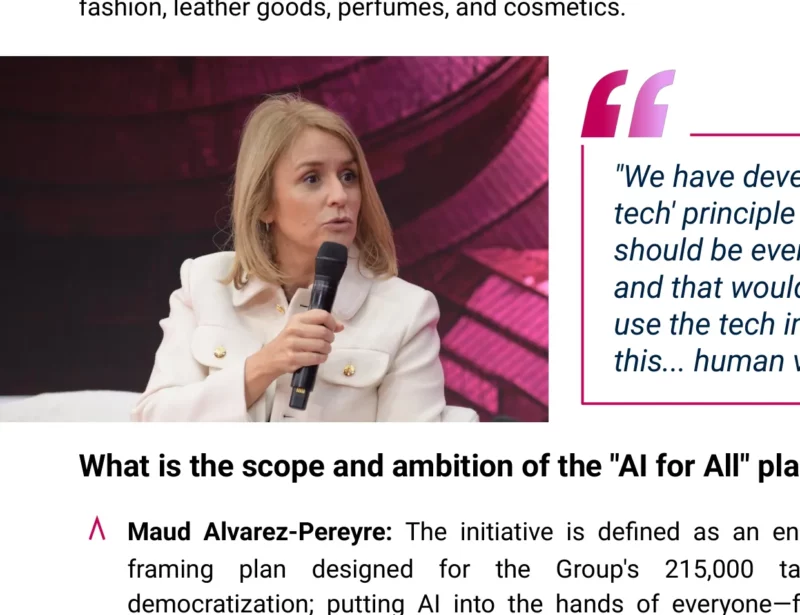
Speakers: Maud Alvarez-Pereyre, Chief People & Transformation Officer
Gonzague de Pirey, Chief Omnichannel and Data Officer
About Maud Alvarez-Pereyre: As Chief People & Transformation Officer, she leads the Group’s human resources strategy, focusing on talent development, culture, and organizational transformation for LVMH’s massive workforce.
About Gonzague de Pirey: Serving as Chief Omnichannel and Data Officer, he orchestrates the Group’s digital acceleration, data governance, and the integration of AI technologies across all Maisons.
About LVMH: Headquartered in Paris, LVMH is the world’s leading luxury group (2023 Revenue: €86.2B, ~213,000 Employees), creating high-quality products across wines, fashion, leather goods, perfumes, and cosmetics.
We have developed this ‘quiet tech’ principle to say that the tech should be everywhere but invisible and that would be the best way to use the tech in order to serve this… human values.
What is the scope and ambition of the “AI for All” plan?
Maud Alvarez-Pereyre: The initiative is defined as an engagement, upskilling, and framing plan designed for the Group’s 215,000 talents. The ambition is democratization; putting AI into the hands of everyone, from hotels and stores to warehouses and ateliers, to encourage experimentation. It is less of a technical conversation and more of a cultural one, establishing where the company chooses to use AI and where it does not. For example, while HR could record career conversations for data, they choose not to immediately do so to preserve the quality of human interaction.
Why accelerate this transformation now, and what are the pillars?
Gonzague de Pirey: While LVMH has worked with data and AI for years, the focus has shifted from “innovation” to “transformation.” The plan rests on three pillars: 1) Mobilization of all Maisons at the highest executive levels; 2) Developing and scaling business cases across commerce, marketing, and operations; and 3) Evaluating adoption and impact. Crucially, the goal is business development and reinforcing values, rather than a cost-cutting or restructuring exercise.
How do LVMH’s core values guide the practical application of AI?
Maud Alvarez-Pereyre: The Group’s values, Innovation/Creativity, Excellence, Entrepreneurship, and Engagement, dictate the strategy. Since the “founders” of the Maisons were entrepreneurs, there is a responsibility to keep the culture human-centered. Just as LVMH personalizes the client experience, they are using AI to personalize the employee journey for their top talents, ensuring the technology serves the asset of human capital. The transformation must be positive for the teams, turning potential disruption into a tool for growth.
How do you balance technology with the human-centric nature of luxury?
Gonzague de Pirey: Successful adoption requires alignment with the company’s strategy; luxury is fundamentally a human journey based on artistic creation, handcrafting, and in-person sales. Using AI to replace these elements would be “orthogonal” (contradictory) to the industry’s success factors. Instead, LVMH adopts the “Quiet Tech” principle: technology should be ubiquitous but invisible, serving as an enabler for human values rather than a replacement.
It’s really about standing back… the moto for us [is] that the humans will remain the maestros of the group… but we need to give them the best creative environment and that one that will be powered by AI.
Retail at the pace of AI
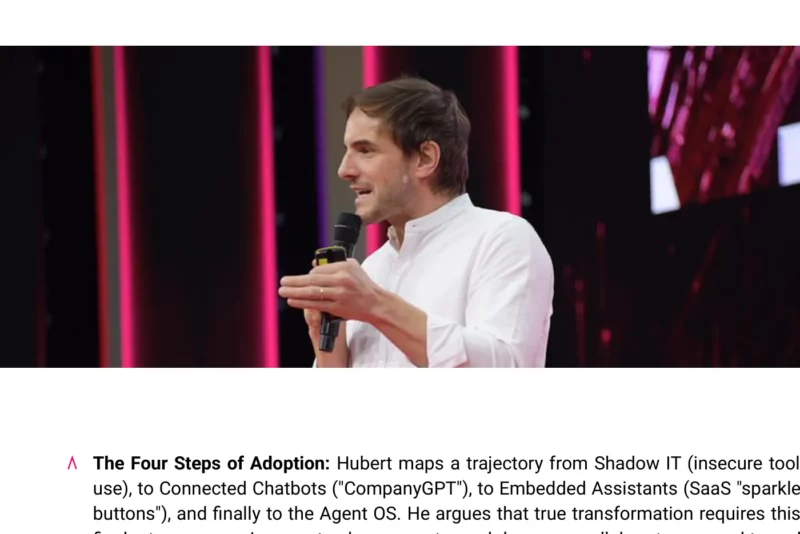
Speakers: Gabriel Hubert, CEO & Founder
Gabriel Hubert: A serial entrepreneur and product leader who previously served as Head of Product at Alan and held senior roles at Stripe after the acquisition of his first startup, Mashape. He co-founded Dust in 2023.
Dust: Dust is a horizontal AI platform (founded in 2022, HQ: Paris) with approximately 15–25 employees and an estimated revenue in the early-growth stage, focused on deploying specialized AI agents.
- The Four Steps of Adoption: Hubert maps a trajectory from Shadow IT (insecure tool use), to Connected Chatbots (“CompanyGPT”), to Embedded Assistants (SaaS “sparkle buttons”), and finally to the Agent OS. He argues that true transformation requires this final step: an environment where agents and humans collaborate on end-to-end projects.
- The Agent OS & “Meter Index”: The “Meter Index”, the duration an agent can work autonomously, is currently at 2 hours and doubling every 7 months. By late 2026, agents will handle 8-hour workdays. Dust is building the operating system to manage these “agentic” workloads at scale.
- The CRM Parallel: Gabriel Hubert compares AI to the CRM era; the competitive advantage isn’t the model itself, but how it is embedded into unique company processes, turning “lists” of data into automated pipelines.
- Cultural Blueprints for Success: High-performing CEOs succeed by mandating AI from the top while allowing a bottom-up motion where teams (like Back Market’s fraud team or Mirakl’s workforce) build their own local agents.
- Strategic Conclusion: To move past failing pilots, companies must stop treating AI as a “tool” and start treating it as a new way to work, where inventing an agent is a path to a promotion, not a threat to job security.
Software needs to evolve to fight the information chaos that creeps in as teams grow fast. We believe in creating the operating software that lets smart teams get better work done.
The future of luxury retail: how Loewe is accelerating time to market
Speakers: Adriana Mirón, Head of PMO & Governance
Lucy Barclay, Senior Director of Global Field and Partner Marketing
Using a tool just for using it is the same as when we are talking about AI: you need the process and the governance in place first.
Adriana Mirón: Head of PMO and Governance at Loewe, focusing on digital transformation and operational excellence within the luxury fashion sector.
Loewe: A LVMH-owned Spanish luxury house with ~1,200 employees and €600M+ revenue, HQ’d in Madrid, specializing in high-end leather goods.
Lucy Barclay: Lead for Field and Partner Marketing at Asana, specializing in scaling work management solutions for global enterprise retail accounts.
Asana: A work management platform with ~$650M annual revenue and 1,700+ employees, HQ’d in San Francisco, focused on organizational clarity.
Lou Dana: A digital strategy and retail expert acting as the moderator for high-level industry dialogues between tech providers and luxury brands.
How do human skills evolve as AI takes over manual processes in traditional industries?
Lucy Barclay: In traditional luxury, hard skills were historically prioritized, but soft skills like reasoning and transparency are becoming more critical. Organizations must upskill employees to manage AI’s conclusions and ensure data quality, as AI without “controls” can produce inaccurate results.
How did Loewe manage the heavy change management required for this transition?
Adriana Mirón: Change management cannot be underestimated. Loewe implemented the tool department-by-department (Marketing, Finance, etc.) because each has unique needs. The focus was on ensuring “non-tech” people found the tool straightforward to use to maximize visibility and centralize communication away from email.
How is AI specifically integrated into work management for the retail sector?
Lucy Barclay: Retailers face “work about work” where growth increases complexity across time zones and tools. AI is used as an enabler to eliminate status meetings and email chains. However, for AI to be effective, it requires a foundation of clarity, knowing who is doing what and why, which Asana provides.
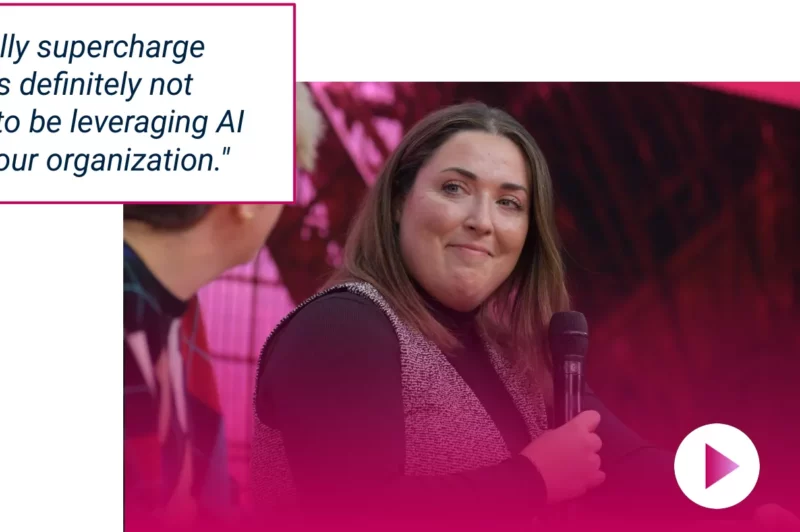
AI has the power to really supercharge human judgment, but it’s definitely not replacing it… You need to be leveraging AI as a teammate within your organization.
AI for operations: augmented execution and operational excellence
Speakers: Pierre Kroning, CIO & Managing Director Beiersdorf Shared Services IT
François-Xavier Pierrel, Group Chief Data Officer & Adtech Officer
Qihua Wang, Executive Vice President Strategy & AI
Virginie Brard: Regional Vice President France & Benelux at Fivetran, acting as a strategic facilitator between data infrastructure and business impact. Fivetran: Automated data movement platform; Revenue: ~$250M; Employees: 1,200+; HQ: Oakland, CA; Mission: To make access to data as simple and reliable as electricity.
Pierre Kröning: CIO of Beiersdorf since Sept 2025, previously leading Data & Analytics with 20+ years of IT/Finance expertise. Beiersdorf: Consumer goods giant (Nivea, Eucerin); Revenue: €10B; Employees: 20,000+; HQ: Hamburg, Germany; Mission: Leading the market in skin care through operational excellence.
Qihua Wang: Global EVP Strategy & AI at Lagardère Travel Retail, a former strategy consultant driving global business process reimagination. Lagardère Travel Retail: Global travel retailer in 51 countries; Revenue: €7B+; Employees: 20,000+; HQ: Paris, France; Mission: Reimagining travel retail through intelligent technology.
François-Xavier Pierrel: Chief Data & Adtech Officer at TF1, recognized expert in data strategy with past leadership at Meta, Microsoft, and JCDecaux. TF1 Group: Leading European broadcaster; Revenue: €2.3B; Employees: 2,800+; HQ: Boulogne-Billancourt, France; Mission: Transforming from traditional broadcast to a leading destination streaming platform.

Can you define your current flagship AI project and its business rationale?
- Pierre Kröning: At Beiersdorf, the focus is on “Operational Excellence” in market segmentation. Since they are a B2B2C company lacking direct consumer interaction, they use AI agents to scan the internet and enrich panel data (Nielsen) with visual product attributes, such as whether a competitor’s product looks “modern” or “traditional”, and technical specs like SPF levels to complete their ecosystem.
- Qihua Wang: Lagardère is leveraging Generative AI to accelerate the “Tender Management” process. In the complex world of airport retail bids, responding to tenders involves drafting 400-page documents; GenAI queries their global knowledge base to automate the technical wording, allowing humans to focus on the core value proposition and concept design.
- François-Xavier Pierrel: Following the launch of TF1+, the group uses AI to disrupt “Video Creation.” Beyond content editing, they are deploying “Agentic AI” to create a “data democracy,” enabling employees to query complex technical ecosystems without requiring SQL training, thereby automating the operational version of themselves.
If the data is crap, the results of course they don’t pay out… everybody thinks you can just throw AI on a process and then solve the whole issue.
What were the major misconceptions or “myths” regarding AI at the start of your projects, particularly concerning data?
- Pierre Kröning (Beiersdorf): The biggest hurdle is the belief that AI can be thrown at a process to fix it instantly. If the data is poor, the output is useless. The real challenge is educating people that they must redesign processes for digital first. Even with AI, human judgment is required to validate outcomes.
- Qihua Wang (Lagardère Travel Retail): AI is not a tech project; it is a business transformation project. The myth is that it’s “cool and sexy,” but the reality is “dirty work”: cleaning data, transforming processes, and convincing staff that AI creates value rather than stealing jobs. Successful execution requires a mix of change management, technical profiles, and strong business sponsorship.
- François-Xavier Pierrel (TF1): The initial misconception was “I have a problem, AI is the fix.” It took 6-12 months to shift the mindset from “doing AI for the sake of AI” to identifying actual business problems. They learned that there is no magic wand; it involves politics, governance, and budget. They had to move from simple automation to creating genuine value through data democracy.
It’s not a click of [a] finger that you have you see the magic happens… to summarize it’s not a tech project in the end it’s about business transformation.
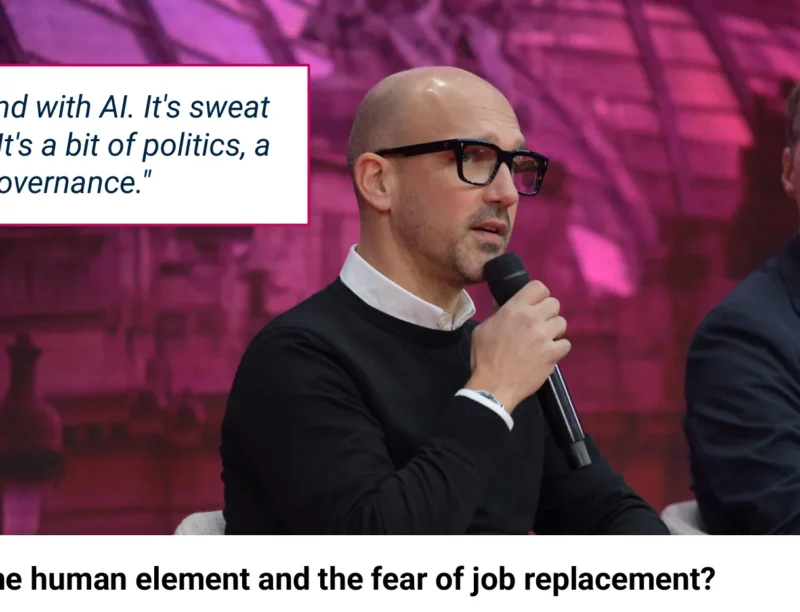
There is no magic wand with AI. It’s sweat and tears all the time. It’s a bit of politics, a bit of money, a bit of governance.
How do you manage the human element and the fear of job replacement?
- Qihua Wang (Lagardère Travel Retail): The reality lies between “AI sucks” and “AI fixes everything.” It is a test-and-learn process to build trust. The goal is to remove tedious, repetitive tasks, like answering standard tender questions, so employees can focus on high-value strategy. It is about arbitrating what is best done by a robot versus a human.
- Pierre Kröning (Beiersdorf): You must redesign processes before automating them. If you automate a bad process, you are just efficiently bad. This shifts the role of employees; someone who used to build PowerPoint slides might now need to become a Product Owner, requiring them to make tough decisions rather than just formatting information.
What is your final advice or takeaway for the audience?
- François-Xavier Pierrel (TF1): Avoid FOMO (Fear Of Missing Out). The technology is here to stay. “Rush, but not too fast.”
- Qihua Wang (Lagardère Travel Retail): Adopt a mindset of “Drop everything, learn, and learn.” Be willing to fail, as the learning gained from failure is more valuable than immediate success.
- Pierre Kröning (Beiersdorf): Focus on what you are not going to do. With limited resources, prioritization is key to allocating effort where it truly matters.
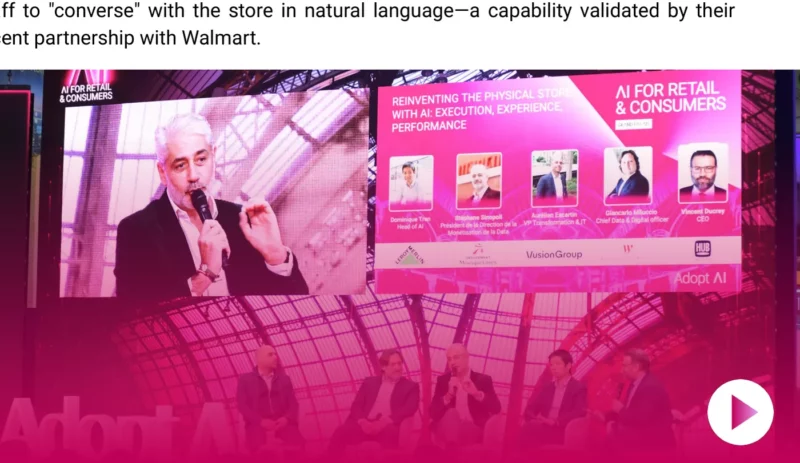
Reinventing the physical store with AI: execution, experience, performance
Speakers: Dominique Tran, Head of AI
Stéphane Sinopoli, Président de la Direction de la Monétisation de la Data
Giancarlo Miluccio, Chief Data & Digital Officer
Aurélien Escartin, VP Transformation & IT
About Dominique Tran: Head of Data & AI at Leroy Merlin, driving the integration of generative and operational AI into customer journeys and internal processes.
About Leroy Merlin: A leading French home improvement retailer (Adeo Group) with approx. €9.8B annual revenue (France), 30,000+ employees, and HQ in Lezennes.
About Stéphane Sinopoli: Intermarché Franchisee (Adhérent) and President of Data Monetization & Innovation for Les Mousquetaires.
About Les Mousquetaires: A major French retail grouping (Intermarché, Bricomarché) generating approx. €39.9B in turnover, with ~150,000 employees and HQ in Bondoufle.
About Giancarlo Miluccio: Chief Data & Digital Officer at Unibail-Rodamco-Westfield (URW), leading the digital transformation of commercial real estate assets.
About URW: A global developer and operator of flagship shopping destinations, reporting €3.5B in proportionate turnover, HQ in Paris.
About Aurélien Escartin: VP Transformation & IT at VusionGroup (formerly SES-imagotag), specializing in IoT digitization and retail infrastructure.
About VusionGroup: Global leader in electronic shelf labels and retail IoT solutions, generating ~€800M revenue, HQ in Nanterre, France.
How is AI currently being integrated to enhance the customer journey and experience?
- Dominique Tran (Leroy Merlin): The customer is now “augmented” and highly knowledgeable (often consulting ChatGPT before visiting). Leroy Merlin uses AI to determine where human interaction adds value versus where digital tools should take over. A key success is their energy performance simulator (DPE), running thousands of AI-driven simulations monthly to help clients plan renovations.
- Stéphane Sinopoli (Les Mousquetaires): The strategy is rooted in “Carrelage Truth” (pragmatism). AI handles high-volume, low-value interactions. For instance, 65% of calls to their 3,500 stores are simple queries (e.g., opening hours); Conversational AI now automates this, saving thousands of labor hours. Additionally, Computer Vision in self-checkouts detects “suspicious gestures” to tackle shrinkage, which is 4x higher in automated lanes.
- Giancarlo Miluccio (URW): Unlike the strict short-term ROI rule at Intermarché, URW invested early in data to map the “Consumer Journey.” They utilize AI to visualize exactly what visitors do inside the mall, moving beyond simple footfall counting to granular behavioral analysis, allowing them to optimize the environment for better shopping experiences.
- Aurélien Escartin (VusionGroup): Focuses on “Shelf Intelligence” and “Spatial Intelligence.” Using mini-cameras and IoT to capture hourly shelf data, they identify irritants (out-of-stock, pricing errors). This data feeds Edge AI, enabling customers and staff to “converse” with the store in natural language, a capability validated by their recent partnership with Walmart.
How does AI empower first-line teams and store employees (The “Augmented” Worker)?
- Dominique Tran (Leroy Merlin): To mitigate shadow IT risks, they deployed a secure, enterprise-grade GenAI solution to 100% of employees. Operationally, AI now drives core processes: assortment definition, pricing strategies, and detecting “hidden ruptures” (inventory errors), systematically augmenting staff capabilities across the board.
- Stéphane Sinopoli (Les Mousquetaires): AI is deployed to solve specific pain points for store staff (Directors, accountants, fresh food managers). Examples include screening hundreds of CVs to shortlist candidates instantly and generating humorous, error-free signage for out-of-stock products to maintain customer rapport. The goal is pure productivity to protect their aggressive low-price positioning.
- Giancarlo Miluccio (URW): AI bridges the gap between IT and Leasing teams. Leasing managers no longer just sell square meters; they sell audiences and productivity based on granular shopper profiles. Similarly, their Retail Media agency (Rise) uses AI to treat physical ad assets like digital inventory, qualifying and targeting audiences in real-time.
- Aurélien Escartin (VusionGroup): AI reduces cognitive load by “revealing the invisible.” Instead of scanning every product, staff are directed only to specific anomalies (e.g., a product with zero stock but physical presence). He notes that retailers using AI-guided paths and smart glasses for picking/drive execution see a 3x increase in productivity compared to traditional methods.
Before, we focused on knowing how many people were there… now we know what they are doing. We are creating Digital Twins of our shopping centers.
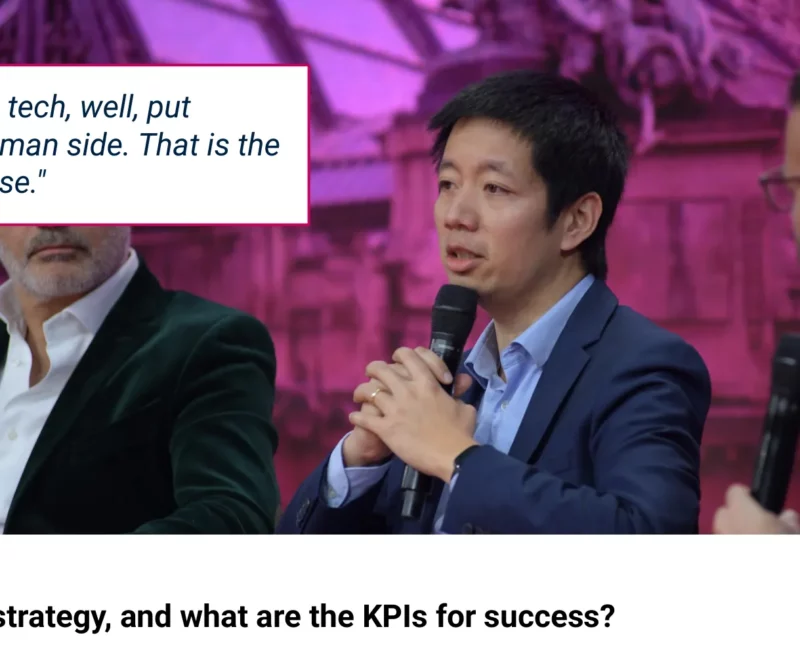
When you invest €1 in tech, well, put double that into the human side. That is the most complicated phase.
How does AI feed HQ strategy, and what are the KPIs for success?
- Dominique Tran (Leroy Merlin): The primary challenge is adoption, not technology. Their golden rule is “Invest €1 in tech, invest €2 in human.” Strategic success is measured by team adoption rates. They employ a “build, test, pivot” approach, involving store teams early to ensure the change management succeeds.
- Stéphane Sinopoli (Les Mousquetaires): AI at HQ targets massive administrative overhead. Analyzing thousands of 100-page supplier contracts is no longer scalable for humans; AI now assists legal teams. Marketing costs are also slashed, producing a TV spot via AI costs ~€100k versus ~€1M traditionally. The strict KPI remains: ROI must be achieved in under 12 months without increasing OPEX.
- Giancarlo Miluccio (URW): AI has evolved from a “new revenue” experiment to a transversal transformation engine (Finance, Leasing, Ops). They are building “Digital Twins” of shopping centers to simulate and optimize operations. The ultimate KPIs are simple and binary: Sales (of retailers) and Footfall.
- Aurélien Escartin (VusionGroup): The focus is on speed and co-construction. AI allows HQ to measure the impact of merchandising changes instantly. He emphasizes the need for “geek” optimization to reduce compute costs (GPU/Retrieval), ensuring that AI solutions remain affordable (low OPEX) for franchisees and independent retailers.
The connected glasses we selected cost €300… A Zebra [scanner] costs much more. We need solutions that franchisees can afford.
The “Silo Breaker”: How is AI transforming Internal Structure (Leasing, Legal, Finance)?
- Stéphane Sinopoli (Les Mousquetaires): The impact on the “Upstream” (Headquarters) is just as critical as the store.
- Legal Metric: In the 90s, contracts were 4 pages. Today, they are 100+ pages. With 1,000 suppliers, reviewing 100,000 pages of legal documents annually is impossible for humans without hiring an army of jurists. AI summarizes and risk-assesses these contracts instantly.
- Marketing Metric: Producing a TV commercial typically costs €1 Million. Using GenAI video tools, they produced a comparable spot for €100,000, a 10x cost reduction that flows directly to the bottom line.
- Giancarlo Miluccio (URW): AI has forced a cultural shift. Previously, the “Leasing” team (who sell space) and “Data” team never spoke. Now, Leasing managers pitch retailers not just on square footage, but on “Audience Profiles” and “Productivity Zones” generated by AI analysis of shopper movements. This has turned a real estate conversation into a media/performance conversation.
Retail Media: Can Physical Stores really compete with Digital Ad Platforms?
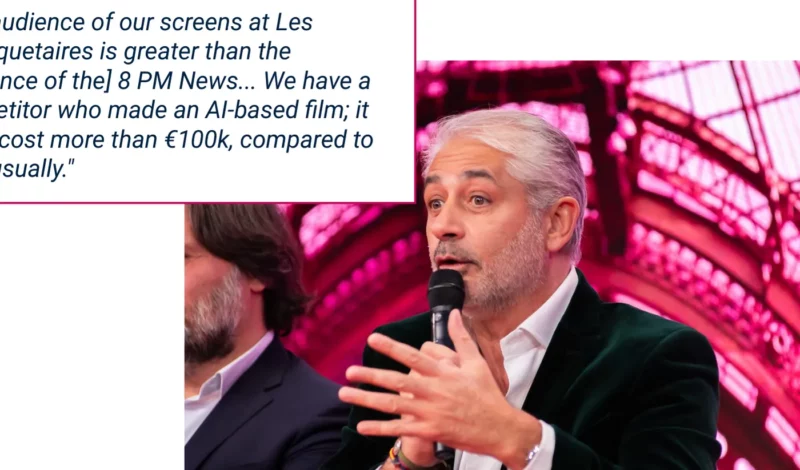
- Stéphane Sinopoli (Les Mousquetaires): Yes, and the numbers are staggering. They are installing digital screens and tracking “Media Performance” across the network. Key Insight: The aggregate audience of Intermarché’s in-store screens on a Sunday morning is superior to the audience of the 8 PM News (20h) on major French TV channels. They are waking up to the fact that they are a massive media broadcaster.
- Giancarlo Miluccio (URW): URW’s agency, Rise, now treats physical advertising assets (billboards in malls) exactly like digital inventory. AI qualifies the audience standing in front of a screen in real-time (demographics, dwell time), allowing them to sell “Qualified Views” rather than just static poster space.
- Aurélien Escartin (VusionGroup): Retail Media is the “Pure Margin” engine. By using shelf-edge cameras to track which products customers touch but don’t buy, they can serve targeted promotions at the shelf edge. This new revenue stream helps finance the hardware investment, creating a self-sustaining tech ecosystem.
The audience of our screens at Les Mousquetaires is greater than the [audience of the] 8 PM News… We have a competitor who made an AI-based film; it didn’t cost more than €100k, compared to €1M usually.
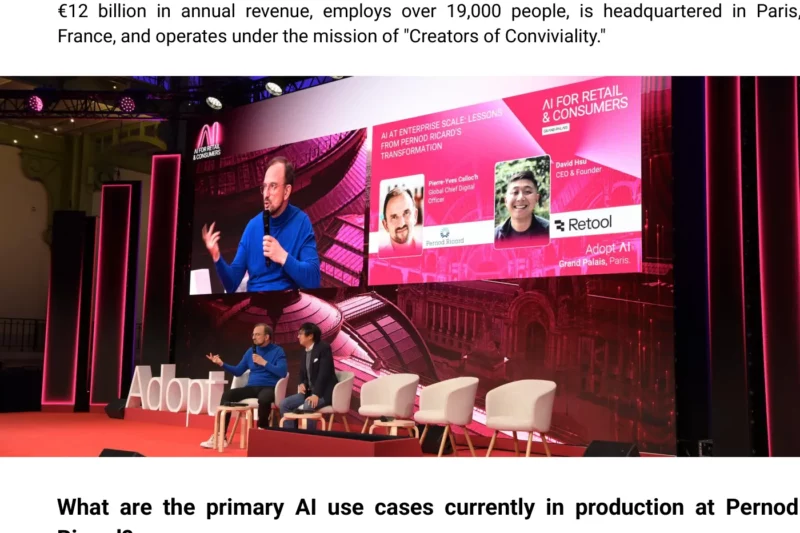
AI at enterprise scale: lessons from Pernod Ricard’s transformation
Speakers: Pierre-Yves Calloc’h, Global Chief Digital Officer
About Pierre-Yves Calloc’h: Currently serving as the Chief Digital Officer at Pernod Ricard, Pierre-Yves leads the group’s global digital transformation, focusing on leveraging data and AI to enhance commercial effectiveness and marketing efficiency.
About Pernod Ricard: A global leader in the wine and spirits industry, holding prestigious brands like Absolut, Jameson, and Havana Club. The company generates approximately €12 billion in annual revenue, employs over 19,000 people, is headquartered in Paris, France, and operates under the mission of “Creators of Conviviality.”
What are the primary AI use cases currently in production at Pernod Ricard?
Pierre-Yves Calloc’h: Pernod Ricard has deployed a recommendation engine for its 5,000 sales representatives across 60 countries. Started in 2020, this tool provides weekly visit lists and specific product push suggestions based on localized data, such as identifying underperforming brands or ineffective promotions. This system has driven 2-3% sales growth over two years in deployed countries. Additionally, they utilize Marketing Mix Modeling (MMM) across 20+ countries to optimize media spend (TV vs. social media) based on three years of historical data.
How do you manage the deployment journey and select the right projects to ensure success?
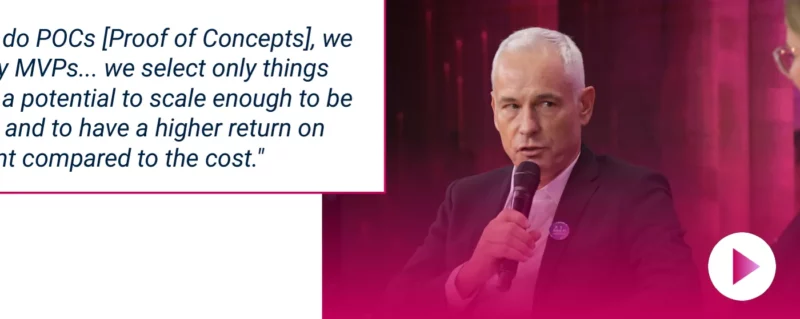
Pierre-Yves Calloc’h: The strategy relies on extreme focus, capping active AI projects at a maximum of eight simultaneously. The team filtered an initial backlog of 72 potential digital projects down to just six to ensure high quality and scalability. Crucially, Pernod Ricard rejects “Proof of Concepts” (POCs) in favor of “Minimum Viable Products” (MVPs) deployed immediately in two countries to prove replicability. Post-ChatGPT, they face thousands of potential use cases but apply strict financial criteria, rejecting projects with fractional efficiency gains (e.g., saving 0.5% of an FTE) in favor of those with a measurable impact on the P&L.
How does the technology stack evolve from prototype to production, and what role does low-code play?
Pierre-Yves Calloc’h: User adoption is the critical bottleneck, which necessitates speed. Waiting 18 months to integrate a solution into Salesforce would kill the project, so they use Retool to build web-app interfaces in days or weeks. This allows for rapid iteration; feedback received during morning training sessions can be implemented by the afternoon, significantly boosting user trust. While Retool offers immediate 90% business value with production-grade security, the long-term goal (1-2 years later) remains to integrate stabilized solutions into the core Salesforce automation tool.
What is your stance on “Vibe Coding” (AI-generated UIs) versus low-code platforms?
Pierre-Yves Calloc’h: While AI-generated UI platforms like Lovable are impressive for demos, they currently lack the security, authentication, and data handling required for production environments. Since Pernod Ricard does not do POCs and only builds deployable MVPs, they cannot yet rely on vibe coding for live business tools, preferring established low-code solutions that are production-ready.
We don’t do POCs [Proof of Concepts], we do directly MVPs… we select only things that have a potential to scale enough to be profitable and to have a higher return on investment compared to the cost.
AI as a scalability engine: how Pepkor is building group-wide capabilities across 30 brands
Speakers: Jason Peisl, Chief Information Officer
About Jason Peisl: Current CIO of Pepkor Group, responsible for transforming the IT function from a service provider to a strategic enabler across a complex federation of retail brands.
About Pepkor Group: A South African retail giant with $6B in annual revenue, 6,500+ stores, and ~50,000 employees; HQ in Cape Town, South Africa, serving the discount and value market.
How do you manage to scale data and AI across a group of competing retail brands?
- Jason Peisl: Upon taking the role, the existing approach involved expensive pilots with low adoption because data scientists were disconnected from brand needs. Peisl implemented a radical split: Centralized Enablement vs. Decentralized Execution.
- Centralized: Engineers and MLOps remain central to build a solid foundation and democratize data access.
- Decentralized: Data scientists and AI competencies were moved into the specific brands. This ensured they understood the specific retail mechanics and problems of that brand, driving actual business value rather than theoretical models.
What bold decisions were required to build trust and collaboration in a previously federated environment?
- Jason Peisl: The IT function historically lacked strategic influence, resulting in a fractured landscape with no trust between brands. Peisl launched “Vision 2030” to address the technical debt caused by years of federation.
- The “Mess”: The group currently operates 5 ERPs, 12 Warehouse Management Systems, and 9 HR systems, causing massive complexity in data ingestion and accuracy.
- The Goal: A 5-10 year roadmap to consolidate into single systems per function (One ERP, One WMS). This simplification is the prerequisite for accurate data and scalable AI.
- Community Building: To foster collaboration, he established cross-brand communities (e.g., Advanced Analytics, Security) to discuss innovation and shared projects like “Customer 360,” which consolidates customer data across the group for the first time.
What are the top AI use cases that every retailer should adopt?
- Jason Peisl: There is no single “silver bullet” use case that adds hundreds of millions instantly. Instead, Pepkor pursues a strategy of “Marginal Gains” (akin to professional cycling).
- The Strategy: Aggregating many smaller use cases that add 0.1% to 0.5% efficiency each, eventually compounding to a 5-6% bottom-line improvement.
- Specific Example: Supply Chain optimization. With over 1 billion items moved annually, AI is used to optimize routing and logistics, contributing to these marginal gains.
We don’t do POCs [Proof of Concepts], we do directly MVPs… we select only things that have a potential to scale enough to be profitable and to have a higher return on investment compared to the cost.
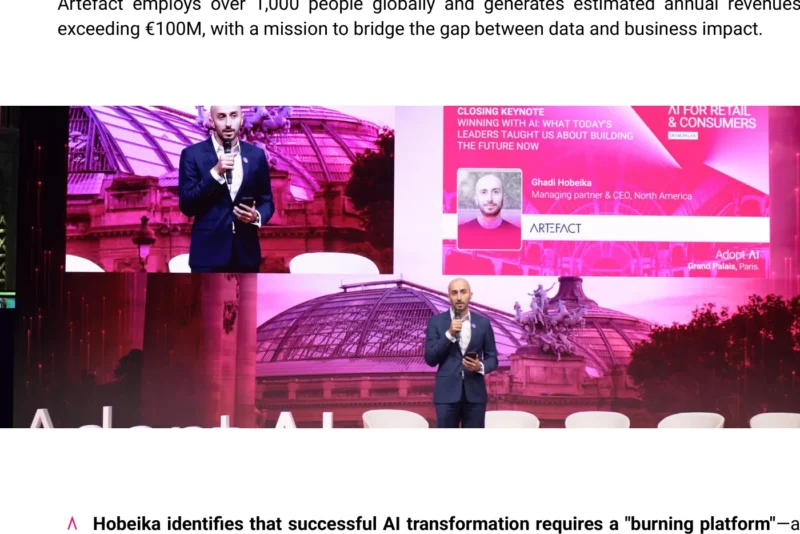
Winning with AI: what today’s leaders taught us about building the future now
Speakers: Ghadi Hobeika, Managing Partner & CEO, North America
About Ghadi Hobeika: Ghadi Hobeika is the Managing Partner and CEO of North America at Artefact. A seasoned executive with a background in retail and real estate transformation, he previously served as Chief Commercial Officer at Unibail-Rodamco-Westfield, bringing deep expertise in bridging digital strategy with business ROI.
About Artefact: A global data and AI consulting company headquartered in Paris, France. Artefact employs over 1,000 people globally and generates estimated annual revenues exceeding €100M, with a mission to bridge the gap between data and business impact.
- Hobeika identifies that successful AI transformation requires a “burning platform”, a clearly defined strategic reason (“Why?”) to rally resources, money, and troops. Companies like Les Mousquetaires (Intermarché) use it for productivity/pricing, while LVMH focuses on curated luxury experiences, and Unibail-Rodamco-Westfield (URW) seeks new revenue streams in a challenged market.
- Revolutionizing Customer Experience (CX): The rise of “Gen-tic commerce” (GenAI Commerce) and AI search requires optimizing assets for robot-to-robot interaction. L’Oréal uses AI to deliver hyper-personalized experiences to 2 billion customers, a scale impossible for humans or traditional automation alone.
- Reinventing Core Operations: AI is eliminating manual tasks and streamlining handoffs in HQs, warehouses, and stores. Lagardère Travel Retail uses AI to accelerate RFP tendering; Leroy Merlin automates price changes; and Pernod Ricard empowers 5,000 sales reps across 60 countries with “next best action” recommendations.
- Employee Augmentation: The focus is on making work more enjoyable. Les Mousquetaires uses AI to screen hundreds of CVs, while Leroy Merlin empowers associates to answer complex tech questions. Success relies on a clear value prioritization framework (“Where is the money?”), clean data, and anticipating adoption challenges through co-creation with teams (as recommended by TF1).
- AI impact has shifted from nominal to massive. The ROI is undeniable, L’Oréal’s CIO noted that every €1 invested in customer care saves €60–€70. However, while AI augments capabilities, the ultimate differentiator remains the people, their personalities, and their skills.
AI used to be nominal in terms of impact. It’s becoming massive… Every euro that he [L’Oréal CIO] invests in customer care saves about 60 to 70. That’s one of the best ROIs you’ll ever find.
Masterclass North & South
Construire l’avenir du commerce de détail grâce à l’IA
Speakers: Yann Le Rhun, CTO France
Edouard Renoux, Retail & Transportation Lead France
Alan Ferbach, Co-Founder & CEO
Édouard Renoux: Lead for Retail and Transport at NVIDIA, specialized in accelerating AI workloads for major groups like L’Oréal and Carrefour. NVIDIA: A global leader in GPU and AI computing with revenue of approximately $60B and over 29,000 employees, headquartered in Santa Clara.
Yann Le Rhun: Chief Technology Officer (CTO) for Lenovo France, overseeing strategic technical architectures and the “AI Innovators” ecosystem for enterprise clients. Lenovo: A multinational technology company with $62B in revenue and 77,000 employees, HQ’d in Beijing and Morrisville, focused on “Smarter Technology for All.”
Alan Ferbach: CEO and Co-founder of Vidéotix, an expert in AI-driven video analytics and software integration for physical security and retail traffic. Vidéotix: A French software editor specializing in computer vision; recently acquired by a Swiss group to expand 360° retail counting and journey analytics.
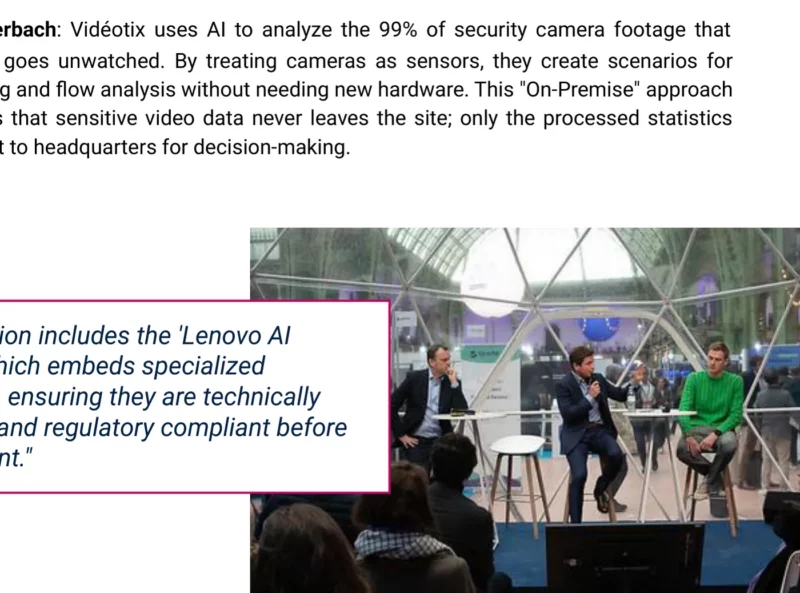
How does NVIDIA integrate into the retail landscape and what specific use cases do you address?
Édouard Renoux: NVIDIA provides a full technology stack beyond just GPUs, including CPU/DPU hardware and the “Metropolis” framework for computer vision. This allows retailers to exploit existing video feeds for high-ROI use cases like fraud control. For a €10B retailer, a 2% shrinkage rate represents €200M lost; NVIDIA’s solutions can halve this, offering an infrastructure ROI in just 3–4 months.
What does the Lenovo Hybrid Advantage offer to retailers looking to scale AI?
Yann Le Rhun: The “Lenovo Hybrid Advantage” allows retailers to “start small” with specific use cases and scale to thousands of stores. It bridges the gap between the lab and production. A key reference is Kroger in the US, where this solution achieved a 3-month ROI across several thousand stores. The platform also includes an “AI Library” of validated startups to ensure regulatory and technical compliance.
How does Vidéotix transform existing store infrastructure into data sensors?
Alan Ferbach: Vidéotix uses AI to analyze the 99% of security camera footage that usually goes unwatched. By treating cameras as sensors, they create scenarios for counting and flow analysis without needing new hardware. This “On-Premise” approach ensures that sensitive video data never leaves the site; only the processed statistics are sent to headquarters for decision-making.
Our solution includes the ‘Lenovo AI Library’ which embeds specialized startups… ensuring they are technically validated and regulatory compliant before deployment.
AI agents for retail: Back Market’s fraud detection agent in practice
Speakers: Aurélien Gervasi, Senior Engineering Manager, AI
Alban Dumouilla, Product Growth
Aurélien Gervasi: Senior Engineering Manager specializing in AI at Back Market, responsible for leading the company’s AI transformation and agentic strategy. Back Market: The world’s leading refurbished electronics marketplace, headquartered in Paris, with over 700 employees and approximately €2B+ in GMV.
Bertrand Stephann: Product Growth lead at Dust, specializing in scaling AI “operating systems” that bridge the gap between LLMs and internal company data. Dust: A specialized AI platform that enables enterprises to build custom, action-oriented agents connected to internal tools like Slack, Notion, and Jira.
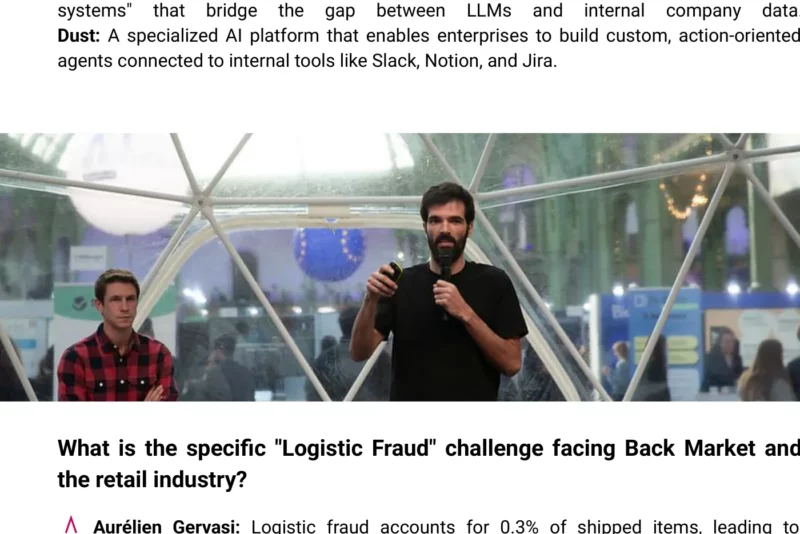
What is the specific “Logistic Fraud” challenge facing Back Market and the retail industry?
Aurélien Gervasi: Logistic fraud accounts for 0.3% of shipped items, leading to significant GMV and revenue leakage. This includes “forward fraud” (false claims of non-receipt) and “return fraud” (label tampering). A historical attempt to curb this via rigid manual verification caused a public backlash, highlighting the need for a solution that balances high-security detection with a seamless customer experience.
How does the new “Fraud Orchestrator” agent leverage a multi-agent architecture?
Aurélien Gervasi: Back Market implemented a multi-agent system where a central Orchestrator coordinates specialized sub-agents: Customer History, Tracking Incidents, Payment Incidents, and Conversation Patterns. By using LLMs to analyze unstructured text, they can now detect “first-message” templates used by professional fraudsters, a task previously impossible with standard SQL or regex.
How does the Dust platform differentiate between AI “Assistants” and AI “Agents”?
Alban Dumouilla: The paradigm has shifted from “assistants” (passive chatbots) to “agents” (active workers). Agents are connected to internal knowledge (Google Drive, Notion) and tools (Zendesk, Front), enabling them to autonomously perform actions like drafting replies, changing ticket statuses, or triggering alerts.
Can you demonstrate the speed of deploying a specialized retail support agent?
Alban Dumouilla: Using a “Prompt Coach” agent, a functional support agent was built in three minutes. By connecting it to past tickets and the “Front” ticketing system, the agent autonomously analyzed a refund request, applied company policy, and sent a resolution email, all within minutes of the customer’s initial message.
This is a clear example of how Dust enable these domain experts to become AI builder; they are able to solve their own problem with genai without relying on engineering resources.
Achieving peak performance with SAP’s Black Friday and Cyber Monday readiness program
Speakers: Manoj Gupta, Head of Support for Commerce and Consumer Industries
Rohan Patel, Global Vice President, Head of Support, Spend Management
Manoj Gupta: Head of Support for Commerce and Consumer Industries at SAP, he oversees the stability and performance of SAP’s retail ecosystem, specializing in large-scale event readiness.
Rohan Patel: SVP and Head of Global Cloud Services Support at SAP, he leads the digital transformation of customer support through a 5-year strategic roadmap focused on AI-driven “agentic” solutions.
SAP: A specialized AI platform that enables enterprises to build custom, action-oriented agents connected to internal tools like Slack, Notion, and Jira.
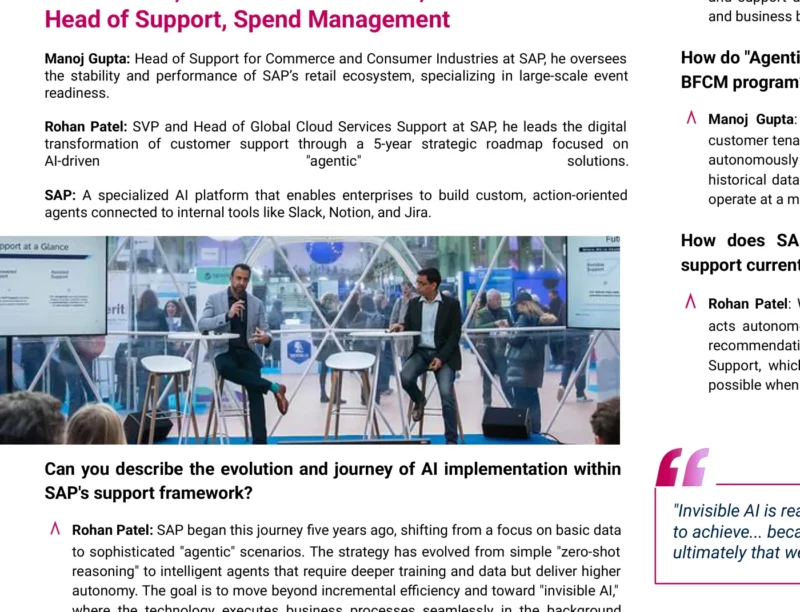
Can you describe the evolution and journey of AI implementation within SAP’s support framework?
Rohan Patel: SAP began this journey five years ago, shifting from a focus on basic data to sophisticated “agentic” scenarios. The strategy has evolved from simple “zero-shot reasoning” to intelligent agents that require deeper training and data but deliver higher autonomy. The goal is to move beyond incremental efficiency and toward “invisible AI,” where the technology executes business processes seamlessly in the background without user friction.
What is the specific role of AI in securing peak retail periods like Black Friday and Cyber Monday?
Manoj Gupta: For retailers, these are the six most critical days of the year. We provide a layer of “invisible support” aimed at achieving 100% uptime and zero degradation. Our autonomous agents work 6–8 weeks in advance, analyzing system health, event history, and support data to create a preventive risk mitigation report. This identifies technical and business bottlenecks before they can impact the live event.
How do “Agentic AI” and autonomous agents function technically within the BFCM program?
Manoj Gupta: We utilize multiple agents working in tandem. These agents monitor customer tenants, generate specific alerts, and classify whether an issue can be resolved autonomously or requires human intervention. If the agent finds a solution based on historical data, it can respond to the customer directly with no human involvement. We operate at a massive scale, supporting over $12B in GMV last year with zero downtime.
How does SAP differentiate between the various layers of AI-driven support currently available to customers?
Rohan Patel: We categorize support into three distinct pillars: Invisible Support, which acts autonomously to prevent issues; Empowered Support, which uses AI to provide recommendations and rich self-service data to the user; and Assisted/Accelerated Support, which focuses on making the interaction with SAP experts as effortless as possible when a human is needed.
Invisible AI is really what we’re all striving to achieve… because that’s the true value ultimately that we see in our industry.
Startup Stage
AI agents that ask the right question at the right time
Speakers: Cyril Reinhard, Co-founder & CEO
Cyril Reinhard: As the Co-Founder of Zelinqa, Cyril Reinhard introduces the company’s debut public presentation in France, focusing on a new approach to conversational AI that prioritizes effective questioning over immediate answering, drawing on his expertise in technological entrepreneurship.
Zelinqa: Zelinqa is a new startup focusing on developing AI agents specialized in Human Questioning Intelligence to address the “crisis of trust” in conversational AI. While specific figures are not public for this new startup, its mission is to enable AI to drive conversations through strategic questioning, leading to fewer interactions, higher-quality solutions, and lower energy consumption by utilizing small, specialized models.
- The “crisis of trust”: The market is facing a “crisis of trust” due to LLM reliance, where larger models hallucinate significantly, up to 20% for general topics and 70-80% for specialized domains like healthcare and education. This fundamental flaw stems from the current paradigm of “answer first” AI, which fails to adapt and listen effectively, unlike human conversation.
- The approach based of three principles-Small, Specialized Models: Echoing Marvin Minsky’s 40-year-old vision from “The Society of Mind,” the platform utilizes multiple small agents that are experts in their domain and communicate collaboratively.
- Power of Questioning: The core innovation is the “best question engine,” developed after two years of R&D at a Grenoble university laboratory, which grants the AI the ability to ask the right question at the right time within a specific domain.
- Goal-Driven Conversation: The system is engineered to drive the conversation based on a specific, predefined goal (e.g., a doctor’s goal is to find the best treatment), which allows the engine to embed Q&A expertise and find the optimal question in a cluster based on real-time context.
- Use Case & Metrics Illusion: A pilot customer, school.fair, uses Zelinqa’s agent “Zelia,” specialized in career guidance, trained on all French post-baccalaureate assets. Zelia begins by asking questions to understand the user’s constraints, only starting to answer after sufficient qualification. This “question-first” strategy reduces the number of interactions required to find a high-quality, straight-forward solution, implicitly consuming less energy.
- Question First AI: The company’s philosophy is a direct transition from “answer first AI” to “question first AI.” This shift leads to better quality, less time spent, fewer interactions, and an implicit reduction in energy consumption by focusing on small/medium models instead of overly large ones.
- Human Questionning Intelligence: Focusing on “Human Questioning Intelligence” creates a compelling use case for high-stakes, high-quality interactions like healthcare qualification or specialized career guidance, where accuracy and trust are paramount.
If you never read the book of Marim Minsky, “The Society of Mind”, I invite you to read this book because today we talk a lot: MCP, agentic, multi-agent… 40 years ago he already says that. So, it is a principle that we are using.
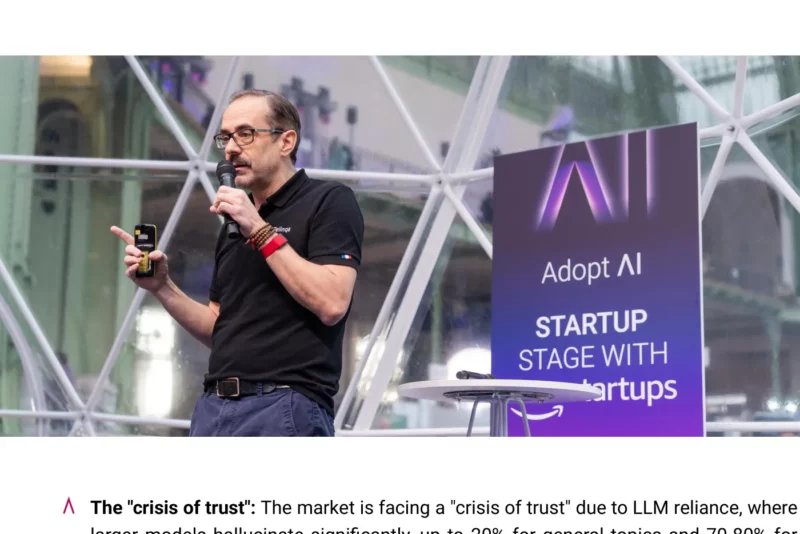
Beyond RAG: from trusted answers to real business actions
Speakers: Cédric Carbone, Co-founder
Cédric Carbone: Cédric Carbone is the Co-founder of Hymalaia, a company focused on building “agent factories” to connect diverse enterprise data sources for creating advanced, action-oriented AI agents.
Hymalaia: Hymalaia is a specialized AI firm building enterprise agents and focused on connecting data inside agents. While specific revenue and employee figures are not in the transcript, the company’s mission is to provide trusted, 360-degree views of customers or topics from massive, disparate data sources (CRM, ERP, Notion, Mailbox) to combat the unreliability of standalone LLMs and drive business action. The HQ is not mentioned in the transcript.
- The “explosion of data”: Enterprises face an explosion of data, with “millions of documents” needing to be indexed, while Large Language Models (LLMs) alone lack the reliability, trust, and relevance companies demand, leading to the necessity of a Retrieval-Augmented Generation (RAG) system. The basic, simple RAG implementation, which is “very easy” to develop but “not working” in production suffers from poor accuracy, necessitating advanced architectures
- Multipass Indexing: To increase search accuracy and manage massive data, Imalaya utilizes a multipass indexing workflow that indexes the same document multiple times using both large and mini chunks to capture both broad context and fine details simultaneously, overcoming the traditional chunk-size dilemma.
- Hybrid Search and Re-ranking: A standard vector similarity search is often inadequate when the user’s question uses different terminology (business glossary, language) than the source documents. This is solved by adding a BM25 keyword search (lexical search) to the semantic vector search, generating multiple outputs that are then subjected to normalization, score adjustment, and re-ranking to ensure the selection of the most relevant internal company documents.
- Agent-Based Multi-Step Querying: For complex, large questions spanning multiple entities (e.g., “all information about BBC”), a single query fails. The solution is an agent mode utilizing a Long Graph architecture that splits the main question into several sub-questions (e.g., “pains,” “equipment deployed,” “needs”) and runs them in parallel, iteratively asking sub-questions until enough information is retrieved. This approach is “more accurate” but has a high response time (up to 3–4 minutes), which the speaker deems acceptable for a good answer.
- The MCP layer: The core value proposition moves Beyond RAG (understanding, precision, traceability) by adding the MCP (Action) layer. The RAG acts as the brain providing knowledge, while the MCP acts as the hand to execute real business actions like updating an opportunity in Salesforce, sending an email, or updating the ERP system, thus creating a complete, complex, action-oriented enterprise agent .
It’s better to wait and have a good answer than have a bad answer in 10 seconds.
Luxury customer care in the era of AI: the Le Bon Marché use case
Speakers: David Martin, Head of Client IT
Bertrand Stephann, Co-founder and CEO
David Martin: David Martin is part of the LVMH Tech department, overseeing client solutions, including marketing campaigns, clienting, and customer care for the LVMH Group. LVMH: LVMH is the world’s leading luxury group, managing 75 Maisons, including Le Bon Marché, and prioritizing customer-centric innovation.
Bertrand Stephann: He is the founder and CEO of Alcmeon, a conversational customer relations platform established in 2011. Alcmeon: Alcmeon is an enterprise conversational platform connected to 15+ digital channels and major CRMs like Salesforce, trusted by LVMH and other major retailers across Europe and beyond.
Can you introduce the history and innovative spirit of Le Bon Marché?
David Martin: Le Bon Marché was founded in 1852 by Aristide and Marguerite Boucicaut and has always been a pioneer in retail innovation. They were among the first to implement profit sharing and paid holidays for employees long before they were legal requirements in France. For customers, they introduced revolutionary concepts like fixed pricing and product returns, establishing a DNA of forward-thinking service that continues today.
What were the primary challenges you faced with customer service on social media?
David Martin: The first challenge was scale; we needed to ensure every customer was heard despite the high volume of requests on Instagram and Google Reviews. Unlike other industries, we don’t want to “deflect” contact; we want to speak with our customers to create a link. The second challenge was preserving our “DNA”, the unique, upscale brand language and tone of voice that distinguishes a luxury maison from a standard retailer. We must avoid a robotic, standard voice.
How does the AI Assistant solution actually work for the advisors?
Bertrand Stephann: We implemented an AI assistant within the Alcmeon processing page. When an advisor receives a comment. For example, an Instagram post saying “Magnifique”, they can click a black “AI Assistant” button. The AI then generates an elegant, non-generic suggestion that goes beyond a simple “thank you.” The advisor reviews, validates, or edits the text before sending it. It is a “human-in-the-loop” system designed to augment, not replace, the advisor.
What are the key results in terms of adoption and performance?
- David Martin: We’ve seen a very high level of adoption with a limited number of messages being modified by advisors, which proves the AI is hitting the right tone of voice.
- Bertrand Stephann: A significant side effect is that every customer now receives an answer. Previously, the team had to prioritize issues and often ignored positive reviews. Now, the time gained allows them to respond to everyone, which has a positive impact on SEO and brand visibility.
Opposite to many customer care that you will see in different industry, we are not trying to deflect contact. We want to speak with our customer to create that link.