
Dear readers,
Welcome to the third edition of Artefact’s Healthcare Quarterly. What distinguishes this quarter is the pace of adoption.
Health AI assistants are no longer experimental. According to OpenAI’s January 2026 analysis, roughly 200 million of ChatGPT’s 800+ million regular users submit health-related queries every week. New assistants are launching quickly; most were announced in one quarter, disrupting patients’ daily lives. It doesn’t stop there; in the U.S., for instance, about 76% of physicians are adopting LLMs into their daily work.
Furthermore, the offer of GenAI assistants is expanding at a very rapid pace. In just one quarter, four of the biggest tech companies launched their own AI health assistants: ChatGPT health for OpenAI, MedgeMMA 1.5 and MedASR for Google, Amazon OneMedical, and others.
The entire healthcare ecosystem is undergoing a transformation, prompting nations to reevaluate public health policies. In January 2026, Utah launched the USA’s first state-approved AI prescription refill pilot, which allows an AI system to autonomously renew routine medications for chronic conditions.
The Core Questions
For patients: As AI becomes the first recipient of their health concerns and intimate questions, what will remain distinct about clinical relationships? Will AI cross the intimate barriers regarding their concerns and needs?
For clinicians: What will the future look like when patients are increasingly informed? What will happen when AI is more successful for clinical purposes?
In this issue, we’ve curated a series of essential topics. Here are the highlights:
- The new EU AI Act will take effect in August 2026. It will introduce new requirements that will become mandatory for health organizations related to high-risk AI systems. For a healthcare company, the consequences of this date are structural, financial, and operational with the transition from a single-track regulatory world (medical safety) to a dual-track regime (medical safety + AI ethics/governance).
- At Adopt AI 2025, emerging health trends were discussed, demonstrating the concrete impact of AI on the healthcare ecosystem. AI is compressing timelines across the entire therapeutic value chain, with documented cases showing that protocol development timelines have been cut by 75%. Sophisticated AI agents are now being deployed to autonomously orchestrate and execute complex operational, clinical, and commercial workflows.
Healthcare moves slowly by design. However, the tools that are reshaping it move at unprecedented velocity. That tension defines what comes next.
We hope this edition provokes both reflection and action.
Warm regards,
Paul de Balincourt
Healthcare Consulting Partner
How Health AI Assistants (and GEO) will transform Patient and HCP experience and what Pharma has to do to be an active part of it

Somewhere right now, a patient is asking ChatGPT whether your molecule is the right choice for them. A specialist is querying OpenEvidence before their next prescription decision. A general practitioner is managing a consultation shaped by an AI response their patient read at 2am. Most pharmaceutical brands have no idea what these models are saying about them.
Discover how Health AI Assistants (and GEO) will transform Patient and HCP experience, and what your organization should do about it, starting now.
Trust as strategy: How pharma wins by industrializing accountability

The EU AI Act’s August 2026 compliance deadline isn’t just a regulatory hurdle: it’s a strategic inflection point for biopharma. While many companies struggle to scale scattered AI pilots, market leaders are building a scalable trust stack.
- By embedding transparency, human oversight, and rigorous governance directly into their operating models, organizations can turn regulation into a competitive advantage.
- By industrializing accountability, companies ensure faster regulatory approvals, build essential trust with HCPs, and accelerate the molecule-to-market journey.
Discover how to successfully transition your organization from “innovation theatre” to enterprise-scale, trustworthy AI.
#1 AI Becomes the Front Door of Personalized Healthcare
Perplexity partners with b.well to connect its AI search engine to real patient medical records, enabling answers grounded in individual health history instead of generic data. The platform taps into a network covering 2.4M providers and 350+ health plans, with strict user consent and privacy controls.
#2 Microsoft Enters the Race for “Medical Superintelligence”
Microsoft launches Copilot Health, a consumer AI tool aggregating medical records, lab results, and wearable data from 50,000+ providers and 50+ devices to deliver personalized insights. Built with clinician input and strong privacy safeguards, it signals Big Tech’s ambition to become the primary interface for health decision-making.
#3 Roche Scales Industrial AI with NVIDIA
Roche expands its partnership with NVIDIA to launch a hybrid cloud AI factory, accelerating drug discovery and diagnostics through large-scale computing infrastructure. The move reflects a shift toward industrialized AI platforms in pharma R&D, combining on-premise and cloud capabilities.
#4 Anthropic Pushes Into Healthcare with AI Toolkit
Anthropic is expanding into healthcare with a dedicated AI toolkit designed to support clinical documentation, medical research synthesis, and patient interaction workflows. The toolkit enables healthcare organizations to build customized AI assistants powered by Claude, with capabilities such as summarizing complex medical data, drafting reports, and supporting decision-making.
#5 Google Expands Its European Health AI Play
DocMorris partners with Google to enhance one of Europe’s leading digital health platforms with AI capabilities. The collaboration focuses on scaling personalized, AI-driven patient experiences, reinforcing Big Tech’s role in shaping digital health ecosystems across Europe.
Synthesis of insights from the AI for Health stage at Adopt AI 2025
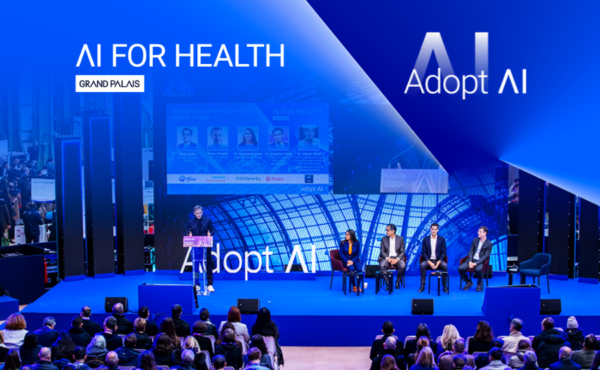
At Adopt AI 2025, the AI for Health discourse confirmed that emerging, converging AI trends are actively creating a new competitive and operational reality. AI will:
- Accelerate the R&D pipeline by drastically compressing timelines, including cutting protocol development by 75% and accelerating patient recruitment by 50%.
- Shift to proactive health and decentralized diagnostics with integrated multimodal models and consumer wearables that predict chronic diseases years before clinical symptoms manifest.
- Automate complexity through agentic AI and clinical co-pilots that absorb administrative burdens, giving healthcare professionals back invaluable time for direct patient care.