
#SaaSpocalypse #Davos/WEFRecap #AIImpactSummit #AIRetail #Cowork #Clawbot #AISafetyReport
Dear readers, Hold on to your chips, the AI world just leveled up. February isn't about maybe doing cool things with GenAI anymore; it's all about the Great Industrial Revolution of AI, where all that "experimentation" is getting shoved aside for massive, industrial-scale deployment. This seismic shift is hitting everything: global economics, how businesses are run, the way you use software, and even what your next job might look like. Inside this issue, we're diving deep into the fallout: • The Five-Layer Stack: Find out why the smart money (and people like Jensen Huang) are saying AI dominance isn't just about the models – it's about controlling the stack, from energy to applications (Davos/WEF Recap). • The SaaSpocalypse: We're tracking the market panic as the agentic workforce goes live. Think of it as your software doing the work, not just managing it. Anthropic’s Claude Cowork is just the beginning. • Money & Power Plays: We break down the latest multi-billion-dollar investments, the race to figure out AI ad monetization (yes, ads are coming to ChatGPT!), and the wild new retail experiences, like Brunello Cucinelli's menu-less, 100% AI website.
GenAI News Podcast
Don't have time to read this newsletter?
Top Highlights
#1. Davos 2026 / WEF 2026 Recap – we’re moving from AI experimentation to industrialization. Davos signals a shift in the global AI conversation from speculation to pragmatic scaling and integration. Key points include: 1. AI as Physical Infrastructure • Leaders (e.g., Nvidia’s Jensen Huang) described AI as a five-layer stack: energy → chips → cloud → models → applications. • Dominance is tied not just to models but control over energy, hardware, and compute economics. • New macro KPIs like “tokens per dollar per watt” were proposed to measure AI efficiency. 2. Strategic Sovereignty & Enterprise Value • Talks emphasized the need for companies to embed their own knowledge into AI rather than just consuming generic models — or risk losing strategic advantage. • AI is no longer just a tech project; it’s part of enterprise governance and competitive edge. 3. Global Diffusion & Practical Impact • Discussions stressed real-world use cases — especially in healthcare and emerging markets — rather than futuristic AGI. • Leaders urged focusing on tangible ROI: using AI to alleviate administrative burden and improve outcomes. 4. Planning Under Uncertainty • Experts agreed that the horizon for broad automation has shortened, pushing decision-makers to plan in conditions of radical uncertainty. • Integrating AI deeply into risk, operations, strategy, and human systems is now seen as essential. Key takeaway: AI’s maturation is less about models and more about building sustainable systems, governance, and operational pipelines that align energy, data, compute, and human insight.
#2. India AI Impact Summit 2026 shapes governance & investment. Held Feb 16–20 in New Delhi, the summit drew heads of state, ministers, and CEOs of OpenAI, Google, Anthropic, Microsoft, Adobe, and more to discuss responsible AI innovation and global cooperation. Major commitments included Microsoft’s $50 B investment in AI initiatives for the Global South, Google’s cross-border “America-India Connect,” and OpenAI’s academic partnerships – signaling strategic investment flows and capacity building.
#3. Brunello Cucinelli’s new website, entirely conceived as a 100% AI experience, is shaking up all the codes of online shopping, eliminating classic e-commerce architecture (menus, search, category pages) for a continuous, conversational AI experience. Product access is solely via AI selections, a wishlist, and conversational history. This "dialogue with the brand universe" is a radical UX shift from standard browsing, risking user disorientation but innovative and in keeping with the times. Access the new website here.

Breaking News
#1. ElevenLabs has launched The Eleven Album – a music collection created using its AI voice synthesis and audio tools. #2. Since January 2026, Friend.com has started promoting in the Parisian metro their star product Friend, a necklace-style pendant marketed as a “digital friend and AI companion”. The embedded AI listens to your environment through an always-on microphone and uses that input to generate conversational responses or supportive messages on your phone. The campaign has triggered debate around tech, loneliness, privacy, and how we want AI integrated into daily life. #3. rentahuman.ai is a startup offering for your AI agent to rent a person to execute a real-world task.
Business News & Market Insights
#4. Advertising in AI is live: OpenAI has started selling ads inside ChatGPT, charging premium rates (~$60 CPM) and engaging major agencies as part of a broader monetization push. Google is evolving AI Mode and Discover to integrate shopping-focused ads and product discovery directly into conversational search experiences, blending inspiration with commerce. Competitors like Perplexity and Anthropic are distancing themselves from ads to protect user trust. AI platforms are experimenting with ad monetization and commercial AI experiences, potentially reshaping search, discovery, and commerce ecosystems.
#5. A survey of Japanese junior high and high students shows ~80 % use generative AI (e.g., ChatGPT, Gemini) for schoolwork or entertainment. AI is often used for information checking, structuring ideas, and conversation. Girls were more likely than boys to use AI for consultation or emotional interaction. GenAI is ubiquitous among teens, shifting from a niche tool to a mainstream study and communication aid.
#6. AI semiconductor company Cerebras Systems secured $1 billion in Series H funding. Capital will accelerate development of large-scale AI infrastructure hardware. Cerebras is known for wafer-scale AI processors optimized for training and inference of massive models.
#7. International AI Safety Report 2026: a multi-stakeholder report outlines global AI safety challenges and priorities for 2026. Key themes include: responsible model deployment, governance mechanisms, cross-border cooperation, ethical risk mitigation. The report aggregates insights from policymakers, researchers, and industry leaders.
#8. The United States and China declined to sign a joint declaration on regulating AI use in the military, citing sovereignty and national security priorities as reasons for staying out.. Other major powers agreed to principles aimed at preventing destabilizing autonomous weapon systems and unintended escalation.
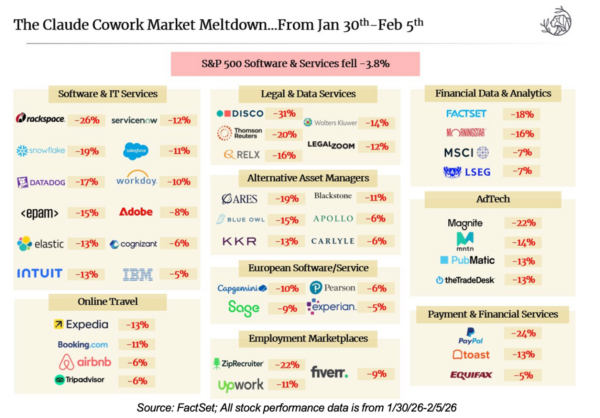
#9. Tech sector market capitalization dropped as major AI-related equities declined. Broader market pressures (rising interest rates, mixed earnings, regulatory uncertainty) contributed, investors are recalibrating expectations around AI monetization timelines and profitability. This market shift signals a valuation reassessment for AI-heavy stocks, reminding us that business models and monetization strategies matter as much as technological promise.
#10. Filmmaker Darren Aronofsky is developing a Revolutionary War TV series that will use AI for production elements, particularly voice generation, while still employing human actors. Aronofsky’s approach reflects experimental storytelling with AI as a tool, not a replacement… yet..
New Models & Innovations
#11. Anthropic's Claude Cowork, with its 11 business plugins, has triggered the "SaaSpocalypse," wiping out $300 billion in software sector capitalization. Unlike traditional SaaS, Claude's plugins "teach" the AI to perform the work itself across key business areas (e.g., Sales, Finance, Legal, Marketing). Each plugin combines three elements: 1) Skills: Procedural knowledge (e.g., prospect research methodology). 2) Connectors (MCP): The system to read/write real-time data from company tools (CRM, Slack, etc.). 3) Sub-Agents: For complex tasks, the plugin divides and coordinates parallel work. The clear message: Competitive advantage lies in the quality of agents orchestrated, not the software owned. The "SaaSpocalypse" signals the birth of the agentic workforce.
#12. Swedish startup Strawberry has launched an open beta of its AI-powered browser, designed to make AI agents accessible to non-technical users. Instead of standalone AI tools, Strawberry embeds agents directly into a web browser, enabling users to delegate real web-based tasks (e.g., lead sourcing, CRM checks, research) through natural language. After a year in closed beta, the company claims strong performance benchmarks and plans deeper personalization features next. Strawberry positions itself as a competitor to Perplexity’s Comet and ChatGPT Atlas with AI-centric browsing features.
#13. OpenAI officially retired GPT-4o, GPT-4.1, GPT-4.1 mini, and others from the ChatGPT interface as of Feb. 13, 2026. These models remain available via the API for now, with support buy-offs phased through April. The shift consolidates usage around newer models like GPT-5.2. The retirement has triggered user backlash, with campaigns and petitions to “#keep4o” because some users valued its conversational qualities. This shows model lifecycles and deprecation choices can have real community and emotional impact – not just technical implications.
#14. China’s Moonshot AI released Kimi K2.5, an open-source multimodal model trained on ~15 T visual/text tokens, capable of text, image, and video understanding, and supporting agent swarm orchestration — coordinating many sub-agents for complex tasks.
#15. What is Clawdbot & why is it trending? Clawdbot (now Moltbolt) is an AI agent/tool gaining rapid attention on platforms like Reddit and Twitter. It acts as a self-referential AI assistant, able to understand and manipulate its own outputs, refine instructions, and adapt workflows automatically. Popularity is fueled by open-source experimentation, meme culture, and developer curiosity about autonomous AI agents. It represents a broader trend toward self-improving systems that can iterate on tasks with minimal human prompting.
#16. ByteDance (parent of TikTok) has unveiled Seedance-20, a generative model lauded for physics-aware, hyper-realistic visual generation. Seedance-20 reportedly captures natural motion and visual physics better than many peers. The focus on physical plausibility reflects a maturation in generative visuals, and not just plausible visuals, but ones that behave plausibly (e.g., motion, texture, lighting).
#17. Anthropic updated its flagship model suite with Sonnet 4.6, targeting robustness, enterprise usage patterns, and enhanced reasoning over extended contexts. While some controversy surrounds benchmarking claims, the update signals Anthropic’s commitment toward business-ready GenAI deployments.
Policy Updates & Ethical Debates
#18. Academia is still figuring out policy and pedagogy around AI – balancing assistance with academic integrity. Professors at Virginia Tech have divergent approaches to GenAI in the classroom. Some embrace AI as a learning aid or tutor-like tool, treating it like outside help. Others prohibit its use for core assignments to preserve writing and critical thinking skills. Another sees potential but notes practical limitations and flaws.