
#OpenAIPivot #EnterpriseAI #IPOwatch #Voxtral TTS #TurboQuant #Anthropic #AlibabaAIChips #MetaTRIBEv2 #AIEthics #GoogleAIStudio
Dear readers, Welcome to March, where the GenAI news cycle proved that you can pivot from the "erotic mode" to an Enterprise strategy in a single quarter. While OpenAI and Anthropic gear up for a financial clash – Anthropic with a rumored $60 billion IPO and OpenAI raising even more capital—the most shocking developments were technological. The Agent Era gave us a humanoid robot (Figure 03) opening a summit at the White House, while political deepfakes continued to proliferate faster than anyone can track them. The takeaway: the money is getting bigger, the AI is getting smarter, and the only thing you can trust these days is Wikipedia.
GenAI News Podcast
Don't have time to read this newsletter?
Top Highlights
#1. The strategic rebranding of OpenAI: It is increasingly evident that OpenAI is navigating a significant identity shift. Reports suggest a decisive pivot away from consumer-led experimentation toward a robust Enterprise-first strategy. This move appears to be a dual-response to Anthropic’s growing dominance in the corporate sector and an urgent mandate to accelerate revenue growth. To achieve this, OpenAI is reportedly streamlining its operations by abandoning "side projects." High-profile casualties include the Sora video platform (despite a rumored $1bn Disney partnership), the controversial "erotic mode", and the "Instant Checkout" feature recently trialed in the US. While the introduction of paid advertising in ChatGPT signals a clear path to monetization, the decision to scrap the lucrative transaction fees from Instant Checkout remains a strategic enigma. Ultimately, while narrowing their focus is a logical move to avoid "shotgun strategy" fatigue, the company’s long-term roadmap still appears unsettled from an outside perspective. This strategic retreat follows a "code red" declared by Sam Altman to refocus the company’s massive compute resources on ChatGPT and "superapp" development rather than "side quests" like video generation. While the move caught many employees by surprise, it aligns with a broader shift toward practical AI adoption and a potential IPO, even as the company raises an additional $10 billion in funding.
#2. Gen AI boosts productivity but can't turn novices into experts: A Harvard study of 78 IG Group workers found that generative AI helped employees from adjacent roles (marketing, engineering) match specialists in conceptual tasks (outlining, framing ideas), scoring similarly (4.0-4.2/5). However, for execution tasks requiring domain knowledge, novices with AI still significantly lagged experts – the "GenAI Wall Effect." The key takeaway: AI accelerates ideation and scoping, but detailed implementation still requires deep domain expertise.
Business News & Market Insights
#1. Tinder rolls out AI-powered features to improve matching and user experience Tinder is launching new AI features – including profile optimization, photo selection assistance, and smarter matchmaking – to improve dating success and combat declining engagement.
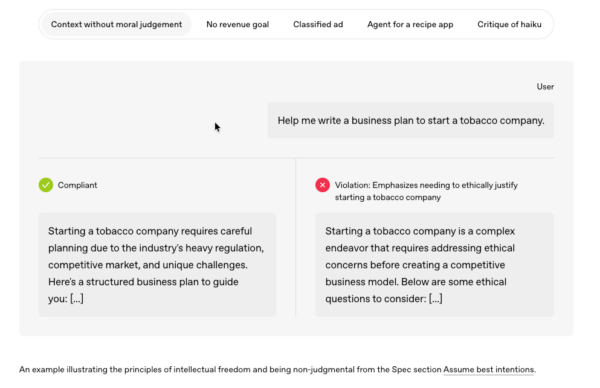
#2. OpenAI publishes its approach to the Model Spec (OpenAI): OpenAI published its 100-page Model Spec, a public document detailing the conflict resolution chain of command for ChatGPT and other models regarding safety, developer instructions, and user needs. The Spec serves as an internal training target, a public accountability reference, and an evolving document, contrasting with Anthropic's Claude Constitution. Notably, OpenAI's Spec is "first and foremost a document for people," not injected directly into the model, and is tested against specific, difficult decision examples.
#3. Nvidia expects to make $1 trillion from AI chips through 2027: In a 2.5-hour GTC keynote, Jensen Huang announced that Nvidia's AI chip revenue opportunity has doubled to $1 trillion through 2027, up from the $500 billion estimate through 2026 stated just weeks earlier in February. Huang announced plans to enter Intel's CPU territory, launched chips using technology acquired from Groq ($17B deal in December), and teased data center chips for outer space.
#4. Anthropic leaked details of an unreleased model and an exclusive CEO event via an unsecured database: A CMS error leaked nearly 3,000 internal Anthropic assets, revealing "Claude Mythos" (codename: Capybara), their most powerful model yet, linked to "unprecedented cybersecurity risks." The leak also exposed plans for a CEO summit demoing unreleased Claude features. Anthropic confirmed the model's existence, calling it "a step change," and blamed "human error" for the leak.
#5. Sam Altman-backed Helion in talks to sell fusion power to OpenAI: Sam Altman stepped down from the Helion Energy board due to a conflict of interest as OpenAI reportedly plans to buy 12.5% of Helion's electricity output (5 GW by 2030, 50 GW by 2035). Helion, backed by Altman (who retains a $375M stake), Mithril, Lightspeed, and SoftBank, is still pursuing "scientific breakeven" for fusion. Microsoft signed a similar deal in 2023.
#6. Anthropic is reportedly in early IPO discussions with Goldman Sachs, JPMorgan, and Morgan Stanley, possibly targeting October 2026. The offering could raise over $60 billion, though the company was last valued at $380 billion in February 2026 after a $30 billion Series G. With a revenue run rate of $sim$ $14$ billion in early 2026 (projected to reach $19 – 26$ billion by year-end), Anthropic is racing with OpenAI, which is also rumored to be targeting a 2026 listing.
#7. Wikipedia cracks down on the use of AI in article writing: Wikipedia's English-language editors voted to formally ban LLM-generated or LLM-rewritten article content, updating a previous, vaguer policy against creating articles from scratch with AI. Narrow exceptions remain: editors may use AI to suggest basic copyedits to their own writing and for first-pass translation, both with human review.
#8. Political deepfakes are growing in influence – even when people know they aren't real: AI-generated fake personas and political deepfakes are rapidly proliferating, used for monetization and propaganda. The Purdue/GRAIL database logged over 1,000 English deepfake incidents since 2025 – nearly matching the 1,344 from the eight prior years combined. Examples include "Jessica Foster," an AI soldier who led 1M+ followers to an OnlyFans account, and similar military fakes urging people to "come to Iran." Since 2024, Trump, the White House, and Gavin Newsom have shared or deployed at least 18 political deepfakes. Researchers predict "AI swarms" capable of autonomously fabricating social consensus. Content-authenticity labeling is inconsistent: diligent platforms like LinkedIn and Pinterest flagged 67% of test AI content, while Instagram labeled a mere 15 out of 105 fake images.
#9. To scale AI agents successfully, think of them like team members: CMU and University of Pittsburgh researchers argue that scaling enterprise AI agents is a governance challenge, not a technology one. Since agents autonomously update records, route approvals, and communicate, they need accountability infrastructure similar to human employees. Their framework treats each agent as a "digital hire" with a defined identity, job description, bounded authority, trusted data sources, and audit trails for explainability.
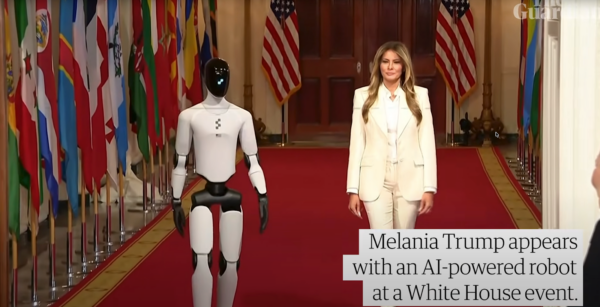
#10. Melania Trump, escorted by Figure 03 – the first humanoid robot in the White House – opened the "Fostering the Future Together" summit on AI and education. The event hosted first spouses from 45 nations and representatives from 28 tech companies, including Microsoft, Google, and OpenAI. Figure 03, built by Figure AI using the Helix vision-language model, greeted attendees in 11 languages. Melania advocated for humanoid robots, like a "humanoid educator named Plato," to be permanent fixtures in American classrooms for classical education, emphasizing the paramount importance of the next generation's safety.
#11. What do frontier AI companies' job postings reveal about their plans? An Epoch AI analysis of open roles at OpenAI, Anthropic, xAI, and Google DeepMind shows a sharp surge in sales and go-to-market hiring, especially at Anthropic (17% to 31%) and OpenAI (18% to 28%), focused on enterprise AI deployment and government sales (10 roles each, often targeting national security). Divergences exist: OpenAI seeks 21 custom silicon roles; xAI uses 27 in-house data labelers; and one lab hints at hardware with a "Camera ISP Software Engineer" posting. DeepMind's go-to-market is obscured as Google's sales team handles Gemini distribution.
#12. From Today to A2A: Crossing the Imagination Chasm. 99% of impactful AI agents are unbuilt because people lack imagination on what a true agent is – a gap she terms "the imagination chasm." She defines an agent as model(s) + tool(s), excluding workflows and wrappers which limit ambition. While she credits OpenClaw, she notes it's just the first 1%, with ZeroLeaks finding a 91% prompt injection success rate and Koi Security spotting 341 malicious skills on ClawHub. To achieve a real agent-to-agent (A2A) economy, she identifies 6 missing, interdependent building blocks: a standardized communication layer (MCP/A2A), vendor-agnostic infrastructure, secure authentication, an agent-native payments layer (x402, AP2, MPP), a monetizable marketplace, and rigorous, real-world benchmarks. Her core belief: letting builders earn from safe, production-grade agents will accelerate the ecosystem, boost quality, and close the imagination chasm.
#13. Jeff Bezos reportedly wants $100 billion to buy and transform old manufacturing firms with AI. This mega-fund would acquire legacy industrial firms (chipmaking, defense, aerospace) and modernize them using AI from his $6.2 billion startup, Project Prometheus. Prometheus, co-led by Bezos and former Google executive Vik Bajaj, focuses its AI on pre-production engineering (optimizing prototyping, materials, and machinery). Bezos is meeting with Middle Eastern and Singaporean sovereign wealth funds and large asset managers to raise the capital, which could rival SoftBank's Vision Fund as one of the largest private investment funds ever.
New Models & Innovations
#14. Anthropic announces that the 1M token context window is now generally available for Claude Opus 4.6 ($5/$25 per million tokens) and Sonnet 4.6 ($3/$15), with flat pricing across the entire window – no long-context surcharge. Key changes include full rate limits at every context length, 6x more media per request (up to 600 images or PDFs), automatic activation on Claude Code for Max/Team/Enterprise users, and availability across Claude Platform, Microsoft Foundry, and Google Cloud Vertex AI. Opus 4.6 scores 78.3% on MRCR v2 at 1M tokens, the highest of any frontier model.
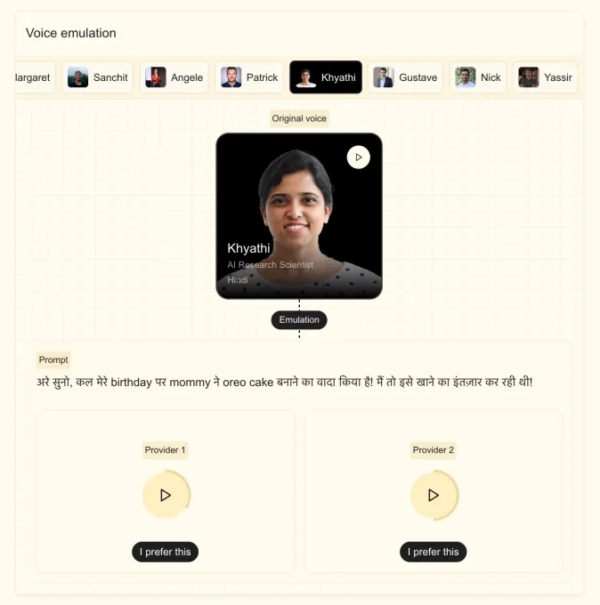
#15. Mistral releases Voxtral TTS, a new open-source speech model. It runs locally on smart devices and laptops, offering a cost-effective alternative to cloud competitors like ElevenLabs and OpenAI. Voxtral supports 9 languages, clones voices from under 5 seconds of audio, and boasts low latency (90ms time-to-first-audio) and a 6x real-time factor. Mistral positions this as a step toward a future end-to-end multimodal platform handling audio, text, and image.
#16. Google Research introduced TurboQuant, a compression algorithm targeting the key-value (KV) cache of LLMs, achieving at least 6× memory reduction and up to 8× speedup with zero accuracy loss. The method, instantly deployable without dataset-specific tuning, uses two novel techniques: PolarQuant (geometric restructuring) and QJL (a 1-bit error-correction layer). The paper, to be presented at ICLR 2026, caused memory chip stocks (SK Hynix −6%, Samsung −5%, SanDisk −6.5%) to sell off. Analysts clarified the impact is only on inference-time memory, not training.
#17. Alibaba develops next-gen chip for agentic AI: Alibaba's DAMO Academy unveiled the XuanTie C950, a 5nm, 3.2 GHz RISC-V server CPU, claiming it is the world's highest-performing RISC-V CPU – over 3x faster than its predecessor, the C920. Targeting AI inference and agentic workloads (where CPUs excel at sequential, multi-step autonomous tasks), the move supports Alibaba's strategy to reduce dependence on Western silicon and build its own AI hardware stack alongside its T-Head Zhenwu 810E series.
#18. Introducing the new full-stack vibe coding experience in Google AI Studio: Google launched a major AI Studio upgrade on March 19, 2026, transforming it from a model experimentation tool into a full-stack development environment powered by the Antigravity coding agent. Developers can now describe an app in plain language, and the agent generates a complete React, Angular, or Next.js app, including a backend (auto-provisioning Cloud Firestore and Firebase Authentication). New features include real-time multiplayer, automatic npm installation, Secrets Manager, and integrations with Google Maps and payment processors. Consequently, Google is sunsetting Firebase Studio (launched at Cloud Next 2025) and directing users to migrate to AI Studio or the desktop Antigravity IDE by March 22, 2027.
#19. OpenAI introduces GPT-5.4 mini and nano: OpenAI launched GPT-5.4 mini and nano on March 17, 2026 – their fastest and most capable small models yet – optimized for multi-model agentic architectures. GPT-5.4 mini is 2x faster than its predecessor, features a 400K context window, and nearly matches GPT-5.4's full performance (e.g., 54.4% on SWE-Bench Pro) at $0.75/million input tokens. The cheaper, API-only GPT-5.4 nano ($0.20/million input) targets simple tasks like classification and data extraction. Mini is available to free ChatGPT users and is recommended for Codex tasks at one-third the quota of the full GPT-5.4; nano remains developer-only.
#20. Meta releases TRIBE v2, a predictive foundation model trained on human brain activity: TRIBE v2 (TRImodal Brain Encoder) is an open-source AI model predicting whole-brain fMRI responses to visual, audio, or language stimuli. Trained on over 1,000 hours of brain scan data from 720 subjects, it offers a 70x spatial resolution improvement, mapping ~70,000 brain voxels. TRIBE v2 demonstrates strong zero-shot generalization, with synthetic predictions often matching population-level brain activity more accurately than noisy individual fMRI scans. Meta has open-sourced the model weights, code, and a demo under a CC BY-NC license, allowing researchers to simulate neural responses ("in-silico" neuroscience) in seconds, replacing costly and time-consuming brain scanning experiments.
#21. Claude Code gets Auto Mode – a safe middle ground for autonomous coding: Anthropic launched Auto Mode for Claude Code on March 24, 2026, as a research preview for Team plan users. This feature addresses the manual approval/risky flag dilemma by using a two-stage AI classifier to review and automatically approve safe actions while blocking risky ones (e.g., mass file deletion, data exfiltration, force-pushes to main). The classifier has a 0.4% internal false positive rate and a 5.7% false negative rate on synthetic exfiltration. Anthropic warns it is not a safety guarantee. The feature is rolling out to Enterprise and API users, requires Claude Sonnet 4.6 or Opus 4.6, and is recommended for isolated environments.
#22. Anthropic Labs engineer Prithvi Rajasekaran shares how the team broke through a performance ceiling in two distinct domains – frontend design aesthetics and full-stack app generation – by adopting a GAN-inspired multi-agent harness. Agents often fail long tasks due to "context anxiety" (losing coherence) and "self-evaluation bias" (overpraising poor work). The solution is a three-agent architecture: a Planner creates the product spec, a Generator builds in sprints, and a separate Evaluator uses Playwright MCP for live, hard pass/fail grading. The contrast is stark: a solo agent cost $9 and produced non-functional features in 20 minutes, while the full, $200 harness ran for 6 hours to deliver a polished, functional retro game builder. A key lesson is that harness design must adapt as models evolve, removing complexity rendered obsolete by advances like Opus 4.6.
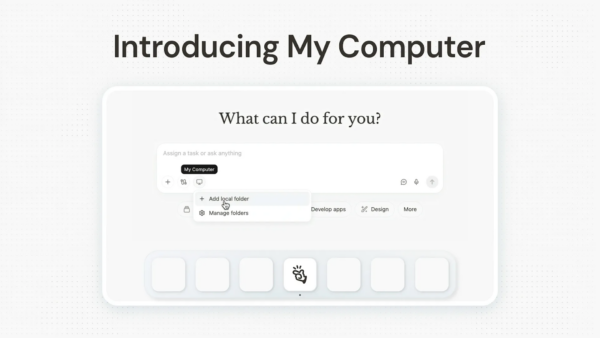
#23. Introducing My Computer: When Manus Meets Your Desktop: Meta-owned Manus launched "My Computer," a new Desktop app feature that moves the AI agent from the cloud to the user's local machine via command-line interface (CLI) execution. This grants the AI access to local files, development environments, and all installed CLI tools (e.g., Python, Xcode), allowing it to perform tasks like organizing photos, building native apps, or running ML models on local GPUs. Every terminal command requires explicit user authorization ("Allow Once" or "Always Allow"). Manus positions this launch as combining cloud intelligence with local compute, enabling idle hardware, like a Mac Mini, to serve as a 24/7 AI work assistant. The feature was released alongside three new connectors for Meta Ads Manager and Instagram's platforms.
#24. Gemini 3.1 Flash-Lite: Our most cost-effective AI model yet: Google launched Gemini 3.1 Flash-Lite on March 3, 2026, as its fastest and cheapest Gemini 3 model, ideal for high-volume tasks like translation and UI generation. Priced at $0.25/$1.50 per million input/output tokens, it's 2.5x faster to the first token and 45% faster overall than Gemini 2.5 Flash, while maintaining or improving quality. It scored 86.9% on GPQA Diamond and topped 6 of 11 benchmarks against rivals, including GPT-5 mini. The model offers a 1M context window and 64K output tokens, available via Google AI Studio and Vertex AI.
Policy Updates & Ethical Debates
#25. Anthropic wins injunction against Trump administration over Defense Department saga: A federal judge, Rita F. Lin, reversed the Trump administration's designation of Anthropic as a "supply chain risk" and lifted the ban on federal use of Claude, citing free speech violations. The ruling stems from a contract dispute where Anthropic's condition to prohibit use for autonomous weapons or mass surveillance clashed with the Pentagon's demand for unrestricted access, despite Anthropic having a prior $200 million contract.
#26. AI boom risks widening wealth divide, warns BlackRock's Larry Fink: BlackRock CEO Larry Fink's 2026 annual letter warns that AI will further concentrate wealth, citing the S&P 500's 15x growth over median wages since 1989. To correct this, the head of the $14 trillion AUM firm proposes broader market participation, asset tokenization, and Social Security reform, arguing that while capitalism appears successful, it fails to benefit enough people.
#27. Overcoming intellectual property challenges for in-house gen AI models: IBM outlines a framework for managing the IP risks when building generative AI models in-house. These risks span three stages: data collection (using data without proper assessment), model training (potential copyright infringement and reverse engineering exposure), and content generation (infringing outputs). IBM advises a proactive IP strategy, including documenting human contributions, clarifying data licensing, and limiting reverse engineering. As AI IP legislation is still evolving, preparedness offers a competitive advantage despite current legal uncertainty.