Faced with transatlantic giants, Europe suffers from a systemic lag: models like Meta AI, Gemini, or Claude consistently arrive on our soil several months late. The diagnosis from ecosystem leaders is clear: while tech adoption within European companies is a reality (91% adoption of hybrid AI), the dependence is absolute. Today, the American Cloud hosts nearly all the innovation driving CAC40 and FrenchTech flagship companies.
Yet, a shift is underway. General intelligence is becoming a commodity, and raw compute power will soon no longer guarantee a competitive edge. The true strategic value now lies in transforming corporate structures. To survive, businesses must execute three major strategic shifts: mapping their sovereignty risks, hybridizing their data models, and making targeted investments in vertical European infrastructure.
The Historical Analogy: The Electric Revolution and Factory Reorganization
In the late 19th century, the advent of electricity in the industrial landscape triggered the exact same technological transformation we are seeing with artificial intelligence today.
Before this disruption, factories ran on steam. All machinery had to be crowded around a single, central power source via a complex, rigid system of belts and drive shafts. When the first electric motors emerged, manufacturers’ initial reaction was simply to replace the steam engine with an electric motor, without changing the layout of the workshops. The productivity gains? Close to zero. The tool had changed, but the system remained old.
The technological breakthrough quickly became democratized. Access to electricity became a commodity available to all competitors, neutralizing the raw advantage of its mere adoption. The real performance gains came from reinventing the workspace. Productivity accelerated only when a small motor was placed on each machine, the assembly line was invented, and logistical flows were reorganized.
The Current Diagnosis: The Specter of the “Token Ban” and the War Economy
Today, companies are repeating that 19th-century mistake: they are plastering ultra-high-performance generative AI models onto obsolete organizational structures. ROI is stagnating, even as budgets skyrocket.
Meanwhile, the United States is operating under a true war economy. The scale of growth there is directly correlated to colossal investments, creating a dramatic 100x gap with Europe: OpenAI raises 100 times more funding than our local champions, and Anthropic generates 100 times more revenue than Mistral.
Global AI consumption, which hovers between 25 and 50 GW worldwide in early 2026, is expected to saturate the equivalent of the entire existing data center footprint within 5 years. Compute capacity is being allocated on a just-in-time basis. The risk facing Europe is no longer just regulatory; it is operational. It is the specter of a “token ban” or token rationing. The token is becoming a vital resource, just as electricity was in its time. If an American sovereign player decides to turn off the tap or prioritize its domestic market, what will be left of fully automated European customer services and production lines?
The Three Strategic Shifts
1. From Cyber Risk Management to the Digital Resilience Index
The traditional IT security model has long focused on border protection: blocking intrusions, securing access, and auditing code. Today, the major threat is no longer just a cyberattack, but the outright shutdown of an outsourced service or a unilateral change in API access terms.
Companies must urgently map their critical technological dependencies by creating a true Digital Resilience Index. Being sovereign doesn’t mean living in autarky; it means giving yourself choices. However, this requires the systematic deployment of multi-API strategies and strict portability clauses.
The 10% Rule: Just like market-pioneering companies, resilience is built today by systematically shifting 10% of critical IT consumption to French or open-source AIs. This is the mandatory investment required to seed our own ecosystem.
2. From the “AI Model is King” to the Sancturization of Proprietary Data
The advantage does not go to the one with the largest language model; general intelligence is commoditizing and costs are plummeting. Value has shifted: AI is merely an inbound and outbound flow (token in – token out). The true barrier to entry lies in the quality, specificity, and governance of corporate data.
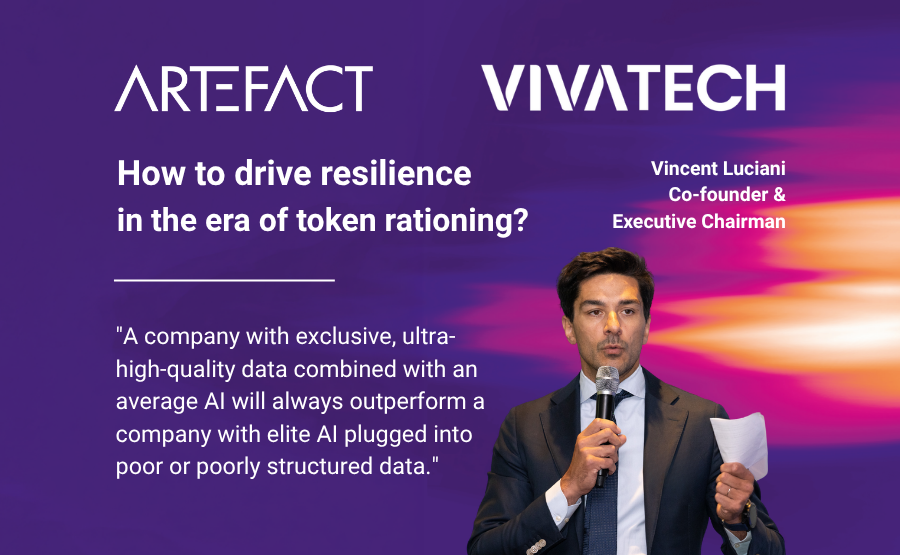
A company with exclusive, ultra-high-quality data combined with an average AI will always outperform a company with elite AI plugged into poor or poorly structured data.
- The Retail example: The risk of data capture is immediate. In Europe, 84% of consumers already use AI for brand discovery or product searches. While AI traffic to retail sites has surged by 393% in one year, the danger is that tech intermediaries will hijack the customer relationship. The day they own the interface, they know your customers better than you do.
- The Industrial Maintenance example: To answer the question “How do I fix machine X023?”, the language model does nothing on its own. The exclusive value depends on the proprietary technical catalog, the ability to tailor the response to the worker’s qualification level, and real-time verification of their safety clearances. The intelligence is in the information system, not the LLM.
3. From Generalist AI to End-to-End Vertical Excellence
Trying to compete head-on with American generalist models on the technological frontier is a losing battle. The United States boasts 5,500 data centers—more than ten times the footprint of any other country. Europe must wage an asymmetrical war by betting on the long-term strategic planning of vertical AI.
Future value is nestled in hyper-specific sub-domains, where barriers to entry are the most complex: business workflow integration, heavy regulatory constraints, and highly sensitive data (healthcare, defense, advanced manufacturing). To achieve this, Europe must structure a sovereign offering capable of competing through specialized excellence.
This is the entire purpose behind the recent launch of the AION consortium, of which Artefact is a founding member. The goal of this “AI Gigafactory” approach is to secure major sovereign compute capacity (200 MW, 10 billion tokens) and back it with all indispensable services (governance, data processing, deployment). Faced with the risk of a token shortage, securing capacity represents a fixed cost, but missing this step would mean a permanent cost to our competitiveness.
Conclusion
— Vincent Luciani, Co-Founder & Executive Chairman of Artefact
To successfully navigate this transition, business leaders must steer their trajectory along three axes:
- Drive by the Resilience Index: Enforce multi-API strategies and sanctuary 10% of critical IT on open-source or European solutions.
- Sanctuary Data “Moats”: Structure exclusive data assets to prevent surrendering customer and business relationships to token distributors.
- Support Vertical Infrastructure: Commit adoption toward end-to-end integrated ecosystems, like the AION consortium, to turn regulatory constraints into a competitive barrier.
Pragmatism requires moving at two speeds: adopting massively so as not to lose ground in the short term, while methodically rebuilding our sovereignty across the entire value chain.