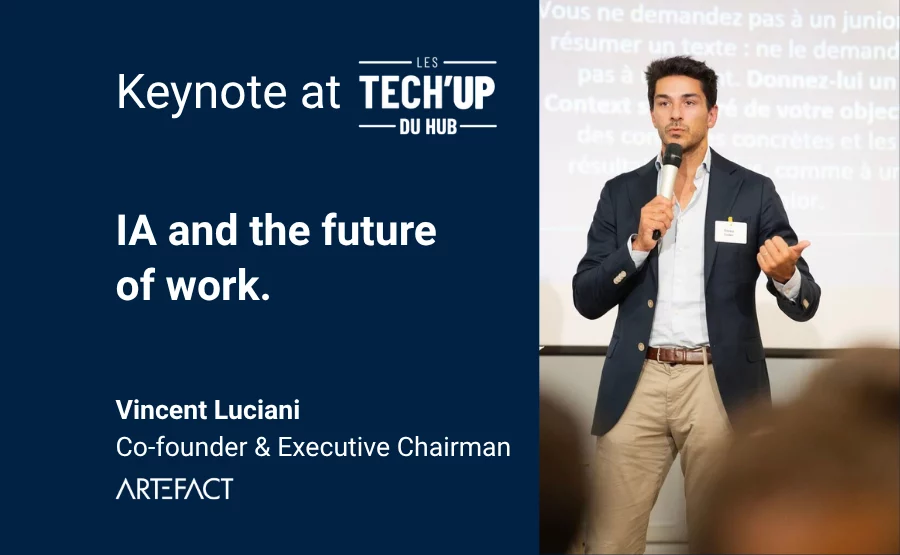
Key takeaways from Vincent Luciani, Co-founder & Executive Chairman of Artefact, speaking at Bpifrance’s Tech Up du Hub event on September 17.
On September 17, Bpifrance gathered the tech ecosystem for its annual Tech Up event, centered on the operational adoption of AI across businesses. Invited to address the pivotal theme of AI and the future of work, Vincent Luciani, Co-founder & Executive Chairman of Artefact, delivered a ten-minute keynote titled: “AI and the Future of Work”.
Steering clear of abstract speculation and alarmist narratives, Vincent Luciani shared field-tested perspectives derived from enterprise deployments: the tangible impact on employment, the reality of the human-machine collaborative model, the rise of autonomous agents, and the essential governance framework required for sustainable transformation.
Jobs and Employment Dynamics: Why the “Job Apocalypse” Has Not Happened
Opening his remarks, Vincent Luciani emphasized the sheer scale of technology penetration across industries. Artificial intelligence has entered virtually every enterprise today: 90% of organizations now utilize AI in at least one business function, according to McKinsey’s State of AI (2026) report, with Europe currently leading global adoption rates.
The measured business impacts are substantive. Among small U.S. employers with the highest levels of AI utilization, Federal Reserve data (Fed, 2026) highlights direct operational gains: measurable productivity improvements, a 39% increase in deliverable quality, and a 31% increase in sales.
Crucially, this rapid diffusion has not triggered widespread workforce reduction. Speaking from direct field experience, Vincent Luciani noted that he has yet to observe any large-scale wave of AI-driven layoffs. Independent market studies corroborate this observation:
- A study highlighted by The Economist estimates that approximately 1 million jobs have been created across the U.S. AI ecosystem, compared to roughly 200,000 job cuts attributed to AI since mid-2023, even across heavily exposed fields such as software engineering and legal services.
- A rigorous study published in the Financial Times indicates that large enterprise adopters of AI post a +10.2% headcount increase two years post-adoption, including a +12% increase across junior roles.
For Artefact’s executive chairman, the takeaway is unambiguous: the “job apocalypse” has not occurred and is unlikely to materialize.
Promise vs. Reality: Human-Machine Collaboration Meets Organizational Friction
While public discourse often fixates on end-to-end task automation and wholesale human displacement, Vincent Luciani underscored that the predominant enterprise model today remains hybrid collaboration between human experts and machine intelligence.
A substantial gap persists between isolated autonomous agents operating successfully in proof-of-concept setups and their practical integration within enterprise structures. A professional role cannot be reduced to a purely sequential chain of tasks; it fundamentally relies on cross-functional collaboration, tacit context, and informal workflows. Consequently, operational productivity gains experience significant friction as implementation scales outward:
- Individual development: AI adoption delivers a 4x to 5x boost in task execution speed.
- Team level: Net productivity gains moderate to approximately +80%.
- Enterprise level: Net productivity gains compress to roughly +20%, dampened by organizational bottlenecks, dependencies, and complex internal procedures. As organizations expand, systemic complexity inevitably catches up with technological gains.
As a result, genuine end-to-end autonomous agents remain scarce in production. Organizations primarily deploy automated decision logic coupled with human-supervised AI across targeted segments of broader processes:
- Utilities sector: Operations teams at a water utility deploy AI to extract, review, and group contractual obligations across hundreds of contracts, driving substantial time savings and improved analytical accuracy.
- Construction & engineering: Site managers automate routine inspection reports and site visit documentation.
Across these use cases, the primary benefits lie in accelerated execution and heightened output quality, enabling tasks that otherwise would have been abandoned due to bandwidth constraints, while effectively upskilling less experienced personnel. However, these tools remain explicitly tethered to and supervised by human professionals.
The Rise of Autonomous Agents: Emerging Use Cases and Cautionary Signals
Notwithstanding these constraints, a new cohort of autonomous agents is beginning to emerge. Defined by clear objectives, expanded latitude in decision-making, and non-deterministic behavior, these systems carry direct operational execution capabilities.
This evolution initially took root in software engineering. Teams can now summon agentic workflows directly via Slack to troubleshoot and remediate codebase issues. Artefact has deployed this internally across proprietary tools: an agent independently parses analytics error logs, diagnoses the underlying incident, and opens a Pull Request (PR) without manual intervention. Code review has swiftly become a primary proving ground for production-grade agentic autonomy.
Beyond software development, agentic workflows are expanding into customer interactions as well as back-office operations. In commercial environments, companies such as Heineken are deploying automated sales agents, while enterprise support functions are progressively introducing specialized agents across Human Resources, Procurement, and Finance.
As autonomy deepens, Vincent Luciani outlined several critical challenges and cautionary lessons emerging from early deployments:
- Scaling remains non-trivial: Moving beyond controlled pilots to enterprise-wide scale introduces unexpected dependencies and operational friction.
- Risk management and criticality calibration: Defining delegation limits and operational guardrails is essential. An ordering miscalculation by an agent at Heineken may be manageable within a hospitality supply chain; an equivalent deviation in a clinical healthcare environment carries severe liability.
- Inference cost inflation: Running sophisticated autonomous workflows can be costly (upwards of €15 per complex run). As multiple agents coordinate and converse, compute consumption compounds rapidly. Vincent Luciani highlighted market-wide budget runaways observed across major tech players (Microsoft, Uber), as well as enterprise clients such as L’Oréal, whose initial operational forecasts were significantly exceeded.
- Shifting competency profiles: Professional work is moving along a spectrum: from continuous human intervention, to human-in-the-loop augmentation, to partial automation, and ultimately to high-level supervisory oversight. Navigating this evolution requires maintaining robust foundational expertise and practical craft, or professionals risk degradation of core qualifications.
- Organizational horizontalization: Autonomous agents do not respect traditional silos; their workflows cut across established corporate boundaries. For example, an inventory supervision agent identifying an upstream supplier shortage can autonomously issue a replacement purchase order via Procurement, recalculate quarterly cash-flow forecasts for Finance, and reschedule delivery schedules for Logistics in real time.
Five Strategic Recommendations for Collective Transformation
To conclude his keynote at Tech Up, Vincent Luciani laid out five strategic priorities to translate isolated technical experiments into structured, long-term enterprise transformation:
- Prioritize organizational context: For AI agents to generate differentiated enterprise value, they must be grounded in company-specific institutional knowledge, internal conventions, and structural context.
- Establish AI governance and treat agents like new hires: AI agents must undergo structured onboarding, contextual training, ongoing performance evaluations, and rigorous access control and privilege management.
- Cultivate an internal community of AI builders: Sustainable transformation must be led and owned by operational business units through experiential, hands-on practice (learning by doing).
- Invest systematically in workforce capabilities via Strategic Workforce Planning: Upskilling cannot be treated as a one-time initiative; it requires continuous, near-real-time calibration. Two structural shifts are already apparent: first, accelerated technical literacy across non-engineering disciplines (as seen at OpenAI, where Product Managers now spend an estimated 50% of their working time generating code, compared to 0% previously); second, dedicated training in supervisory delegation and managerial oversight.
- Empower and protect human capital: Successful change management hinges on mutual trust. Employers must guarantee transparency regarding strategic AI deployment decisions alongside access to meaningful continuous education, ensuring teams evolve in parallel with their professions.