





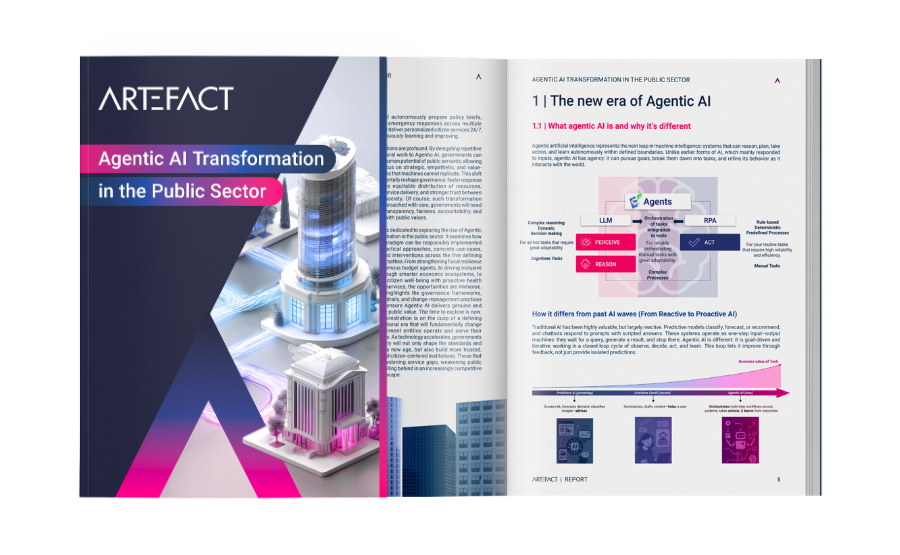
The public sector stands at a decisive moment. With global public debt reaching an unprecedented $102 trillion in 2024, governments are caught between opposing structural forces. On one side, fiscal space is shrinking rapidly, with over 3.4 billion people living in countries that spend more on debt interest than on health or education. On the other side, citizen expectations are soaring, demanding digital services that rival the speed and personalization of Big Tech.
Most organizations frame this convergence as an insurmountable bureaucratic crisis. Market leaders, however, recognize it as a strategic opportunity. By building a scalable trust stack driven by Agentic Artificial Intelligence, governments can fundamentally reshape service delivery and build a defensive moat of accountability around public institutions.
The problem: The end of business as usual
Ask any public sector leader about their digital transformation, and they’ll talk about scattered portals, isolated machine learning pilots, and incremental reforms. Yet, these efforts consistently struggle to deliver breakthrough results at the necessary scale.
The data is unambiguous. Public spending continues to rise, now averaging 40 % of GDP in OECD countries, while bureaucratic silos bog down critical programs. Historically, artificial intelligence in government has been highly valuable but strictly reactive. Predictive models classify risk, and chatbots provide scripted answers to citizen queries. These systems operate as simple input and output machines. Without the capacity to take autonomous action, AI remains trapped in the realm of “innovation theater,” failing to alter the fundamental economics of public administration: business as usual will not win the battles ahead.
The solution: The digital public servant
Agentic AI represents the next leap in machine intelligence, featuring systems that can reason, plan, take action, and learn autonomously within defined boundaries. These are not just algorithms. They are digital public servants. They operate in a continuous closed loop of observing, deciding, acting, and learning.
Crucially, the economics making this possible have flipped entirely. As the Stanford AI Index reports, “depending on the task, LLM inference prices have fallen anywhere from 9x to 900x per year”. This massive cost reduction enables continuous agentic loops without breaking strained public budgets.
The five battlegrounds of modern governance
To secure prosperity and stability, agentic AI is the force multiplier needed to win five defining battles:
- The public finance battle: Plugging leaks and boosting the war chest. Governments must plug revenue leaks and tackle mounting national debt. Autonomous tax compliance agents can detect complex tax evasion in real time, recovering billions lost to fraud. Furthermore, procurement watchdogs can flag bid rigging before contracts are signed, acting as tireless guardians of the public purse.
- The economic development battle: Attracting capital and driving growth. As the UN notes, “capital still flows where it’s easiest, not where it’s most needed”. Agentic AI can seamlessly underwrite SME credit, match foreign direct investment opportunities to local industrial clusters, and orchestrate complex supply chain logistics to make economies irresistible to global investors.
- The human and social development battle: Uplifting health, education, and welfare. Proactive intervention is required here. Instead of reactive healthcare, autonomous agents can design personalized chronic disease care pathways, deploy early dropout risk detectors in schools, and simulate long-term pension sustainability.
- The infrastructure and citizen services battle: Delivering smart, responsive urban governance. Digital twins and predictive maintenance agents can automatically dispatch repair crews for utility leaks or road defects before major service disruptions occur, saving millions in reactive maintenance costs.
- The judiciary, safety, and security battle: Upholding justice means delivering speed and fairness. Court docket optimization agents can aggressively reduce case resolution times, while dynamic patrol allocation agents optimize law enforcement resources in real time.
The Playbook: From ambition to public impact
The transition from scattered pilots to enterprise-scale, trustworthy AI follows a rigorous, industrialized sequence.
- Strategic clarity: Identify mission-critical use cases. Do not simply deploy AI for the sake of modernizing. Focus on areas where AI can deliver high impact with manageable risk, using an impact and feasibility matrix to prioritize projects.
- Data and workflow readiness: AI success depends entirely on accurate, connected data. Alarmingly, only 12 % of surveyed executives believe their current data infrastructure is sufficient for AI applications. Governments must establish common data standards, digitize inputs, and map end-to-end workflows before introducing autonomy.
- Controlled pilots: Start with a bounded pilot in a high-impact area. A 90-day pilot provides a safe, low-risk environment to test agentic AI, ensuring human oversight is meticulously maintained for sensitive decisions.
- Industrialized governance: Establish robust oversight mechanisms. Align with regulatory frameworks like the EU AI Act. Crucially, the white paper states that “governance is a feature, not friction: clear accountability, impact assessments, and continuous monitoring are what make autonomy safe”.
- Scaled adoption and change management: Technology alone will not deliver success. With 71% of public sector employees feeling unprepared for AI, targeted reskilling and change management are mandatory. Introduce hybrid roles where civil servants supervise agents rather than perform repetitive tasks.
The stop-doing list
Equally important is what government leaders must abandon immediately.
- Stop funding pilots without exit criteria. If an algorithm has not proven its value or a path to safe compliance within a designated timeframe, redeploy the capital elsewhere.
- Stop treating governance as an afterthought. Impact assessments, data sovereignty, and audit mechanisms must be embedded from day one.
- Stop automating broken workflows. Map end-to-end processes first. Digitizing an inefficient bureaucracy only produces faster inefficiencies.
- Stop ignoring the human in the loop. The best AI fails if civil servants and citizens do not trust it. Adoption is fundamentally a change management challenge.
Why early movers win
The global public sector race will separate into two distinct pathways. Fast and fragile organizations will deploy models with minimal governance, facing public backlash, audit failures, and a total loss of citizen trust. However, trusted architects will treat regulation and accountability as fundamental design requirements, building resilient, citizen-centric institutions.
Early movers will leapfrog legacy inefficiencies, compounding benefits across departments to create a flywheel of faster learning and higher quality public outcomes. The question is no longer if governments should act, but where to start.
Industrialize agentic accountability now. Begin with one high-impact workflow. Prove value. Scale with care. And let a new generation of digital public servants work side by side with humans to lead the next era of public service.
More about the author:
Omar Hallak is a Senior Partner and Public Sector Lead at Artefact, with over 13 years of consulting experience at leading global firms. He specializes in government transformation, national data initiatives, fiscal planning, and tourism development across the Middle East, advising senior public-sector leaders on data-driven strategies and large-scale transformation programs. Omar has led the design and implementation of national and city-level data hubs, fiscal data-quality programs, and tourism data platforms that enhance governance, decision-making, and service delivery. He holds an MBA from INSEAD and a BBA in Finance & Accounting from the American University of Beirut.