
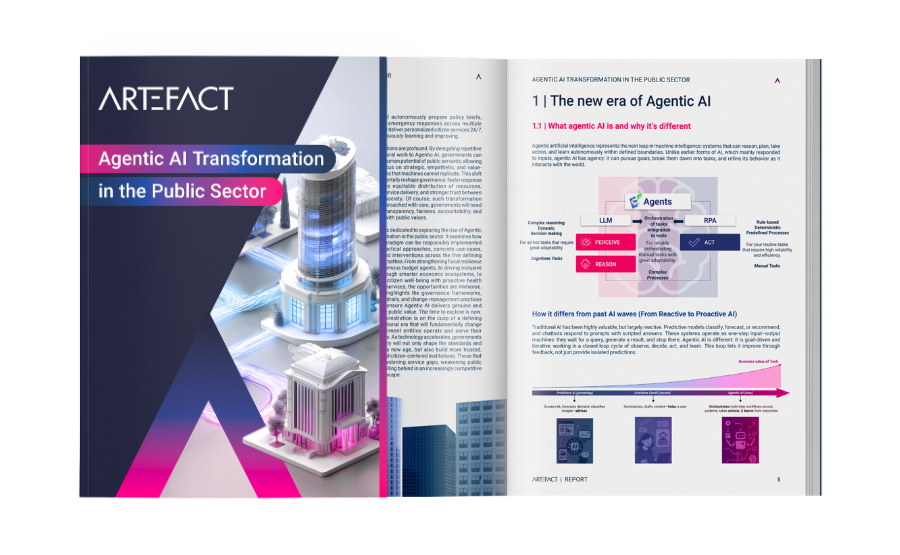
Governments are facing a perfect storm of soaring public debt, reaching $102 trillion globally, and rapidly rising citizen expectations. To navigate this, leaders must move beyond reactive algorithms and embrace Agentic AI. These autonomous systems can reason, plan, act, and learn within defined boundaries, acting as tireless “digital public servants” that execute complex, multi-step workflows.
As noted in Artefact’s white paper, Agentic AI Transformation in the Public Sector, “business as usual will not win the battles ahead”. Agentic AI is the critical force multiplier needed to secure prosperity across five defining battlegrounds:
- Public finance: Plugging revenue leaks and managing debt with autonomous tax compliance agents and procurement watchdogs.
- Economic development: Attracting global capital and driving inclusive growth by seamlessly orchestrating SME credit underwriting and matching foreign direct investment opportunities.
- Human and social development: Uplifting societies through proactive healthcare pathways, personalized learning tutors, and targeted welfare distribution.
- Infrastructure and citizen services: Delivering smart urban governance with digital twins that predictively dispatch maintenance crews for utilities and roads.
- Judiciary, safety, and security: Upholding justice and protecting borders through court docket optimization and dynamic law enforcement patrol allocation.
By delegating procedural work to autonomous agents, governments can unlock the human potential of public servants to focus on strategic, empathetic care.
The transition from isolated AI pilots to enterprise-scale autonomous governance requires rigorous execution. For agentic AI to deliver public value safely, governments must invest heavily in data, infrastructure, and human-centric change management. Artefact’s new white paper, Agentic AI Transformation in the Public Sector, presents an adoption framework outlining the critical imperatives for successfully scaling agentic AI:
- Identify mission-critical use cases: Start by prioritizing workflows that offer high impact with manageable risk, utilizing an impact and feasibility matrix.
- Ensure data and workflow readiness: Digitize and map end-to-end manual processes. Implement common data standards and federated lakes, as only 12% of surveyed executives believe their current data infrastructure is AI-ready.
- Launch controlled pilots: Deploy bounded, 90-day pilots. Maintain strict human-in-the-loop oversight to refine systems safely before expanding.
- Industrialize governance: Establish independent ethics committees, conduct impact assessments, and align with regulatory frameworks like the EU AI Act. As the white paper emphasizes, “Governance is a feature, not friction: clear accountability, impact assessments, and continuous monitoring are what make autonomy safe”.
- Drive change management: With 71% of public employees feeling unprepared for AI, targeted reskilling is mandatory. Redesign jobs into hybrid roles where civil servants supervise AI agents rather than perform repetitive tasks.
Ultimately, successful adoption relies on building a robust digital backbone, including hybrid clouds and zero-trust security, to ensure digital public servants remain resilient, secure, and citizen-focused.
Share this report