




The Expanding Role of the CDP in the AI-Driven Enterprise
The CDP was once viewed as a marketing database, a way to merge web, CRM, and transactional data into a unified profile. But today’s leaders are reframing it as part of a broader intelligence layer that fuels enterprise-wide value creation.
Modern organisations are embedding AI and analytics directly into their CDP workflows to answer questions like:
- Which customers are most likely to convert or churn?
- How can media investments be dynamically optimised based on real-time engagement?
- What is the next best action for each customer across channels?
This shift marks a profound change: the CDP is no longer the destination for data; it is the launchpad for intelligent action.
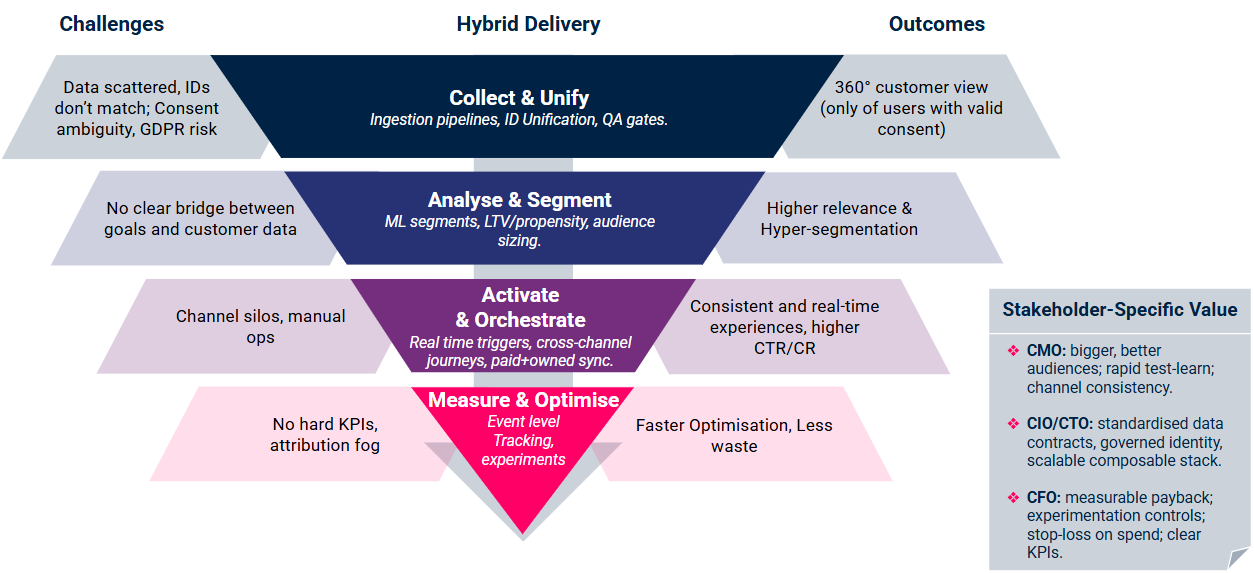
Our clients’ most successful transformations stem from adopting a hybrid delivery model, one that integrates marketing, data science, and technology within a single, outcome-oriented roadmap. By linking each stage of the CDP journey (from Collect & Unify to Activate & Optimise) to measurable business impact, organisations can turn what was once a technical project into a strategic growth engine.
Overcoming the 6 Barriers to Intelligent Growth
Even as CDPs become smarter and more composable, many organisations struggle to extract full value. Across 30+ Artefact projects between 2019 and 2023, we have identified 6 recurring barriers, each rooted in deeper structural or strategic issues, and the leadership principles that help overcome them.
The following framework illustrates how our hybrid delivery approach connects common CDP challenges to measurable business outcomes, and how value is realised across the organisation.
1. Data Integration and Trust
Fragmented, inconsistent data is the number one inhibitor of insight. When multiple systems hold conflicting identifiers or incomplete records, trust erodes and activation stalls.
The solution lies not only in better technology but in data governance and stewardship, establishing clear ownership, quality standards, and identity resolution protocols.
Enterprises that treat data as a strategic asset rather than a technical dependency build the foundation for reliable, AI ready insights.
2. Privacy as a Competitive Advantage
The post-cookie era has reframed privacy from a compliance obligation into a brand differentiator. Customers increasingly expect transparency and control over how their data is used.
Leading companies now embed privacy by design workflows and consent management directly into their CDP architecture. Doing so doesn’t slow innovation, it accelerates trust.
Our privacy councils and cross-functional governance frameworks ensure that every data flow aligns with purpose and permission, turning compliance into a foundation of customer trust.
3. Strategic Use Case Prioritisation
A common trap in data transformation is the “shiny object” syndrome, launching advanced personalisation or predictive models before the fundamentals are proven.
Successful organisations anchor their CDP strategy in business impact sequencing: identifying quick wins that fund long-term innovation.
For example, our clients often start with measurable use cases such as lead nurturing or media look-alike modelling, before advancing to lifetime value prediction or omnichannel orchestration.
This disciplined approach ensures each step builds on the last, technically, culturally, and financially.
4. Breaking Down Organisational Silos
No technology, however advanced, can succeed without human alignment. CDPs touch marketing, IT, data, and compliance, yet many companies still operate in functional isolation.
Establishing cross-functional CDP squads with shared OKRs is a proven accelerator. When data insights surface directly in marketing workflows, or when media teams use unified metrics for decision making, collaboration becomes habitual rather than aspirational.
Leadership plays a vital role here: executive sponsorship and visible success stories foster adoption far faster than process mandates alone.
5. Navigating the Composable Future
The martech landscape has shifted decisively toward composability, modular architectures that integrate best of breed solutions rather than monolithic stacks.
Instead of committing to an all-in-one CDP deployment, progressive enterprises start small, testing interoperability between their cloud warehouse and CDP through a proof of value approach.
Our experience shows that composable CDPs not only reduce implementation risk but also give businesses the flexibility to evolve with changing data, AI, and privacy ecosystems.
6. Measuring What Matters
As marketing budgets tighten, proving ROI has become paramount. Vanity metrics no longer suffice; leaders need incremental, event-level measurement to link CDP activation directly to growth outcomes.
The most advanced organisations integrate feedback loops that quantify the incremental contribution of campaigns and feed those learnings into the next sprint.
Our measurement frameworks have enabled clients to identify and optimise key growth drivers, contributing to outcomes such as a 30% reduction in media costs, 10% incremental digital sales growth, and 20% higher engagement rates.
From Platform to Performance: The Human Element
While CDP success begins with technology, it endures through people.
The most transformative organisations are those that foster a test and learn culture. By accelerating upskilling and iterating on insights, our clients have achieved up to 4x faster learning cycles and halved their time to actionable insight.
But the true differentiator isn’t just speed, it’s curiosity. AI and automation can analyse millions of signals, but human judgment determines which signals matter most. The future of marketing belongs to teams that combine analytical rigour with creative experimentation.
The Next Frontier: From Personalisation to Prediction
As AI capabilities evolve, the frontier of marketing intelligence is shifting from descriptive analytics (“what happened?”) to prescriptive and predictive insight (“what should we do next?”).
CDPs are becoming the operational layer for real-time decisioning, powering adaptive journeys that respond to each customer’s context in milliseconds.
Tomorrow’s leaders will not just react to customer behaviour but anticipate it, leveraging machine learning to determine who to engage, when, where, and why.
The integration of AI-driven models directly into CDP orchestration layers is already enabling this shift, transforming marketing from campaign planning to continuous optimisation.
Conclusion: Building Intelligent Growth Engines
CDPs represent far more than a data integration tool. They are the cornerstone of intelligent growth, enabling organisations to unify data, apply AI ethically, and deliver value to both customers and the business.
Yet technology alone is never the full story. Success lies in alignment, aligning data with purpose, teams with outcomes, and strategy with customer value.
By approaching CDP not as a software deployment but as a strategic capability, brands can turn marketing transformation from a buzzword into a sustainable growth engine.
We believe the future belongs to organisations that view data and AI not as enablers, but as co-drivers of creativity, efficiency, and customer experience.
The next wave of marketing transformation will not be powered by platforms alone, but by intelligent systems, and the people bold enough to lead them.