


We are living through a period of immense technological possibilities. Across industries, leaders are being inspired by what AI can achieve, yet realizing that value requires more than just installing new software. To bridge the gap between a successful proof-of-concept and scalable business value, we must embrace a spirit of process reinvention. The projects that succeed are those that treat AI not just as a tool, but as a catalyst for cultural evolution.
It is time to shift our focus from technical specifications to human strategy, transforming how we work, collaborate, and lead.
The problem, however, rarely lies with the technology itself. The overlooked truth is that successful AI adoption has less to do with math and more to do with mindset. Strategy, culture, and leadership matter much more than algorithms and data platforms. True progress occurs when organizations recognize that AI transformation is fundamentally a human challenge, not a technological one.
In this article, we aim to cut through the noise by revealing five counterintuitive facts that separate organizations that achieve real value from those still stuck in the pilot phase.
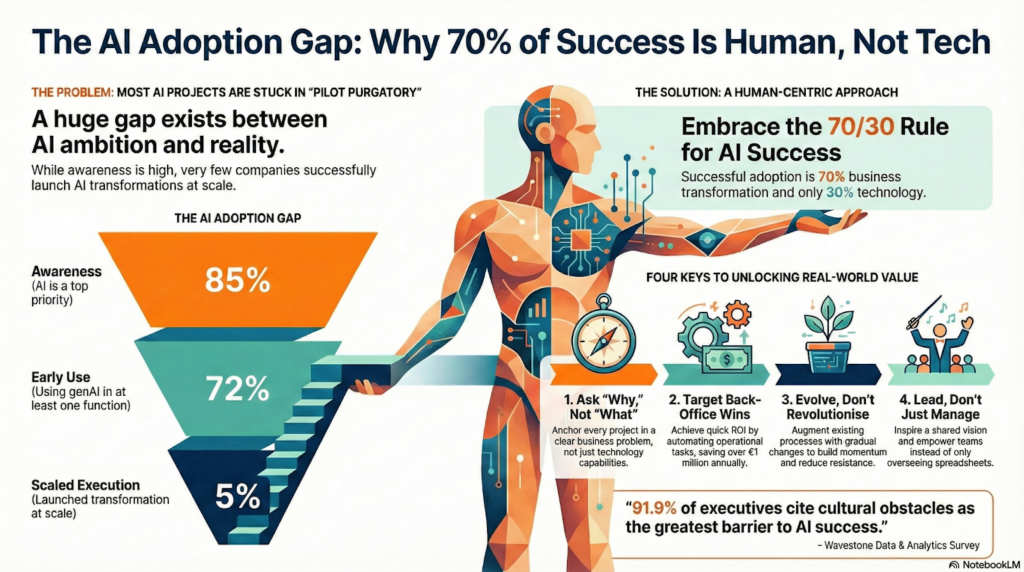
1. AI success is 70% human and only 30% technology.
The most critical principle for AI success is the “70/30 rule,” which states that successful implementation is only 30% technical and 70% cultural. The problem is that many organizations get the formula backwards.
The cultural aspect is rooted in people, processes, and organizational change. This may seem surprising, as organizations often invest significant resources in complex tools such as agentic AI or digital twins, assuming technology is their main obstacle. In reality, the most difficult challenge is navigating the human dynamics of the organization.
Successful AI adopters follow the 10/20/70 rule: “Devote 10% of your resources to algorithms, and 20% to technology and data. The remaining 70% of your resources go to people and processes.” – Boston Consulting Group
AI adoption requires a shift in mindset, new workflows, and a culture that trusts data-driven insights. Even the most advanced technology will fail to deliver on its promise if the human elements of change management, upskilling, and alignment of people behind a common goal are not addressed.
This understanding entirely reframes AI adoption: it stops being an IT project managed by a technical team and becomes a fundamental business transformation that demands a human-centric, top-down approach.
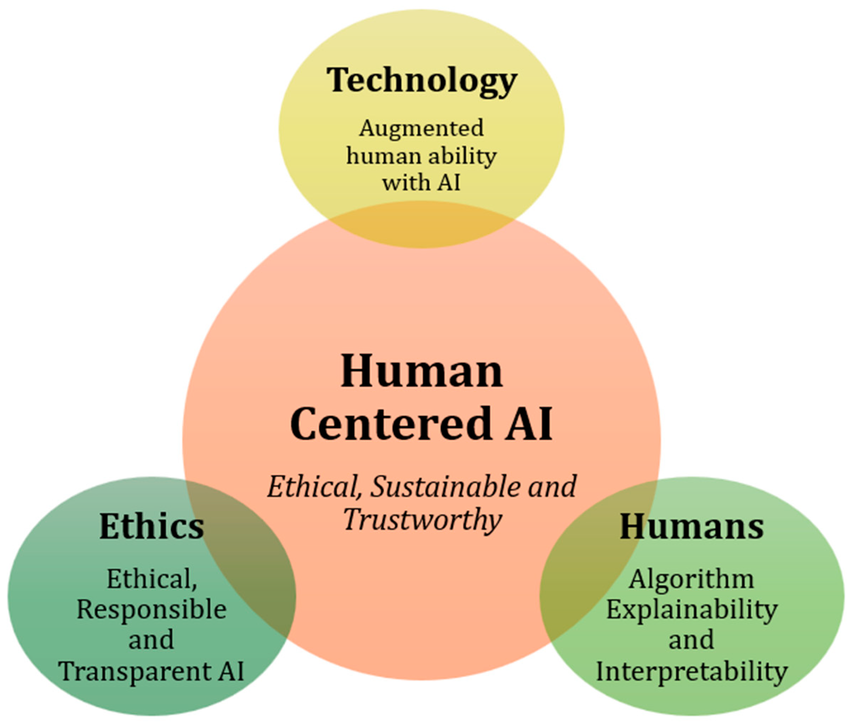
Sustainability – Published by MDPI
2. Great leaders ask “why,” not “what.”
Gartner reports that nearly 47% of AI projects never advance beyond the prototype phase, remaining trapped in a costly limbo. If this sounds familiar, chances are you’re experiencing what the industry calls “pilot purgatory.” Despite the promise of revolutionary technology, initiatives around the world are stalling. Organizations deliver POCs but fail to generate scalable business value.
The problem rarely lies with the technology itself. A common error that leads to pilot purgatory is starting with the technology. Great leaders avoid this by cultivating a culture of customer obsession. This forces them to ask, “Why does this matter to the business and, most importantly, to the customer?” rather than “What can the technology do?”
This question ensures that every initiative solves a specific business problem with measurable outcomes, be it revenue growth, cost efficiency, or ESG impact. It compels the formulation of a quantified business case that functions not as a static sales document to procure funding, but as a “living commitment to value” that guides the project long after deployment. This strategic “why” is the first step in addressing the 70% human element, as it aligns people around a shared purpose, not just a shared tool.
3. The best ROI might be hiding in your back office.
Although high-profile applications of AI in manufacturing or customer-facing products tend to garner the most attention, the low-hanging fruit for immediate, tangible value often lies in back-end operational processes. The biggest and fastest returns can often be found in these essential but unglamorous workflows.
Automating back-office tasks with agentic agents can produce dramatic results. For example, successful implementations have demonstrated:
- A 60% reduction in resolution time for operational issues
- Over €1 million in recurring annual savings
- A 75% reduction in time for tasks like automating ticket processing
By automating monotonous and repetitive tasks, organizations enable management and employees to prioritize high-value work that requires creativity, strategic thinking, and human relationships. This approach directly targets the 70% human component by demonstrating immediate value and reducing the burden on employees, building the trust and momentum needed for broader change.
4. Smart leaders opt for evolution over revolution.
The tech world loves the idea of disruption, of tearing down old systems and replacing them with something entirely new. However, an “evolutionary approach” to AI integration is far more effective and sustainable in established organizations. Rather than attempting a revolutionary overhaul, this strategy focuses on gradual, iterative change.
This approach involves:
- Augmenting existing processes instead of replacing them entirely
- Selecting pilot areas where the business impact is clear and measurable
- Introducing agility gradually, especially in highly structured corporate cultures where flexibility must coexist with established governance
This strategy respects the 70% human component by mitigating the organizational fear and resistance that revolutionary “rip-and-replace” projects inevitably trigger. It builds momentum by demonstrating value in small, manageable steps, earning stakeholder buy-in, and integrating innovation into the company’s DNA without causing chaos.
5. It’s time to stop managing and start leading.
Successfully navigating an AI transformation requires a profound shift from management to leadership. While managers tend to focus on oversight and spreadsheets, controlling details and monitoring task completion, true leaders inspire shared vision and foster high-trust environments where teams are empowered to execute.
This distinction is crucial for AI success, as the path forward is often unclear and requires adaptability and team commitment. True leaders walk beside – or ahead of their team, inspiring and guiding them toward a shared vision.
This leadership style is key to unlocking the 70% cultural component of AI success. It involves trusting people, giving them clear goals, and empowering them to deliver. By leading instead of merely managing, executives can build the resilient, aligned, and motivated culture required for genuine and lasting transformation.
“91.9% of executives cite cultural obstacles as the greatest barrier to AI success, compared to only 8.1% who cite technology.” – Wavestone Data & Analytics Survey
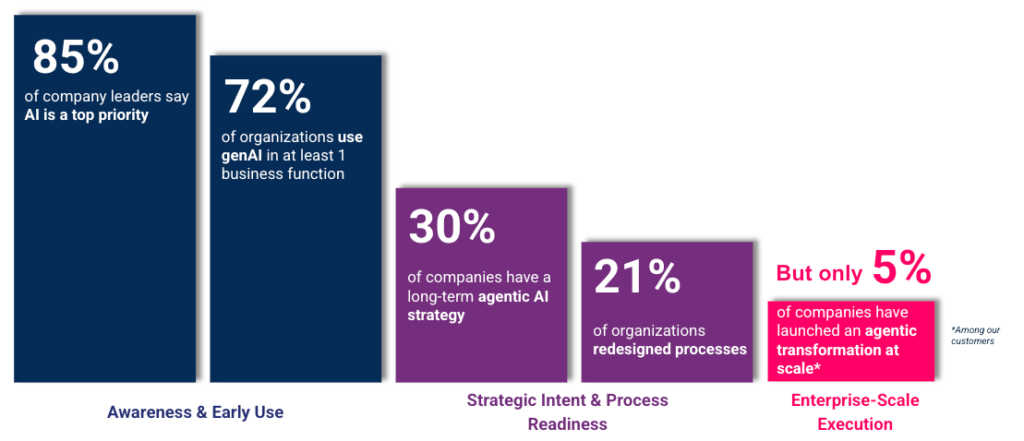
Conclusion: Achieving enterprise-scale transformation.
The race to AI maturity will ultimately be won not by the organization with the most powerful technology, but by the organization that best aligns its technology with its business strategy. AI success is fundamentally a human endeavor guided by strategic purpose, cultural readiness, and authentic leadership. Organizations that recognize the true power of AI lies in augmenting, rather than replacing, human capability will prevail.
The technology is ready. Are your people? Are you? If the future of your business depends on blending human judgment with machine precision, it’s imperative that you lead the transformation, not simply manage the tools.
Sources:
- Making Science. (2025, April 15). Google Cloud NEXT ’25: The Rise of Agentic AI for Transformative Customer and Employee Experiences.
- McKinsey & Company. (2025, March 12). The state of AI: How organizations are rewiring to capture value.
- Boston Consulting Group (BCG): The CEO’s Guide to the Generative AI Revolution
- Gartner: Top Strategic Predictions and AI Survey
- McKinsey & Company: The State of AI in 2023/2024
- Wavestone (formerly NewVantage Partners): Data and Analytics Leadership Executive Survey
- National Bureau of Economic Research (NBER): Generative AI at Work
- Thomas Friedman: Thank you for being late