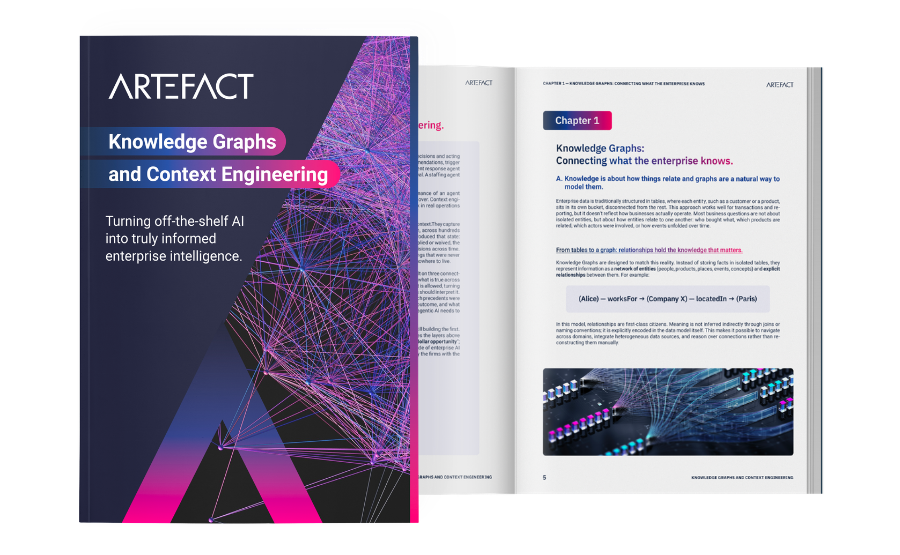
AI agents are transitioning from passive assistants to autonomous decision-makers, creating a critical new bottleneck: context. An agent’s performance now depends less on its underlying model and more on the context it can reason over. Unfortunately, traditional data architectures only capture the current state of operations, entirely missing the tacit reasoning and historical precedents that live in human heads and fragmented chats.
To bridge this gap, enterprises must build a three-layered foundation with:
- Knowledge graphs that map what the business knows, connecting scattered entities into navigable networks.
- Ontologies that define what these connections mean, establishing shared semantic rules and strict operational guardrails.
- Context graphs that capture how the organization actually decides, recording decision traces, policy exceptions, and causal chains over time.
While software built for humans captures what is currently true, software built for agents must capture how it became true. Ultimately, the next decade of enterprise AI will be won by the firms with the best context.
Authors

Florence Bénézit
Partner & Global Lead Manufacturing
Artefact France
Share this report