

Every organization trying to accelerate AI adoption hits the same wall: the knowledge that actually drives business outcomes lives inside people’s heads. It doesn’t reside in systems, but in the judgment of your most experienced contributor and the undocumented mental shortcuts your team leader uses to close complex deals.
None of these resources, in their raw state, are usable by AI agents.
The three-layer problem in knowledge infrastructure
When the market discusses implementing artificial intelligence in corporate settings, the conversation immediately jumps to technical infrastructure: vector databases, RAG pipelines, and LLM selection. However, the real frontier operates at the very first layer:
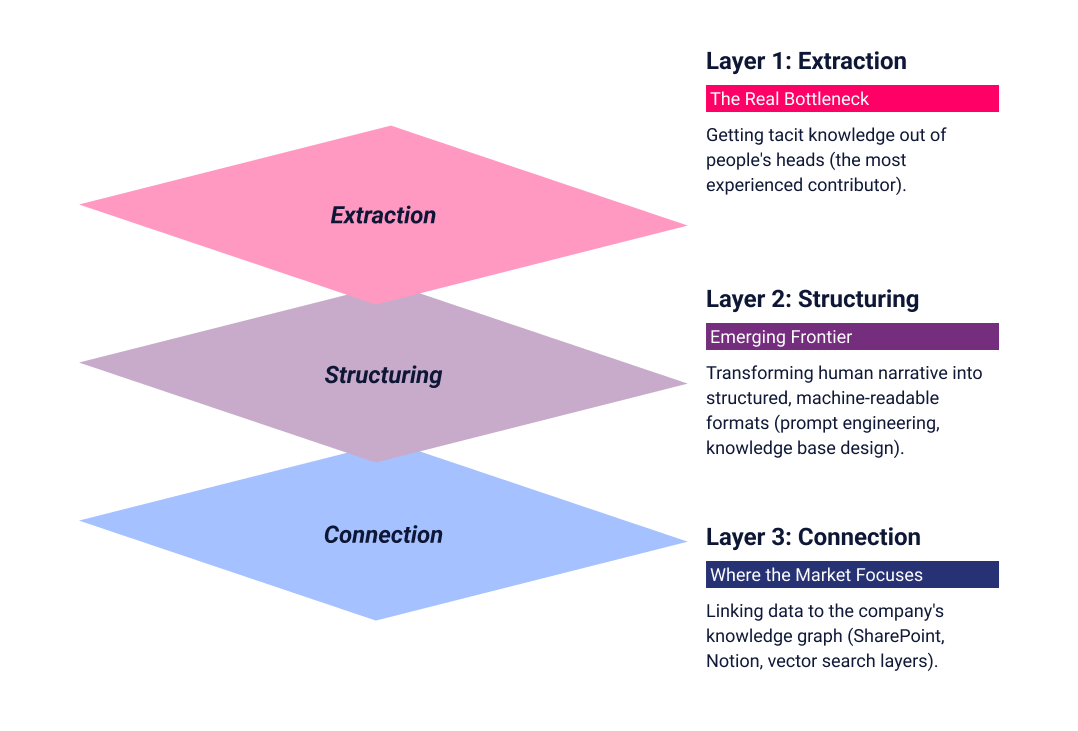
- Extraction: Getting knowledge out of people’s heads.
- Structuring: Transforming this information into a machine-readable format (this is where prompt engineering comes into play).
- Connection: Linking this data to the company’s broader knowledge network.
Most companies focus their investments on layer three. They organize directories in SharePoint and Notion, and set up smart search capabilities. A few are starting to test layer two. But almost no one has cracked layer one, and that is the actual bottleneck for scaling the technology today.
The invisibility of tacit knowledge
Practical, day-to-day knowledge rarely makes it into documentation for a simple reason: it is invisible to the person holding it. The expert doesn’t know what they know until they are put under pressure during a client meeting, a crisis resolution, or a high-stakes negotiation.
Because this information is entirely context-dependent, demanding that high-level professionals simply stop to “document their routines” does not work. This creates an inefficient manual grind that is completely disconnected from business reality.
This is exactly why corporate “second brain” projects stall so often. These initiatives fail because they assume people know what to document and how to format it for machine consumption.
Culture as the technological foundation
Business management leaders often resist an uncomfortable truth: you cannot solve a culture problem by writing code.
A knowledge hub without active contributions simply becomes a highly expensive cloud storage cost. Even worse, models trained on outdated files will provide wrong answers. This destroys team trust and drives down internal adoption.
The failure loop feeds itself.
A genuinely data-driven corporate culture requires three pillars that no software vendor can sell you:
- Psychological safety to share imperfect, evolving knowledge without fear of judgment.
- Shared ownership of the information repository, treating it as a team asset rather than individual territory.
- A clear incentive for collaboration, directly tied to a visible financial impact or an improvement in the contributor’s own quality of work life.
The companies successfully leading agent integration have already figured out that documentation is a cultural act, not a mere technical task.
How to generate structured and consumable context
Once the cultural barrier is overcome, the tactical challenge is transforming human narrative into a format the machine can process and connect. Raw text or direct transcripts lack the precision the algorithm needs.
Most knowledge, even when captured, exists as an unstructured narrative. It lacks:
- Clear boundaries (where exactly does this knowledge apply?).
- Explicit dependencies (what other processes or information does this assume?).
- Confidence signals (how reliable is this guideline, and under what conditions?).
- Update triggers (when does this context expire or require a review?).
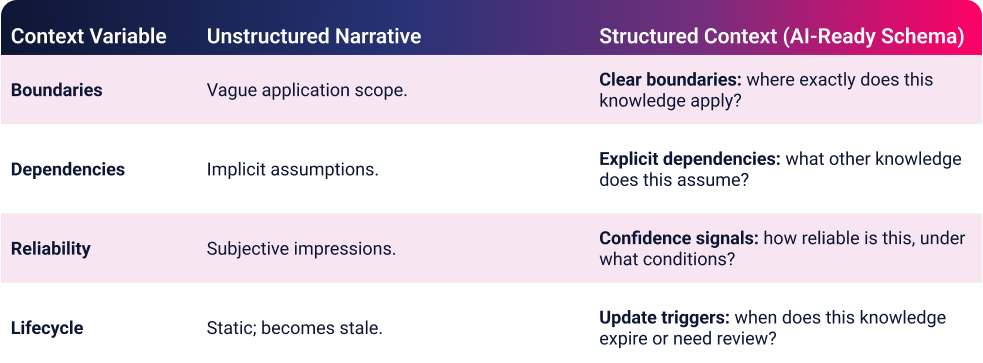
An agent consuming raw narratives acts like a first-time reader analyzing meeting minutes: it picks up loose impressions, which causes operational slowness and inconsistency.
The solution requires a data architecture that organizes this information into structured formats. This preserves the richness of human intelligence while translating its logic so the system can actually “reason” through it.
The executive ROI case for knowledge hubs
The argument for adopting knowledge hubs at the executive level is straightforward: every hour your best professionals spend re-explaining what they already know is an hour lost for creating new value.
These systems are not meant to replace experts, but to multiply them. When a senior partner’s judgment is transformed into structured context, a junior professional equipped with artificial intelligence starts operating at a much higher delivery tier.
Decisions that previously required escalation can now be resolved at operational levels. This compresses onboarding time from months to weeks and raises the bar for data-driven decision-making.
What this looks like in practice
The most mature organizations in technology and innovation are executing this transition by doing three things differently:
- They make capture frictionless: knowledge capture happens as a byproduct of routine work, not as an additional task (using meeting transcripts, voice notes, and Slack threads).
- They invest in knowledge curation roles: they assign someone whose job is to transform raw capture into structured, connected context. This is a new function that doesn’t yet have a clear home on the org chart.
- They treat the knowledge graph as a product. It has owners, versioning, and quality metrics. The question is no longer “do we have documentation?”, but rather “how fresh is our context, and where are the gaps?”
The honest conclusion
A “second brain” is an organizational transformation with a technological layer on top.
The companies that will win the agent era are the ones that solved the hardest problem first: extracting the exact knowledge from the right people, putting it into the right structure, and connecting it to the rest of the company.
And it all starts with a culture that makes sharing safe, visible, and rewarding.