

Successful companies are those capable of balancing the Demand for their products and services with their Supply. It seems obvious, and it has always been this way.
“IBP connects strategy, portfolio, demand, supply, and finance into a single business plan, under the responsibility of senior leadership, through a monthly replanning process focused on exceptions, resulting in a single operational plan with a rolling horizon of 24 months or more.” (Oliver Wight, 2005)
Although the objective and structure of the process haven’t changed over the last 20 years—since it shifted from just balancing supply and demand to generating a single integrated plan aimed at the best overall business value—the speed and quality of this integration are completely different today.
More integrated data with greater processing capacity and the use of AI tools have made manageable a level of complexity that was once purely aspirational: scenarios that took weeks to build are now updated in real-time, data that was trapped in silos is now comparable, and decisions that depended on endless alignment meetings can now simply be confirmations.
We have observed a widely varying degree of AI adoption in IBP across the market. While some sectors and functions have already mastered tools and reached maturity in their application, other challenges remain latent and poorly addressed, as shown in the table below:
| IBP Stage | Maturity | What is already in practice | Artefact Example |
|---|---|---|---|
| Portfolio Review | Low | Use of Generative AI to consolidate R&D and marketing inputs and simulate portfolio scenarios. | Large B2B Fragrance Industry: Implementation of GenAI that converts visual marketing concepts into technical descriptions and formula searches. Results: 99% reduction in portfolio cross-referencing time (from several days to just 20 minutes) and a 35x increase in the number of new formula simulations analyzed. |
| Demand Review | High | ML models incorporating multiple demand drivers beyond historical sales: seasonality, weather, market, commercial signals. | Leader in Gas Distribution Sector: Unified AI Hub that integrates and forecasts commercial demand fronts for bulk and bottled LPG. Results: • 2% reduction in global MAPE for demand forecasting compared to the legacy model. • 33% reduction in critical commercial planning errors. • 4x increase in the number of client portfolios operating within the ideal supply accuracy level. |
| Supply Review | Medium-high | Digital twins and ML optimization for capacity, allocation, and inventory level decisions. | Agribusiness sector: Plant simulator and optimization model scaled for multiple production lines, reducing losses and optimizing margin per plant. |
| Integrated Reconciliation | Low-medium | Agents that automatically consolidate data from different areas to accelerate the reconciliation of operational, commercial, and financial plans. | Retail sector: Agent that gathers expansion, geomarketing, and finance data and generates a complete feasibility study for a new store in minutes (a process that previously took weeks among three teams). |
| Executive Review | Low | Augmented BI allowing the exploration of scenarios in natural language, with output adapted to the executive’s profile. | Consumer goods sector: Multi-year journey of end-to-end use cases connecting finance, pricing, operations, and HR, providing evidence that value grows when use cases connect, rather than remaining isolated. |
As expected, the closer the stage is to a well-defined statistical problem, the faster the adoption has been. The more it depends on organizational negotiation, the slower the maturity.
This also points to where it is worth investing right now. Depending on the criticality of the stage for the sector and the company’s maturity, Supply Chain and IT leaders must evaluate pilots and structural projects. In a Fast-Moving Consumer Goods (FMCG) company, for example, having a forecast based solely on time series means lagging far behind what has been available and generating value for competitors for years. From another perspective, for companies in the cosmetics or pharmaceutical sectors with a high pace of innovation, investing in advancing the Portfolio Review, despite its low maturity, can generate a significant competitive advantage.
What AI still doesn’t solve
Despite notable advances, we also observe some intrinsic challenges in the IBP process that still rely heavily on human judgment and a deep understanding of the organizational context.
- Goal setting and incentives. Sales, operations, and finance often measure the same transaction in different ways (volume, margin, OTIF), and each area optimizes for its own KPI. No model solves this alone because it is not a data or accuracy problem: it is a governance problem, of explicitly deciding what the company wants to prioritize when departmental goals collide. Until this definition is established with the right benchmark, AI will only automate the conflict.
- Collaboration beyond organizational walls. CPFR and VMI tools have existed for decades and continue to evolve, but scaling their application—synchronizing plans with suppliers and distributors systematically—remains far from reality for most operations in Brazil. It is a structural bottleneck: it depends on contracts, commercial trust between parties, and compatible systems among partners, not just available technology.
- Trust in models and AI adoption. Even when the model is technically capable, the organization hesitates to transfer decision-making power to it. This hesitation is largely healthy; capacity and portfolio decisions carry consequences that are too costly to be delegated without a proven track record of accuracy. The path involves a parallel validation period, where the model proves its accuracy before taking over the decision, rather than a direct leap from “no AI” to “AI in charge.”
The next wave: from assistant to orchestrating agent
The advances of the new AI-leveraged IBP in stages like Demand Planning and Supply Review are likely to continue generating superior results for companies and increasingly integrating with the other stages of the process. The vision of a fully autonomous supply chain is still aspirational, but there are already examples of agents that collect market signals and relevant news to shape demand, automatically trigger optimization models, and flag inconsistencies before a human needs to look for them.
In this new scenario, the IBP analyst’s routine undergoes a profound transformation. The professional who previously spent two-thirds of their time consolidating scattered data, structuring pivot tables, and organizing columns to extract insights—only to then align boxes in presentations that were obsolete upon creation—will see their daily life change radically. Their focus shifts increasingly toward critical analysis and verification of the agents’ work, negotiation with suppliers and clients, and the identification of opportunities within the plan. A much more interesting and higher value-added job. And it is precisely this analyst, freed from the pivot table, who will drive the maturity of the stages that are still lagging behind.
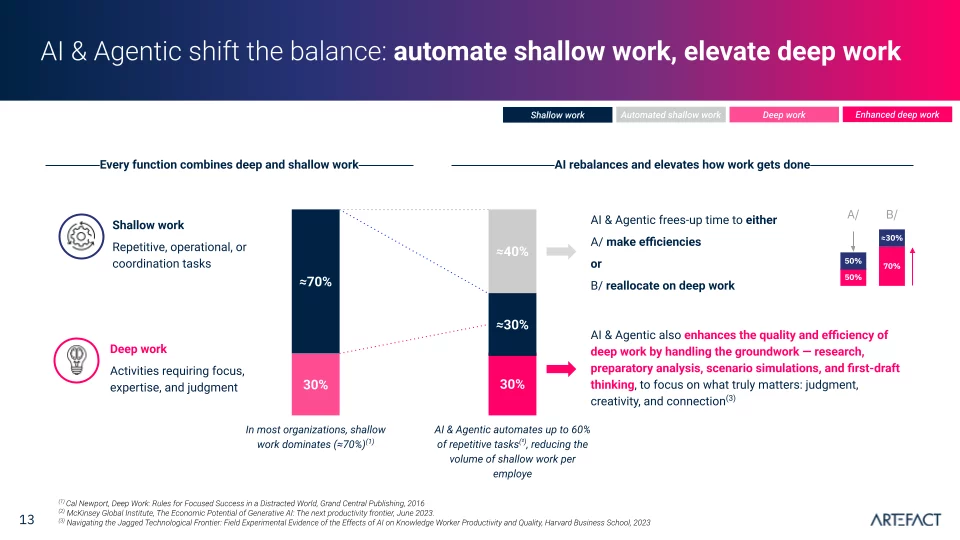
Since the IBP objective of balancing supply and demand remains the same, but its tools have evolved into the AI dimension, the knowledge accumulated by managers and directors in the process becomes even more valuable. Far from replacing decades of experience and contextual reading, AI is capable of expanding the reach of this human capital, allowing leaders to use it to experiment where they previously saw limitations, generating efficiency at every critical stage and building the foundation for a more agile and intelligent platform in the medium term.