



The sensors work, the dashboards are live and still the city cannot answer a simple question. The cities that stall are not short on technology, they are short on shared meaning and the gap carries a cost that compounds.
Opening night at a city’s new operations center. The far wall is a mosaic of live feeds: traffic running green, air quality nominal, energy balanced, every sensor reporting home. The build has landed within the designated time and budget. The room has every right to feel proud.
Then an executive asks a plain question. Which neighborhoods are getting worse, and how many serious incidents did we have this week?
The room goes quiet. Not because the data is missing. It is all there, glowing on the wall. It is because the traffic platform, the safety system and the environmental feed each define “incident” and “neighborhood” differently, and no one ever did decide which definition wins. The city can sense everything and conclude nothing.
This is not a glitch to be patched in the next release. It is the signature of a specific, expensive and widespread failure, and it is almost never about the technology.
The seduction of the sensor
It is easy to see how cities can end up here. Sensing, prediction and optimization have become genuinely powerful and easy to buy. A vendor can stand up a live traffic model this quarter. A camera network flags an incident faster than any patrol. The capability is real and rising fast, so leaders reasonably conclude that the hard part is being solved in front of them.
But the part you can see and buy is the easy part. It demonstrates well, which is exactly why it attracts the budget. A city’s value, like a company’s, is not only in its instrumentation. Its value sits in a layer that no platform ships with: the shared meaning of its data, and the accountability for what is done with it. Instrumentation and data volume do not imply understanding; the distance between the two is where a smart city’s value is won or lost.
“Sensors, platforms and models can be procured by anyone, which is precisely why they no longer confer advantage. That advantage now lies in the meaning beneath the technology: what the data represents, and whether the organization agrees on it. It is something an organization must build, not buy.” – Ali Farhat, Data Engineering Manager, Artefact
Three layers: the Meter, the Model, the Mandate
We’ve found it useful to think about smart-city data in three distinct layers. Each solves a different problem, each has different owners and a different degree of automation.
The Meter is machine-led sensing. Telemetry, computer vision, forecasting, anomaly detection. Structured work with measurable outputs, and the right place to automate aggressively. It is also the layer everyone over-buys because it is the one you can put on a wall. The principle is simple: if the signal can be specified and checked cheaply, automate it.
The Model is the shared meaning. The definitions every agency has to agree on before the data can be trusted, and where they quietly disagree. A “zone” is a parking area to the parking team and a policing district to public safety, and the two boundaries never line up. An “incident” is a traffic disruption to the roads system and a harm to a person to the safety system. An “asset” is one road to the highways authority and a hundred numbered segments to the maintenance team. One word, two meanings, and the totals never match. These are the code lists, the KPI definitions and the cross-system mappings that let a transport feed and a planning system agree they are describing the same street. It is slow, cross-departmental and unglamorous, and no vendor can deliver it end to end. That is precisely why it gets skipped. The principle is: interoperability is a decision, not a purchase.
The Mandate is human-owned accountability. Data sovereignty. Retention and privacy. The trade-off between surveillance and service. The trust that decides whether citizens accept the next feature at all. Technology can inform every one of these. People must own them. The principle is: keep accountability human.
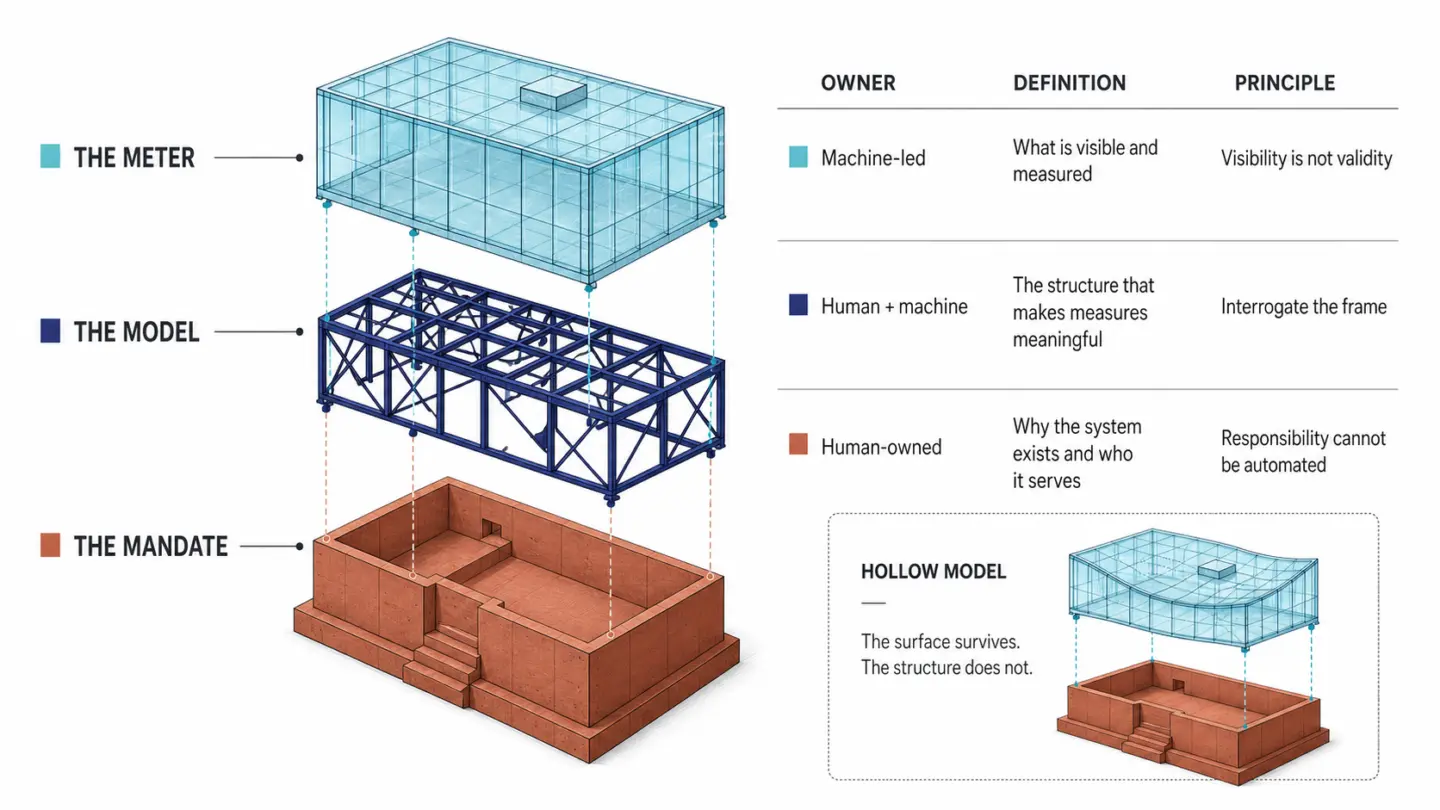
FIGURE 1 – the Meter, the Model, the Mandate: the signature three-layer framework, From machine-led to human-owned, each layer with its definition and principle.
The layers move over time, and they should. As tools improve, more sensing passes cleanly into the Meter, which frees people for the judgment only they can do. But capability moves faster than accountability and a task becoming automatable does not make the decision around it context-free. The failure is not automation. The failure is funding the Meter, gesturing at the Mandate with a vision deck, and hollowing out the Model in between.
Remove the frame and the tower still looks impressive from the street. It is simply not habitable.
The cost has a name: meaning debt
When a city instruments faster than it standardizes meaning, the gap does not sit still. It compounds, quietly, like interest. We call it meaning debt, and like technical debt it is invisible in the demo and punishing at the point of delivery.
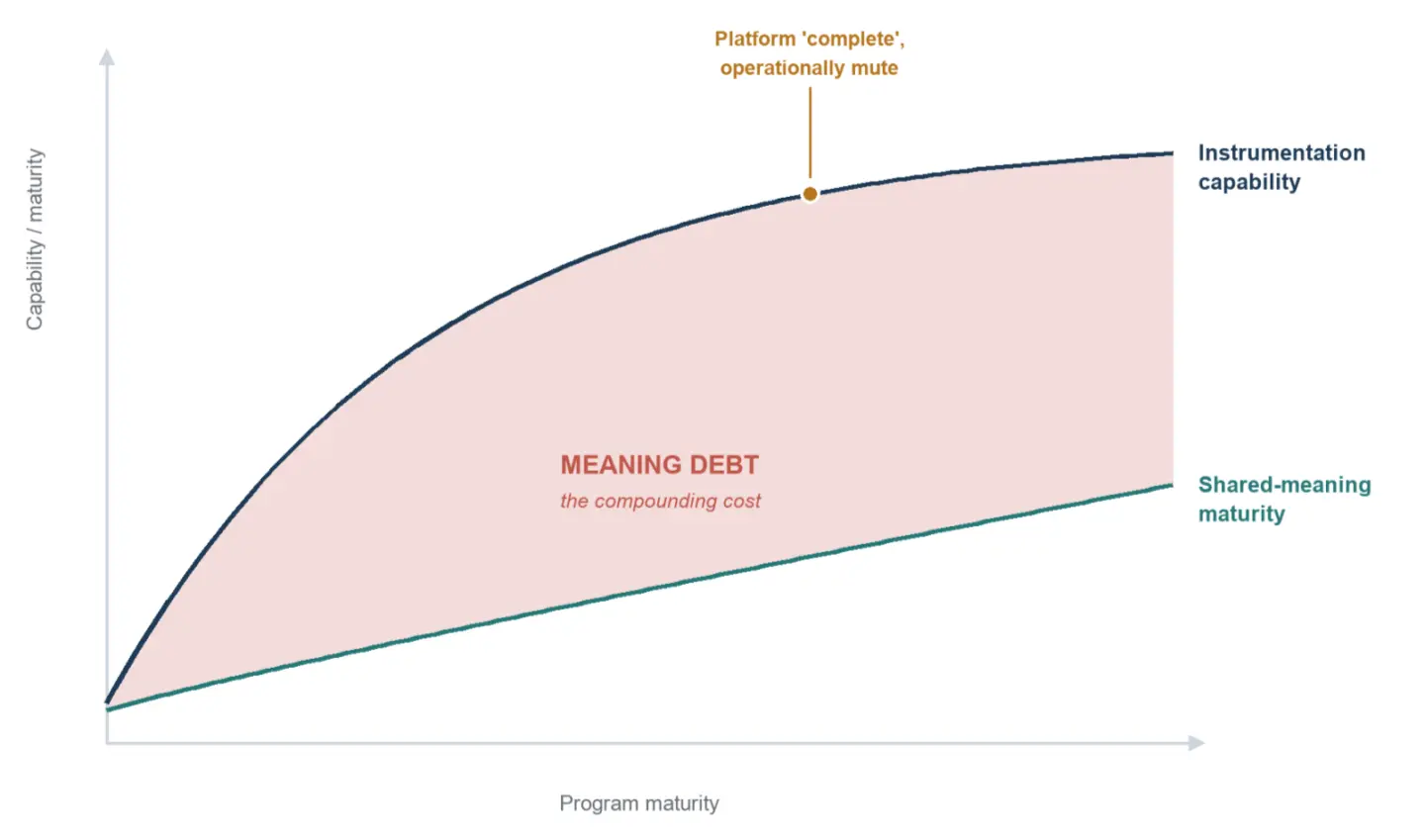
FIGURE 2 – Meaning debt: instrumentation capability racing ahead of shared-meaning maturity.
It surfaces as concrete business cost, not abstraction. KPIs that are reported but cannot actually be computed end to end, so the executive dashboard is decorative. Integrations that stall because two systems will not reconcile without a person translating between them by hand. Rework, because every new source added to an incoherent foundation enlarges the eventual clean-up. Compliance exposure, discovered late, because retention and ownership were never defined. And the slowest and most expensive symptom of all, a time-to-value that keeps slipping because the platform is finished and the city still cannot make a decision with it.
We have seen a data model pass every automated check, zero errors and zero warnings, and remain entirely unusable. The structure was sound, so it validated. But the code lists meant to constrain values were empty, waiting on a business owner to confirm them. The performance indicators were carried in the model but had no formula, so nothing could compute them. The mappings that would let one agency’s data flow into another did not exist. The fields for retention and ownership were blank. Everything was green but nothing could be decided. The schema read as done because the value was never in the schema. It was in the hundred human agreements the schema was waiting for.
This is not hypothetical
The failures that reach the headlines are the same story at civic scale.
Alphabet’s Sidewalk Labs won the right to build a smart district on Toronto’s waterfront in 2017, with a vision of sensors woven through the public realm. The project collapsed in 2020. The stated reason was economic, but it had been unravelling for two years over a question the technology could not answer for itself: who governs the data a city collects about its people. The project’s own privacy adviser resigned when she could not secure a guarantee that data would be de-identified at the point of capture. The Meter was never in doubt. The Mandate was never settled.
Songdo, built from reclaimed land near Incheon at a cost in the tens of billions, was marketed for years as the model smart city, sensors and automation everywhere. It has also become shorthand for a place that is instrumented and strangely lifeless, frequently reported as under-occupied. The instrumentation worked. What was missing was the harder, human question of what the city was actually for. Instrumentation can be flawless and still measure a place no one wants to live in.
Even the most deliberate cities discover the Mandate the hard way. Singapore launched a pandemic contact-tracing tool on the public understanding that its data would be used only for tracing. When it later emerged that the police could access that data under existing law, the backlash forced new legislation to restrict it. The technology had behaved exactly as built. What had not been agreed in advance was the promise about what the data was for. Trust is decided in the Mandate, not the Meter, and in a city those moments decide whether citizens consent to the next feature.
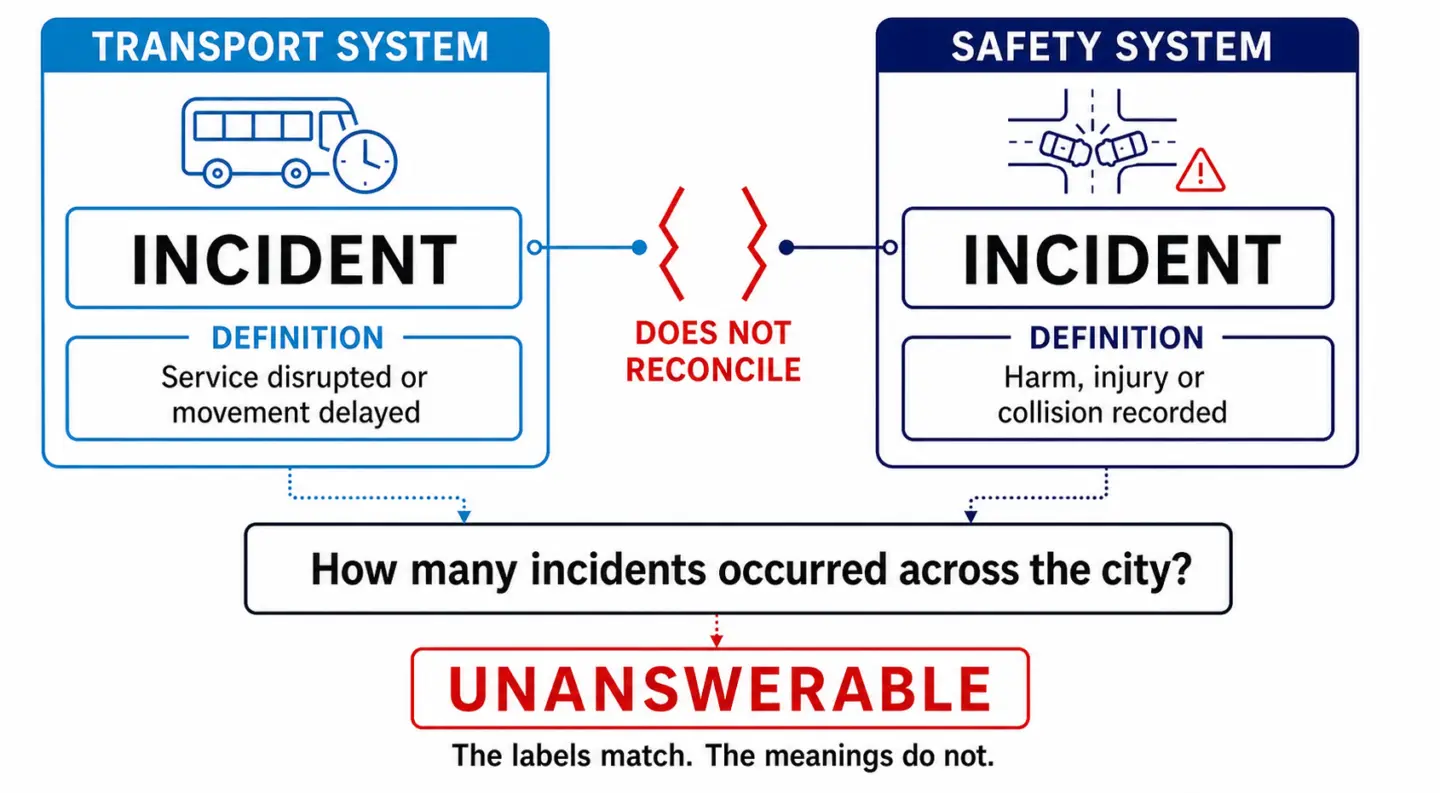
FIGURE 3 – One word, two meanings.
The counter-examples divide into two kinds, and both are instructive.
Some never accrued the debt. Estonia is the clearest case. Its national data-exchange layer, X-Road, has let public systems share data securely since December 2001, on a once-only rule: a citizen gives the state a piece of information once, and every agency reuses it instead of asking again. Estonia’s X-tee now handles on the order of two billion queries a year. Finland joined the same backbone in 2015, and since 2017 the two countries have developed it jointly through the Nordic Institute for Interoperability Solutions, a body they own together. The Model was built as infrastructure from the start, which is why every service added since has snapped onto it.
Others paid the debt down deliberately. Barcelona reframed city data as a shared civic asset and insisted its platforms serve residents rather than the reverse. Amsterdam and Helsinki went further into the Mandate, publishing public registers of the algorithms their administrations use so residents can see, and contest, the automated logic applied to them. None of this is anti-technology. It is accountability treated as infrastructure.
The honest objection
There is a serious case on the other side, and it deserves a fair hearing.
A disciplined technology leader will say you cannot govern data you have not collected, and that waiting for a dozen agencies to agree every definition is a recipe for never shipping. Standards emerge from use, not from committees. Get the sensors in, get the data flowing, and negotiate meaning once there is something real to argue about. And some of the “meaning” work that consultants love genuinely is ceremony, ontology debates that outlast the budget and change nothing.
Parts of this are correct. A city that refuses to instrument until every term is settled will fall behind, and its staff will keep doing by hand what machines could do. But the reasoning stops one step too early. The point is not to slow the Meter. It is to fund the Model in parallel, so that instrumentation lands on a foundation that can absorb it. Skipping the Model does not remove the work. It converts it into meaning debt and charges interest on it. Toronto and Singapore did not expose a weakness in smart technology. They exposed the cost of settling the easy questions first and the hard ones under pressure.
Where to start
The programs that compound value, rather than accumulate debt, tend to make four moves.
Fund the Model as a workstream, not a byproduct. Give shared definitions, code lists and cross-system mappings a named owner and a budget, running alongside the platform rather than after it. The Model is not documentation you write at the end. It is infrastructure you build in parallel.
Measure outcomes a citizen would recognize. Not sensors deployed or dashboards shipped, but questions answered and services improved. A simple test: if a KPI cannot be computed end to end from real data today, it is not yet a KPI. It is an intention.
Make the Mandate explicit before the rollout, not after the incident. Decide data ownership, retention and access up front, and where the logic touches citizens, make it visible. Trust is cheaper to build than to rebuild.
Treat interoperability as a contract. For every cross-agency exchange, agree the source of truth, the shared definitions and the update cadence before the integration, not during the escalation.
What these four moves share is that none of them can be bought. Each is a decision someone has to own.
“A city does not get smarter by sensing more. It gets smarter the moment sensor data becomes meaning, meaning translates into decisions, and decisions yield results. That is the real infrastructure, and it is the one thing you cannot buy, automate, or postpone.” – Roland Debbane, Partner, Artefact
This holds whether an existing city is going smart or a new one is being built from the ground up. The new build has no legacy silos to untangle, which is a real head start, but it has to stand up the Meter, the Model and the Mandate all at once, at speed, with even the definitions still to be written. The existing city has the silos, and with them the advantage of knowing exactly which questions it already cannot answer. Either way, get the Model right early and it compounds: every new service snaps onto a foundation that already fits. Skip it, and you spend years paying an interoperability tax on a platform that looks finished and cannot answer a straight question.
Back in the operations center
Picture the same wall of feeds a year into a program that did the unglamorous work. The senior executive asks the same question. This time the room does not go quiet, because “incident” and “neighborhood” mean one agreed thing across every system, the indicator behind the number has a formula anyone can inspect, and it is clear who owns the data and who is accountable for the call. The sensors are no better than they were on opening night.
The city simply learned to mean something by what it senses.
This is not an argument to slow down. Cities that hesitate on AI and sensing will be outcompeted, and their residents will be poorer for it. It is an argument to treat a smart city as an act of organizational design, not procurement, and to fund the layer that no vendor will sell you because no vendor can.
Technology can instrument a city but it is people who give it meaning. Before you instrument the next workflow, three questions decide whether you are building an asset or accruing debt:
What belongs in the Meter? Where must the Model be shared before the data can be trusted? Who holds the Mandate, and who owns the consequences?