


Executive Summary
- Wealth managers struggle to match client expectations for e-commerce-style product recommendations due to complex product attributes, compliance constraints, and multi-dimensional goals.
- Rule-based or segmentation-based approaches produce blunt, one-size-fits-all advice, eroding client trust and limiting scalability.
- By overlaying machine learning models, mathematical optimization (portfolio optimization), large language models, and an Agentic AI orchestration layer, banks can integrate diverse data and translate the raw machine learning output into better explanations, recommendations, and automated actions.
Wealth management is stuck in the past. Clients live in a world of effortless, hyper-personalised recommendations from YouTube, TikTok, or Amazon, yet banks push products through rule books, clunky segmentation, and advisor guesswork. Banks struggle to keep up with client expectations and the complexity of today’s portfolios. Hybrid AI can change this. By fusing machine learning, portfolio optimization discipline, and the contextual intelligence of large language models, governed by an Agentic AI layer, wealth managers can deliver recommendations that feel smart, personal, and well-timed. The system can learn from every interaction, adapts to regulatory constraints automatically, and explains itself in language clients and advisors actually understand.
The outcome is a genuine leap: advisors get sharper guidance, digital channels become conversion engines, and clients feel understood rather than targeted. Banks that embrace Hybrid AI will define the next era of advisory, one where human-touch relationships are powered by AI-to-AI collaboration, and where trust is built not by relationship or salesmanship, but by intelligence.
Introduction
In the age of Netflix, we have grown used to highly personalized products and services in our daily lives. Wealth management clients,especially the segments served by relationship managers (RMs), increasingly expect the same level of tailored recommendations for financial products that they get with movies or shopping. But delivering Netflix-style personalization in a high-stakes, heavily regulated wealth context is far more complex. Financial products carry intricate attributes, including risk levels, terms, and tax implications, and must align with each client’s unique goals and constraints. Firms that bridge this personalization gap stand to deepen client engagement and loyalty.
This whitepaper explores how generative AI can transform product recommendations in wealth management through a hybrid approach that marries traditional machine learning and portfolio optimization with GenAI.
The personalization gap in wealth management
Wealth management faces unique challenges that make effective product recommendations difficult. ML-based recommendations used in e-commerce typically optimize for a single objective (next best product to buy), but wealth managers juggle multiple objectives and constraints: capital growth, income, risk mitigation, tax efficiency, liquidity, as well as individual client goals and preferences. Both ML and PO are built around structured data; a holistic product recommendation should incorporate unstructured information such as market trends, client risk profiles, behavioral patterns, and client sentiment, which is hard to encode into structured information that ML and PO models need to be trained on.
Traditional recommendation systems in wealth management, where they exist, tend to be simplistic. Many banks rely on rule-based asset allocation or broad client segmentation. These are blunt instruments and fail to account for personal nuances, like a client’s interest in sustainable investing or their liquidity needs. It can also lead to generic, one-size-fits-all suggestions. Hence, many RMs default to manual approaches, relying on their own experience and intuition rather than data-driven insights. Clients, for their part, may receive product pitches that feel disconnected from their goals, reducing their confidence in the advisory process.
Advances in AI, especially GenAI combined with machine learning and portfolio optimization, offer a way to leapfrog forward.
A Hybrid GenAI Approach for Smarter Recommendations
To overcome current limitations, we propose a hybrid GenAI-powered recommendation engine tailored for wealth management. “Hybrid” here means it combines multiple AI techniques and integrates human oversight, leveraging the strengths of each while mitigating their weaknesses.
1) Machine learning: traditional ML models are effective in analyzing client behavior data past investments, product inquiries, or website/app clicks. This uncovers patterns and peer group insights (e.g., identifying that clients similar to Client A are showing interest in ESG equity funds).
2) Portfolio optimization: the system incorporates endogenously different objectives and managerial/regulatory policies, including
- Compliance rules: This ensures that no matter how creative the AI gets, the suggestions are appropriate, permissible, and aligned with firm strategy, for instance, risk profile.
- Strategic asset allocation: Model Portfolios incorporating portfolio manager views and Capital Market Assumptions such as liquidity requirements.
- Campaigns: CIO or CFO led asset class prioritisation to direct the front-line towards certain products or product categories at any given point in time, for instance, a target allocation in an asset class such as bonds or stocks
3) Channel integration:
- For human-centric use, the system should integrate into the RM’s daily workflow. Recommendations should surface in the advisor’s CRM dashboard or as alerts in a mobile app for on-the-go use. The platform should capture the advisor’s feedback: (“the client is only interested in hearing about USD bonds”). Over time, this creates a learning loop where the AI adapts to what advisors find useful or not, tuning itself to the client.
- For digital channels–mobile banking apps, chats, email–the system should cater for channel-specific messages, e.g. truncated pitches for products, delivered at the right time.
4) LLM-powered reasoning: A large language model component adds context to candidate recommendations and can take rule-based and ML-based inputs and add a layer of reasoning. LLMs can ingest unstructured data such as model portfolio information, client profiles, RM meeting notes, and market research to evaluate ML and rule-based input. For instance, if a machine learning model flags a tech sector fund that clients similar to our target client bought, the LLM might note that Client A recently expressed caution about tech stocks in an email. The LLM can then adjust the recommendation ranking or propose an alternative.
5) Reinforcement learning & feedback loop: a reinforcement learning component evaluates outcomes and continuously fine-tunes the recommendation strategy. The feedback can come from multiple sources: client actions (did the client buy or express interest in the recommended product?), advisor actions (did the advisor share the recommendation with the client or skip it?), and performance outcomes (did the recommended investment perform as expected relative to client goals?). These signals feed into the learning algorithm to adjust the model.
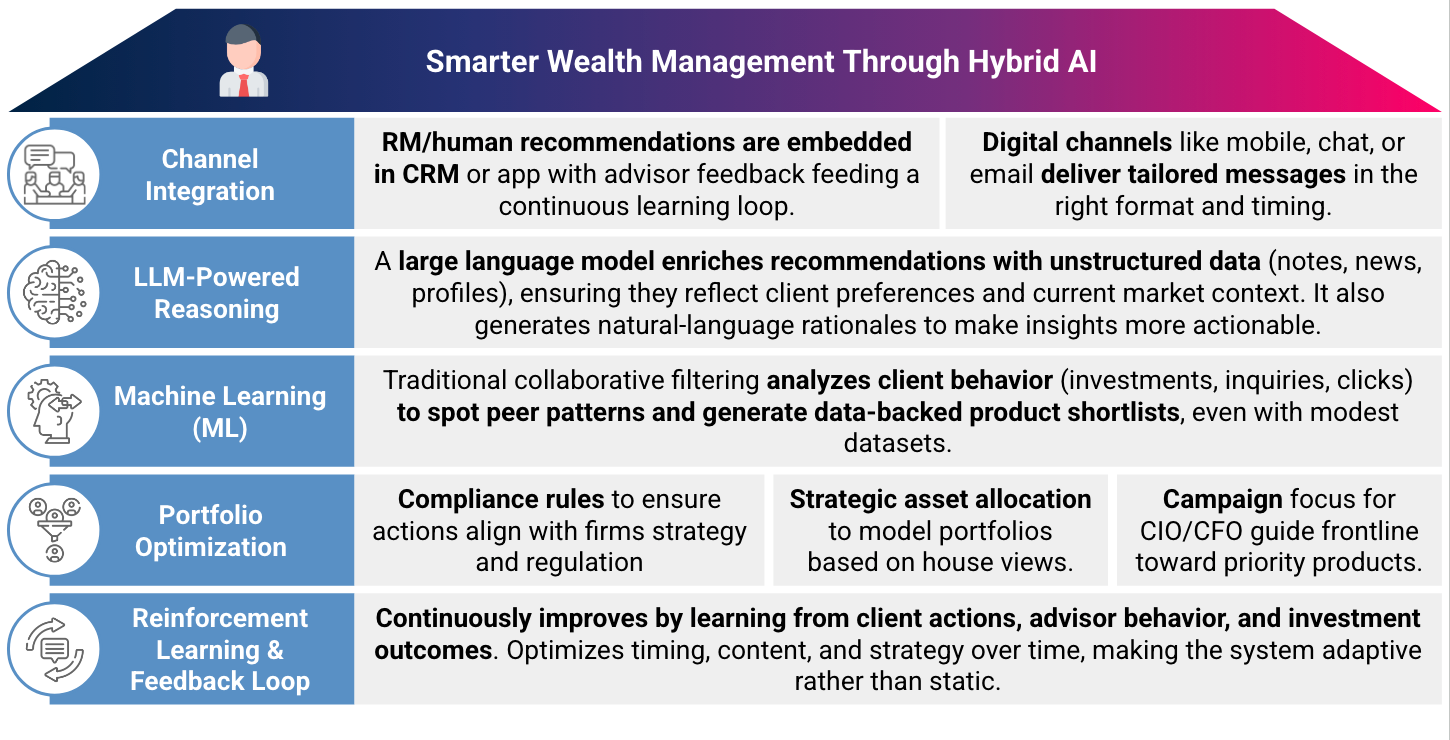
Through this multi-layered hybrid approach, the recommendation engine blends data-driven insight, contextual understanding, strict governance, and continuous learning. It’s GenAI-powered, but grounded in the realities of high-touch wealth management.
Getting Started
Combining the precision of machine learning, portfolio optimization, with the contextual intelligence of large language models and agentic AI can create a powerful end-to-end decision engine. Machine learning and portfolio optimization excel at structured prediction tasks because it can process large, clean datasets with high accuracy. However, these outputs are often narrow and context-blind. By overlaying machine learning models, portfolio optimization, large language models, and an Agentic AI orchestration layer, banks can incorporate “noisy” data such as client conversations, feedback, or market commentary and translate the raw machine learning output into better explanations, recommendations, and automated actions.
Hybrid-AI-powered product recommendations in WM represent a powerful opportunity to reset the standards for advisory services in their respective markets. Banks should:
- Review the current client-personalization platform and processes. Often, few people within the bank understand the end-to-end system and how it is used in reality.
- Explore the GenAI tools and data assets already in place (you might be closer than you think to deploying such a system), and the many newer models and methods in the market today.
- Experiment in controlled pilots – e.g., starting with a subset of advisors and clients, and a narrow product set, to trial the hybrid recommendation engine in action.
Beyond Hybrid AI
The trend towards blending traditional machine learning with LLMs and AI Agents is not unique to financial services. E-commerce players are bracing for the rise of Agentic Commerce: a world where humans no longer engage with apps and websites directly but instead get their personal AI assistants to discover and transact for them. A world where customers ask their personal AI agents, “how can I best re-mortgage my house” or “find me some sneakers as my son’s birthday gift”.
In this world, traditional machine learning and product recommendations don’t work as before – instead, we will see AI-to-AI engagement, AIs that engage and perform exploration, discovery, negotiation, translation, and fulfillment, with oversight from humans to set direction, nudge along the way, and ultimately approve.
Wealth Managers too may face this trend – rather than meeting with clients, relationship managers and their AI tools might soon be engaging with their clients’ personal AI representatives instead of the customer. Banks should treat this shift not as a threat, but as a design brief to build advisory platforms that can earn the trust of AI Agents – and the humans behind them.