


The 2026 edition of Friends of Search confirmed a fundamental shift: the era of deterministic, rule-based PPC is over. We have transitioned into a landscape dominated by AI Overviews, now the world’s most utilized generative AI product with over 2 billion monthly users.
Search is no longer about matching keywords. We are now managing Query Fan-out, where user intent is longer, more conversational, and deeply complex. In this “brave new world,” a five-word query is the minimum norm, and your strategy must be fluid enough to capture it.
In this article, we share the three key lessons from Friends of Search 2026 that will change how you run PPC in the agentic realities of 2026.
Lesson 1: Without Grounding, AI becomes a brand risk
While Google’s AI Max promises a 14% increase in conversions, these gains aren’t automatic. Success requires Grounding, a concept championed at the event by Krishna Madhavan. Grounding is the connective tissue between LLM outputs and your brand’s verifiable, high-quality data. Without anchoring your AI to first-party truths, you risk “algorithmic drift,” where your brand becomes an unverified rumor rather than a trusted primary source.
Lesson 2: Become fluid to keep up with fragmented consumer journeys
As behavior diversifies, brands must chase “vibe” as much as “volume” to optimize for profits. This is illustrated by TikTok users now converting 3.3x more than other search platforms, signaling a splintered reality for the new generation.
That fluidity is the champion mindset is further demonstrated by Rituals’ success with Omnichannelbidding where they optimized for both online conversions and offline actions to keep up with their customer’s post-pandemic customer journey. In a similar manner, the Friends of Search 2026 PPC Award winner, Asics, also serves as a definitive blueprint for this era. By leveraging first-party data from loyalty programs they deployed automated stage-specific ads via Channable and in turn achieved a 108% increase in presales.
These successes prove that power lies in maximizing profit across the entire customer lifecycle using enriched data. They rewarded fluidity over rigidity and won.
Lesson 3: Discard simple automation and experiment with agentic systems
The future belongs to those who move from simple automation to Agentic Systems. This involves documenting client tone, SOPs, and optimization logic into a “centralized brain” that guides AI agents.
We are seeing a move toward AI-based Ad Group Prioritization, where systems evaluate landing page depth and query meaning over simple bid weights. To survive, PPC managers must stop providing “data dumps” and start innovating toward new processes. As Amy Hebdon suggested, we must focus on The Why and What happens next, rather than just reporting the “What.”
On a technical level, the move from rigid scripts to “vibe-coding” represents a massive efficiency gain. As Frederick Vallaeys pointed out, we can now build on-demand software in under an hour to solve specific account problems. However, human oversight still remains the only reliable defense against AI optimizing your budget into oblivion.
The shift in strategy
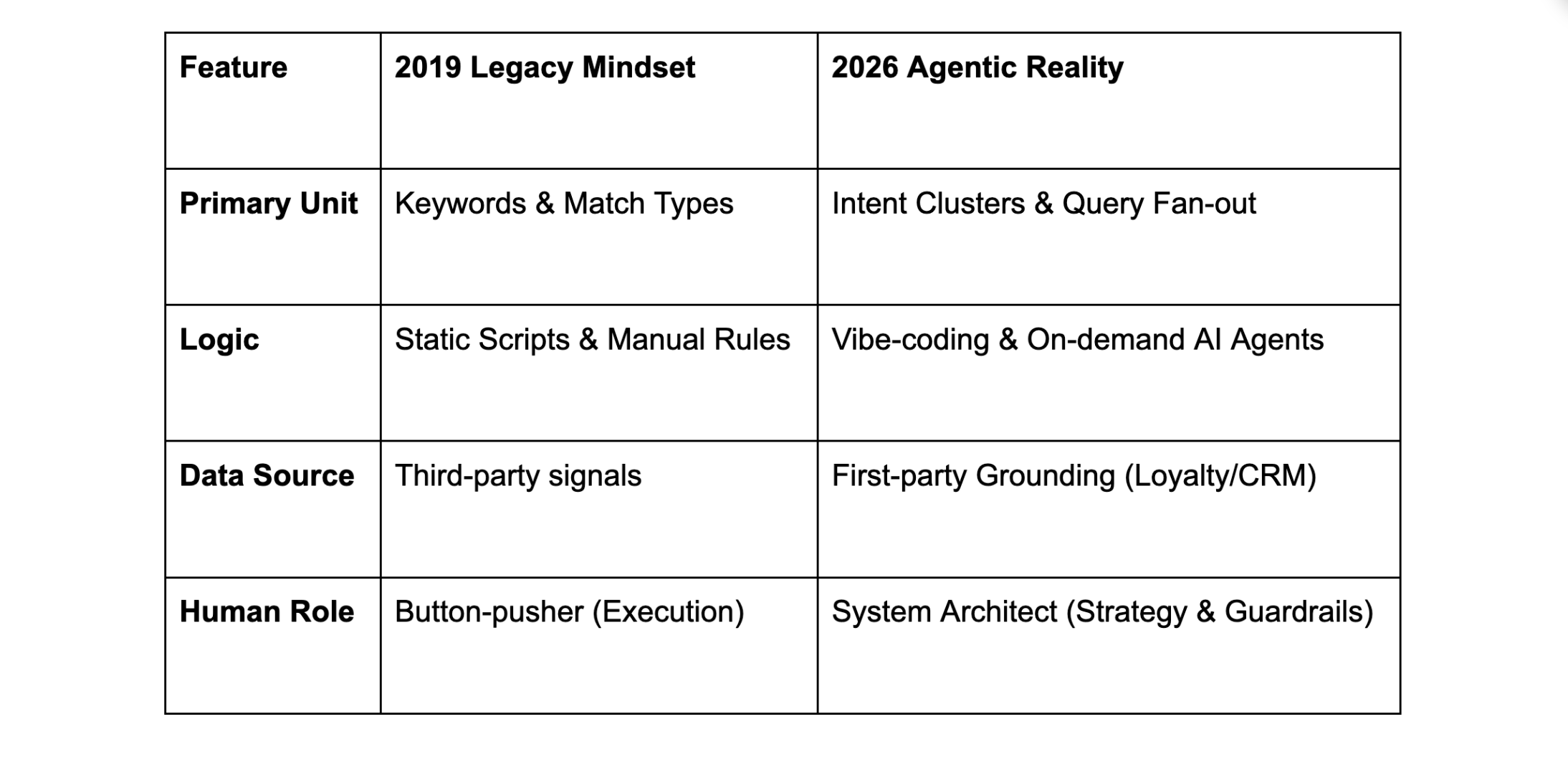
The 2026 checklist for success:
- Prioritize Grounding: Ensure your AI is fueled by your specific business data, not just general web knowledge.
- Embrace vibe-coding: Use AI to build bespoke tools for your unique account challenges.
- Move to system architecture: Focus on the guardrails and the “Central Brain” of your accounts.
- Optimize for profit: Move beyond channel silos by using enriched first-party data to follow consumer “vibe” across touchpoints, maximizing profit throughout the entire lifecycle.
Conclusion: With the power of agentic AI and vibe-coding, technology is no longer the bottleneck; our ability to provide the correct guardrails is. It’s time to move beyond 2019-era development mindsets and align our strategies with the realities of agent-driven systems.