
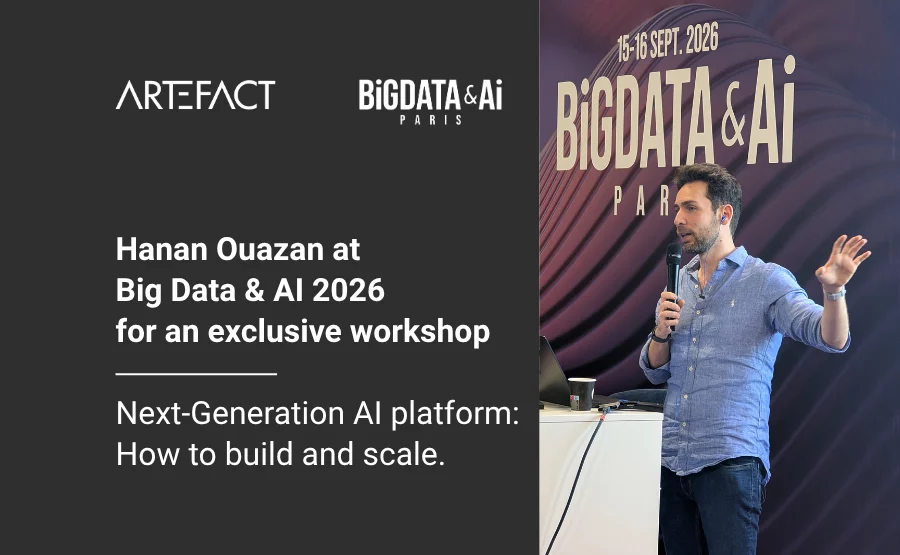
At the recent Big Data & AI Paris conference on September 15, Hanan Ouazan, Group Chief AI Strategist at Artefact, shared his unfiltered vision of AI-driven transformation. In his presentation, Hanan explained how to move beyond simple individual productivity gains to build an enterprise knowledge platform and maintain a competitive edge.
From Individual Adoption to Enterprise ROI
A major paradox currently shapes the AI market and how organizations capture value:
- Massive investments: Approximately $582 billion in AI investments projected for 2025 (nearly 0.5% of global GDP), with models capable of tackling problems that have remained open for decades.
- Limited real impact: According to a McKinsey study, only 6% of companies actually manage to capture business impact through AI.
This gap is explained by the limitations of the two traditional deployment approaches. The top-down approach (executive-driven transformation projects) quickly runs into human constraints and the burden of legacy technology. Above all, the financial equation is unforgiving: a €1 million project must generate €1 million in ROI within the year, because in three years, the technology will have changed multiple times. As a result, only 10% to 20% of company processes are actually eligible for these major transformation projects.
Conversely, the bottom-up approach (providing generative AI tools to all employees) creates an illusion of productivity. The individual becomes “hyper-productive,” but this value struggles to transfer to the broader organization. As a June Financial Times study illustrates, it is a cascading effect: a developer produces 3 times more code, that gain drops to 1.5 at the product team level, and ultimately translates into only 30% more features for the company. Even top-performing organizations capture only a fraction of individual gains.
The San Francisco Example: Redefining Work
True transformation is not about simply distributing licenses, but about deeply redefining how work gets done.
In San Francisco, major tech players have changed how they design products. Product Managers use AI to build the first functional prototypes themselves. As a result, the time from identifying a user need to putting it into production has dropped from an average of 3 to 6 months to just 3 to 6 weeks.
To capture productivity gains, simply providing a tool is not enough; employees must redefine their job roles.
“Deploying AI platforms simply for the technological allure is useless. The success of such an initiative relies above all on its alignment with real business use cases.” — Hanan Ouazan, Group Chief AI Strategist at Artefact.
Contextual Logic: Connecting and Disseminating Information
One of the challenges associated with AI is information retention and dissemination. Today, if an employee learns in a meeting that a client is unlocking a new budget or changing leadership, this crucial information often remains trapped in their personal notes or in an unused meeting summary.
Convinced that it is impossible to sell transformation to clients without being able to transform internally, Artefact redesigned its internal architecture around an initiative called “ACE” (a Context Platform). The core principle is to create enterprise context logic: connecting knowledge objects (clients, companies, areas of expertise) where they live, rather than stacking them in a single database, so information flows by default and is accessible to everyone.
In practical terms, ACE simply qualifies information factually: which client, project, or people a note refers to, and who has permission to view it. Each product then retrieves what is relevant to it and extracts what it needs.
“Your company’s primary asset lies in your proprietary data and knowledge. In a world where AI models are becoming commodities, it is this unique knowledge that makes the difference.” — Hanan Ouazan, Group Chief AI Strategist at Artefact.
The 3 Pillars of a Profitable and Secure AI Strategy
To guarantee ROI and avoid the proliferation of platforms disconnected from actual usage, an AI strategy must rely on three concrete pillars:
- Value is in your data, not in the models: AI models are becoming increasingly powerful while their costs plummet. What constitutes your true competitive advantage is your internal data and domain expertise (your knowledge), which the rest of the world does not possess.
- Natural information capture: Do not rely on manual effort to feed your knowledge bases. Data must be collected as naturally as possible, directly where employees work (Google Chat, meeting transcripts, etc.), to minimize friction.
- Protect your “Harness” (Know-How): Your value lies in how you govern and frame AI usage (skills, governance rules, security, cost and token management). Do not give this know-how to public platforms for them to learn from you. Build and control your own environment.
Ultimately, the success of an AI initiative is not simply about stacking technologies together; it requires being backed by real-world use cases and genuine user needs.