Listen to the podcast: Building AI: From vision to execution | A conversation with Artefact | Ardian
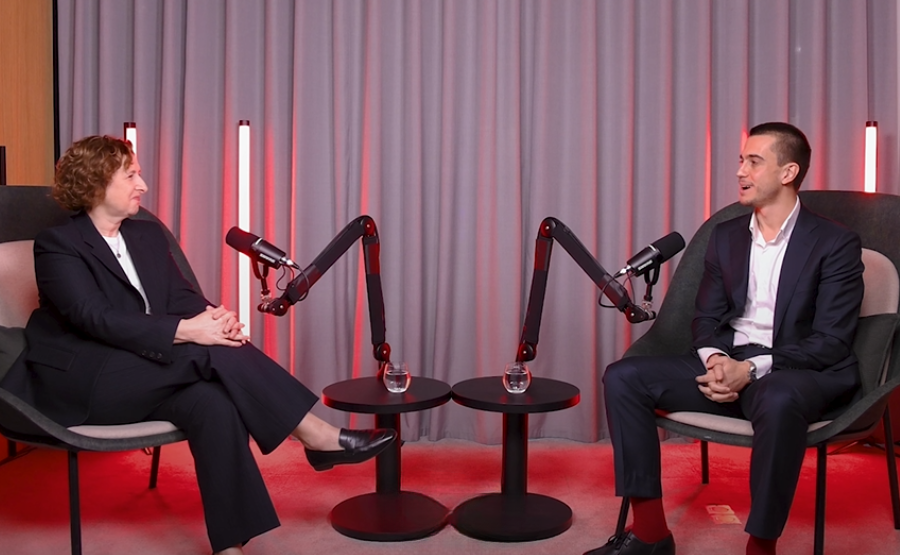
In the rapidly shifting landscape of private equity, the conversation has moved far beyond simple financial engineering. Today, value creation is increasingly driven by a firm’s ability to harness data. At the second edition of the AI for Alternative Investment (AI x AI) conference, Arthur Garnier of Ardian’s Data Science team sat down with Elina Ashkinazi-Ildis, a Partner at Artefact, to dissect the journey from theoretical AI potential to tangible operational excellence.
Their conversation reveals a crucial truth: while Generative AI (GenAI) is the “sexy” catalyst getting everyone into the room, the real winners are those who have spent years doing the unglamorous work of building robust data foundations.
“Data governance and data quality… It’s not sexy, it’s less exciting. But now with Generative AI, the fact that you can create amazing use cases and get crazy results… suddenly makes people interested. They say: ‘What can I do myself to leverage the full capacity of AI?’ And often the answer is: first, you have to align on data governance,” says Arthur Garnier, Senior Data Scientist, Ardian.
The four-layer pyramid of AI success
Artefact, a former Ardian Expansion portfolio company, has spent a decade refining its approach to digital transformation. According to Elina, successful AI integration isn’t about the technology first; it’s about a four-layer pyramid that ensures sustainability:
- The use case layer: “What business are we in?” This is the starting point. Before a single line of code is written, firms must identify where teams spend their time and which pain points, if solved, would move the needle on Sales and margins.
- The operating model: How do you connect investment professionals and data scientists? Success requires a framework where these two worlds can collaborate efficiently.
- Infrastructure and governance: This is the “engine room.” Without clean, structured, and accessible data, even the most advanced algorithms will fail
- Change management: This is where the human element lives. It involves changing processes, training, shifting mindsets, and ensuring that the organization is ready to evolve alongside the technology.
GAIA: A case study in strategic agility
A centerpiece of the discussion was GAIA, Ardian’s internal generative AI platform. GAIA represents a strategic middle ground in the “Build vs. Buy” debate. Elina’s advice is pragmatic: “If there’s a market solution that answers all your questions and it’s within budget… don’t build it. Just buy it.”
However, Ardian chose to build GAIA because it allowed them to maintain absolute control over their internal intelligence. Arthur notes that when a company does 95% of the heavy lifting to clean, organize, and own its data, the final 5%, integrating that data into a custom AI tool, is a natural and powerful next step. By building a custom layer on top of partner technologies like Microsoft, OpenAI, Mistral, and others, Ardian achieved several key goals:
- Technological agility: They remain “agnostic,” able to swap out one LLM for a newer, better one without rebuilding the entire system.
- Bottom-up innovation: Many of GAIA’s features didn’t come from a boardroom; they came from an internal hackathon event, such as “Ardian Startup Studio”, and internal pitches where employees identified their own needs.
- Data sovereignty: 95% of the work in AI is cleaning and owning the internal data. Once that is done, the final implementation becomes a proprietary asset rather than a rented service.
The “process re-engineering” imperative
Perhaps the most profound insight from the conversation was Elina’s mantra: “Let’s get process re-engineered.” Applying AI to a broken or messy process is like putting a faster engine in a car with square wheels. Elina compares teaching an AI “agent” to teaching a young child to cross the street. You cannot give them a million variables and “shortcuts.” You must simplify the process into binary, precise steps:
Red light: Stop. * Green light: Look both ways, then walk.
“The technology is going to be a very small part… it’s the first part [process simplification] that’s going to be really tricky for any industry,” explains Elina Ashkinazi-Ildis
For a private equity firm like Ardian, this means looking at portfolio companies, from digital natives to “hard-core” manufacturing, and helping them strip away inefficient legacy workflows before layering AI on top.
Closing the gap: From technical silos to business impact
The overarching theme of the Ardian AI x AI conference was clear: the era of the “siloed” data scientist is over. Arthur emphasized that for AI to have a real impact, data science must be embedded within the business units.
When technical teams work in a vacuum, they build dashboards no one uses. When they work alongside investment teams, incorporating live feedback and “ambassadors” from across the firm, they build tools like GAIA that fundamentally change how the company operates.
As the private equity industry continues to evolve, the duty of the investor is no longer just providing capital; it is providing the technological roadmap to ensure their portfolio companies don’t just survive the AI wave, but ride it to new heights of efficiency.
Listen to the podcast: Building AI: From vision to execution | A conversation with Artefact | Ardian