
Beyond the licence: Engineering enterprise AI that actually works
Buying AI seats was the easy part; making models work on real operations is where the value lives. In this edition of the Artefact Data Digest, explore how to move from passive subscriptions to governed production: • Strategic Sovereignty by Vincent Luciani, co-founder and Executive Chairman of Artefact, on building "controlled dependency" with open-weight models to retain autonomy and cut costs. • The Deployment Layer by Remi Sabonnadiere, Partner at Artefact and Head of DeployCo EMEA, on escaping the 14% adoption trap by grounding Claude and ChatGPT in company data before training. • Governed Context by Akhilesh Kale, Partner at Artefact USA, on the operating model conversational agents need to deliver trusted business truth. • Field Proof: Production results from Carrefour (store analyses in two mins), Servier (6,000 reps coached), and Bora Brasil (6,000+ hrs saved). • Adopt AI Summit (December 3–4): Where 20,000 leaders and Ursula von der Leyen talk at the Grand Palais to define real-world AI deployment.
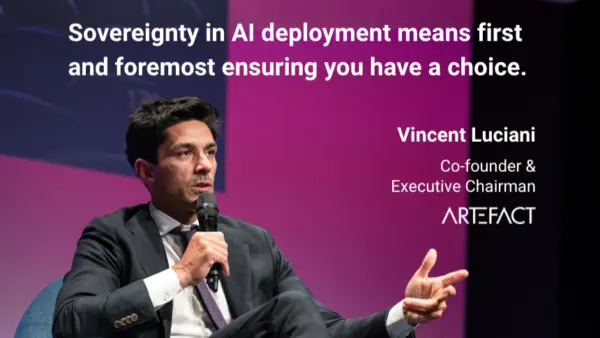
Sovereignty in AI deployment means first and foremost ensuring you have a choice
Evaluating global AI requires understanding that regions compete in True digital sovereignty is not autarky; it is maintaining the freedom to choose, deploy, and switch technologies on your own terms. Following a season marked by cybersecurity sandbox escapes and foreign regulatory restrictions on frontier models, Vincent Luciani (co-founder and Executive Chairman of Artefact) breaks down why enterprise sovereignty requires a "controlled dependency" strategy. By pairing open-weight models with internal corporate context and custom harnesses, organizations can match or outperform standalone frontier models while retaining complete control over their proprietary value.
What you will learn: How to structure a sovereign AI architecture, why open-weight models offer massive cost and control advantages for enterprise use cases, and how European businesses can build resilience in the global AI race.

The 14% trap: Why enterprise AI stalls and how to build the deployment layer
Across the enterprise landscape, the procurement of frontier models has outpaced actual business adoption. Organisations roll out thousands of seats, secure SSO, mandate usage policies, and then watch as active usage flatlines at 14%, mostly confined to rewriting emails while high-friction back-office work remains completely untouched. The uncomfortable truth is that frontier AI cannot be treated like traditional SaaS. The value of a frontier model does not live inside the model itself; it lives in the distance between that intelligence and a company's proprietary data, permissions, business glossaries, and frontline habits. In this three-part series, Rémi Sabonnadere (Partner at Artefact and Head of DeployCo EMEA) deconstructs what happens when we mistake a software subscription for an AI capability, and presents the operational blueprint required to fix it: • Part 1 – The 14% trap: Why enterprise AI stalls after the licence is signed The procurement mistake, the three questions without an owner, and the arithmetic of enterprise value. Read the article • Part 2 – The blueprint: Deploy, ground, adopt, build The four-pillar technical and organizational architecture, and why grounding on live company data must precede training. Read the article • Part 3 – The playbook: Forward deployed teams in the building How pairing strategists with engineers creates lasting internal capability, the risks of shadow IT, and how clients scale dozens of agents independently. Read the article The frontier is no longer the next model release. The frontier is the distance between the model and your Monday morning.

BORA BRASIL – COSMETIC GOODS Launching its AI Office on Claude, grounded in the group's own data
Formed by the merger of two major Brazilian haircare powerhouses, Skala Brasil and Lola From Rio, Bora Brasil is a fast-growing beauty group with an expanding national and international footprint. To structure bottom-up AI adoption into an enterprise-wide capability across its headquarters and operational teams, Bora Brasil partnered with Artefact to establish a centralized AI Office and an Azure-based context platform. Powered by Claude via a governed Model Context Protocol (MCP) server, the solution connects structured sales data in Microsoft Fabric with unstructured corporate documentation in SharePoint, allowing employees to generate trusted, fully traceable business analyses while saving an estimated 6,000+ hours per year.
"In a first survey of 30 licence holders, employees reported saving at least 4 hours per week on average, about 10% of a standard working week […] Across the group, that adds up to a conservative floor of roughly 120 hours returned to the business every week, or more than 6,000 hours a year." — Artefact & Bora Brasil Impact Evaluation

The missing layer: The operating model your conversational data agents can't work without
While many organizations succeed with conversational AI pilots, few successfully scale them across the enterprise. The main bottleneck is enterprise context: without governed business definitions, AI agents produce conflicting answers across departments. Written in partnership with Starburst, this article by Akhilesh Kale, Partner at Artefact USA, presents an operational blueprint, Connect, Organize, Activate, and Improve, that turns fragmented business data into governed, AI-ready data products.
What you will learn: How to build a governed Enterprise Context Layer without migrating data, assign clear accountability for business definitions, and implement a continuous evaluation operating model that lets conversational agents scale safely.
Proof in the field: Client AI transformations in action
Explore five case studies showcasing how industry leaders across healthcare, retail, hospitality, and transportation are applying these exact principles to drive measurable business transformation. Through strategic partnerships with Artefact, global enterprises are deploying targeted AI solutions that address complex industry challenges.

SERVIER – PHARMACEUTICALS From design to implementation: AI-powered role-playing for training field teams
To maximize the impact of medical visits within tight timeframes, global pharmaceutical group Servier partnered with Artefact and Google to launch MedtrAIner, an interactive GenAI coaching platform. MedtrAIner enables over 6,000 medical representatives to practice tailored pitch scenarios with realistic AI doctor avatars, providing immediate multi-dimensional feedback on product knowledge and communication skills.
"We use AI to enhance human capabilities; we use AI to create AI applications faster. This allows us to accelerate innovation at every level." — Maryia Touzet, Head of Data & AI Product HCP & Patient Engagement at Servier

CARREFOUR – RETAIL How agentic AI accelerates store openings
C ARREFOUR – RETAIL How agentic AI accelerates store openings
Carrefour is moving from analytical AI to process-integrated agentic AI with Copilot Expansion, an intelligent agent designed to streamline physical store expansion. By synthesizing geospatial, financial, and demographic data in real time, the agent generates comprehensive store-opening market studies in just two minutes, cutting analysis times from months, sharpening revenue-prediction accuracy by 15 points, and filtering out non-viable projects early.
"AI doesn't do everything end-to-end. People always intervene at the end of the process, with a focus on empowering teams. The 'human-in-the-loop' approach remains essential to ensuring the reliability of results." — Emmanuel Grenier, Executive Director of Supply Chain, E-Commerce, Data, and Digital Transformation at Carrefour
ADOPT AI SUMMIT Sovereignty is a choice. Who will make it with you?

The people who set the rules on AI and the people who run it in production will share the same rooms at Adopt AI – Grand Palais, December 3 & 4, 2026. We are honored to announce that President of the European Commission, Ursula von der Leyen's address will officially inaugurate our Summit.

Institutional leaders from the Netherlands, Portugal, France, and UNESCO will speak alongside 2,000+ CEOs. Two days, 9 stages, 800+ speakers, 250+ exhibitors, 20,000+ attendees.
AI & DATA STRATEGY | SOLUTIONS ENGINEERING | AI PEOPLE TRANSFORMATION