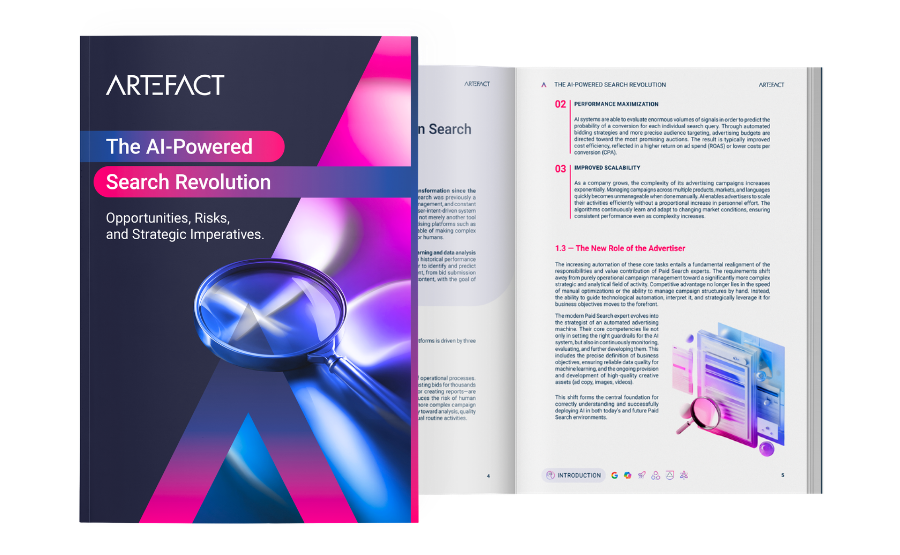
Why traditional search frameworks are expiring, and how to protect your enterprise’s “Share of Model” in a post-SEO landscape.
The rules of digital visibility have changed.
Search Engine Marketing is undergoing a volatile structural shift. The traditional playbook, built on manual keywords and predictable link indexes, is giving way to a dual-engine reality powered entirely by AI.
As consumer journeys move toward dialog-oriented, synthesized answers, your brand faces an immediate risk: becoming completely invisible to a rapidly growing share of users. This exclusive executive whitepaper by Paul Schmitz and Marco Heinemann provides a clinical, high-level framework for navigating the transition from declining traditional SEO to Generative Engine Optimization (GEO), while managing the volatile “black box” risks of automated platforms like Google Ads and Microsoft Ads.
Table of contents: what you’ll learn
1. Introduction: The AI Revolution in Search Engine Marketing
Context, definition, key benefits, and the new strategic role of the advertiser.
2. AI Applications in Google Ads
Bidding logic automation, Performance Max (PMax), and the Enterprise “Data Gap.”
3. AI Applications in Microsoft Ads
Bidding Maturity, Copilot/DALL·E Integrations, and Exclusive LinkedIn B2B targeting.
4. The Future of Paid Search
Ad Placements in AI Overviews, Search Automation via AI Max, and AI Asset Hubs.
5. Generative Engine Optimization (GEO)
The Search-to-AI Pivot, “Share of Model” Mechanics, and core optimization strategies.
6. Risks and Disadvantages: A Critical Perspective
The “Black Box” control problem, Data compliance/bias, and creative brand dilution.
7. Strategic Recommendations for Advertisers
The “Human in the Loop” framework, Value-Based Tracking Assets, and Portfolio diversification.
Share this report