- By 2029, Agentic AI will autonomously resolve 80% of common customer service issues without human intervention, leading to a 30% reduction in operational costs.
- By 2028, at least 15% of day-to-day work decisions will be made autonomously through agentic AI, up from zero percent in 2024.
Hanan Ouazan, Managing Partner at Artefact, shares his expertise on AI Agents and how they are automating business processes.
Hanan Ouazan, Managing Partner at Artefact, shares his expertise on AI Agents and how they are automating business processes.
Hanan Ouazan explains the evolution of AI Agents, discusses their wide-ranging business applications, and explores their role in everything from software development to company culture, governance, and more. Generative AI technologies can be categorized into three components: 1- LLM: First, there were models designed to answer questions from their knowledge base. 2- Assistant: Then came assistants capable of interfacing with knowledge systems to assist us in our daily lives (e.g., RAG use cases) – the well-known “COPILOTS.” Here, the AI doesn’t “execute” tasks but enriches its knowledge and supports the user. 3- Agent: An agent is an application that seeks to achieve a goal by observing the world and acting on it using the tools at its disposal. What’s new here is the “awareness” of its environment, which allows the agent to adapt to unexpected situations. AI agents have applications across many domains:
- Customer relations: Intelligent chatbots that can not only answer questions but also perform actions (update a contract, generate an invoice, handle specific requests).
- Back office: Next-generation document management (GED 2.0), automation of document handling, incident management, and internal requests.
- Code writing: AI tools assist developers by generating code, optimizing scripts, or automating tests. “Use cases will need to be rethought in terms of processes and not merely translated into AI. The goal is not to layer AI on top but to redefine the process without the constraints that previously existed.” Hanan further explores areas about AI agents in this interview: – The impact of AI agents on software development. – How AI agents will address challenges of interoperability between applications? – AI agents: adoption, challenges, and their impact on work.
The Agentic wave is coming: It’s time to redefine enterprise organization – by Hanan Ouazan.
The Agentic wave is coming: It’s time to redefine enterprise organization – by Hanan Ouazan.
The adoption of AI agents in enterprises is reshaping productivity and workflows at two levels:
Task Agents – A new invisible workforce layer. Task Agents (or Interface Agents) integrate directly into workstations, boosting efficiency by 5-30%, and creating an invisible layer of workforce augmentation. But governance is needed to avoid agent proliferation, resource redundancy, and a lack of oversight.
Workflow Agents – Rewriting business processes. Workflow Agents optimize multi-team processes, enhancing speed, reducing cost, and improving reliability. Risks arise from over-reliance on autonomous agents, potentially leading to operational breakdowns due to technological or regulatory changes.
To ensure effective adoption, enterprises must focus on two core pillars:
A centralized AI Agent management platorm that centralizes data and API access, monitors performance, and prevents redundancy.
A robust governance framework that distributes oversight across teams and balances agility with control to avoid inefficiencies or stifled innovation.
Integrating AI agents requires orchestrated management to avoid silos and unlock AI’s potential in a controlled, efficient ecosystem.
Keep up with the latest technologies with Artefact’s GenAI News.
Keep up with the latest technologies with Artefact’s GenAI News.
If you want to know what’s happening in the world of generative AI, this is the place! Twice a month, Artefact scours international AI news to bring you a curated analysis of the latest Gen AI news and insights, as well as updates on new models and features.
A few examples of AI Agent news to get you started (click on the links):
:
- Elon’s Grok Chatbot Calculates Probability That Trump Is a Russian Asset.
- OpenAI reportedly plans to charge up to $20,000 a month for specialized AI ‘agents’ | TechCrunch.
- What you need to know about Manus, the new AI agentic system from China hailed as a second ‘DeepSeek moment’ | VentureBeat.
- GitHub – PennyroyalTea/gibberlink: Two conversational AI agents switching from English to sound-level protocol after confirming they are both AI agents.
How are AI Agents hyper-personalizing enterprise software – by Victor Coimbra.
How are AI Agents hyper-personalizing enterprise software – by Victor Coimbra.
The rise of agentic AI and AI agents is revolutionizing software development by enabling broader participation in technology creation, a shift compared to the democratization sparked by the personal computer. Tools like these empower business users to craft hyper-personalized applications that meet specific needs without waiting for IT intervention. Benefits include:
- Faster development: Reducing deployment time from months to hours.
- Cost efficiency: Lowering development costs by 70–90% for simple applications.
- Hyper-personalization: Tailoring tools to specific roles, departments, or individual needs, like custom dashboards or onboarding platforms. This transformation addresses long-standing enterprise challenges, such as IT bottlenecks and misaligned solutions, while fostering innovation across business units. However, it introduces risks, including potential governance gaps and system fragmentation. Agentic AI doesn’t replace software engineers: it reallocates their focus toward infrastructure, security, and strategic guidance. Business users gain autonomy to address specific problems, creating a collaborative ecosystem that balances agility with oversight. This shift positions enterprises to harness innovation, enhance efficiency, and secure competitive advantages.
Victor Coimbra Partner and Lead for AI & Engineering – Americas at Artefact
Victor Coimbra has been recognized in the Forbes Under 30 Brazil list for his outstanding contributions to AI innovation. He co-founded Artefact’s Latin American operations, which now serve as a global tech hub with 200 employees. He brings deep expertise in scaling AI solutions and building high-performance tech teams across international markets.
As AI agents transform the way consumers discover and purchase products, brands and retailers must rethink their strategies to stay ahead.
As AI agents transform the way consumers discover and purchase products, brands and retailers must rethink their strategies to stay ahead.
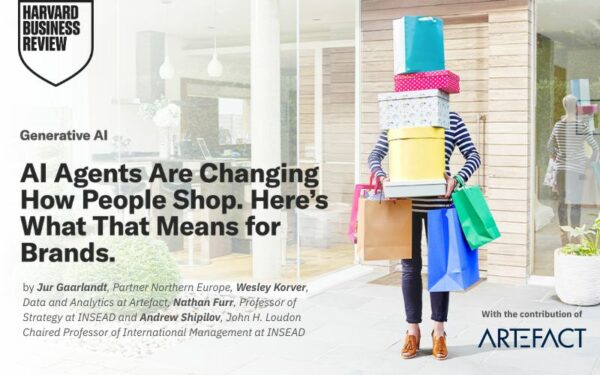
AI agents are reshaping consumer shopping habits, changing how brands and retailers engage with customers. AI Agents search broadly, analyze product options, and optimize purchasing decisions based on user-defined criteria like price, availability, and service. As a result, the traditional power dynamics between brands and retailers are shifting. Brands that rely solely on historical brand equity face significant challenges. Generic products or undifferentiated offerings are vulnerable to AI-driven comparisons that favor cheaper alternatives. In this new landscape, brands must adopt AI agent optimization (AAO) similar to SEO for search engines. Some tactics include:
Price: Ensuring competitive or strategic pricing to remain visible in AI recommendations.
Product innovation: Highlighting unique features, superior materials, or performance metrics that differentiate products in searches.
Design: Offering visually distinct, high-quality products that appeal to niche markets.
Service: Providing standout customer experiences (e.g., warranties, easy returns) emphasized in AI-sourced forums.
Artefact releases EuroBERT: A major advance in NLP.
Artefact releases EuroBERT: A major advance in NLP.
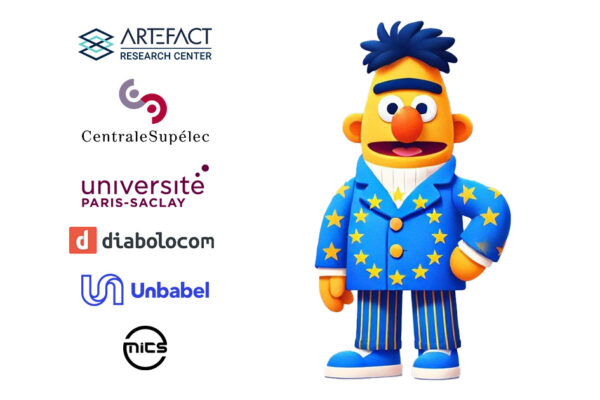
Here’s the original Bert. Our BERT stands for “Bidirectional Encoder Representations from Transformers” and he has a fancier outfit.
EuroBERT is a multilingual text encoder designed to enhance AI applications in European languages and beyond. EuroBERT was developed in collaboration with CentraleSupélec‘s MICS laboratory, Diabolocom, Artefact, and Unbabel, supported by the technological expertise of AMD and CINESs, leveraging expertise from both academia and industry. EuroBERT stands out from currently available encoders in six key ways:
It is sovereign and fully open-source, including both its source code and datasets.
It supports 8 major European languages as well as 7 of the most widely spoken non-European languages.
Trained on 5 trillion tokens, more than twice the size of LLaMA 2, it allows for deeper linguistic understanding and better contextual accuracy.
The EuroBERT family provides the best foundation for information retrieval (RAG), classification, and quality estimation (summarization, translation).
It excels in previously underexplored areas such as mathematical data processing and programming languages.
EuroBERT’s three model sizes (210M, 610M, and 2. 1B parameters), provide options for different level of computational efficiency and accuracy.
“By focusing on analyzing existing documents rather than generating new ones, EuroBERT addresses a critical and recurring need for business text analysis.” Emmanuel Malherbe, Director of the Artefact Research Center
Artefact’s International Adopt AI Summit will welcome you to the iconic Grand Palais in Paris on November 24 – 25 – 26, 2025 SAVE THE DATE
Artefact’s International Adopt AI Summit will welcome you to the iconic Grand Palais in Paris on November 24 – 25 – 26, 2025 SAVE THE DATE
After a successful inaugural edition in 2024, the Artefact Adopt AI International Summit returns, this time to the iconic Grand Palais in Paris on November 24th (VIP dinner), and 25th and 26th (full days of conferences). Visit our new website: adoptai.artefact.com This unique event will bring together Artefact’s flagship initiatives, including AI for Finance, AI for Industry, AI for Health, AI for Sport, AI for the Planet, AI for Tourism, and AI for Luxury. The summit promises an inspiring line-up of CEOs of major enterprises and global thought leaders in AI transformation, as well as business and technology key players. Join us for three days of insight, innovation, and networking with the visionaries shaping the future of the economy, society, and the planet.