

AI can replace more tasks than ever. Companies that confuse those tasks with judgment risk automating away to their own advantage.
In early 2026, Oracle asked employees to document their workflows and use its internal AI tools. Some of those employees were later laid off.
One former senior software manager told Time that junior engineers were using AI to generate large amounts of faulty code. Senior engineers then had to work backwards through it and make it usable. Oracle subsequently reduced headcount, including experienced staff.
The sequence captures one of the central risks of the current AI boom. Oracle automated part of the execution, then weakened the layer of judgment that made the output valuable.
This is not just an Oracle story, or even a software story. Across industries, leaders are looking at what AI can now do and asking how many people they still need. The question is understandable. The capability gains are real.
METR, a nonprofit that evaluates AI agents, measures the length of tasks that models can complete at a given level of reliability. Its research found that the 50 percent task horizon of frontier agents doubled roughly every seven months between 2019 and 2025. Newer versions of the benchmark continue to show rapid gains, although METR cautions that its longest measurements remain uncertain. The tasks are also concentrated in software engineering, machine learning, and cybersecurity. They are not a complete proxy for knowledge work.
That qualification matters. The benchmark tells us AI is becoming much better at completing longer, well-specified tasks. It does not tell us that an AI system can run a company, understand a client, develop a professional, or decide which trade-offs an institution should make.
Yet those ideas are often treated as if they were the same. If AI can complete more of the work, the logic goes, fewer people should be required to produce the same output. On a spreadsheet, the case can look irresistible.
Inside a real organisation, it is far more complicated.
Execution is not judgment
The most useful distinction in the AI and jobs debate is not between tasks that AI can and cannot perform. That boundary is moving too quickly. The more durable distinction is between execution and judgment.
Execution is work that can be clearly specified and assessed. Write this function. Check this application against a set of rules. Review these contracts for unusual clauses. Produce a first draft of this report. Route this customer request. Reconcile these accounts.
AI is already very good at many of these tasks. It is fast, tireless, and cheap at the margin. Used well, it can remove hours of repetitive work and give people more time for difficult problems.
Judgment begins where the specification runs out.
Should this product be built at all? Which technical shortcut will become expensive in two years? Is the client asking for the wrong thing? Does a customer’s history justify departing from policy? Is a technically compliant decision still unfair? What will this recommendation do to a relationship that took ten years to build?
These questions depend on context, consequences, and accountability. They require someone to notice what the system was never told to look for.
AI will get better at supporting such decisions. It may challenge experts and expose weak human reasoning along the way. But organisations will still need people who understand the surrounding reality, can evaluate the output, and are accountable when the answer is wrong.
Better execution does not make judgment less important. Usually it makes judgment more important because the volume and speed of output increase.
The engine, the cockpit, and the compass
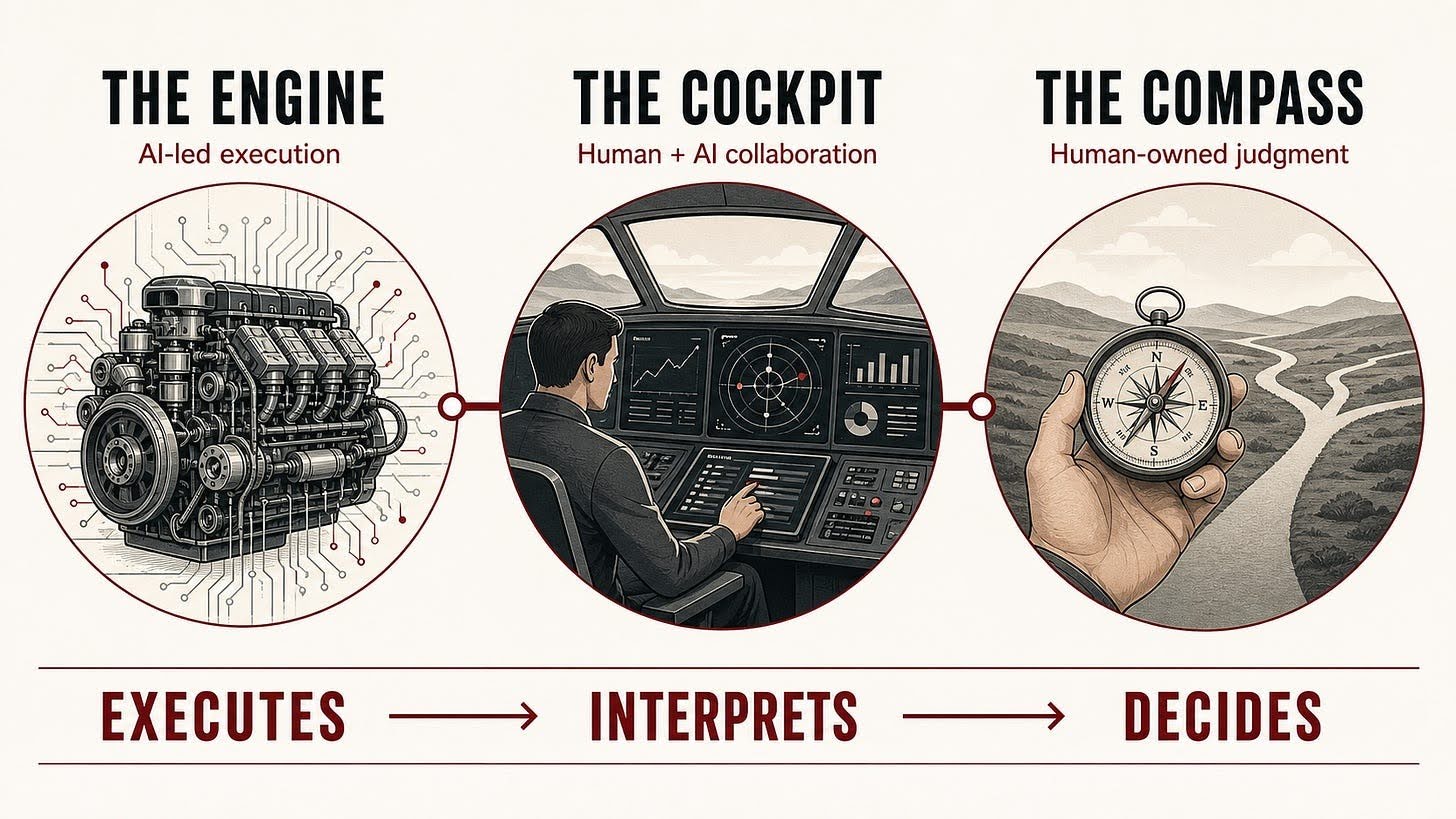
A practical way to apply this distinction is to think of organisational work as three layers.
1. The engine: AI-led execution
The Engine contains structured, repeatable work with clear inputs and measurable outputs. It includes generating standard code, reconciling accounts, routing support requests, screening applications, extracting contract clauses, and producing first drafts.
This is where AI can do the most independent work. The more clearly a task can be specified, and the more cheaply its output can be checked, the stronger the case for automation.
The principle is simple: if the work can be specified clearly and checked cheaply, put it in the Engine.
2. The cockpit: Human and AI collaboration
The Cockpit is the mixed layer. AI produces analysis, options, or recommendations, while a person interprets the situation and decides whether the output fits the context.
Reviewing AI-generated code belongs here. So do handling unusual customer cases, assessing credit exceptions, investigating compliance alerts, and adapting a proposal to the politics inside a client organisation.
The person in the Cockpit is not there to approve everything the machine produces. Their role is to question it, redirect it, and recognise when the situation no longer matches the assumptions behind the system.
The principle is: let AI accelerate the work, but keep a qualified person actively steering it.
3. The compass: Human-owned judgment
The Compass sets direction. It covers goals, values, trade-offs, and accountability. What should the company build? Which risks should it accept? Which customers should it serve? When should a policy change? What kind of organisation does it want to become?
AI can inform these choices. It can surface evidence, challenge assumptions, and model possible outcomes. But people must own both the decision and its consequences.
The principle is: use AI as an input, but keep accountability human.
The boundaries between these layers will move. As AI improves, more work will pass from the Cockpit into the Engine. That is exactly what organisations should want. But capability can move faster than accountability. A task becoming automatable does not mean the surrounding decision has become context-free.
The engine executes. The cockpit interprets. The compass decides.
The failure occurs when leaders strengthen the Engine, hollow out the Cockpit, and assume the Compass will somehow take care of itself.
Klarna found the limit
Klarna offers a useful test of that distinction.
In 2024, the payments company said its AI assistant was doing the equivalent work of 700 customer service agents and handling two-thirds of its service chats within a month of launch. Klarna also froze hiring, and its headcount later fell by about 22 percent, largely through attrition.
The economics looked impressive. Then the company found a limit.
In 2025, chief executive Sebastian Siemiatkowski acknowledged that cost had become too dominant a factor in how customer service was organised, producing lower-quality support. Klarna began recruiting flexible, remote human agents and emphasised that customers should always be able to reach a person if they wanted one.
This was not a wholesale retreat from AI. Klarna continued using the assistant extensively. In a later filing, the company said it handled 80 percent of customer service chats during 2025 and reported no decline in satisfaction, based on its own internal surveys.
The lesson is more interesting than a simple failure story. Klarna kept the efficiency while correcting the assumption that efficiency was the whole product. An automated service can perform brilliantly on the average interaction and still need a person for the moment that does not fit the pattern. In customer service, those unusual moments often shape how people remember the brand.
Klarna did not discover that AI was ineffective. Its Engine worked. The company discovered that customers still needed access to a Cockpit when the interaction no longer fitted the standard pattern.
Reorganisation is not the same as a team
If Klarna shows the difficulty of removing too much human support, Meta shows the difficulty of rearranging people around an AI strategy.
In May 2026, Meta prepared to cut about 10 percent of its workforce while shifting roughly 7,000 employees into new AI-focused organisations. Internal documents described flatter structures, smaller teams, and more ownership. Some employees referred to the compulsory transfers as being “drafted.”
A month later, Meta chief technology officer Andrew Bosworth acknowledged in an internal post that the company had done an “atrocious” job rolling out one of the new divisions. More tellingly, he identified what had been damaged: employees’ trust that their expertise would be valued, that their careers would develop, and that they could have a meaningful impact.
Meta may ultimately build better AI because of the restructuring. A difficult rollout does not prove that the strategy will fail. But assembling talented people into an AI-shaped organisation chart is not the same as creating a functioning team. The Cockpit depends on trust, continuity, and a shared understanding of why the work matters.
People need to know why their work matters. They need managers who understand their strengths and enough continuity to learn how decisions get made. You can move names between boxes in an afternoon. The relationships and shared context do not move with them automatically.
A lawsuit filed in July 2026 by 26 Meta employees sharpens the point. The employees allege that Meta used internal AI systems, activity-monitoring data, token-usage dashboards, and algorithmically assisted performance rankings when selecting people for layoffs. They claim the process treated periods of medical, parental, or family leave as reduced output, making affected workers more likely to be selected. Meta denies the allegations and says people, not AI, made its workforce decisions.
The claims have not been proven. But the alleged failure mode is one every organisation should recognise. A system can process the available metrics accurately and still reach a bad decision because the metrics lack context. Reduced measured output may mean poor performance. It may also mean pregnancy, illness, caregiving, or a disability accommodation.
The Engine applies the metric. The Cockpit asks what the metric means. The Compass decides what consequences the organisation is willing to own.
How organisations remember
Most organisational knowledge is not stored where leaders imagine it is. It is not all in the codebase, the CRM, the policy manual, or the shared drive. Much of it lives in small interactions that barely register as work.
It is the weekly stand-up where someone remembers why a similar idea failed three years ago. It is the client debrief that reveals the real objection was political, not technical. It is the senior engineer who looks at code that passes every test and says, “This will fail under the conditions we actually operate in.”
These moments can look inefficient. They are also how organisations remember.
In a law firm, consultancy, bank, or agency, the relationship is part of the product. Value comes not only from the deliverable, but from understanding the client’s history, internal politics, tolerance for risk, and unstated constraints. The same is true in government, where a caseworker or planning officer may carry years of practical knowledge that nobody thought to write down.
AI can help capture more of this. Better search, transcription, and institutional-memory tools are genuinely useful. But documentation is always a selection of reality. People record what they already know is important. Experience is partly the ability to recognise importance before anyone has documented it.
When competitors have access to similar models and infrastructure, durable advantage comes from how the technology is directed, what context surrounds it, and what standards are applied to its output.
AI can create parity. People turn parity into advantage.
Layoffs change the people who stay
The cost of a layoff is usually modelled as severance, legal exposure, transition time, and the loss of the people leaving. The behaviour of the people who remain is harder to price.
A 2002 meta-analysis by Magnus Sverke, Johnny Hellgren, and Katharina Näswall examined 72 studies of perceived job insecurity. It found negative relationships between insecurity and job satisfaction, organisational commitment, and performance. These were correlations, not percentage declines caused by a particular layoff. Even so, the direction is consistent: when people stop feeling secure, their relationship with the organisation changes.
Research by Charlie Trevor and Anthony Nyberg associated a 1 percent workforce reduction with an estimated 31 percent increase in voluntary turnover the following year, although the surrounding HR practices affected the outcome.
That creates a selection problem. The employees most able to leave are often those with strong skills, useful networks, and attractive alternatives. A company chooses one group to remove, then risks prompting another group to remove itself.
This does not mean layoffs are never necessary. It means a headcount reduction is not a clean subtraction. It changes trust, incentives, and behaviour across the organisation. When AI is the stated reason, the effect may be sharper because employees are being asked to train and improve the systems that could justify the next reduction.
The talent pipeline has a delayed failure
Junior roles are among the easiest to automate because much of their output is structured and reviewable. That makes them an obvious target for cost reduction. It also makes their removal dangerous.
A junior engineer does not become a senior engineer by avoiding simple work. A trainee solicitor does not develop judgment without reviewing ordinary contracts. A new consultant does not learn to read a client room by receiving only the final recommendation.
Expertise is built through repetition, correction, observation, and supervised mistakes.
If AI performs most entry-level execution, organisations will need to redesign how people acquire experience. That could be a genuine improvement. Many traditional junior tasks are tedious and teach less than senior professionals like to admit. But removing the task is not the same as replacing the learning.
If companies cut junior hiring while also cutting the senior people who review AI output, they break both ends of the development cycle. They lose today’s judgment and tomorrow’s supply of it.
The consequences will not appear this quarter. They will surface several years later, when organisations discover they have many tools capable of producing answers and too few people capable of recognising a bad one.
The talent pipeline is not an HR programme. It is production infrastructure with a long lead time.
The case for cutting anyway
There is a serious argument on the other side.
A disciplined chief financial officer could say that much junior work genuinely is disappearing, and pretending otherwise is nostalgia. Protecting roles the technology has made redundant is not stewardship. It is a subsidy that competitors will not carry. Some of the institutional knowledge lost in a layoff is simply habit dressed up as wisdom. Firms have automated craft work before, from manufacturing to typesetting to back-office finance, and the economy adjusted.
On this view, retaining and retraining people only defers a necessary change. Companies that act first will have lower costs and cleaner operations while everyone else hesitates.
Parts of that argument are correct. Some roles will not return, and defending every one of them is a recipe for slow decline. The response is not that cuts are always wrong. It is that the reasoning often stops too early.
Headcount is not the only variable worth optimising. Leaders also need to decide which capabilities must survive the transition: judgment, review, relationships, and the pipeline that produces future expertise. They need to know which work belongs in the Engine, where the Cockpit still matters, and who holds the Compass. Only then can they make an informed choice about which people should be cut, retrained, or redeployed.
Oracle and Klarna did not expose a weakness in AI. They exposed the cost of optimising for what was easiest to measure while neglecting what was harder to see.
A better balance
DBS, Singapore’s largest bank, offers a more deliberate, though not painless, model.
The bank expects around 4,000 contract and temporary roles to disappear over three years as AI takes on more work. It has also said it expects to create around 1,000 AI-related jobs, while retraining existing employees for new responsibilities. Tellers, for example, have been trained to work with video teller machines or move into relationship roles.
DBS is also continuing to invest in its talent pipeline. In May 2026, it announced plans to bring in more than 500 young local participants through management-associate, internship, and traineeship programmes.
This is still workforce reduction. The distinction is that DBS is explicitly deciding which work can move into the Engine and which human capabilities it wants to preserve and grow in the Cockpit. Its continued investment in early-career talent also protects the future supply of people capable of holding the Compass. It is too early to judge the outcome, but the approach asks a better question.
The answer is not to slow AI adoption. Organisations that refuse these tools will become less competitive, and their employees will be left doing unnecessary manual work. The better approach is to treat AI adoption as organisational design rather than headcount arithmetic.
That means putting clearly bounded execution into the Engine while strengthening the Cockpit around it. It means measuring outcomes rather than prompts, tokens, or hours saved. It means identifying the relationships and operational knowledge that depend on a team before reducing it. If AI removes junior tasks, their learning function must be replaced deliberately through reviews, simulations, client exposure, and access to senior reasoning.
It also means giving people some agency in the transition. Meta’s experience shows how quickly an AI strategy can become a trust problem when employees feel drafted into unfamiliar work without a clear purpose or career path.
Most importantly, leaders should stop assuming that headcount must be the only variable that falls when productivity rises. Higher productivity can support lower costs. It can also support better products, faster service, more experimentation, and work that was previously uneconomic.
The choice between growth and reduction is a management decision, not an automatic consequence of the technology. It belongs at the Compass.
The company is more than its output
AI systems will keep handling longer and more complicated tasks. The boundary between human and machine execution will keep moving. Any article claiming to know exactly where it will sit in five years is likely to age badly.
But a company is not a collection of tasks.
It is a network of judgment, trust, memory, incentives, and relationships. Its products emerge from that network, but the network is not visible in the product itself. That is why it is so easy to damage. A company can keep shipping while the knowledge beneath the output quietly thins out.
The organisations that benefit most from AI will not necessarily be those that reach the smallest possible headcount first. They will be those that understand which work should disappear, which capabilities must become stronger, and how people will continue developing judgment when machines perform more of the practice.
AI can automate execution.
People build organisations.
The distinction is not sentimental. It is strategic.
Before your organisation automates another workflow, three questions are worth asking:
- What belongs in the Engine?
- Where does the Cockpit still matter?
- Who holds the Compass, and who owns the consequences?