- Agentic commerce from AI use cases to end-to-end reinvention: Are you ready?
- White paper – The rise of agentic commerce: Strategic implications for enterprises
- China AI transformation: A different game
- Generative AI vs. agentic AI: Why 2026 is the year of autonomous marketing
- White paper – Scaling Data Collaboration: Access data from anywhere to use it everywhere
- TF1 Client case – Data collaboration at the heart of media strategy: A concrete case with Graph:ID
Agentic commerce from AI use cases to end-to-end reinvention. Are you ready?
Agentic commerce from AI use cases to end-to-end reinvention. Are you ready?

The time of isolated AI experiments is over. Agentic AI is reshaping organizations with software that can perceive, reason, and autonomously act across multiple systems. As Edouard de Mézerac, Group CEO Artefact and Global Lead Retail, Luxury & Beauty, emphasizes, “there is zero magic” in agentic AI. True value requires rigorous, end-to-end process reinvention rather than just automating existing inefficiencies.
Insights for successful agentic transformation:
- Set a bold North Star: Aim for massive step-changes, such as 30% cost reductions and 50% faster processes.
- Lead from the top: Agentic AI is a cross-functional, CEO-level transformation that must be unified rather than fragmented by department.
- Don’t automate broken processes: Completely redesign workflows instead of layering agents onto existing bottlenecks.
- Target the right use cases: Prioritize tasks with multi-system complexity, repeated coordination, and predictable patterns.
- Solidify foundations: Agentic AI raises the bar, requiring clean data, clear definitions, and aligned systems as strict prerequisites.
Agentic AI is moving fast, from personal shopping assistants to fully integrated enterprise workflows. Are your data, processes, and technology ready for the shift?
China AI transformation: A different game.
China AI transformation: A different game.

China’s AI adoption follows a fundamentally different path than Western markets. Instead of focusing merely on cost efficiency, Chinese companies embed AI directly into their growth engines to drive top-line revenue. Key insights from Kenn Liu, China Co-Lead & Partner at Artefact, reveal how organizations must adapt:
- Adopt a “local-first” foundation: Architectural and regulatory constraints require multinational brands to shift from global standards to fully localized AI ecosystems (e.g., Alibaba Cloud) to ensure compliance and rapid market responsiveness.
- Prioritize revenue-driving use cases: AI is transforming sales and marketing, utilizing GenAI for deep semantic consumer insights and scaling human sales expertise through AI-powered coaching.
- Leverage deep ecosystem integration: The seamless connection of China’s social, e-commerce, and payment platforms allows AI to scale instantly across touchpoints, from product discovery straight to transaction.
- Master hyper-personalization: As AI agents become the new “decision gatekeepers,” brands must optimize their data for AI discoverability. The high density of user signals from AI interactions opens up new opportunities for real-time hyper-personalization and long-term consumer memory.
Generative AI vs. agentic AI: Why 2026 is the year of autonomous marketing.
Generative AI vs. agentic AI: Why 2026 is the year of autonomous marketing.

Marketing organizations are struggling under the weight of “transformation debt,” with GenAI hitting a glass ceiling that creates unmanageable content debt and tech stack complexity. To realize the definitive ROI of AI, brands must move from generative experimentation to agentic execution. Key insights for this transition include:
- Reconstruct workflows: Stop retrofitting AI onto obsolete legacy processes. Redesign operating models to enable near-zero latency execution.
- Sanctify deep work: Delegate repetitive “shallow work” to autonomous agents, freeing human teams to focus on “deep work”: strategy, empathy, and brand DNA.
- Orchestrate the transformation: True transformation is 70% human and organizational. Brands must transition marketing teams from mere “doers” to high-level orchestrators.
Scaling Data Collaboration: Access data from anywhere to use it everywhere.
Scaling Data Collaboration: Access data from anywhere to use it everywhere.
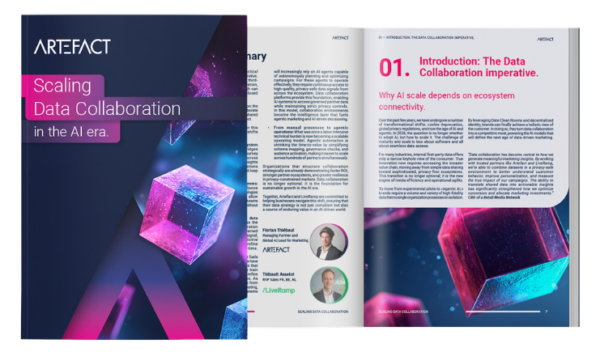
To transition from AI pilots to scalable, agentic operations, secure data collaboration is a strategic imperative. Key insights reveal how organizations must adapt:
- Move to ecosystem intelligence: Connect disparate datasets across the value chain. Secure Data Clean Rooms enable closed-loop measurement and bridge blind spots in the customer journey.
- Turn privacy into a competitive lever: Use robust identity resolution like RampID. Industries can safely match high-fidelity data, from retail sales to healthcare cohorts, without exposing sensitive PII.
- Build AI-ready data products: Governed compute hubs must supply high-signal external data to train predictive models and fuel AI activation channels, such as CRM and LLM interfaces.
- Shift to agentic operations: Eradicate manual technical tasks. Fed with privacy-safe data, AI agents can autonomously plan campaigns, map schemas, and execute cross-partner activations.
- Establish organizational readiness: Create a cross-functional Center of Excellence uniting legal, marketing, and engineering to ensure data hygiene, interoperability, and clear ROI use cases.
Data collaboration at the heart of media strategy: A concrete case with Graph:ID .
Data collaboration at the heart of media strategy:
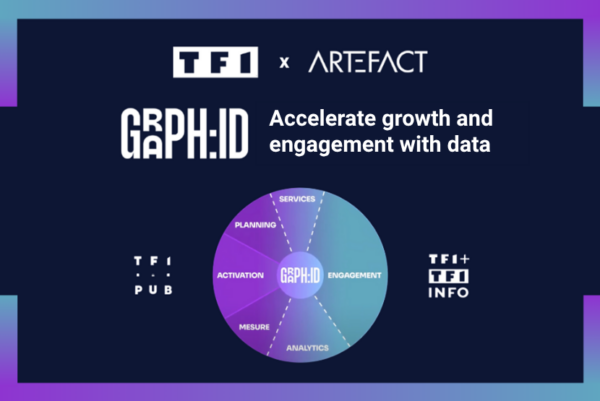
TF1 Group is a leading French media holding company. The launch of their streaming platform demanded a structural shift from siloed operations to unified data collaboration. By deploying the Graph:ID project, TF1 placed comprehensive customer knowledge at the heart of its media strategy. As François-Xavier Pierrel, Group Chief Data and Adtech Officer at TF1, explains: “The project aimed to restructure all of our data sets around the user, so that the user becomes the center of our thinking and understanding.” Key insights from this transformation reveal how media groups can adapt:
- Break down informational silos by consolidating streaming and advertising datasets into a 360-degree view, ultimately creating 25 million qualified user profiles based on over a hundred criteria.
- Leverage interoperable infrastructure using platforms and clean rooms to safely exchange data with advertisers without compromising sensitive first-party data or strict GDPR compliance.
- Drive dual value by delivering highly precise audience segmentation for advertisers and uniquely personalized platform experiences that maximize user retention and engagement.

DATA / AI STRATEGY & TRANSFORMATION | DATA / AI FOR CUSTOMER | DATA / AI FOR OPERATIONS | DATA / AI FOR SUPPORT FUNCTIONS | IT & AI TECHNOLOGIES