
The challenge for business leaders today is no longer whether to adopt AI, but how to operationalize AI at scale. As organizations face increasing complexity due to more data, more decisions, and more pressure on teams, they increasingly look to AI to support faster, better-informed decision-making across the enterprise.
In this issue, we present real-world client cases that show AI in action, not just on the roadmap: :
- BURGER KING: Conversational AI that brings data insights directly to business teams
- GROUPE BARRIÈRE: Generative agents that support customer experience and operations
- VINCI AIRPORTS: A data platform that turns complexity into a performance advantage
Together, they illustrate a critical point for leaders today: harnessing AI isn’t just about adoption, it’s about embedding it into workflows, culture, and governance so it becomes a true enabler of better decisions.
BURGER KING: Accelerating decision-making with conversational AI.
BURGER KING: Accelerating decision-making with conversational AI.
With nearly 600 restaurants, €2 billion in revenue, and 30,000 employees, Burger King France operates across both national teams and a wide network of franchisees. To support faster, more informed decision-making, the brand partnered with Artefact to deploy REBEKA, a conversational AI solution that gives business teams instant access to data. Challenge: Build a foundation of reliable data Burger King manages vast volumes of transactional, CRM, and operational data. While traditional BI tools provided structured reporting, they struggled to keep pace with evolving business questions. Teams needed faster, more flexible access to granular insights that required no technical expertise. Solution: A chatbot that makes data speak Supported by Artefact, Burger King France built REBEKA, a text-to-SQL conversational chatbot that allows users to query data in natural language. The tool offers three key advantages:
- Enhanced data query granularity
- Data cross-referencing
- Delivery of status reports in seconds rather than weeks Results: Rapid adoption and enhanced data culture REBEKA has significantly reduced time to insight, improved analytical depth, and strengthened data-driven decision-making across the organization. Burger King France is now moving toward more autonomous analytical AI, shifting from answering questions to proactively explaining performance drivers.
GROUPE BARRIÈRE kicks off its AI roadmap: Launching tailor-made generative agents.
GROUPE BARRIÈRE kicks off its AI roadmap: Launching tailor-made generative agents.
Groupe Barrière shared how a century-old “French-style resort” leader (hotels, casinos, wellness, entertainment) is laying the foundations of an enterprise-wide AI strategy, led by Salomon Bentolila (Director of Data & Acquisition) and powered by Artefact. Challenge: Scale AI without compromising service excellence to improve productivity and operations; enhance customer/employee experience, and explore new GenAI services.
Solution: A test-and-learn GenAI platform with three pilot agents:
- Barrière GPT for secure access to generative AI and shared prompt libraries
- A Call Center agent to streamline customer interactions with instant answers from business documentation
- Barrière Play Support with 24/7 AI assistance to field teams via back-office integration
Results: Adoption and use of Barrière GPT by 100 users generating 4,000+ prompts; Call Center shows 60+ active users and 1,000+ prompts; Barrière Play Support has 30+ active users, 350+ prompts, high satisfaction. Artefact supported delivery and change with adoption materials, iterative integration choices, and continuous improvement via “LLM-as-a-judge” quality monitoring. By putting users, governance, and quality control at the core, Groupe Barrière demonstrates how to scale GenAI while maintaining brand identity.
How VINCI AIRPORTS uses AI to optimize its operational, commercial, and financial performance.
How VINCI AIRPORTS uses AI to optimize its operational, commercial, and financial performance.
Operating 70 airports across 14 countries, VINCI Airports manages complex, local operations while making decisions at a global scale. At a recent Google Cloud Summit, Benoît Forest, Director of Operations, shared how the Group is using AI to turn complexity into a performance lever with Artefact and Google Cloud. As their model relies heavily on anticipating passenger traffic (capacity planning, retail strategy, financial forecasting, service level, decarbonization), a unified traffic view is essential. Challenge: Collect and process fragmented, non-standardized data across the Group’s airports to build a reliable, group-wide view for enhanced decision-making. Solution: With Artefact, VINCI Airports built a global Data Factory on Google Cloud to federate data without forcing traditional IT harmonization. The approach combines robust architecture with strong business ownership from day one.
Results: Adoption, satisfaction, and strong traction shown by pilots:
- Improved passenger traffic forecasting at all levels
- Operational efficiency gains that keep security wait times under 10 minutes
- Commercial optimization by aligning retail offers with passenger / travel profiles
- A shared data culture embedded across the network.
By pairing scalable AI models with strong governance and user adoption, VINCI Airports shows how AI can support better decisions without replacing human expertise.
AI for Retail & Consumer Goods Report – All conferences (replays & summaries) at the Adopt AI Summit.
AI for Retail & Consumer Goods Report – All conferences (replays & summaries) at the Adopt AI Summit.
For retail and consumer goods leaders, generative AI is no longer about experimentation at the margins but about embedding intelligence into everyday operations to drive measurable P&L impact at scale. This report, based on insights from our Adopt AI summit, highlights how leading organizations are moving from isolated pilots to durable competitive advantage.
Successful transformations are driven by a clear focus on six strategic imperatives:
- Operational reinvention: Using predictive and autonomous systems to anticipate issues, optimize decisions, and scale expertise.
- Human augmentation as the primary ROI: Enabling teams to work faster and smarter while focusing on higher-value activities.
- A redefined customer experience: Powered by large-scale personalization and conversational commerce across physical and digital channels.
- A strong data foundation: Combining central enablement with decentralized execution to support innovation at the edge.
- Pragmatic value realization: Driven by tightly scoped use cases with clear, measurable business outcomes.
- Adoption and culture: Where executive sponsorship and local experimentation accelerate enterprise-wide change.
Together, these imperatives offer a practical roadmap for retail and consumer goods leaders looking to turn generative AI into a sustained driver of enterprise value.
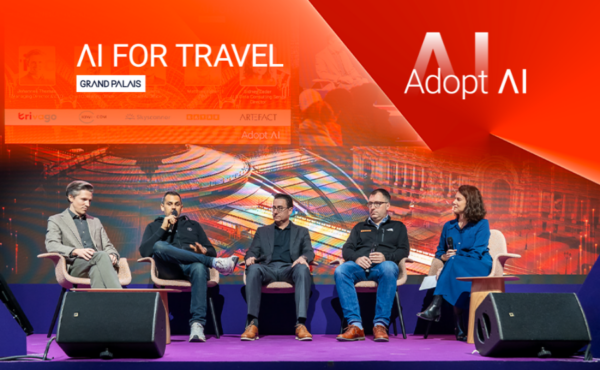
AI for Travel Report – All conferences (replays & summaries) at the Adopt AI Summit.
AI for Travel Report – All conferences (replays & summaries) at the Adopt AI Summit.
AI for Travel has sharpened the strategic roadmap for the industry’s next defining chapter. The insights in this report reflect the concrete imperatives now facing travel leaders as AI reshapes how value is created, delivered, and scaled. Five priorities stand out as decisive for the sector:
:
- From transactions to experiences: Shifting away from commoditized products toward hyper-personalized, end-to-end traveler journeys powered by real-time data.
- Operational reinvention: Using AI to fundamentally transform passenger flow forecasting, resource planning, and asset management while reallocating human effort to higher-value work.
- The new customer interface: AI-powered agents become the frontline for customer engagement, handling volume at scale and enabling more human, high-impact interactions.
- Ecosystem-driven innovation: Built on secure and sovereign data collaboration across the travel ecosystem to unlock shared value and address industry-wide challenges.
- Workforce and business model transformation: Requiring large-scale upskilling, new roles, and operating models where humans guide automated execution.
These priorities form a clear framework for leaders navigating AI-driven change. The full session replays offer deeper insight into how travel organizations can translate strategy into execution.
Explore the reports from the CEO Stage and the six ecosystem stages of the Adopt AI Summit, which took place at the Grand Palais on November 25–26.
For additional insights and coverage of the other reports, stay tuned for the February edition of the Artefact Data & AI Digest.
Adopt AI Grand Palais 2025 Recap: Driving AI adoption at scale and Save the Date for December 3rd & 4th, 2026.
Adopt AI Grand Palais 2025 Recap: Driving AI adoption at scale and Save the Date for December 3rd & 4th, 2026.
We’re excited to share the aftermovie of Adopt AI 2025, the landmark summit on AI adoption recently held at the iconic Grand Palais in Paris. This video recap captures the energy, insights, and innovation that brought together 20,000+ attendees, 600+ speakers, and 250+ exhibitors across seven ecosystems, from AI in Finance and Health to Industry, Retail, and more.
Adopt AI will return on 3 – 4 December 2026 at the Grand Palais, Paris. Mark your calendars now and stay tuned for updates on speakers, sessions, and how to register for the next edition.