
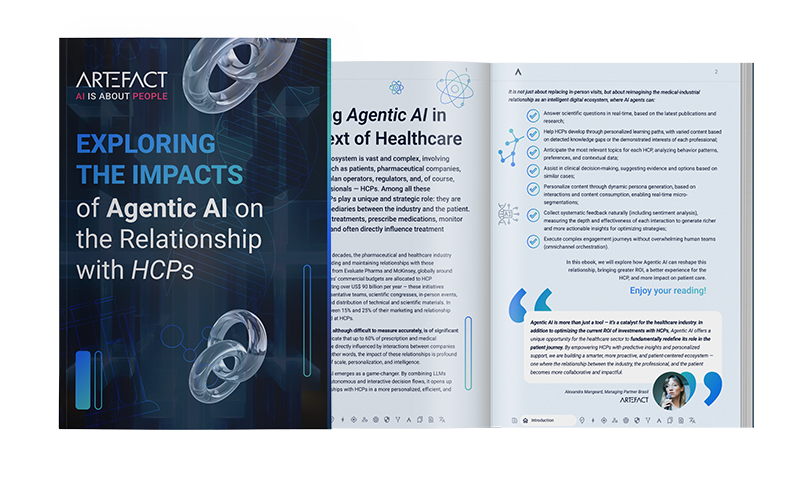
Artefact’s new white paper, Exploring the impacts of agentic AI on the relationship with HCPs, shines a light on the healthcare industry at a pivotal moment. Patients today are more digital, autonomous, and informed than ever before. Many consult online platforms and even AI tools before visiting a doctor. At the same time, healthcare professionals (HCPs) are overwhelmed by a flood of content, from scientific updates to promotional campaigns, and struggle to cut through the noise. Traditional engagement models centered on in-person visits and one-size-fits-all communication are no longer sufficient to maintain relevance.
Against this backdrop, organizations in the healthcare sector must rethink how they build trust, deliver value, and support medical practice. The emergence of agentic AI offers a unique opportunity to combine the contextual reasoning of large language models (LLMs) with the autonomy of digital agents. This new wave of technology enables more personalized, proactive, and scalable relationships with HCPs. Far from replacing human representatives, agentic AI complements their expertise, allowing them to focus on strategic relationship-building while agents orchestrate the complexity of data, channels, and personalization.
The return on these investments, although difficult to measure accurately, is of significant strategic importance. Studies indicate that up to 60% of prescription and medical recommendation decisions can be directly influenced by interactions between companies and healthcare professionals.
Why agentic AI matters in the context of healthcare
Agentic AI represents a shift from static tools toward systems capable of reasoning, learning, and acting. It integrates:
- Generative AI, which interprets complex contexts and generates natural language outputs
- Autonomous agents, which execute multi-step tasks with minimal supervision
- Real-time data, which ensures every interaction is contextualized and adaptive
This combination allows companies to move from reactive, fragmented engagement to intelligent, end-to-end orchestration. In healthcare, where precision, empathy, and compliance are all critical, the ability to scale meaningful interactions with HCPs is a game-changer.
“Agentic AI is more than just a tool – it’s a catalyst for the healthcare industry. In addition to optimizing the current ROI of investments with HCPs, agentic AI offers a unique opportunity for the healthcare sector to fundamentally redefine its role in the patient journey. By empowering HCPs with predictive insights and personalized support, we are building a smarter, more proactive, and patient-centered ecosystem – one where the relationship between the industry, the professional, and the patient becomes more collaborative and impactful.” – Alexandra Mangeard, Managing Partner at Artefact
Four critical challenges and the agentic AI response
Despite years of digital transformation, companies still face four recurring challenges in HCP engagement. Agentic AI provides a new path forward with:
- Volumetry: Reaching all HCPs
Traditional in-person visits remain costly and limited in scale. Meanwhile, more than two-thirds of physicians prefer digital communication. Agentic AI enables 24/7, personalized interaction with HCPs, using tailored scientific content and adaptive digital channels that meet professionals where they are. - Quality: Delivering relevant information
Generic communication, focused solely on product features, often fails to resonate. Studies show that over half of doctors change their perception of a treatment based on content they encounter online. Agentic AI elevates engagement by delivering hyper-personalized “Next Best Actions,” from clinical updates to event invitations, aligned with each doctor’s profile and current interests. - Frequency: Staying top of mind without creating overload
Historically, companies attempted to maximize frequency through repeated visits and outreach, often leading to fatigue and disengagement. Intelligent omnichannel orchestration avoids this pitfall by maintaining presence across the right channels, at the right cadence, with the right tone, so that each interaction adds value, not noise. - Trust: Building long-term relationships
Traditional trust-building tools (e.g., events, congresses, gifts) face ethical limits and diminishing returns. Agentic AI strengthens trust by offering continuous services that directly support medical practice, such as monitoring patient adherence, suggesting relevant studies, or tailoring learning resources. By focusing on utility and partnership, companies can foster genuine, lasting trust.
The Sales Rep Agentic Hub: From individual to ecosystem
In this new model, the role of the sales representative is transformed. Instead of acting alone, the rep becomes the orchestrator of a Sales Rep Agentic Hub: an intelligent ecosystem of specialized agents that operate in the background to support every interaction.
These include:
- Journey Intelligence Agents that track where each HCP is in their engagement journey
- Synthetic Persona Agents that predict interests and anticipate objections
- Next Best Action/Offer Agents that suggest timely, relevant outreach
- Channel Agents that identify the optimal communication channel
- Scientific Agents that pull the latest evidence from trusted sources
- Tone of Voice Agents that adapt messaging to each doctor’s preferences
- Multimodal Generation Agents that deliver content in text, audio, video, or infographics
The result is a scalable model that preserves scientific rigor, improves personalization, and frees human representatives to focus on empathy, creativity, and strategic influence.
“Traditional HCP engagement models have reached their limits. With Agentic AI, we gain the ability to deliver predictive and truly personalized value at scale. This enables us to build strong trust that goes far beyond isolated interactions and genuinely influences clinical decision-making. This is an opportunity to lead the next generation of physician relationships, ensuring a competitive and differentiated ROI while reinforcing our commitment to patient care.” – Ricardo Kim, Associate Director, Data & AI at Artefact
Real-world applications already delivering results
Several pioneering companies have already implemented agentic solutions with measurable success:
- HCP interaction summaries: Providing sales reps with a consolidated view of past interactions saves time and improves meeting relevance, with reported boosts in Net Promoter Scores.
- Medical writing assistants: AI accelerates the preparation of regulatory documents, reducing timelines by up to 30% and bringing medicines to patients faster.
- AI persona generators: By synthesizing structured and unstructured data into realistic synthetic profiles, companies have achieved 5% to 10% market share gains and stronger campaign performance.
Ethics and compliance: Essential guardrails for trust
Because healthcare involves sensitive data and critical decisions, ethical and compliant adoption of agentic AI is non-negotiable. Companies must address:
- Privacy and consent: Ensuring data is handled transparently and securely
- Accountability: Defining clear ownership for automated decisions
- Bias mitigation: Preventing skewed recommendations by monitoring agent performance across demographics
- Transparency: Explaining agent decisions and citing scientific sources when applicable
Frameworks such as the EU AI Act, the FDA’s Good Machine Learning Practices (GMLP), and ISO/IEC 42001 provide guiding standards to ensure safe, auditable implementation.
A proposed roadmap for adoption
Artefact recommends a structured approach to maximize value and minimize risk:
- Empower individuals: Train employees to use secure, user-friendly agentic tools, encouraging adoption and experimentation.
- Focus on impactful use cases: Prioritize pilots that demonstrate measurable results quickly, creating momentum and organizational buy-in.
- Scale transformation: Build transversal programs that integrate governance, cultural change, and technical platforms to enable sustained adoption across the enterprise.
Conclusion: The future is human + agentic
Agentic AI is not about replacing human intelligence, but amplifying it. For healthcare, it represents a profound redefinition of how companies engage with HCPs: from sporadic, generalized contact to intelligent, continuous partnership. By leveraging agentic AI responsibly, companies can deliver greater efficiency, foster genuine trust, and, most importantly, support better outcomes for patients.
The future of medical engagement will be powered by autonomous agents, but its success will always depend on the uniquely human qualities of empathy, creativity, and judgment. In short, the future of agentic AI consulting in healthcare is, above all, human.