Laying the foundations for GenAI adoption: :
- Scaling GenAI across the enterprise (strategy, culture, and processes) unlocks efficiency, ensures compliance, and drives innovation.
- Our 6-step roadmap shows you how to get there. Bringing Agentic Intelligence to life:
- 4 Ps that accelerate agentic transformation: Processes, People, Platform, and Position. How leading organizations are putting AI into action:
- ARDIAN client, Mistral AI, and Artefact: Fast-tracking Private Equity knowledge base management with GenAI platform GAIA.
- ADEO client: Connecting content and knowledge through AI.
GenAI adoption: A pragmatic roadmap for real impact.
GenAI adoption: A pragmatic roadmap for real impact.

Generative AI is no longer a trend, it’s a boardroom priority. But true impact doesn’t come from scattered tests; it comes when GenAI is woven deeply into an organization’s strategy, culture, and processes. The path from experimentation to sustainable impact is structured, requiring both strategic top-down programs and grassroots bottom-up momentum. The top-down approach focuses on automating cross-functional workflows for high impact, while the bottom-up route drives fast, low-risk adoption by equipping employees with tools for daily productivity. Companies need both to deliver tangible returns. Artefact has a proven, six-step roadmap to accelerate this journey: :
- Maturity Audit: Pinpoint existing strengths and gaps to avoid “false good ideas”.
- Executive Momentum: Secure leadership buy-in with concrete, inspiring examples.
- Democratize Skills: Train employees on basics like prompt engineering to encourage experimentation.
- Spot the Real Levers: Interview business teams to find genuine challenges, building ownership.
- Move into Action: Run team-specific workshops to embed GenAI into daily work with hands-on tools.
- Scale with Specialized Agents: Roll out function-specific copilots to mature the organization into advanced use cases.
“True adoption isn’t about testing a tool; it’s about embedding GenAI into the very fabric of organizational processes, culture, and strategy,” concludes Rémi Sabonnadiere, Partner at Artefact Switzerland.
Success requires leadership alignment, hands-on training, and strong governance to ensure compliance and security. By moving deliberately now, companies can capture productivity gains and build a sustainable competitive advantage.
Case Study: From curiosity to capability in order to scale GenAI in commodity trading.
Case Study: From curiosity to capability in order to scale GenAI in commodity trading.

For a leading global commodity trading company client of Artefact (one that trades in primary economic sectors, such as agriculture, energy, and metals, rather than manufactured products), the challenge was clear: scale generative AI across the enterprise to improve efficiency, compliance, and innovation. Challenge: The company was experimenting with tools like Microsoft Copilot, but hadn’t yet achieved enterprise-wide impact. Employees needed structured training to use GenAI confidently, while business leaders wanted to move beyond experimentation to automation, developing AI assistants to handle complex workflows such as compliance checks and document analysis. Solution – From learning to doing with co-creation: Artefact applied its GenAI adoption framework, tailored to the high-stakes world of commodity trading.:
- After a maturity audit to identify high-value opportunities, Artefact launched an upskilling program with workshops, e-learning, and community engagement.
- Multidisciplinary agent hackathons united business, data, and compliance teams to co-develop custom AI assistants.
- One key development was a Copilot-based compliance assistant that automates document reviews, extracts key information, and supports audit readiness. Results – Tangible benefits across multiple dimensions: Within weeks, Copilot engagement rose across departments. Over 50 business-relevant prompts and workflows were created. AI assistants began delivering measurable efficiency gains in document management and compliance. AI was transformed from isolated experimentation into a scalable enterprise capability, creating lasting value and a confident, AI-ready culture.
The 4Ps for successful agentic AI transformation: Processes, People, Platform, Position.
The 4Ps for successful agentic AI transformation: Processes, People, Platform, Position.
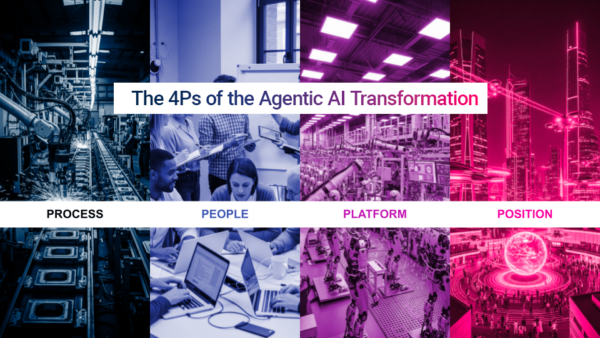
The real challenge in AI today isn’t testing or accessing technology; it’s scaling it across organizations. Speaking about AI transformation, Hanan Ouazan, Managing Partner & Global Lead AI Acceleration, shared what he calls the 4Ps of Agentics: four dimensions that determine whether an AI transformation succeeds or stalls.:
- Processes: True change comes from orchestrating how humans and AI collaborate, not from automating isolated tasks. Entire processes must be redesigned by deciding where to automate, where to augment, and how to combine both effectively.
- People: AI isn’t replacing humans; it’s reshaping how we work. Some tasks will disappear, others will evolve, and new roles will emerge. But no transformation can succeed without training. Even the best AI system won’t succeed if people can’t use it.
- Platform: As agents multiply, companies need governance: a platform that tracks, monitors, and manages them. It’s not just an IT issue; data, business, and tech teams must share responsibility for keeping agents aligned, ethical, and effective.
- Position: Conversational engines like ChatGPT and Gemini are changing how consumers discover and buy products. This isn’t SEO 2.0, it’s a complete rethink of digital strategy.
“Scaling AI is an organizational journey. Those who master the 4Ps will be the ones who truly bring agentic intelligence to life,” says Hanan Ouazan, Managing Partner & Global Lead AI Acceleration at Artefact.
Beyond automation: Designing the hybrid agentic organization.
Beyond automation: Designing the hybrid agentic organization.

The hybrid agentic organization is the new enterprise operating system, where AI isn’t just a tool but an active participant alongside humans. Agents collaborate asynchronously, join discussions, and make micro-decisions, creating a shared ecosystem of human and machine intelligence. This shift introduces agentic resource management: the discipline of orchestrating human (creativity, empathy, judgment) and machine (precision, memory, speed) capabilities to amplify each other. Leaders now manage cognitive capacity by designing interaction patterns rather than dividing labor.
“Becoming a hybrid agentic organization isn’t about replacing humans, it’s about amplifying what humans can achieve through intelligent collaboration.” – Victor Coimbra, Partner AI & Engineering, Artefact LATAM & NORAM
Work now exists in three modes:
- Manual (fully human-driven)
- Augmented (human and machine in tandem)
- Agentic (autonomous execution within explicit boundaries). Underlying this is a move from master data to enterprise context management. Agents need context (the meaning that explains why data matters) to act with relevance and restraint. Future advantage lies not in using AI but in organizing intelligence with clarity and trust, embedding explainability, traceability, and accountability for intelligent scalability.
ARDIAN, Mistral AI and Artefact accelerate Private Equity with GAIA, a GenAI-powered document intelligence tool.
ARDIAN, Mistral AI and Artefact accelerate Private Equity with GAIA, a GenAI-powered document intelligence tool.
Dealing with vast volumes of unstructured documents is a universal challenge in Private Equity. To accelerate deal execution and enhance decision-making, world-leading private investment firm Ardian partnered with Artefact and Mistral AI to build GAIA, an internal generative AI platform for document intelligence. GAIA allows Ardian’s investment teams to rapidly analyze, summarize, and compare complex financial and legal documents with unprecedented efficiency. The platform uses a model-agnostic approach, selecting Mistral AI models for their superior multilingual performance with French documents, excellent summarization capabilities, and alignment with European data sovereignty requirements. “In less than a year, daily usage has tripled, with over 500 weekly active users and more than 280,000 user requests. Today, more than half of Ardian’s employees use GAIA to accelerate their work and focus on delivering value for our investors and portfolio companies,” says Mathias Burghardt, EVP of Ardian. GAIA enhances teams’ expertise, allowing them to conduct more thorough due diligence and focus on high-value strategic analysis, rather than information extraction. This success showcases how combining in-house data expertise with cutting-edge LLMs and strategic partners creates a secure, tailored platform that transforms core business workflows.
How ADEO, a major DIY leader, uses AI to link content and knowledge.
How ADEO, a major DIY leader, uses AI to link content and knowledge.
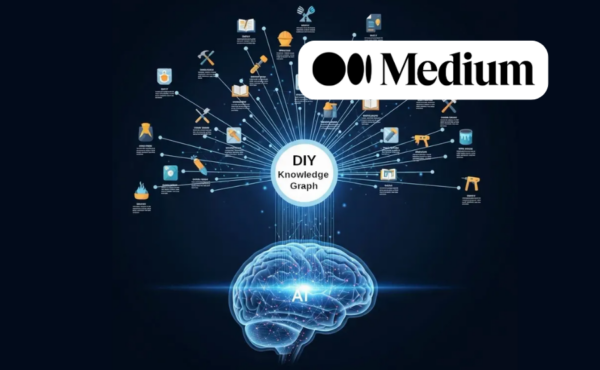
ADEO, parent of brands like Leroy Merlin and Weldom, built a large Knowledge Graph of its product taxonomy, but its rich DIY articles were disconnected from that data structure. Challenge: Without linking content to knowledge, the company couldn’t deliver truly smart search, personalized recommendations, or enriched content experiences. Solution: With Artefact, ADEO deployed an AI-powered pipeline based on LLMs. The two-stage model uses named-entity recognition (NER) to spot mentions in text and named-entity linking (NEL) to anchor them in the Knowledge Graph. Text chunking, vector search, semantic reranking, and hierarchical ranking all combine to make the linking robust. Outcome: Initial results are promising. For the ProductSet category, the linking achieved a solid F1 score of ~60%. The functional API now feeds pre-annotated text to human labelers, accelerating annotation and paving the way for future model fine-tuning. ADEO’s enriched Knowledge Graph will now support smarter search, better product recommendations, and more context-aware content. The collaboration between ADEO, Google, and Artefact continues to drive retail innovation.
THE ADOPT AI PROGRAM IS LIVE! Announcing new CEOs on the CEO Stage.
THE ADOPT AI PROGRAM IS LIVE! Announcing new CEOs on the CEO Stage.
Join Artefact at Adopt AI, the leading European summit on AI adoption and transformation, on November 25 & 26, 2025, at the Grand Palais in Paris. The Adopt AI program is live! Explore the first sessions, discover cutting-edge AI strategies, and build your agenda for two days of high-impact discussions. Held under the high patronage of the President of the French Republic, the event will gather 25,000+ participants, 500 speakers, and 250 exhibitors across seven stages: Health, Finance, Industry, Luxury, Tourism, Sport, Retail & Planet. CEO Stage Lineup (new names announced!) Guillaume Faury (AIRBUS), Vincent Luciani (ARTEFACT), Stefan Oelrich (BAYER PHARMACEUTICALS DIVISION), Nicolas Namias (GROUPE BPCE), Alexandre Bompard (CARREFOUR), Alexander Rinke (CELONIS), Marie-Aude Thépaut (CNP ASSURANCES), Olivier Gavalda (CREDIT AGRICOLE S.A), Éric Petitgand (CRÉDIT MUTUEL ALLIANCE FÉDÉRALE), Florian Douetteau (DATAIKU), Bernard Fontana (EDF), Benoît Coquart (LEGRAND), Christopher Guérin (NEXANS), Christel Heydemann (ORANGE), Olivier Laureau (SERVIER), Dr. Najwa Aaraj (TII), Christophe Périllat (VALEO), Estelle Brachlianoff (VEOLIA), and many more already announced! 🎟️ BOOK YOUR PASS and enjoy the Early Bird rate with 10% off with the code NEWSLETTERADOPTAI