




Every company that approves budget for artificial intelligence runs the same risk: celebrating a technically flawless pilot that does not move a single line of the P&L. The problem is not approving too much. It is measuring the wrong thing: usage, accuracy and adoption instead of financial results.
The numbers show the cost of this confusion. According to S&P Global Market Intelligence, the share of companies abandoning most of their AI initiatives jumped from 17% to 42% in 2025. On average, 46% of proofs of concept were scrapped before reaching production, with cost, data privacy and security among the main obstacles.
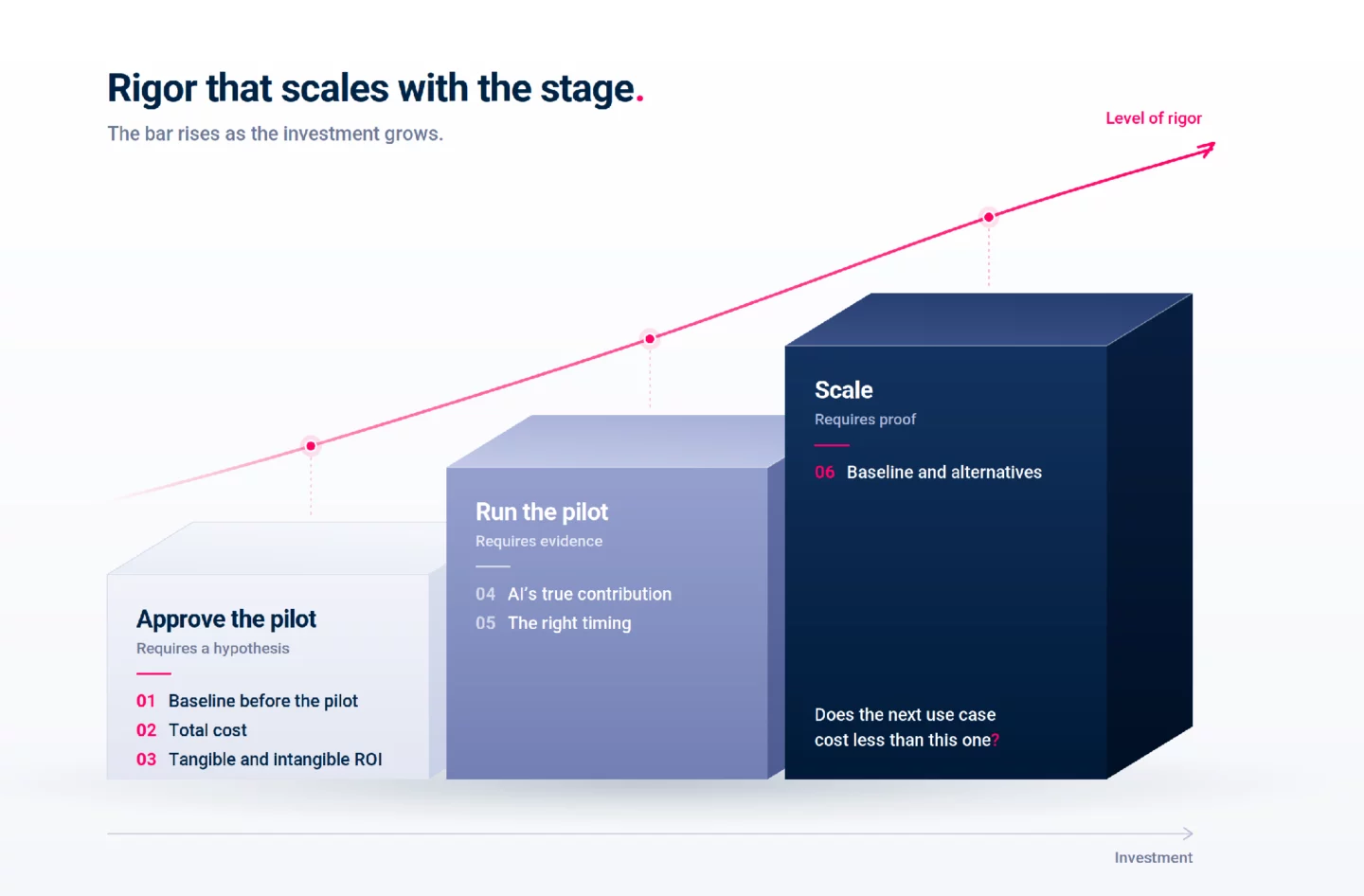
Much of this waste is avoidable with financial discipline applied from the pilot onward. Six steps help assess, with greater rigor, the likelihood that an AI project will deliver a return.
1. Set the baseline before starting a pilot
Adoption metrics, such as active users or model accuracy, tell you whether the tool works. Outcome metrics tell you whether it is worth what it costs.
One of the most common mistakes is deploying the solution without first mapping the affected process, measuring how it performs today and defining the outcome KPIs that will signal the project’s success. Without that starting point, any later gain becomes a matter of opinion.
Each KPI also needs an owner on the business side, not in technology. The person accountable for the P&L result is the one who ensures the gain moves beyond the pilot and reaches the income statement.
At a multinational brewer, a project to build a model that restructured credit decisions tracked the business-relevant KPIs before and after implementation. With that clarity and comparison baselines in place, it was possible to measure the solution’s real impact: a 1.7% increase in purchase volume, a 7% improvement in collection time and a 19% reduction in defaults.
2. Map the total cost, not just the cost of the tool
An AI project has four layers of cost, and budgets often see only the first:
- Direct costs: APIs, infrastructure and software licenses. Easy to spot on invoices.
- Development costs: engineering hours for building, integration and testing. Often diluted in the business unit’s budget.
- Operating costs: maintenance, support and change management, such as training and adoption. Frequently underestimated.
- Hidden costs: governance, compliance, risk management and technical debt. Rarely accounted for, yet they determine long-term viability.
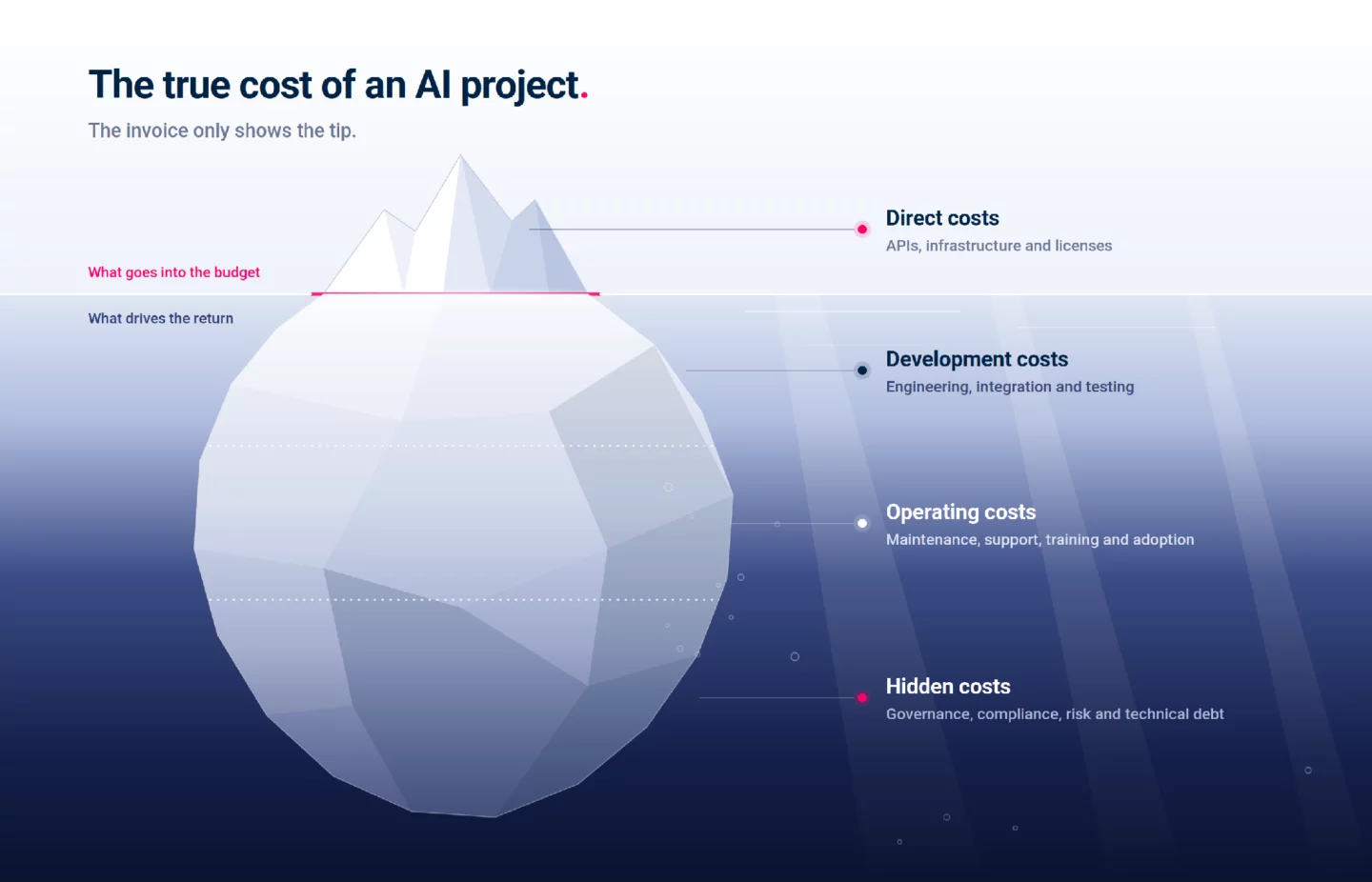
The last layer is the most surprising, because it does not show up as an error in the pilot, but as a growing cost as the company scales. A project that looks cheap on the invoice can be expensive on the balance sheet.
3. Separate tangible from intangible ROI, and calculate both
Tangible ROI is the direct, measurable financial impact: lower operating costs, incremental revenue or freed-up capital. Freed-up work hours only count here when they translate into cost reduction or into capacity redeployed to generate revenue.
Intangible ROI is the indirect, strategic impact, such as customer experience, reduced regulatory risk, decision speed or talent retention.
Tangible ROI is what secures budget approval. Intangible ROI helps sustain the investment over the long term. Both need to be written down, as hypotheses, before the pilot begins.
4. Isolate AI’s true contribution
If a lead-scoring model goes live and the sales team starts closing more deals, who gets the credit: the model, the new sales methodology or the newly hired sales leader?
Isolating AI’s contribution requires experimental rigor: a control group, a comparison with an equivalent period or, at the very least, the discipline not to attribute to AI a result that has multiple causes.
5. Evaluate at the right time
Evaluating an AI project too early is as risky as evaluating it too late. The minimum bar is one full cycle of the affected process, whether a credit cycle, a financial close or a harvest. The exact timeframe depends on the use case, seasonality, data volume and how long operations take to adopt the solution.
After scaling, monitoring continues, because AI systems tend to deliver more value as adoption and maturity grow.
6. Compare before scaling
A standalone ROI figure says little. It needs to be compared against two references: the baseline from step 1 and the alternative use of the same capital, that is, what the investment would return in another initiative. Market benchmarks can serve as a secondary reference, provided their origin is known and they are truly comparable.
There is also a third question, the one that separates a project from a platform: will the next use case cost less than this one? If every new application starts from scratch, returns do not scale with the investment.
Defining these criteria before the decision, rather than afterwards as a justification, turns ROI into a tool for prioritizing among competing use cases.
Practical recommendation: rigor proportional to the stage
The goal is not to block pilots, but to ensure each one answers a business question, not just a technical one. The bar should rise as the investment grows.
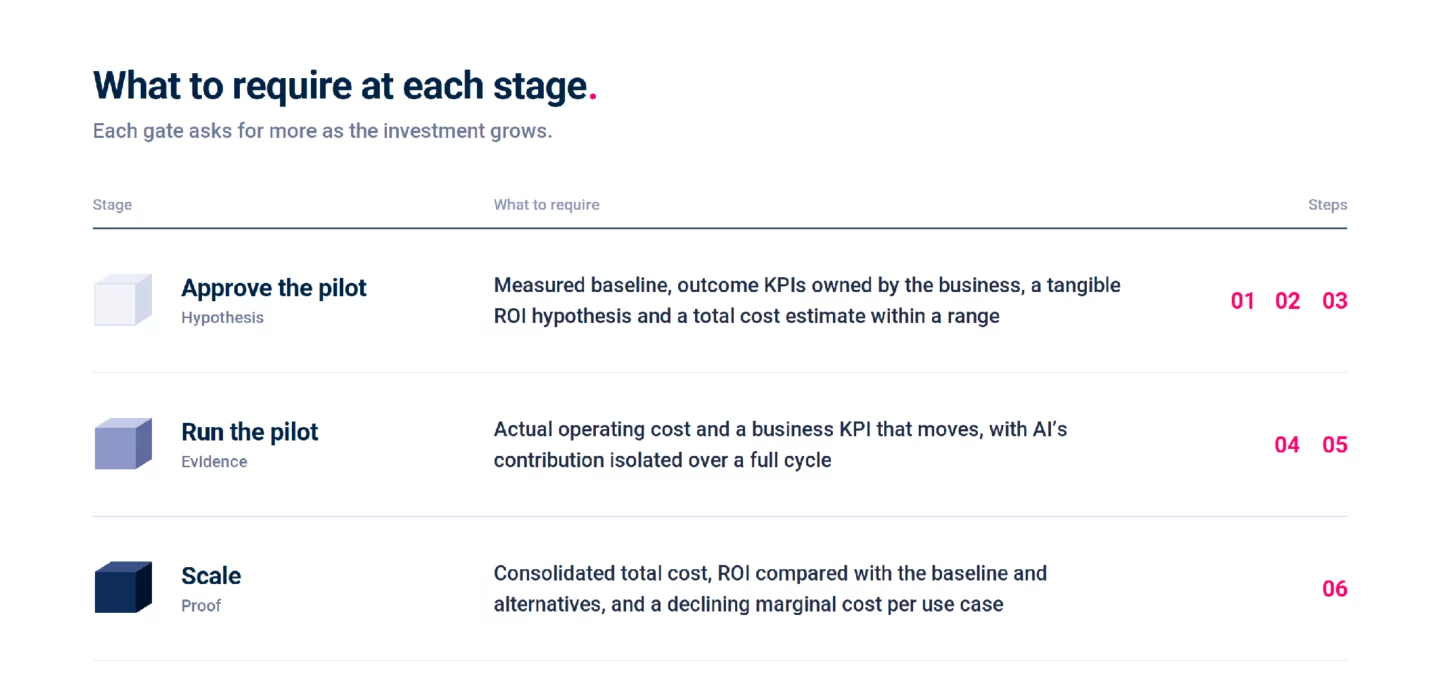
With these answers in hand, approving the next AI project stops being an act of faith and becomes a financial decision, with known risk, estimated return and a clear path to monitoring impact.