

As artificial intelligence models advance, competitive advantage shifts from the models themselves toward the enterprise intelligence they process. Conversational data agents frequently fail to scale beyond initial pilots because they require governed business context—definitions, policies, and institutional knowledge—rather than mere data retrieval. A framework developed by Artefact and Starburst addresses this limitation by introducing an enterprise intelligence layer. This layer connects fragmented information, organizes it into certified data products, and activates it for agentic use. By integrating business accountability with data architecture, the system ensures AI outputs are explainable, traceable, and backed by certified organizational knowledge.
Read this complete article written by Dr Stylianos (Stelios) Kampakis on The Data Scientist website
Section 1: The Contextual Vulnerability in Enterprise AI Pipelines
Traditional Retrieval-Augmented Generation (RAG) and metadata catalogs operate on semantic proximity and keyword matching. They lack the architectural capacity to resolve business authority or reason across complex systemic relationships. A vector search retrieves passages that resemble a user’s query, but it cannot determine if a specific financial figure was authorized by the finance department, or how disparate data points connect across operational silos.
This deficiency creates severe inconsistencies in enterprise environments. When a conversational agent queries the number of “active customers” within a financial institution, it encounters contradictory definitions. Retail banking defines a customer as an account holder; anti-money laundering (AML) teams define it as a risk-assessed individual; marketing relies on behavioral profiles. A probabilistic model that applies a single definition universally will produce conflicting, inaccurate responses. Without a unified context layer, every new agent must independently compute business logic from scratch, leading to duplicated efforts and degraded system trust. The core vulnerability is the assumption that raw data retrieval equates to business intelligence.
Section 2: The Enterprise Context Approach to AI Guardrails
To mitigate this vulnerability, enterprise architecture must separate data retrieval from business logic enforcement. The enterprise intelligence layer serves as this intermediary, combining certified data with business meaning, relationships, and governance rules. Starburst and Artefact identify that an ontology or context layer can rank data definitions based on authorship, usage frequency, and certification status.
This design bridges the gap between raw data mapping and runtime validation. Rather than forcing a massive physical data centralization effort, the architecture federates across existing operational systems, data lakes, semantic models, and business intelligence tools. The system validates and applies these assets through a governed structure. By establishing this intelligence layer, organizations multiply the effectiveness of their models, allowing the AI to evaluate requests against authoritative enterprise intelligence rather than disconnected data points.
Section 3: Architectural Blueprint for Enterprise Intelligence
A production implementation follows a distinct progression to structure and maintain business context:
Connect: The system federates enterprise data and metadata across existing platforms. This avoids disruptive centralization programs, allowing the architecture to utilize intelligence already present within the network.
Organize: Connected data is assembled into AI-ready data products aligned to core business entities, such as Customer, Product, Policy, or Supplier. Each data product embeds structural governance and explicit business meaning.
Activate: These governed products form the common foundation for applications, dashboards, and AI agents. The AI processes inquiries using certified logic rather than formulating superficial guesses.
Discover: The system monitors query patterns, metadata, and consumer behavior to identify opportunities for logic refinement and relationship mapping.
Certify and Reuse: Designated owners validate the discovered relationships, establishing human-in-the-loop trust. Once certified, the intelligence is deployed across the organization, accelerating future AI implementations.
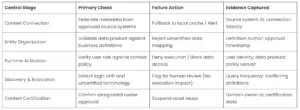
Table 1: Enterprise Control Surface for a Contextual AI Gate
Section 4: Operating Model, Governance, and Continuous Evaluation
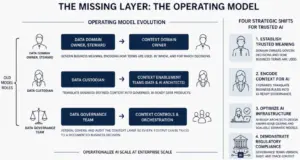
The technological foundation requires a parallel operating model to maintain accuracy and prevent context decay. Business definitions change due to market conditions, acquisitions, or regulatory updates. If the intelligence layer lacks instrumented pipelines and active stewardship, the semantic graph degrades.
To prevent this, the architecture assigns clear accountability across three distinct teams. Context Domain Owners define business meaning and application rules. Context Enablement Teams construct the AI-ready data products. Context Controls and Orchestration Teams audit the layer, ensuring every AI output traces back to a documented policy decision.
Artefact integrates evaluation directly into agent development through its AI Factory methodology. This involves defining trajectory-level rubrics, building scenario libraries tailored to the use case, and implementing continuous monitoring prior to deployment. Under this model, governance transitions into the runtime path, controlling the agent’s actions during task execution rather than solely determining pre-execution read access. When an AI system produces an output, the organization relies on an audited control plane rather than attributing the decision entirely to the model.
Section 5: Conclusion & Future Outlook
Organizations attempting to scale conversational AI must recognize that models alone cannot manufacture business context. The architectural transition from probabilistic retrieval to deterministic, governed intelligence is a prerequisite for production deployment in regulated environments.
The integration model proposed by Artefact and Starburst provides a structural framework for this shift. By establishing certified data products, assigning definitive domain ownership, and implementing continuous runtime evaluation, enterprises can deploy agents that yield auditable, reliable decisions. Future AI scaling will depend on the accountability model managing the enterprise intelligence layer, ensuring that every new agent inherits a stable, certified foundation of institutional knowledge.
For more information, connect:
- Akhilesh Kale, Partner, Artefact — akhilesh.kale@artefact.com
- Adrian Estala, Starburst — adrian.estala@starburstdata.com