
The history of factory electrification provides profound insights into current AI dynamics and the strategic initiatives enterprises must undertake to capture its true value.
Electricity: A foundational lesson
Before the advent of electricity, factories generated their own power. A basement steam engine drove a main driveshaft running through the workshop, with belts distributing power to machines based on their proximity to the central axis.
The introduction of the alternator and the three-phase motor changed everything. By enabling long-distance power transmission without voltage drop, these innovations transformed energy into an accessible commodity available to everyone at the same price. Generating one’s own power ceased to be a competitive advantage.
Yet, despite this major innovation, productivity gains were not immediate. Factories initially just plugged their existing machinery into the new grid without altering their layout. The true productivity breakthrough occurred later, when industrialists seized the opportunity to entirely redesign workflow organization: continuous-flow assembly lines, standardized motions through Taylorism, and three-shift rotating schedules ($3\times8$). This systemic transformation triggered the productivity explosion of the early 20th century and established a framework for sustainable competitive differentiation.
The commoditization of AI
Today, AI is following the exact same trajectory as electricity did a century ago; the market signals are converging and unambiguous.
- Model convergence is accelerating: In March 2026, the leading proprietary model outperformed the top open-weight model by a mere 3.3%. The performance gap between competing solutions is structurally narrowing.
- Costs are collapsing: For equivalent performance levels, the price of artificial intelligence is dropping precipitously; the inference cost of a system on par with GPT-3.5 plummeted by a factor of 200 between 2022 and 2024.
- Value is shifting: Value is migrating away from the underlying models themselves toward application layers and integration services. AI is becoming infrastructure.
Why AI investments have yet to reflect in financial results
Adoption is massive: nearly 90% of organizations now leverage AI in at least one business function, and generative AI expenditures could surpass $100 billion in 2026. However, top-line and bottom-line results still fall short of their potential.
While many enterprises report localized operational ROI—such as higher volumes of processed cases or reduced handling times per file—they struggle to translate these gains into ultimate value creation: namely, revenue growth or structural cost reduction.
The diagnosis mirrors the electrification era: companies have plugged AI into their existing organizational frameworks without modifying their foundational structures. Systemic transformation has not yet occurred.
This reality forces three critical questions:
- What does it mean to invest in AI in a world where it is becoming a commodity?
- How can an organization build differentiation if these identical processes can be replicated exactly by competitors at near-zero marginal cost?
- How do you construct a sustainable competitive advantage, a challenge Google summarized with the phrase, “We have no moat”?
Three Strategic Shifts to Drive Value Creation
From Silo to System
AI accounts for only about 10% of the total value it can potentially generate. In the vast majority of enterprises, individual business functions have already been optimized: Finance has its ERP, Sales its CRM, and Procurement its sourcing tools. Marginal gains within these isolated silos are now limited.
Uncapped value lies at the interfaces, where AI enables the horizontal flow of information across previously siloed systems. For instance, Artefact partners with manufacturing clients to automatically detect factory component inventory levels, trigger reorder requests, and adjust delivery schedules in real time. This unifies a single workflow across three distinct systems. The same principle applies to linking customer feedback directly to product teams, shortening iteration cycles to a matter of days.
This logic demands a value-chain mindset, measuring performance across end-to-end processes: approving credit in 24 hours, designing a new vehicle in a few months, or identifying a new drug candidate within a single year.
From Automation to Augmentation
When electricity emerged, the initial instinct was to automate manual labor. No one anticipated the downstream innovations that followed: mass refrigeration, modern agribusiness, radio, television, electrochemistry, batteries, home appliances, modern transit, and telecommunications.
The dynamic with AI is identical. The new, high-value services it will enable are not yet fully visible, but they will form the next frontiers of market differentiation. Capturing them will require a substantial upskilling effort: shifting customer service from order management to consulting, finance from accounting reconciliation to strategic analysis, and HR from resume screening to talent development.
IKEA provides a concrete illustration of this potential. Following the deployment of its chatbot, Billie—which now handles approximately 50% of incoming queries—the group chose to upskill and transition nearly 8,500 call center employees into remote interior design consultants trained in digital sales and spatial planning. This channel generated €1.3 billion in revenue last year, and the group aims to capture 10% of its total revenue through this model by 2028.
From Execution to Decision-Making
Historically, the capacity to produce, execute, and process at scale constituted a barrier to entry. Designing the Airbus A400M Atlas required 10 million engineering hours. The entire history of industrial productivity has focused on accelerating execution.
This paradigm is currently reversing. Where developing a new application once required a team of four developers over eight months, an experienced manager can now produce a functional version in a few weeks. Execution is no longer the bottleneck.
Decision-making has become the new bottleneck.
This shift requires profound organizational changes: flattening hierarchies, building leaner teams, and delegating decision-making authority closer to the frontline. Amazon CEO Andy Jassy has initiated an explicit restructuring of the individual contributor-to-manager ratio, noting that excessive managerial layers slow down decision cycles.
It also requires building robust AI governance: cost management, performance evaluation, guardrails, and access control. The goal is to allow AI systems to operate with autonomy within a framework of verified trust and controlled oversight.
What really matters in the era of AI is everything that is not AI
Three strategic shifts define this transformation:
- From Silo to System: Move away from optimizing individual functions in isolation and think in terms of an end-to-end value chain.
- From Automation to Augmentation: Replace the question “Where can AI replace labor?” with “How can AI elevate its value?”
- From Execution to Decision-Making: Place decision speed and quality at the core of the strategic agenda, as they now represent the primary limiting factors.
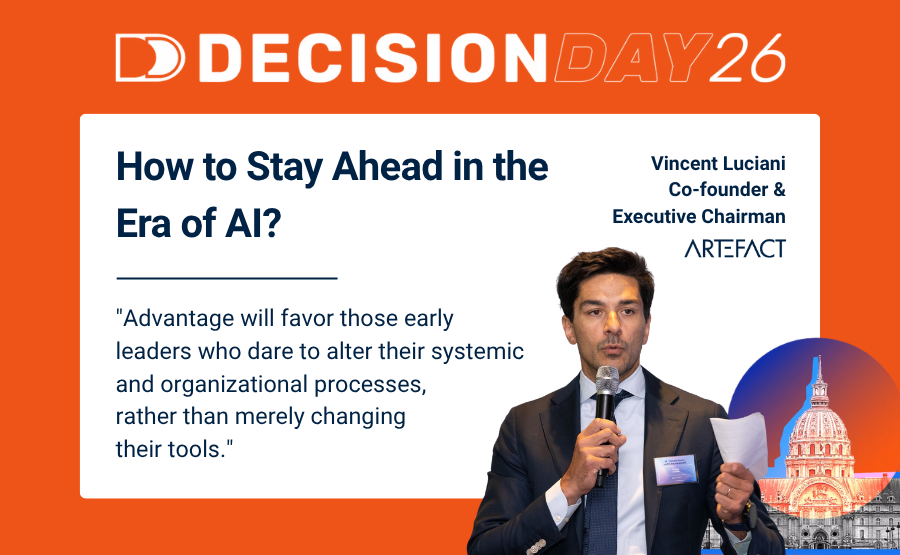
Just as in the era of electrification, the advantage will go to organizations that dare to overhaul the system, not just the tool. Plugging motors into an existing factory yields incremental gains. Redesigning the factory entirely builds a lasting lead.