
Artefact’s C-Suite Guide to Marketing Measurement
Artefact’s C-Suite Guide to Marketing Measurement
Marketing measurement has always been central to proving the value of brand investment, but in 2025, it’s taken on new urgency. CMOs face increased pressure to justify budgets and align with financial expectations, while the complexity of consumer behavior, data privacy regulations, and media channels makes measurement more challenging.
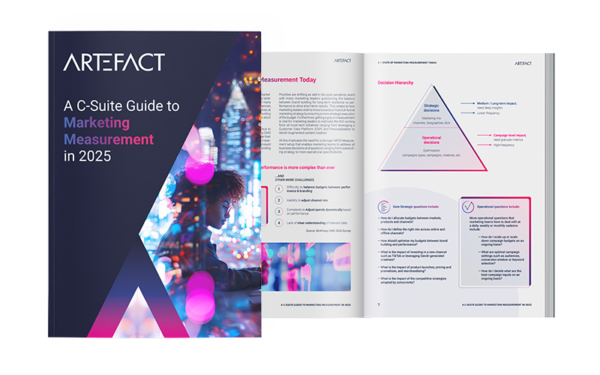
This new guide by Artefact, developed in collaboration with Accor and Nike, is an exploration of marketing measurement designed to help business leaders optimize the true incrementality of marketing and media activities to maximize ROI. Learn about:
- The state of Marketing Measurement today: Why CMOs struggle with dynamic budget adjustments and ROI tracking.
- The Golden Triangle of MROI, with deep dives into: – Marketing mix modeling (MMM) quantifies the impact of marketing on sales, offering optimizers and simulators to guide budget allocation. – Incrementality testing validates whether campaigns truly drive additional outcomes and calibrates both MMM and attribution models. – Multi-Touch Attribution (MTA) informs in-flight optimization by assigning credit across customer journeys.
- Behind-the-scenes client insights: How Accor and Nike drive brand growth with data.
- Five measurement trends to follow: Improved data quality, new frameworks for retail media and connected TV, in-housed MMM with testing, privacy-first approaches, and attention-based metrics.
Operationalizing marketing measurement: How Nike just did it!
Operationalizing marketing measurement: How Nike just did it!

For Nike, the implementation of marketing measurement was essential to assess the true impact of their enterprise-wide marketing goals. Here’s how they met the challenge:
- Objective: Adopt and operationalize incrementality measurement. Nike needed to move beyond surface-level metrics and demonstrate tangible business value.
- Solution: Embed measurement into cross-functional business processes.Thanks to a business-first mindset backed by cultural change and C-suite sponsorship, Nike integrated tools like MMM, attribution, and incrementality testing into planning cycles and digital commerce, supported by consistent scorecards and data literacy programs.
- Result: A shift from surface-level metrics to proving real, incremental impact. Nike built trust, secured leadership buy-in, and created a foundation for long-term business impact.
How AI is changing search for customers, marketers and brands
How AI is changing search for customers, marketers and brands
AI is shifting search from ranking and retrieval towards reasoning and synthesis. A new Artefact whitepaper charts this evolution, explains the mechanics of large language models (LLMs), and sets out the implications for marketers and brands.
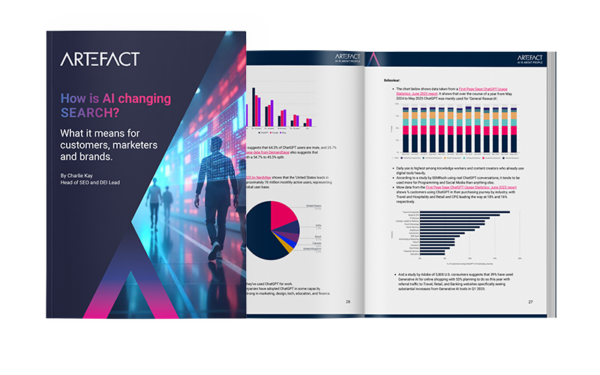
Search has moved from keyword matching to an AI-first era where Google’s AI Overviews and AI Mode deliver conversational, personalized answers. LLMs, trained on vast datasets and augmented with real-time retrieval, generate reasoning-based responses rather than just ranked results. For users, this means fewer clicks but faster answers; for marketers, it shifts visibility from rankings to clarity, authority, and structure. Adoption of AI search is still under 2% of organic traffic but growing fast, led by ChatGPT and Perplexity. Traditional SEO remains essential, since rankings influence AI citations, but strategies must evolve. Priorities now include: :
- Deep audience research
- Measuring influence beyond clicks
- Tailoring content for different platforms
- Optimizing structured and multimodal content
- Preparing for agent-led transactions To succeed in this new ecosystem, brands will need to stay visible across platforms, structure their content for both human and machine readability, evolve their measurement frameworks, and consistently prioritise real value, trust, and usability.
How conversational engines redefine visibility, transactions, and trust
How conversational engines redefine visibility, transactions, and trust

Conversational engines like ChatGPT, Gemini, Claude, Perplexity, and Le Chat are reshaping how brands exist online. Visibility is no longer about ranking in Google’s algorithm, but about appearing in synthesized, contextualized answers. Content must be created to be accessible and exploitable by large language models; otherwise, brands risk vanishing from user interactions. The change goes further:
- Transactions: Purchases, bookings, claims, and banking could soon all happen within the conversation; brands must ensure their systems connect via emerging protocols or risk exclusion.
- Retailers and marketplaces: They will need to reinvent their roles as engines bypass intermediaries and shift value to logistics, service, and experience.
- Advertising: Recommendations embedded in answers blur the line between organic and paid content, putting at risk the credibility that drives adoption. “Between these extremes, the challenge will be to find a sustainable balance between monetization and the preservation of trust, because it is precisely this trust that determines the future of these engines.” – Hanan Ouazan, Managing Partner & Global Lead AI Acceleration at Artefact.
New CEOs to speak at Adopt AI Don’t miss this must-attend AI summit!
New CEOs to speak at Adopt AI Don’t miss this must-attend AI summit!
Join us in the iconic Grand Palais in Paris, on 25 and 26 November 2025. Register now: Enjoy the Early Bird rate until October 13!
Artefact has been at the forefront of organizing the largest AI summits across industries for over a decade. The 2025 Adopt AI Summit is the next chapter in this journey.
As always, the summit will bring together the world’s top AI leaders, business pioneers, technology innovators, and public decision-makers to accelerate AI adoption across industries.
New additions to our 2025 CEO stage lineup include:
- Sébastien Bazin, Chairman & CEO of Accor
- Stefan Oelrich, Member of the Board of Management & CEO of Bayer Pharmaceuticals
- Nicolas Namias, CEO of Groupe BPCE
- Marie-Aude Thépaut, CEO of CNP Assurances
- Olivier Gavalda, Chief Executive Officer of Crédit Agricole S.A.
- Florian Douetteau, CEO & Co-founder of Dataiku
- Bernard Fontana, Chairman & CEO of EDF
- Benoît Coquart, CEO of Legrand
- Christopher Guérin, CEO of Nexans
- Olivier Laureau, President & CEO of Servier
- Kevin Strain, President & CEO of Sun Life Financial
- Dirk Hoke, President & CEO of Voith Group Don’t miss this unique opportunity to connect with global leaders and join in high-impact discussions across seven simultaneous stages dedicated to every major sector:
- The CEO Stage, featuring 30+ cross-industry CEOs.
- Three Main Stages, where top executives will share their strategic visions of AI.
- A series of Masterclass Stages, for hands-on, technical, and sector-focused content.
With 500 speakers, 7 industry-specific stages, and 250 exhibitors, Adopt AI is the place to be for the most innovative AI discussions. We look forward to welcoming you!