


Search marketing has always been different in China
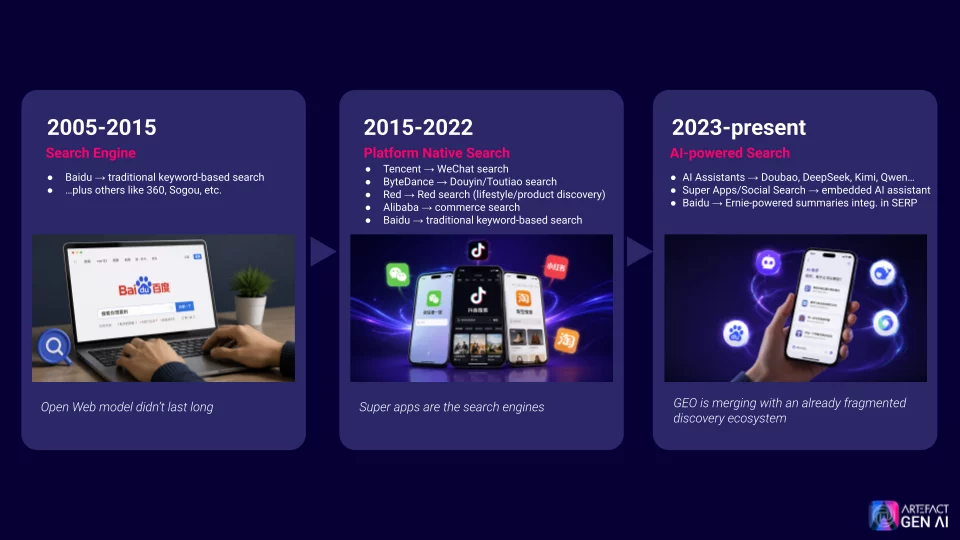
During the first industry boom of Search Engine Optimization (SEO) in the early 2000s, Baidu was the dominant player. The behavior back then was quite simple: users searched for something they needed using a keyword, then the results were displayed on Baidu’s page (using their algorithm), and the brand received organic traffic to its website – if their SEO practices were effective.
From 2015 to around 2022, this behavior changed due to rising competition from top digital and tech ecosystems such as Tencent, ByteDance, Alibaba, and Xiaohongshu. The super apps they built aimed to provide users with a comprehensive mix of content, social features, payment options, and stores. Essentially, they wanted users to complete the entire sales funnel within their own ecosystems.
This paved the way for platform-native search, in which users could conveniently search for things they needed using the specialized offerings of each super app. For example, WeChat has its own WeChat Search function to find official accounts and mini programs of users’ favorite brands. Xiaohongshu also has its own search function that focuses on lifestyle inspiration and product discovery. In essence, the super apps became the users’ search engine.
The arrival of AI-powered search
AI-powered search emerged in 2023. AI assistants such as Deepseek, Doubao, Kimi, and Qwen emerged. Super apps embedded their own AI assistants to encourage users to stay within their ecosystem and find in-app answers to their questions. Examples include Douyin, powered by Doubao, and WeChat, powered by Yuanbao. Essentially, when GEO was introduced, it had to adapt to an already fragmented discovery ecosystem.
GEO in a nutshell
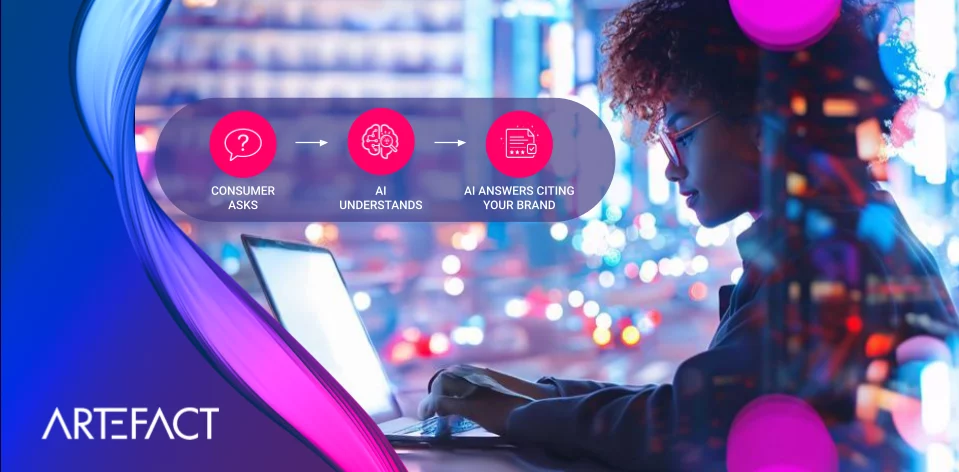
GEO is the discipline of ensuring your brand appears as an answer when someone asks a question within an AI-powered search platform. It is the practice of optimizing your content so that AI-powered search engines cite you in their generated responses.
The content that matters to AI-powered search platforms is that which signals Experience, Expertise, Authoritativeness, Trustworthiness (EEAT). There are best practices in terms of content structure and layout, such as clear headings, modularization, listing, and tabulation. Where you distribute your content also matters, depending on which AI-powered search platform or large model you are targeting. For example, Deepseek frequently references Wikipedia-type and authoritative sources such as government sites, academic publishers, and news organizations. In contrast, Xiaohongshu’s AI search primarily relies on its own content ecosystem, particularly user-generated posts, rather than crawling and citing the broader web.
GEO actually complements rather than replaces traditional SEO. If a brand has already implemented SEO in the past, the knowledge gained, such as which keywords and associated topics should be targeted to attract the right audience, can be used as a foundation for a GEO strategy. Establishing a strong technical and semantic SEO foundation is especially valuable on Baidu’s Earnie-powered summaries, which are integrated with their regular search results page.
Why GEO in China is different from the West and what’s in it for multinational brands
GEO in China differs substantially from that in Western countries because China’s AI ecosystem, content ecosystem, and user behavior are different. While the West adapts open web-centric model (which considers content from company websites, blogs, public forums, government and other publisher websites, and values user contributed content like Reddit discussions and product review sites), China’s GEO adapts more of a closed loop, ecosystem-centric model (valuing internal ecosystem content, platform-native media, and proprietary data). GEO in China also optimizes for compliance, authoritative framing, and trusted institutional sourcing in ways that Western GEO generally does not.
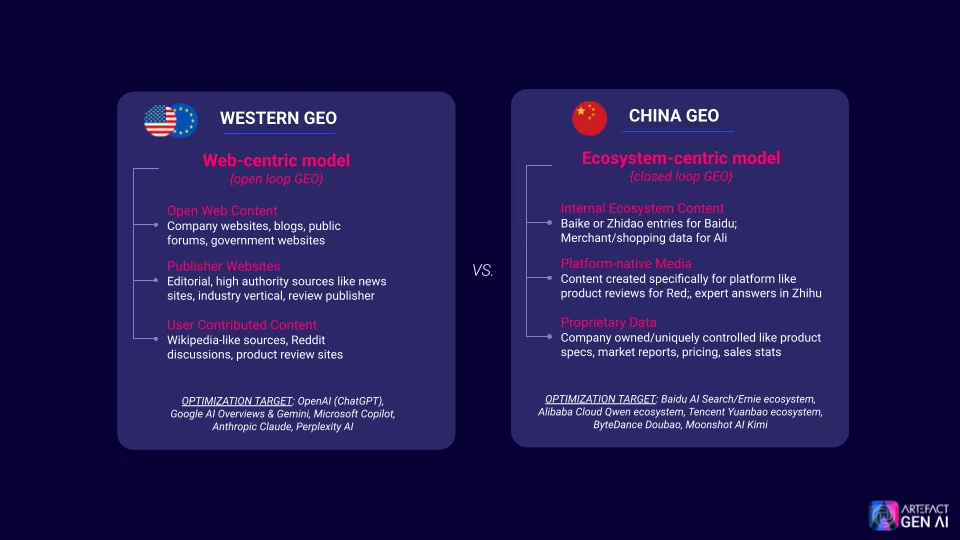
For multinational brands aiming to adapt their global GEO strategy for the Chinese market, it is important to consider these market-specific practices. They should avoid treating China as a translated version of their global GEO program. Instead, brands should run a parallel strategy with distinct content, channels, and success metrics. This requires extensive content localization to resonate with Chinese audiences. Local relevance increases both user trust and AI confidence.
Legitimate GEO practices are also important. Brands should avoid GEO service providers that use aggressive techniques to manipulate or pollute the sources used to retrieve information and the training corpora used by large AI models. China is quickly tightening its laws to counter black-hat GEO methods. Partnering with a strong, data-compliant, and ethical company is paramount for long-term GEO success in China.