In this month’s edition of the Data & AI Digest:
- Agentic commerce: When buying becomes delegating
- Carrefour agentic case: How agentic AI accelerates store openings
- Knowledge graphs and context engineering: Turning off-the-shelf AI into truly informed enterprise intelligence
- Bpifrance agentic case: Deploying agentic AI across 500 employees
- Seeing the invisible: Luxury in the age of agents
- Artefact at VivaTech 2026
Agentic commerce: When buying becomes delegating

Why the next brand battleground will be fought in front of agents, not humans: Commerce is fundamentally shifting from active search to delegation. With generative AI attracting 45 billion monthly visits, AI agents are replacing search engines as the primary intermediaries. Soon, customers won’t search for specific products; they will simply commission outcomes from autonomous agents. This transition poses a profound risk to brand visibility. With 57% of web traffic already automated, product discovery has firmly migrated to AI. The transaction itself is merely the last domino to fall. To survive this displacement of the decision point, brands must master three imperatives:
- Adopt Generative Engine Optimization (GEO) to ensure data is perfectly machine-readable.
- Build interoperable API foundations that allow agents to execute purchases.
- Aggressively double down on brand equity to remain the trusted preference before an AI even begins its selection.
CARREFOUR client case How agentic AI accelerates store openings
CARREFOUR client case
How agentic AI accelerates store openings

The Carrefour Group has 50+ AI applications across areas, including assortment, pricing, promotions, supply chain, and customer recommendations. Today, they’re deploying Copilot Expansion, an AI agent to accelerate store opening decisions. Context: Carrefour opens about 100 stores annually, but evaluating new locations previously took weeks. The extensive back-and-forth between Expansion, Geomarketing, and Finance teams to collect data and calculate ROI led to costly delays and missed opportunities in a hyper-competitive market. Solution: Carrefour partnered with Artefact to integrate the Copilot Expansion agent into their specific business processes. By simply dropping a pin on a map interface, managers can instantly analyze socio-demographics, competition, and financial viability. Results: The impact has been transformative.:
- Market study times plummeted from several months to just two minutes.
- Furthermore, Carrefour achieved a 15-point improvement in revenue prediction accuracy and now filters up to 50% of dossiers upstream.
- This autonomous, self-service model empowers teams to focus purely on high-stakes, strategic decision-making.
Knowledge graphs and context engineering: Turning off-the-shelf AI into truly informed enterprise intelligence
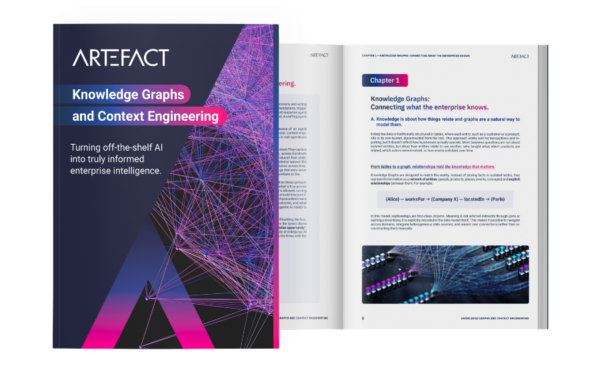
AI agents are transitioning from passive assistants to autonomous decision-makers, creating a critical new bottleneck. An agent’s performance now depends less on its underlying model and more on the context it can reason over. Unfortunately, traditional data architectures only capture the current state of operations, entirely missing the tacit reasoning and historical precedents that live in human heads and fragmented chats. To bridge this gap, enterprises must build a three-layered foundation with:
- Knowledge graphs that map what the business knows, connecting scattered entities into navigable networks.
- Ontologies that define what these connections mean, establishing shared semantic rules and strict operational guardrails.
- Context graphs that capture how the organization actually decides, recording decision traces, policy exceptions, and causal chains over time. While software built for humans captures what is currently true, software built for agents must capture how it became true. Ultimately, the next decade of enterprise AI will be won by the firms with the best context.
How Bpifrance deployed agentic AI across 500 employees with Artefact and Dust
How Bpifrance deployed agentic AI across 500 employees
with Artefact and Dust
France’s public investment bank, Bpifrance, is setting a new standard for scalable and responsible enterprise AI adoption. Challenge: Bpifrance aimed to accelerate AI across its workforce but faced structural hurdles. These included strict regulatory bottlenecks, missing frameworks for evaluating new tools, and the inability to move successful experiments into production. Solution: Bpifrance partnered with Artefact to deploy Dust, a European agentic AI platform. Rather than merely installing software, Artefact implemented a comprehensive transformation strategy featuring:
- A structured selection methodology,
- An adoption program to empower business teams,
- A complete governance architecture that secured coordinated approval in under four weeks. Results: In less than a year, Bpifrance successfully deployed 500 Dust licenses and launched 1,500 custom AI agents. Employees are now fully autonomous in building secure agents, establishing a highly scalable operating model for the future.
Seeing the invisible: Luxury in the age of agents

Luxury doesn’t just sell products; it sells recognition and human connection. Yet, a gap often exists between the price paid and the perceived value because scaling this deeply personalized experience is inherently difficult. To rebuild this value, forward-thinking luxury houses are turning to AI agents. Rather than replacing the human touch with cold, mass-produced chatbots, these agents act as “backstage conductors”. By unifying first-party CRM data with digital behavioral signals, they arm client advisors with total client memory and anticipatory personalization. This ensures the conversation seamlessly continues from anonymous online browsing straight to the boutique. For the first time, AI agents allow brands to scale authentic human relationships. The ultimate goal is not automation, but ensuring every client interaction remains deeply relevant and exceptionally human. NB: Read this article and many other insightful ones in the Contentsquare Magazine for CMOs, which is our Tech Partner.
Wrap-up of an unforgettable VivaTech 2026!
What an incredible few days of innovation, strategic discussions, and shaping agentic AI transformation at the Artefact booth! Led by our Group CEO Edouard de Mézerac, these conversations confirmed the market’s readiness to deploy agentic AI at scale to drive measurable business impact. Along with the Human Technology Foundation and over 25 other companies, we proudly launched the “Agentic AI & Work” Coalition. This initiative aims to anticipate the impact of agentic AI on jobs, support skills development for employees, and rethink organizations to maximize value creation while ensuring the transition remains profoundly human-centric. We brought “Art-e-Fact” to life with live AI demos:
- The Scentographe: Developed with Robertet Group, this real-time NaturIA technology wowed attendees by transforming photographs into custom fragrance signatures for a unique personalized experience.
- Beyond the Mask: Our Artefact Research Center highlighted Responsible AI by demonstrating how to detect and correct biases in 3D facial reconstruction models.
- “Imagine Work in the Agentic Era”: Our fully AI-generated, collaborative comic book, created by Artefact employees to visualize how AI will reshape our daily jobs by 2028.
AI / DATA STRATEGY & TRANSFORMATION | AI / DATA FOR CUSTOMER | AI / DATA FOR OPERATIONS | AI / DATA FOR SUPPORT FUNCTIONS | AI & IT TECHNOLOGIES