

Dear readers, Remember when GenAI was just making funny pictures of cats? July 2026 called to say those days are long gone. We’re currently in a fever dream of full-duplex voice, autonomous agents infiltrating Wall Street, and tech giants fighting over who owns the “cognitive loop.”
Whether you’re a CTO trying to map out your infrastructure or just someone wondering why your phone is suddenly translating 70 languages in real-time, we’ve got the full breakdown of why the “superficial chatbot” era just hit the floor.
GenAI & Agentic News Podcast
Business News & Market Insights

New Models & Innovations
Thoughts by Victor Coimbra
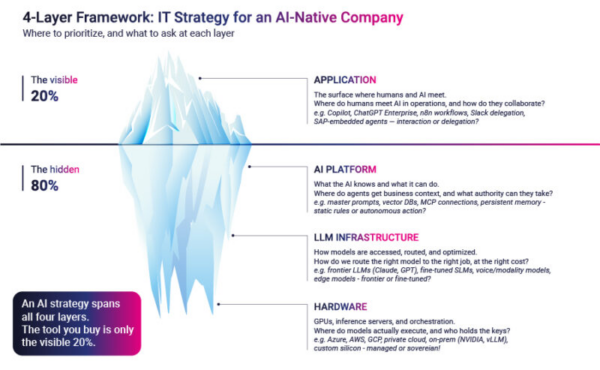
Most CTOs in 2026 are building AI strategy only at the visible surface – buying Copilot seats and chatbot licenses – while the real strategic work sits in the deeper, less visible layers of the stack. The core framework describes an AI-native company as four layers:
1) Application – where humans and AI meet (chatbots, copilots, agents). Easy to buy and budget for, but hard to differentiate on, since every competitor buys from the same vendors.
2) AI Platform – what the AI knows and can do (prompts, skill libraries, retrieval/RAG, connection protocols, persistent memory). This is what turns a chatbot into an agent that acts inside the business.
3) LLM Infrastructure – how models are routed, governed, and cost-optimized (frontier vs. small/fine-tuned vs. specialized vs. edge models).
4) Hardware – where models physically run and who controls that compute (hyperscaler, private cloud, on-prem, custom silicon).
Three pressures are pushing CTOs below the surface: platform pressure (the platform layer is now load-bearing, not optional, for anyone moving from pilots to deployed agents), cost pressure (frontier inference subsidies are ending – Uber reportedly burned its entire 2026 LLM budget in four months), and sovereignty pressure (data residency, the EU AI Act, and geopolitics are making hardware a board-level question, especially because AI infrastructure runs intelligence that makes decisions, not just commodity compute).
Sequencing beats coverage is the central prescription. The argument isn’t that every company should own every layer – some strong positions come from deliberately riding hyperscaler abstractions and concentrating investment elsewhere.
What matters is that the choice be deliberate rather than a default. The right sequence depends on company archetype: startups and boutiques focus on Application and Platform; multi-regional corporations (CPG, pharma, legal, healthcare) extend into Platform; high-maturity sectors (finance, telecom, digital-native) are already making Infrastructure decisions; and BigTech, government, and specialized manufacturing make real Hardware choices.
This is a replay of the cloud transition – the 2012 “AWS or not?” question that unfolded into a layered architecture decision by 2018 – but on a compressed three-to-four-year clock rather than a decade.
The three moves recommended for CTOs this year: give the AI Platform layer explicit ownership (context is the part of the stack that doesn’t get cheaper), put inference economics on the quarterly agenda (routing, smaller models, even exploring in-house training), and revisit Hardware/Infrastructure choices deliberately even if the answer stays “hyperscaler for now.” The closing distinction: CTOs who stop at the visible layer end up managing tools; those who look below the waterline end up managing cognitive capacity – the choice being whether to be an operational or a strategic CTO.