

Autor

Autor

Autor

Com os avanços atuais da tecnologia de IA, o que era complexo e tedioso agora pode ser feito de forma rápida e eficiente. Um desses exemplos pode ser encontrado na interrogação de arrendamentos históricos. Com uma solução personalizada de IA generativa, é possível criar um ambiente seguro de sandbox no qual todos os arrendamentos históricos de imóveis são carregados.
Isso permitirá que qualquer usuário da empresa acesse um chatbot para fazer perguntas em linguagem natural sobre qualquer aspecto dos arrendamentos. Essencialmente, isso se torna uma ferramenta dinâmica de gerenciamento de arrendamento que fornece insights instantâneos incríveis na ponta dos dedos de todos os usuários.
Qual é o problema?
Atualmente, a maioria dos proprietários precisa lidar com grandes quantidades de históricos de contratos de locação. Em geral, esses dados são resumidos em planilhas vastas e complexas ou, ocasionalmente, em um software dedicado de gerenciamento de locações. As soluções existentes são estáticas, rígidas e ineficientes, o que pode gerar frustração. Elas também não são suficientemente flexíveis e fornecem apenas alguns insights com funcionalidade limitada. Qualquer pergunta fora dos KPIs prescritos exige a leitura manual de (muitas vezes centenas, se não milhares de) contratos de aluguel. A equipe de insights gasta um tempo significativo para gerar apresentações de portfólios e contratos de locação, privando os executivos de insights urgentes que ajudariam na tomada de decisões.
Qual é a solução?
Diretamente voltada para os problemas dos executivos do setor imobiliário, a Artefact desenvolveu sua ferramenta proprietária Lease Explorer. Trata-se de uma ferramenta personalizada e desenvolvida para fins específicos que permite a rápida implementação de poderosos modelos de linguagem ampla (LLMs) em um ambiente proprietário e restrito que contém arrendamentos históricos de propriedades. Os executivos do setor imobiliário podem, então, interrogar seus próprios contratos de locação históricos diretamente com o uso de uma interface semelhante ao ChatGPT.
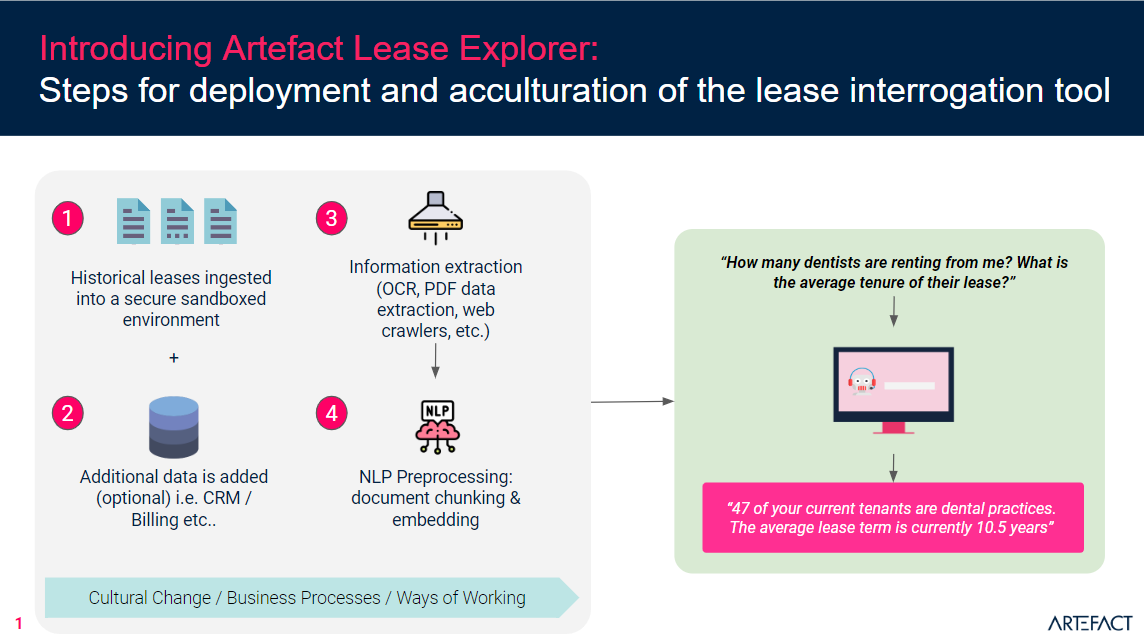
O Lease Explorer consiste em cinco etapas gerais:
Não é preciso dizer que a adoção de uma ferramenta como a mencionada acima exigiria um período de gerenciamento de mudanças subjacente, pois seria necessário adotar novos processos comerciais e formas de trabalho.
Que tipo de perguntas em linguagem natural poderiam ser respondidas
Com a implementação do Lease Explorer, Para o senhor, apresentamos alguns prompts de linguagem natural que um executivo do setor imobiliário pode perguntar ao ChatBot da ferramenta. Obviamente, a medida em que a ferramenta pode retornar com precisão uma resposta à lista de perguntas não exaustiva abaixo está condicionada à qualidade, à estrutura e à disponibilidade da entrada data, que pode exigir acesso a informações além daquelas simplesmente contidas em um documento de locação.
Que benefícios isso gera
A adoção de uma ferramenta de IA como o Enterprise ChatGPT trará uma série de benefícios para os profissionais do setor imobiliário. Em primeiro lugar, é provável que a ferramenta proporcione uma mudança radical em relação à velocidade com que os insights podem ser obtidos, capacitando, assim, os tomadores de decisão com acesso rápido a informações críticas. Além disso, a escalabilidade e a adaptabilidade dessa ferramenta para ingerir um volume cada vez maior de data de locação seriam inestimáveis para ajudar a preparar uma empresa imobiliária para o futuro, atendendo às crescentes demandas do setor.
É provável que a adoção de uma ferramenta desse tipo também produza uma mudança radical internamente em uma organização imobiliária. A adoção de uma ferramenta de IA minimizará qualquer dependência de processos manuais anteriores com relação à análise de contratos de locação. Em vez de depender da incorruptibilidade de uma planilha e do serviço contínuo dos principais funcionários administrativos, uma ferramenta de IA seria capaz de aceitar diretamente as perguntas em linguagem natural dos executivos e fornecer respostas precisas em tempo hábil. Essencialmente, a dependência excessiva das principais dependências para pesquisa e recuperação data é reduzida, e os executivos podem reduzir os recursos necessários no processo de geração de insights. Além disso, para obter o melhor valor dessa ferramenta de IA, é provável que a adoção exija que a empresa passe por um processo transformador de higienização do data, elevando, assim, os limites internos do gerenciamento do data, pois os insights gerados só podem ser tão bons quanto as informações coletadas.
Além disso, o GenAI tem certos benefícios para essa ferramenta em relação às soluções tradicionais de IA/ML. Tradicionalmente, grandes quantidades de data rotulado eram necessárias para treinar e avaliar um modelo para uma tarefa específica. Isso não é mais necessário graças à IA generativa, o que acelera o desenvolvimento de tais soluções. Além disso, a IA generativa permite que as soluções evoluam e mudem sem a necessidade de retrabalho e desenvolvimento adicionais em massa - as soluções podem ser mais flexíveis e menos rígidas.
Como a precisão é estabelecida
Implementar uma nova ferramenta de IA pela primeira vez e permitir que ela gere insights executivos poderosos com um simples comando pode, sem dúvida, ser assustador, especialmente considerando a desvantagem bem citada de “alucinações” da GenAI. As etapas a seguir, quando tomadas em conjunto, devem fornecer proteção suficiente para garantir que o melhor valor possa ser extraído da ferramenta.
Quais são as limitações existentes
Para que essa solução funcione como desejado, há uma série de considerações a serem levadas em conta. Em primeiro lugar, o modelo provavelmente se limitaria a arrendamentos no Reino Unido, devido às peculiaridades do setor imobiliário em relação à localização e às legislações. O Lease Explorer não teria recursos preditivos, pois apenas o desempenho histórico dos documentos existentes seria consultado.
Além disso, como qualquer ferramenta baseada em GenAI, a Lease Explorer O usuário teria dificuldades com solicitações pouco claras e vagas, o que poderia não produzir os resultados desejados. Assim, é sempre recomendável formular perguntas para a interface de bate-papo adequadamente, de forma semelhante a como se faz uma pergunta a um analista da equipe imobiliária.
É importante observar que a leitura e o processamento de documentos PDF em formato legível por máquina requerem OCR (reconhecimento óptico de caracteres) como uma etapa necessária no processo de ingestão. Os documentos que não são legíveis por máquina ou que têm formato e estrutura de página complexos podem não ser assimilados corretamente e, a jusante, isso provavelmente afetará tarefas como a extração de informações e o fornecimento de respostas confiáveis.
Além disso, para responder a perguntas quantitativas analíticas, são necessários outros processos:
Custos e requisitos
A implantação e a aculturação do Artefact Lease Explorer A ferramenta teria um custo razoável de cerca de £45 mil e exigiria pelo menos quatro semanas de trabalho cooperativo, dependendo das funcionalidades escolhidas. É claro que isso seria feito partindo do pressuposto de que os arrendamentos enviados são todos legíveis por máquina, substancialmente semelhantes e em inglês. Após a implantação do Lease Explorer, seria necessária uma assinatura contínua de qualquer LLM do GenAI usado para criar a ferramenta personalizada.
Por que o Artefact?
A Artefact é uma empresa líder em consultoria global dedicada a acelerar a adoção do data e da IA para impactar positivamente pessoas e organizações. Somos especializados na transformação do data e do data marketing para gerar resultados comerciais tangíveis em toda a cadeia de valor da empresa. A Artefact oferece o conjunto mais abrangente de soluções data-driven, com base em ciência data profunda e tecnologias de IA de ponta, fornecendo projetos de IA em escala no setor imobiliário do Reino Unido.
Somos parceiros confiáveis de empresas imobiliárias nas classes de ativos residenciais, comerciais, industriais e especializados. Nossos parceiros incluem empresas listadas no FTSE 350 e organizações privadas de porte semelhante. Com mais de 20 anos de experiência no setor imobiliário, nossa equipe dedicada a propriedades inclui especialistas e profissionais credenciados em avaliações de propriedades, planejamento urbano, desenvolvimento e financiamento.
Nossos trabalhos anteriores vão desde o desenvolvimento de estratégias dinâmicas com nossos clientes - informando-os onde jogar e como vencer em seus mercados escolhidos - até grandes mudanças operacionais, como o estabelecimento de novos braços e propostas de negócios. Trabalhamos em todos os estágios do ciclo de vida da propriedade, desde a aquisição do terreno até a manutenção contínua, e trabalhamos com os clientes para aprimorar cientificamente esses processos.